

Cointime

Download App
iOS & Android

From Super Nodes to Industrial Adoption ENI and Indivara Open the Gateway to Enterprise Web3 in Southeast Asia

Enterprise grade modular public blockchain ENI is entering the Southeast Asian enterprise IT market through Indivara. The core of the partnership lies in connecting blockchain infrastructure, local technology delivery, and real commercial scenarios.

Enterprises need to consider how existing systems will connect, how business data will be managed, how departments will work together, and whether new technology can adapt to local regulatory and operating environments. Base layer performance answers whether a blockchain can carry the business. Local implementation capability determines how the blockchain enters the business.

Recently, ENI and Indonesian technology group Indivara Group formally entered into a partnership. The two companies have signed a memorandum of understanding and a confidentiality agreement. Indivara has also become an ENI Super Node and joined the ENI Top 100 Institutions Program.
ENI will provide a high performance mainnet, modular AppChain, and BaaS capabilities. Indivara will contribute its strengths in enterprise consulting, software development, system integration, and regional delivery. The two parties plan to advance cooperation in network development, enterprise technology services, commercial blockchain applications, and expansion across Southeast Asia.

Headquartered in Jakarta, Indonesia, Indivara is one of the largest IT consulting, software development, and technology investment holding groups in Southeast Asia. Its operations are organized around two primary models: Enabler and Platform business.

Through its Enabler Business, Indivara provisions their various software  for major enterprise clients. Meanwhile, through its Platform Business, Indivara builds collaboration and partnership with respective leading operational businesses to launch platforms spanning from wealth management, retail, and multi-tenant & loyalty platform.

Indivara processes more than 200 million messages each month and provides digital communications and marketing platform services to hundreds of enterprise clients. The group's banking and wealth management systems are used across thousands of bank branches. In 2025, systems associated with Indivara processed transactions of about 900 trillion Indonesian rupiah, equivalent to roughly 50 billion US dollars.

One party provides the enterprise blockchain foundation. The other brings enterprise systems and local delivery capabilities. Together, they give ENI a practical foundation for identifying commercial scenarios that can scale across Southeast Asia.
Indivara Becomes a Super Node and Gives ENI an Industrial Gateway into Southeast Asia

ENI is building a global institutional network through its Super Node program.

This network consists of the Top 100 Institutions, Top 100 Ecosystems, and Top 100 Exchanges. Institutional nodes introduce enterprise resources, users, and commercial demand. Project ecosystems support specific applications. Trading platforms and other partners provide access to assets and users. Ongoing business interaction ultimately accumulates as network value for ENI and forms its Commercial Resonance Flywheel.

The industry background of each Super Node shapes the business boundaries that the network can reach. Trading platforms bring liquidity. Web3 projects bring onchain applications. Traditional technology groups bring enterprise clients, existing systems, and regional market resources.

Indivara's strengths are concentrated in the enterprise market.

The group has long served banks, retailers, payment institutions, and other large enterprises, building a business network that spans enterprise software, financial technology, digital communications, and commercial platforms. This ecosystem can bring more specific industrial demand to ENI and provide testing and deployment environments for joint solutions.

After joining the Super Node network, Indivara will participate in ENI network consensus and ecosystem development while bringing the business needs of Southeast Asian enterprises into ENI. Security requirements for banking systems, transaction volumes on payment platforms, loyalty systems in retail, and the business rules of different markets will all influence the product design and delivery model of enterprise AppChains.

ENI gains an industrial interface into the Southeast Asian enterprise market. Indivara can add modular blockchain capabilities to its existing enterprise solutions and expand the scope of its technology services.

The node relationship is the starting point of the partnership. Enterprise demand, solutions, and actual deployment will determine how far the cooperation can extend.

Modular Public Blockchain Connects with Local IT Services to Form a Complete Enterprise Delivery Chain

ENI positions itself as an enterprise grade modular Layer 1 for large scale commercial scenarios.

ENI Matrix uses a matrix architecture composed of Mainnet, Hub, and AppChain. Mainnet provides a unified network foundation. Hub supports communication and coordination across multiple chains. Enterprises can deploy independent AppChains according to their own business and governance needs. Different business chains can maintain relatively independent execution environments while using Hub for necessary coordination across chains.

The architecture addresses the needs of high frequency business performance, business isolation, system scalability, and enterprise customization. ENI also plans to provide dedicated AppChain services for large enterprises and standardized BaaS components for small and medium enterprises.

A technology architecture must pass through consulting, development, system integration, testing, and operations before it can enter an enterprise production environment.

Indivara has long worked in enterprise software implementation and system integration. Its businesses cover software consulting, banking solutions, wealth management, digital communications, and financial technology.
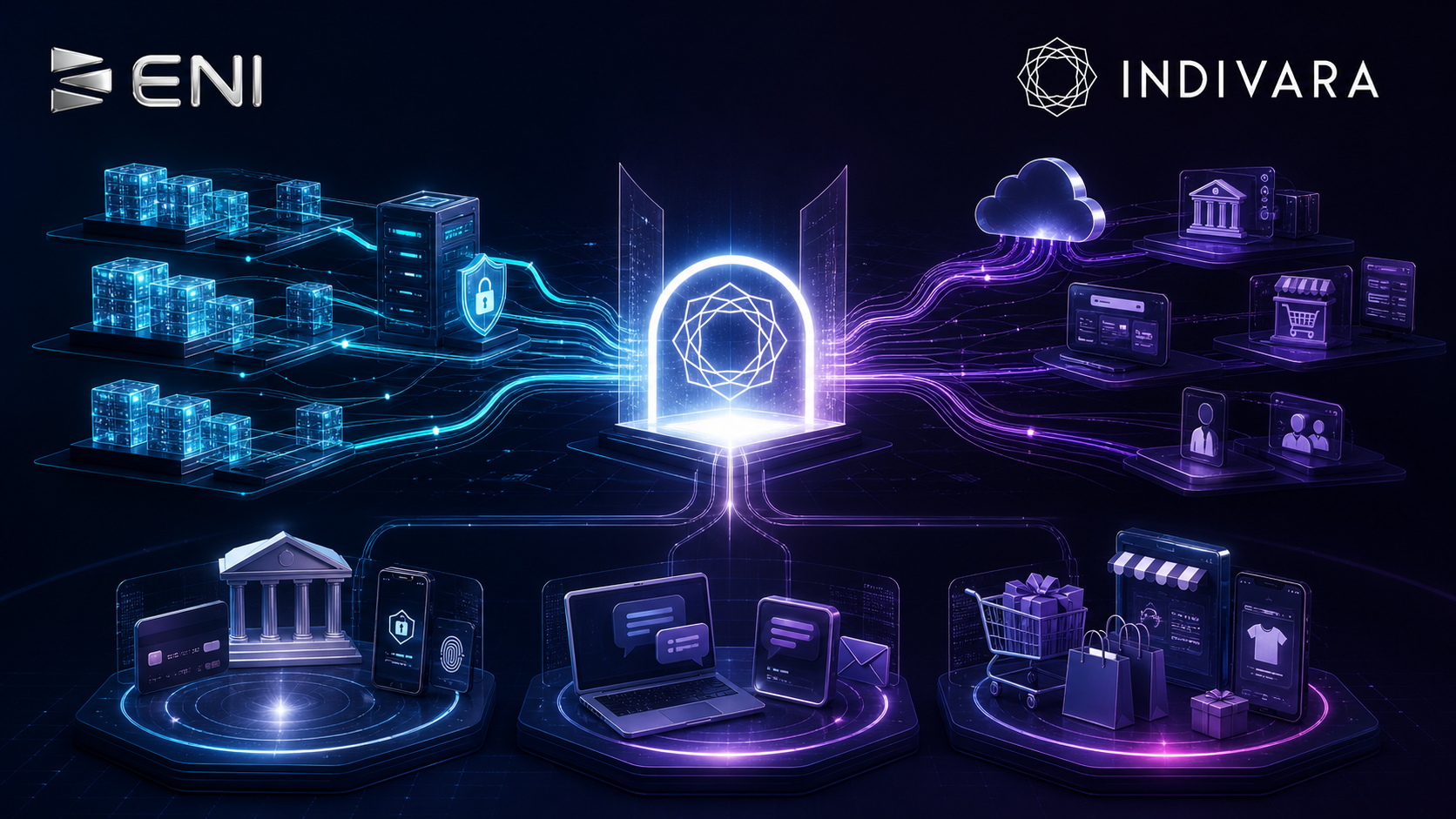
The two parties can establish a joint service process covering enterprise needs analysis, AppChain solution design, interface development, local deployment, and operational support. ENI will be responsible for blockchain protocols, AppChains, and onchain tools. Indivara will connect these capabilities with its various enterprise products.

Enterprises can select business processes suited to blockchain collaboration for a proof of concept, then expand deployment according to operating results. This gradual approach can control transformation costs and reduce the impact of new systems on existing business processes.

Joint delivery can also feed directly into ENI product iteration. Practical feedback from banks, payment platforms, and retailers can become new AppChain components, industry templates, and operating tools, gradually forming standardized solutions for Southeast Asian enterprise markets.


Comments

All Comments

Recommended for you

  • Bank of Japan Keeps Rates Unchanged as Expected

    On July 31, the Bank of Japan kept its target interest rate unchanged at 1%, in line with market expectations. (Jin10)

  • Tesla Officially Introduces Doubao

    On July 31, Tesla China announced the 2026.14.13 vehicle software update, covering Model 3, Model Y, Model S, and Model X. The update began rolling out in batches on July 31, 2026, with a key upgrade being the integration of the "Doubao Large Model" — an intelligent voice assistant that not only provides real-time information but also engages in natural, fluid conversations. It supports multiple premium voice options and can be paired with personalized personas such as "Know-It-All," "Music Lover," and "Storyteller." This feature requires an active Premium Connectivity subscription. (China Economic Net via China News Service)

  • U.S. Listed Companies Hold 1.24 Million BTC, Accounting for 92.7% of Global Corporate Bitcoin Holdings

    On July 31, according to unfolded., U.S. listed companies currently hold a total of 1.24 million BTC, accounting for 92.7% of the global total held by listed companies. Over the past 12 months, U.S. listed companies have accumulated an additional 510,000 BTC, a figure more than three times the amount of newly mined Bitcoin during the same period.

  • BTC Breaks Through $65,000

    Market data shows that BTC has broken through $65,000, currently reporting at $65,005.98, with a 24-hour increase of 1.89%. Market volatility is significant; please manage risks accordingly.

  • South Korean Stocks Surge 14% in Record Intraday Gain

    On July 31, South Korean stocks rallied on Friday, rebounding from a sharp decline in previous days, as spending plans by major tech companies reignited investor optimism about the artificial intelligence trade frenzy. The benchmark KOSPI index surged up to 14%, marking the largest single-day intraday gain in history. Foreign media analysis attributed the surge to SK Group Chairman Chey Tae-won's rare direct purchase of the company's shares, which sent SK Hynix shares soaring as much as 28% in early trading; memory chip peer Samsung Electronics also rose 26%. The KOSPI index had plunged a cumulative 17% over the previous three trading sessions, mainly due to concerns over rising debt levels among global big tech companies. The sharp rally driven by AI this year has become increasingly volatile since the introduction of leveraged products in May. "The recent accelerated sell-off in AI tech driven by deleveraging, de-risking, position closures, and other liquidity factors may be stabilizing," said Shawn Oh, head of Korean spot equities at NH Investment Securities. Meanwhile, Japanese stocks were also boosted, with the Nikkei 225 index rising 4% in early trading, breaking above 64,000 points. (Jin Shi)

  • Hamas Says Agreement with Israel Reached

    July 31, according to Saudi Arabia's Al Arabiya TV on July 31 citing a Palestinian Islamic Resistance Movement (Hamas) official, an agreement with Israel has been reached, and Hamas will soon release an official statement. (Xinhua)

  • He Lifeng Holds Video Call with US Treasury Secretary Bessent and Trade Representative Greer

    On July 30, at 8:00 PM Beijing time, He Lifeng, Chinese lead for China-US economic and trade affairs and Vice Premier of the State Council, held a video call with his US counterparts, Treasury Secretary Bessent and Trade Representative Greer. The two sides engaged in candid, in-depth, and constructive exchanges on implementing the important consensus reached during the meeting between the two heads of state in Beijing, maintaining stable economic and trade relations, expanding practical cooperation, and properly addressing each other's concerns. The Chinese side expressed serious concerns over recent US economic and trade restrictions against China. Both sides agreed to further leverage the role of the China-US economic and trade consultation mechanism under the strategic guidance of the two heads of state, enhance communication, build trust, expand cooperation, and promote stable and positive development of bilateral economic and trade relations, contributing to the construction of a constructive and strategically stable relationship between China and the US. (Xinhua)

  • Meta's Future Data Center Lease Commitments Surge to $279 Billion, Fully Betting on AI Computing Infrastructure

    On July 29, U.S. tech giant Meta Platforms Inc. (META) disclosed in its latest regulatory filing that to support its rapid expansion in the artificial intelligence (AI) field, the company's future data center lease commitments have surged significantly. As of June 30, Meta's total unfulfilled lease commitments reached $279 billion, a sharp 53% increase from $183 billion in the previous quarter, indicating a marked acceleration in its investment pace in AI infrastructure. Meta noted in the filing that these future expenditures, not yet reflected on the balance sheet, primarily involve the construction and operation of data centers, hosting facilities, and specific network infrastructure. In July alone, Meta added as much as $68 billion in new lease commitments, with these contracts expected to begin execution in 2027 and 2028. Behind this massive lease commitment is Meta's 'arms race' to seize the AI track. With the explosive growth in computing power demand for AI model training and inference, global tech giants are locking in data center resources at an unprecedented scale. Data shows that leading companies including Meta, Microsoft, Amazon, and Oracle now have a combined total of over $850 billion in future data center lease commitments to fulfill.

  • Largest On-Chain CXMT Short Seller Adds to Position, Reaching $22.26 Million

    On July 30, according to EmberCN monitoring, as the storage sector surged in a counterattack tonight, the largest on-chain short seller of CXMT (ChangXin Memory Technologies) continued to add to its short position. It opened a short position the day before CXMT's IPO and has been adding to it multiple times. Currently, it holds short positions worth $22.26 million in CXMT, with an unrealized loss of up to $4.06 million.

  • NYSE Parent Intercontinental Exchange Agrees to Acquire MarketAxess for About $6 Billion

    On July 30, the parent company of the New York Stock Exchange, Intercontinental Exchange, agreed to acquire MarketAxess Holdings Inc. for about $6 billion in cash, bringing one of the world's largest fixed-income trading platforms under its trading platform system. According to a statement released on Thursday, Intercontinental Exchange will acquire all outstanding shares of MarketAxess at $167 per share, a 33% premium over the latter's closing price on Wednesday. Intercontinental Exchange shares rose 0.8% to $155.46; MarketAxess shares surged 30% to $163.24, marking the biggest intraday gain since 2008.