

If the AI competition of the past two years was mainly about “who has the strongest model,” then in the second half of 2026, the more important shift is no longer simply the arrival of another larger model. The real change is that models are being reorganized into Agents, Workflows, and continuously operating intelligent systems. OpenAI is pushing its latest models further into coding, research, computer use, and complex multi-step work; Anthropic is bringing Agents into real commercial scenarios such as product discovery, comparison, purchasing, and merchant operations; Google is also advancing Agentic AI capabilities that allow systems to autonomously determine what information to analyze and what actions to take.
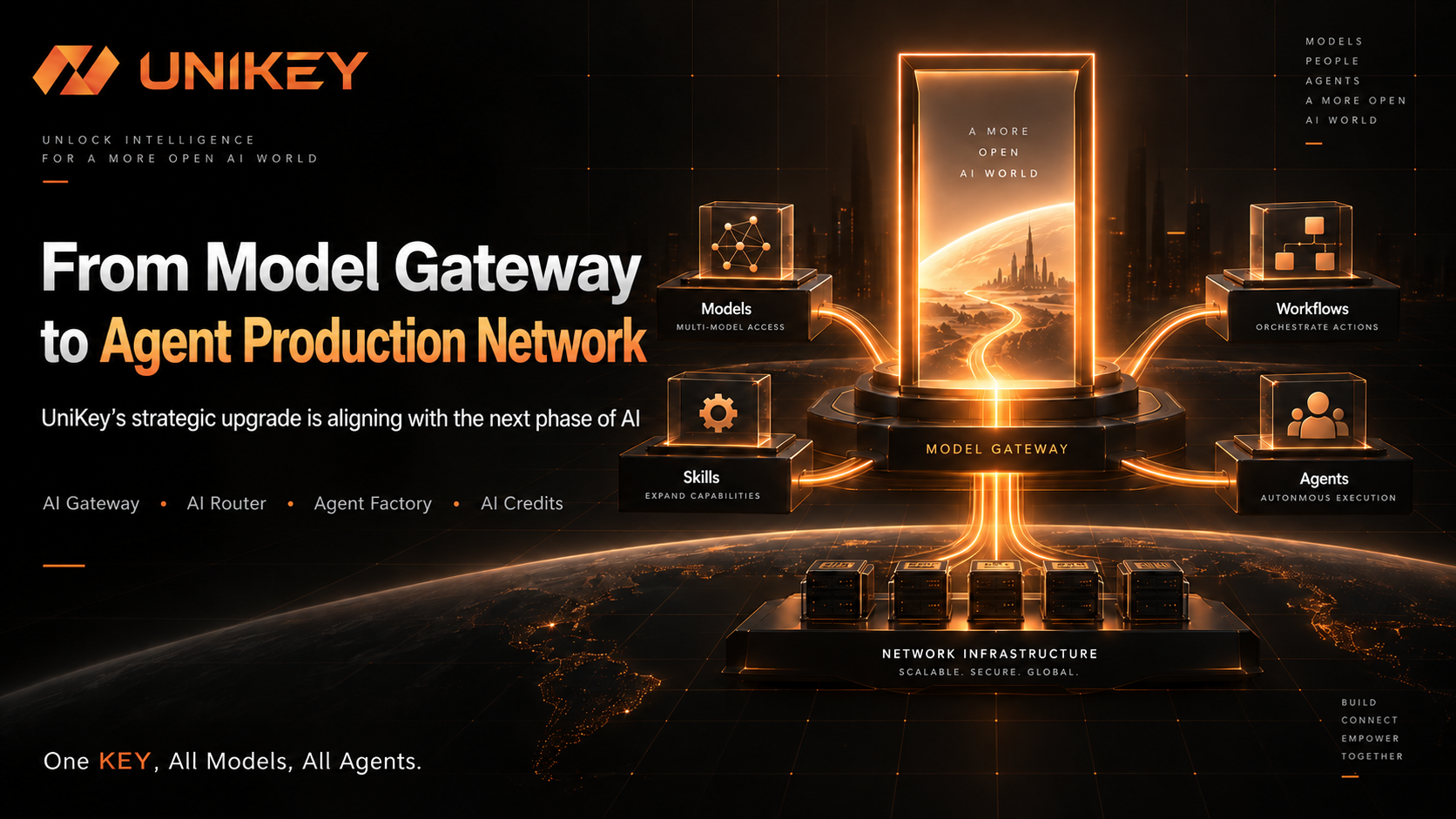
These developments may look like separate product updates, but together they point toward the same direction: AI is moving from content generation to task execution, and from single-model competition to intelligent system competition. Once this transition happens, the scarce capability is no longer simply “having access to a strong model.” The real challenge becomes whether different models, knowledge sources, tools, workflows, and settlement mechanisms can be organized into one usable system. From this perspective, UniKey’s recent product upgrades reveal a much broader strategic direction: it is evolving from a unified gateway to global AI into a more complete Agent infrastructure layer.
Layer One: AI Gateway Is Not Just Model Aggregation—It Is the Next-Generation Intelligence Gateway
The most intuitive value proposition of UniKey has always been simple: One KEY, access global AI. Through a unified entry point, UniKey brings together different models and AI capabilities across text, image, video, coding, and APIs. At first glance, this may look like a multi-model aggregation platform. But as the model ecosystem becomes more fragmented and complex, the strategic value of this layer actually becomes stronger.
In the future, users will not be choosing only between GPT, Claude, and Gemini. They will face a constantly expanding set of models specializing in reasoning, coding, image generation, video, speed, cost efficiency, and vertical tasks. That is why AI Router may ultimately become more important than simply “how many models UniKey supports.” A mature Agent should not require users to manually select a model every time it performs a step. Instead, the system should automatically match the most appropriate capability based on task complexity, cost, latency, and output quality.
The more fragmented and frequently updated the underlying model market becomes, the less users should have to deal with that complexity themselves. What UniKey ultimately aims to provide is a stable access layer over a constantly changing AI supply market: models can keep changing, while the way users and Agents access intelligence remains unified.
Layer Two: Agent Factory Moves AI from “Being Called” to “Being Organized”
UniKey’s recent addition of Agent Factory, Knowledge Base, Skills Management, and Workflow Orchestration represents a major shift in the platform’s product architecture. A truly capable Agent does not work simply because a large model sits behind it. It works because the model is connected to the right knowledge, tools, permissions, and execution processes.
Within the UniKey ecosystem, these layers are beginning to form a clear structure: Knowledge Base determines what an Agent knows, Skills determine what capabilities it can call, Workflow determines how tasks are executed step by step, and Agent Factory combines these components into an intelligent system that can actually work. With multiple ready-to-use templates available, users no longer need to start from code. They can begin with an existing structure and customize it for their own business needs.
This means UniKey is moving beyond simply “providing AI capabilities.” It is beginning to provide a way to produce working intelligence. The difference is significant: a model can generate an answer, but an Agent can continuously organize different capabilities around a goal and carry the task through to completion.
Layer Three: AI Credits and Settlement Give Agents an Economic System
Once Agents begin performing real tasks, another question immediately appears: who pays for all these intelligent services? A single Agent task might call a reasoning model, perform several searches, invoke a Skill, generate an image or video, and execute an external API. Traditional pricing based only on one type of Token is no longer enough to describe this increasingly complex machine-consumption model.
This is why the rise of Agentic payments is important. Around the world, payment infrastructures are beginning to explore how AI Agents could autonomously spend within predefined limits, verify identity, and interact with real commercial systems. If Agents increasingly become active participants in digital commerce, AI infrastructure will need to support not only intelligence and execution, but also authorization, metering, payment, and settlement.
This is where UniKey’s AI Credits + KEY + future Settlement Network becomes strategically relevant. AI Credits can serve as a unified usage unit across models, images, videos, Skills, Agents, APIs, and Workflows, while KEY can connect ecosystem value and service settlement. In the long run, UniKey is not only addressing the question of “how to call AI,” but also a much larger one: when millions of Agents begin autonomously consuming intelligent services, how should those services be measured, consumed, and settled?
UniKey Is Not Just Building Agents—It Is Building the Entire Agent Production Chain
Many projects enter the Agent market by starting with one specific product: a trading Agent, customer-service Agent, marketing Agent, or research Agent. These applications can be valuable, but they are still single-point products. UniKey is taking a more infrastructure-oriented approach. Rather than deciding which Agent users should ultimately use, it is building the underlying production structure consisting of AI Gateway, Router, Knowledge, Skills, Workflow, Agent Factory, and Credits.
As a result, UniKey’s architecture is gradually becoming a complete chain:
Global AI Capabilities → Unified Gateway → Intelligent Router → Knowledge / Skills → Workflow → Agent Factory → AI Credits → Settlement
The important point is not any single module, but the way these modules begin to work together. Models can change, Skills can expand, Workflows can be replicated, and Agents can be continuously created, while the underlying access, routing, and usage systems remain unified. Once this structure becomes mature, UniKey will no longer serve only individual AI users. It could increasingly serve developers, enterprises, Agent builders, and eventually large numbers of autonomous machine accounts.
Product Details Are Improving at the Same Time: Infrastructure Ultimately Depends on Long-Term Usability
Infrastructure products have one defining characteristic: ambitious architecture must eventually be supported by countless details that may appear small individually. In UniKey’s latest update, the platform not only added Agent Factory, Knowledge Base, Skills, and Workflow, but also introduced QQ Mail and 163 Mail registration, fixed video playback issues inside TP Wallet, and resolved occasional login-session problems. Earlier updates also introduced automatic upstream load balancing and continued improvements to the mobile experience.
These changes may not sound as exciting as Agent Factory, but they directly determine whether the platform can move from a demo into long-term daily usage. Agents may eventually run for hours at a time, Workflows may continuously call multiple models, and enterprise users cannot tolerate frequent disconnects or authentication failures. The upper layer must continuously become more intelligent, while the lower layer must simultaneously become more stable, compatible, and usable.
UniKey’s current product evolution is clearly advancing along both tracks at the same time: stronger intelligence above, and more reliable infrastructure below.
Why Is This a More Important Window for UniKey?
In the past, the strongest selling point of multi-model platforms was simple: “use many AI models in one place.” But in the Agent era, that logic changes fundamentally. Future Agents themselves will use multiple models and tools during a single task, and users may not even know which model handled a particular step. At that point, a unified multi-model gateway is no longer just a convenience layer for users—it becomes the intelligence supply layer for Agents.
More importantly, as Agents enter real commercial environments, the industry will need more than models. AI companies are pushing Agents into shopping, enterprise operations, professional services, software engineering, and increasingly complex workflows. At the same time, payment infrastructures are beginning to prepare for Agent-driven transactions. The AI industry is gradually filling in four critical layers: intelligence, tools, execution, and payment.
UniKey’s current roadmap happens to move along the same chain: connect intelligence, organize capabilities, produce Agents, and eventually support intelligent-service consumption. If UniKey originally solved the problem of “how global AI can be accessed through one unified gateway,” the next question is much bigger:
How can global AI be uniformly called, organized, and transformed into continuously operating intelligent services?
Conclusion: UniKey Is Not Trying to Build the Next Model—It Is Building the Layer That Connects the Next AI Era
The model race will continue. GPT will keep evolving, Gemini will keep evolving, Claude will keep evolving, and new models, video systems, and Agent tools will continue to appear. But for ordinary users and enterprises, the real need is not to re-evaluate “which model is best” every single day. What they need is a system that can continuously connect them to the most suitable intelligence.
That may be UniKey’s most important long-term value: not competing with model companies to produce intelligence, but organizing intelligence above the model layer.
From AI Gateway to AI Router; from Agent Factory to Knowledge, Skills, and Workflow; and from AI Credits to the future Settlement Network, UniKey is gradually moving from a unified AI gateway toward Agent-oriented intelligent service infrastructure.
If the future truly becomes a world where hundreds of millions of Agents work autonomously, call services, and generate economic activity, then the most important question may not only be who owns the strongest model.
It may also be—Who can connect all of these intelligent capabilities together?


All Comments