

Cointime

Download App
iOS & Android

From Heavy Asset Hosting Challenges to the High-Frequency Settlement Revolution: As Crypto Mining Companies Enter AI, SuperStrike Introduces a New Paradigm for Value Realization

Introduction: The “Second Quarter Crossroads” for Crypto Mining Companies

As financial reports from publicly listed crypto mining companies for the second quarter of 2026 have been released one after another, the entire computing infrastructure sector is undergoing a profound structural divergence.

On one side, traditional mining profitability is narrowing due to cryptocurrency price volatility, increasing network-wide hash power, and rising mining costs per token. On the other side, leading companies such as Core Scientific and TeraWulf are accelerating their transition toward HPC (High-Performance Computing) and AI data centers. However, financial reports also reveal another side of the story: The significant gap between long-term hosting contracts worth tens of billions of dollars and actual current-period revenue reflects a considerable delivery cycle delay. Heavy asset data center renovations, high electricity costs, and equipment depreciation have created substantial capital and time challenges for traditional infrastructure transformation.

While the industry remains focused on the lengthy waiting process of “when heavy asset data centers will be delivered and when rental revenue will be recognized on financial statements,” the decentralized Web3 infrastructure platform SuperStrike is breaking through from another dimension. Rather than being constrained by self-built heavy infrastructure and lengthy delivery cycles, SuperStrike leverages a lightweight, decentralized protocol network to directly bring real-world demand and high-frequency settlement onto the blockchain, building a business loop capable of generating continuous value flow.

I. Pain Points and Breakthrough: Hash Power Infrastructure Requires a “Micro-Amount, Second-Level, High-Frequency” Settlement Foundation

The core contradiction reflected in crypto mining companies’ financial reports lies in the fact that traditional hash power leasing models still follow the centralized Web2 cloud computing approach of: “monthly/yearly billing with heavy asset investment.”

However, as artificial intelligence advances comprehensively toward the era of AI Agents (autonomous intelligent agents), industry demand has fundamentally changed:

● Large-scale model training (Training) represents low-frequency, stage-based heavy asset investment;

● Real-time AI Agent inference (Inference) and collaboration represent continuous, 24-hour, high-frequency, and micro-value consumption.

The massive and decentralized interactions between intelligent agents require an infrastructure capable of integrating global distributed node resources while supporting second-level micro-value settlements. Relying on StrikeBit AI’s decentralized technology foundation, SuperStrike bypasses the lengthy construction cycles of centralized data centers and directly enters the fields of distributed computing scheduling and full-scenario business settlement. It creates a more agile and instantly realizable value circulation network.

II. Multi-Dimensional Deployment Matrix: From Real External Revenue Streams to $STRIKE Value Accumulation

Unlike traditional projects that rely on long-term expectations or single-source hosting revenue, SuperStrike has built a multi-dimensional deployment matrix covering social interaction, payments, network infrastructure, and idle asset restructuring. This enables every real business interaction to be transformed into direct underlying support for the token:
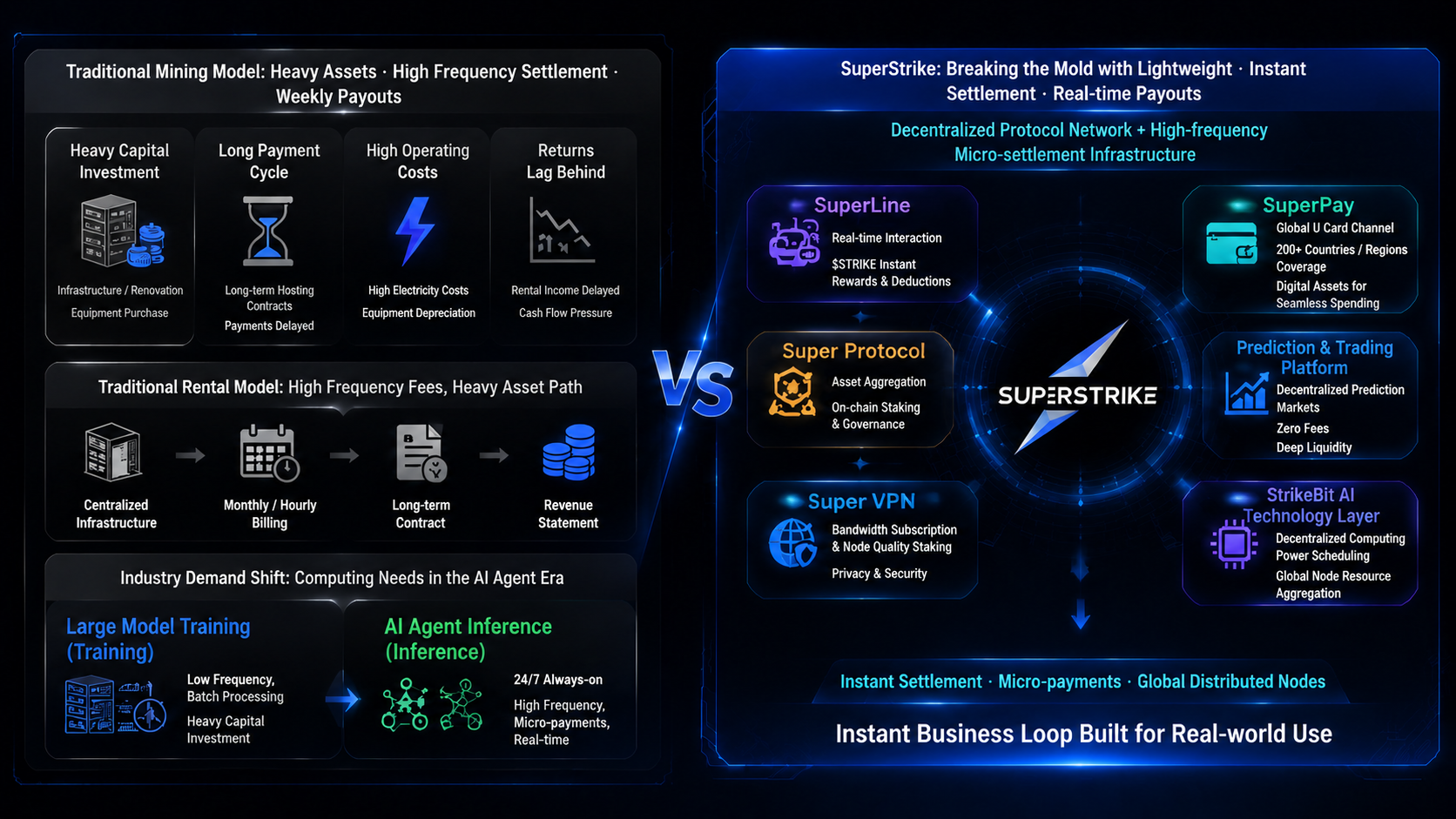
● SuperLine (High-Frequency Interaction Gateway): By combining zero-knowledge proofs with AI intelligent assistants, SuperLine enables “interaction through conversation.” Every intelligent agent API call and service response is directly charged and contributes to $STRIKE burning at the protocol layer.

● Super Idle Flash Protocol (Asset and Idle Resource Matching): Breaking away from centralized intermediary extraction models used by traditional Web2 platforms, intelligent protocols automatically match supply and demand while completing on-chain ownership verification. It transforms idle resources and local consumer scenarios into digital assets that are traceable and capable of generating value.

● SuperPay and Global VISA/Mastercard Payment Networks: Connecting with physical U Card channels covering more than 200 countries and regions worldwide, SuperPay supports direct charging with assets such as USDT. Online subscriptions, offline card payments, and ATM withdrawals become instantly accessible, enabling seamless integration between digital assets and real-world consumption.

● Super VPN (Decentralized Network Channel): Targeting the massive global demand for network privacy and data security, Super VPN adopts a pure pay-as-you-go subscription model combined with node staking mechanisms. This creates a continuous and stable network consumption scenario.

● Decentralized Prediction and Trading Platform: By introducing an unbiased intelligent oracle settlement mechanism, the platform provides decentralized matching services for global hash power scheduling and event hedging. Through the entire process, service fees are continuously accumulated across the network.

III. Institutional Support and Secondary Market Structure: Moving Beyond Inflation-Driven Growth Toward Fundamental Value Creation

In the current crypto market cycle, the logic of maintaining ecosystems solely through inflationary token releases has already been eliminated by the market. SuperStrike demonstrates clear anti-cyclical characteristics:
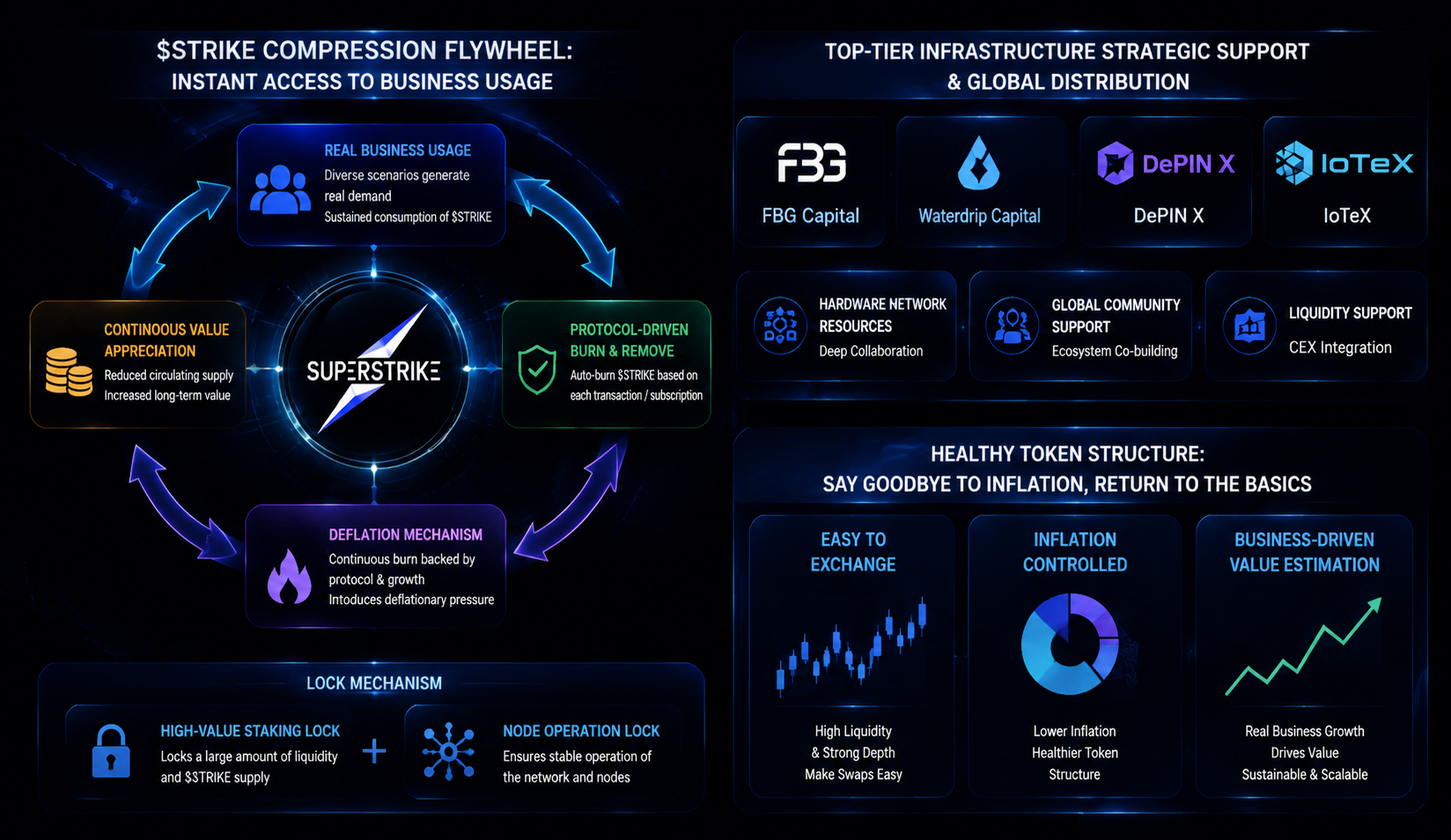
1. Real Supply-Demand and Deflationary Structure: Mechanisms such as merchant staking participation and network node operations lock up a large amount of circulating tokens. At the same time, SuperLine interactions, VPN traffic consumption, and settlement fees across different ecosystem sectors continuously direct $STRIKE into burn mechanisms on-chain. This creates a positive cycle of: “Real usage drives continuous deflation.”

2. Healthy Token Accumulation Structure: After experiencing sufficient market circulation and bottom-level consolidation during its early stage, $STRIKE has undergone relatively thorough cleanup of short-term floating supply. This provides a solid technical foundation for future valuation recovery after the full expansion of the business matrix.

3. Strategic Collaboration with Leading Institutions: The project has received strategic support from well-known investment institutions, including: FBG Capital, Waterdrip Capital, DePIN X, and IoTeX. Relying on the deep resources of these partners across hardware networks, global communities, and liquidity infrastructure, SuperStrike is steadily advancing its integration process with global mainstream centralized exchanges (CEX).

Conclusion: The Value Anchor of the New Hash Power Era

The financial reports of crypto mining companies in Q2 2026 have delivered a warning to the entire industry: Hash power is not a long-term contract written on paper; it must ultimately be transformed into realized current-period revenue.

While traditional crypto mining companies continue to struggle through the ramp-up period of data center transformation and rental revenue recognition, SuperStrike has already established a complete value generation pathway from decentralized services to real-world consumption through its multi-dimensional ecosystem matrix, including: SuperLine, Super Idle Flash, SuperPay, and Super VPN.

Built on real business scenarios and powered by continuous deflation mechanisms, SuperStrike is opening a new cycle of value reassessment for the Web3 infrastructure sector through solid ecosystem implementation data as its new ecosystem matrix fully unfolds.


Comments

All Comments

Recommended for you

  • Bank of America’s Hartnett: 2026 Midterm Elections as a Watershed for AI Bull Market, Republican Victory Could Strengthen AI Stocks Until 2027

    On August 14, according to market news, Bank of America’s Chief Investment Strategist Michael Hartnett and his team released a new research report defining the 2026 U.S. midterm elections as a core watershed for the current AI bull market in U.S. stocks. The report presents two scenarios: if the Republican Party retains the Senate and Texas Governor Greg Abbott is re-elected, the market will interpret this as a continuation of AI data center expansion and favorable AI capital expenditure policies, leading to sustained strength in the U.S. AI sector, with a potential bubble forming by 2027. Conversely, if the Democratic Party wins the Senate and the Texas governorship, the U.S. stock market could experience a significant correction of over 10%, which would simultaneously drive down the dollar and U.S. Treasury yields. Currently, the fundamentals of the U.S. stock market remain supportive, with the S&P 500's earnings growth in the second quarter significantly exceeding expectations, and trillion-dollar AI capital expenditures and wealth effects continuing to boost risk appetite. However, the market's bullish positions are extremely crowded, with Bank of America’s bull-bear indicator rising to 9.3, indicating a sell zone, and private client stock allocations reaching historic highs. If election outcomes, interest rates, or AI earnings expectations fall short, these crowded positions could amplify market volatility. Hartnett also cautioned that persistently rising U.S. Treasury yields and the pressure of servicing the country's massive debt are core constraints on market performance, noting that a significant easing of government debt servicing costs would require the 5-year U.S. Treasury yield to fall below 3.25%.

  • LG Signs Agreement with NVIDIA: Humanoid Robot with NVIDIA Chips to Launch in 2027

    On August 14, LG Group Chairman Koo Kwang-mo met with NVIDIA CEO Jensen Huang at NVIDIA's headquarters in Santa Clara, California, on August 13 local time. The two parties signed a strategic cooperation memorandum covering three key areas: robotics, AI factories, and mobile transportation. They plan to jointly launch a bipedal humanoid robot equipped with NVIDIA chips in the first quarter of 2027, marking a significant step in the collaboration between the two tech giants in the field of physical AI. During the meeting, Koo presented Huang with a miniature model of an LG bipedal humanoid robot.

  • SanDisk's Pre-Market Gains Expand to 6%

    On August 14, SanDisk's pre-market gains expanded to 6%, reaching $1620 per share, following a nearly 14% surge in the previous trading session. Micron saw a pre-market increase of 3%. JPMorgan is optimistic about memory demand, assigning SanDisk an 'Overweight' rating with a target price of $2250.

  • July Loan Rates Remain Low

    Since the beginning of this year, China's loan rates have remained at a low level, continuing a downward trend in July. In July, the weighted average interest rate for new corporate loans was slightly below 3%, approximately 0.2 percentage points lower than the same period last year; the weighted average interest rate for new personal housing loans was about 3.1%, roughly unchanged from the same period last year. (Xinhua News Agency)

  • Scholar: Economic Shockwaves from US-Iran Conflict Spread, Trump Faces Internal and External Pressures

    Professor Simon Mabon from Lancaster University stated that as the economic consequences of the Iran war ripple across the globe, US President Trump is facing increasing domestic and international pressure. He pointed out that with the midterm elections approaching and inflation rising, this conflict has created political challenges within the US, while the global economy is also 'feeling the pinch'—affecting not only oil and diesel but also fertilizers and global shipping routes. Mabon noted that any goods transported through the Strait of Hormuz will be impacted, with rising transportation costs and insurance premiums ultimately passed on to end users.

  • Central Bank: M2 Increased by 7.7% Year-on-Year in July

    On August 14, the Central Bank reported that by the end of July, the balance of broad money (M2) was 355.51 trillion yuan, an increase of 7.7% year-on-year. The balance of narrow money (M1) was 115.46 trillion yuan, up 4% year-on-year. The balance of currency in circulation (M0) was 14.82 trillion yuan, a year-on-year increase of 11.6%. In the first seven months, a net cash injection of 725.5 billion yuan was made.

  • SK Hynix Confirms 3.98 Trillion Won Loss Due to Convertible Bond Exchange and Stock Price Increase

    According to regulatory documents, SK Hynix confirmed a derivative trading loss of 3.98 trillion won related to the convertible bonds issued in April 2023 for the first half of 2026. This loss resulted from bondholders exercising their conversion rights and the increase in SK Hynix's stock price listed in South Korea. SK Hynix stated that the aforementioned accounting loss would not lead to actual cash outflows; at the same time, the gains from the disposal of treasury shares recognized when the convertible bonds were converted into shares have largely offset the related losses. The company noted that all convertible bonds had been converted into shares by the end of the first half, and therefore, there were no remaining derivative valuation losses related to this batch of convertible bonds as of the end of the period. (Bloomberg)

  • US Imposes Up to 100% Tariff on Imported Drones and Parts, Drone Stocks Rise Pre-Market, Unusual Machines Up Over 11%

    On August 14, drone-related stocks in the US market collectively rose in pre-market trading, with Unusual Machines increasing by over 11%, Red Cat Holdings and ParaZero Technologies up over 4%, Vertical Aerospace, Palladyne AI, and Ondas rising over 3%, and AgEagle Aerial Systems gaining nearly 3%. In a statement, the White House announced that President Trump signed a proclamation imposing tariffs ranging from 10% to 100% on imported drones and parts, citing national security threats. The proclamation specifies a 100% tariff on drones with highly sensitive specific sizes or functions, as well as docking stations for such drones and certain critical components. This category includes drones with a maximum takeoff weight exceeding 25 kilograms and those equipped with thermal imaging capabilities. Additionally, a 25% tariff will be applied to certain smaller drones and other drone components that do not possess specific functions. The announcement also states that a 15% tariff will be imposed on drones and components from the European Union, Japan, Liechtenstein, South Korea, and Switzerland. Furthermore, a 10% tariff will be levied on drones from the UK, provided that their hardware, software, and technology primarily originate from the aforementioned countries and regions, as well as the US. The tariffs are set to take effect 21 days after the signing, while tariffs on non-highly sensitive drone components will take effect 180 days after the signing.

  • U.S. Stock Market: Memory Chip Stocks Rise Before Opening, Micron and Western Digital Up Nearly 2%

    On August 14, continuing yesterday's upward trend, memory chip stocks in the U.S. market collectively rose before the opening. Among them, SanDisk surged over 4%, while Micron Technology, Western Digital, and Seagate Technology increased by more than 1%. Winbond Technology, SK Hynix, and Rambus saw gains of less than 1%.

  • SanDisk Stock Rises Over 5% in Pre-Market Trading

    On August 14, SanDisk's stock rose over 5% in pre-market trading. Royal Bank of Canada raised its target price for SanDisk from $1300 to $1600.