

Cointime

Download App
iOS & Android

From Assets to Systems: ENI and Dr. Johnny Ng Define the RWA 2.0 Standard in Hong Kong

On April 19, at the RWI Summit during Hong Kong Web3 Festival, ENI Founder Arion Ho, Legislative Council Member Dr. Johnny Ng, and Web3Labs CEO Casper officially launched a $1M Global Accelerator Program to catalyze institutional Web3 adoption. This milestone, underscored by a strategic MOU between ENI and the publicly-listed Eddid Financial, cements ENI’s role as the "Chief Architect" in Hong Kong’s push to establish the global standard for bridging TradFi and Web3. By convening top policymakers and financial titans, the summit marked a decisive shift from simple "tokenization" to a future where complex financial systems run entirely on-chain.

The Evolution of RWA 2.0: From Static Ledgers to AI-Driven Dynamic Systems

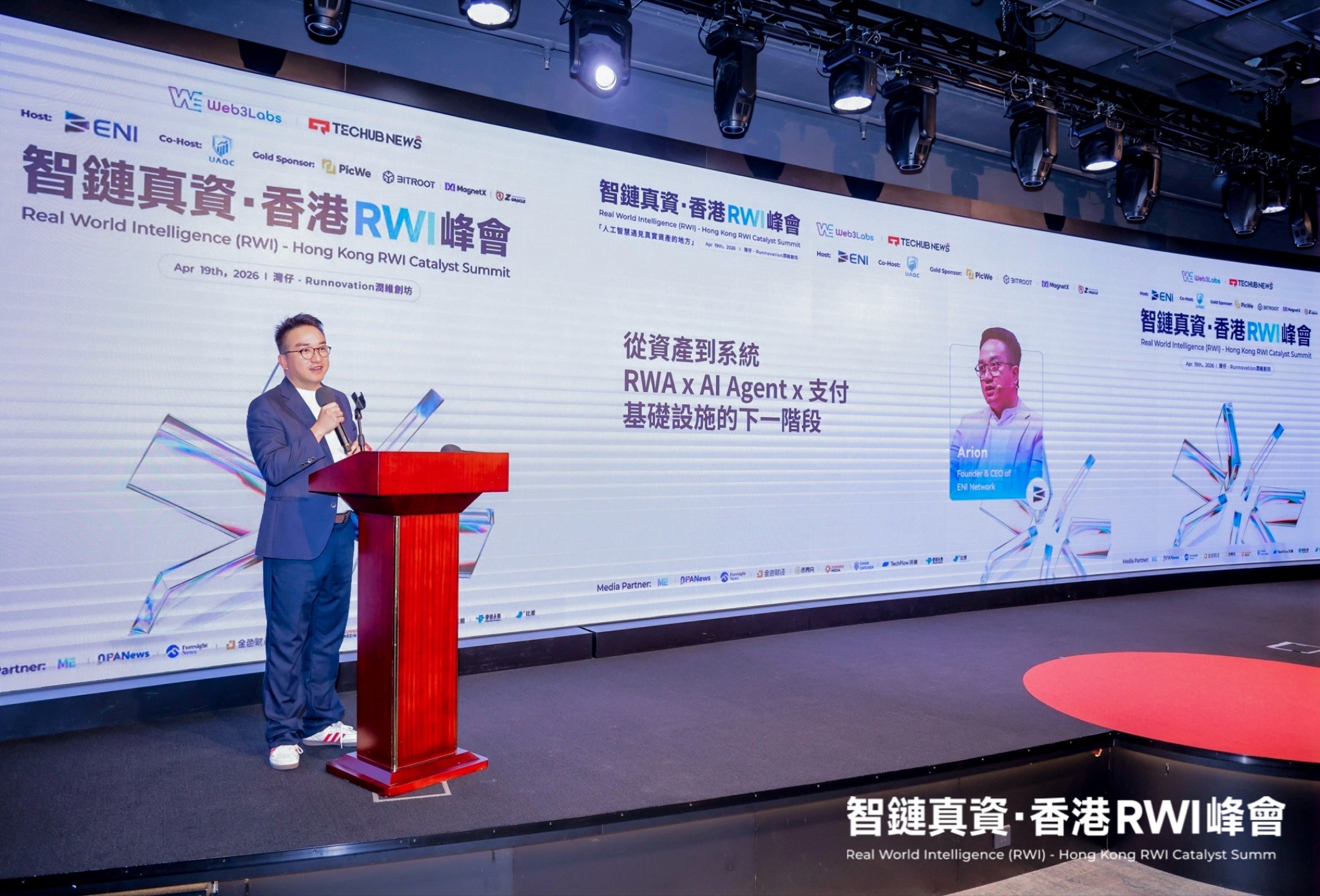
In his keynote titled "From Assets to Systems: The Next Phase of RWA × AI Agents × Payment Infrastructure", ENI CEO Arion Ho delivered a critical thesis: the RWA 1.0 era was about the "migration" of assets, but RWA 2.0 is about "systemic operation."

Arion argued that true financial innovation lies not in the mere registration of assets, but in the continuous execution of economic behavior. By unveiling ENI’s three-tier architecture—ENI (Settlement), ENI PAY (Authorization), and AI Agent (Execution)—he outlined a future of autonomous finance. In this framework, AI is no longer just a tool but a decision-making entity with compliant payment capabilities. This shift from "assets" to "activity" defines ENI’s role as the "Chief Architect" for mass commercial adoption.
The "Standard of Hong Kong": Bridging the Gap with Dr. Johnny NG

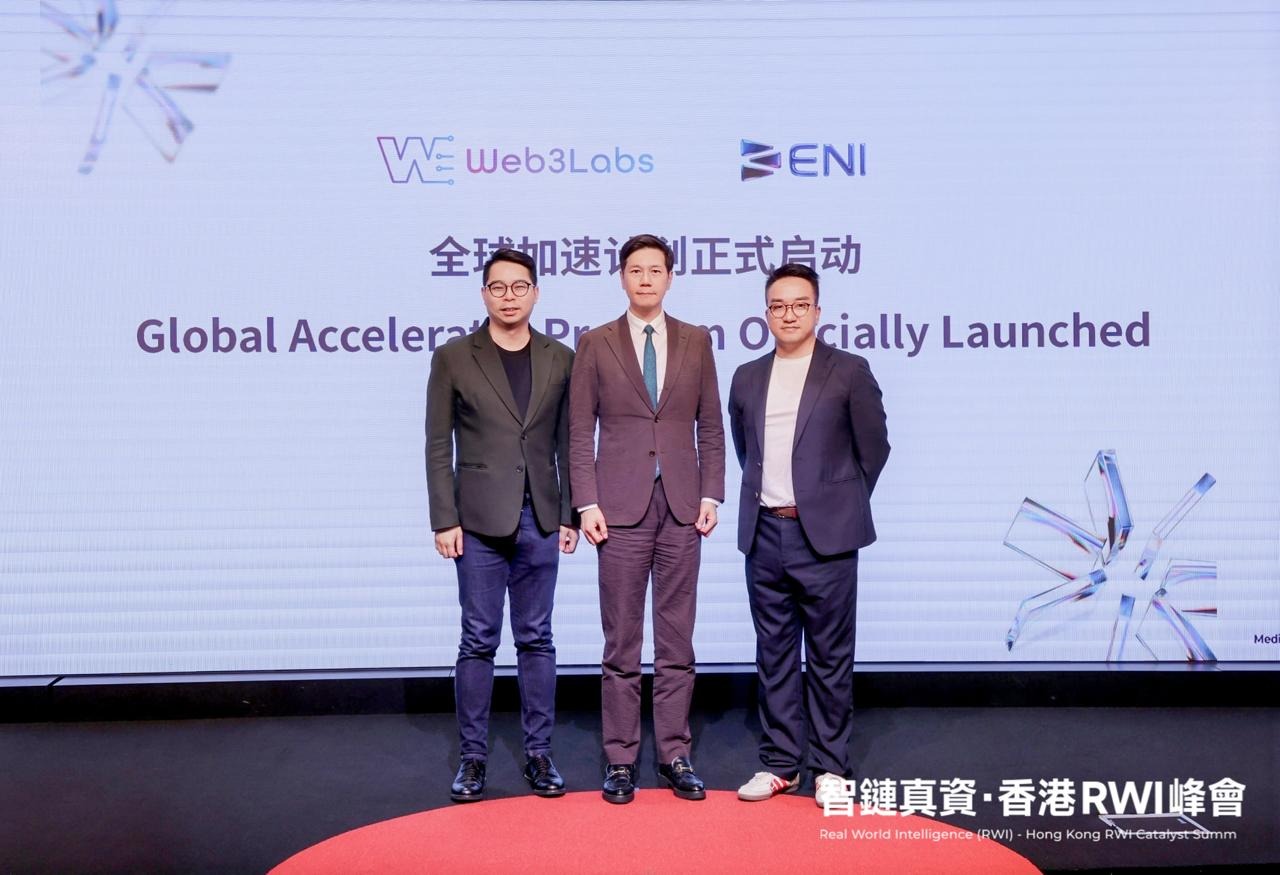
A defining moment occurred when the Johnny Ng, Arion Ho, and Web3Labs CEO Casper took the stage to launch the "Web3Labs x ENI Global Accelerator Program." Backed by a $1M Grant, the program targets five core sectors: enterprise applications, DeFi, RWA/DePIN, NFT/GameFi, and community education.

Johnny Ng’s presence was a powerful signal. As a leading advocate for Hong Kong’s Web3 integration, Ng has consistently pushed for the city to set global standards. Supported by this vision, ENI is positioning itself as the "Bridge of Standards" between TradFi and Web3. Within Hong Kong’s unique ecosystem of regulation, institutional density, and government ambition, ENI is no longer just a project, it is an outpost for global expansion, validated by both political and industrial leadership.
ENI x Eddid Financial: Solving the Last Mile for Institutional RWA

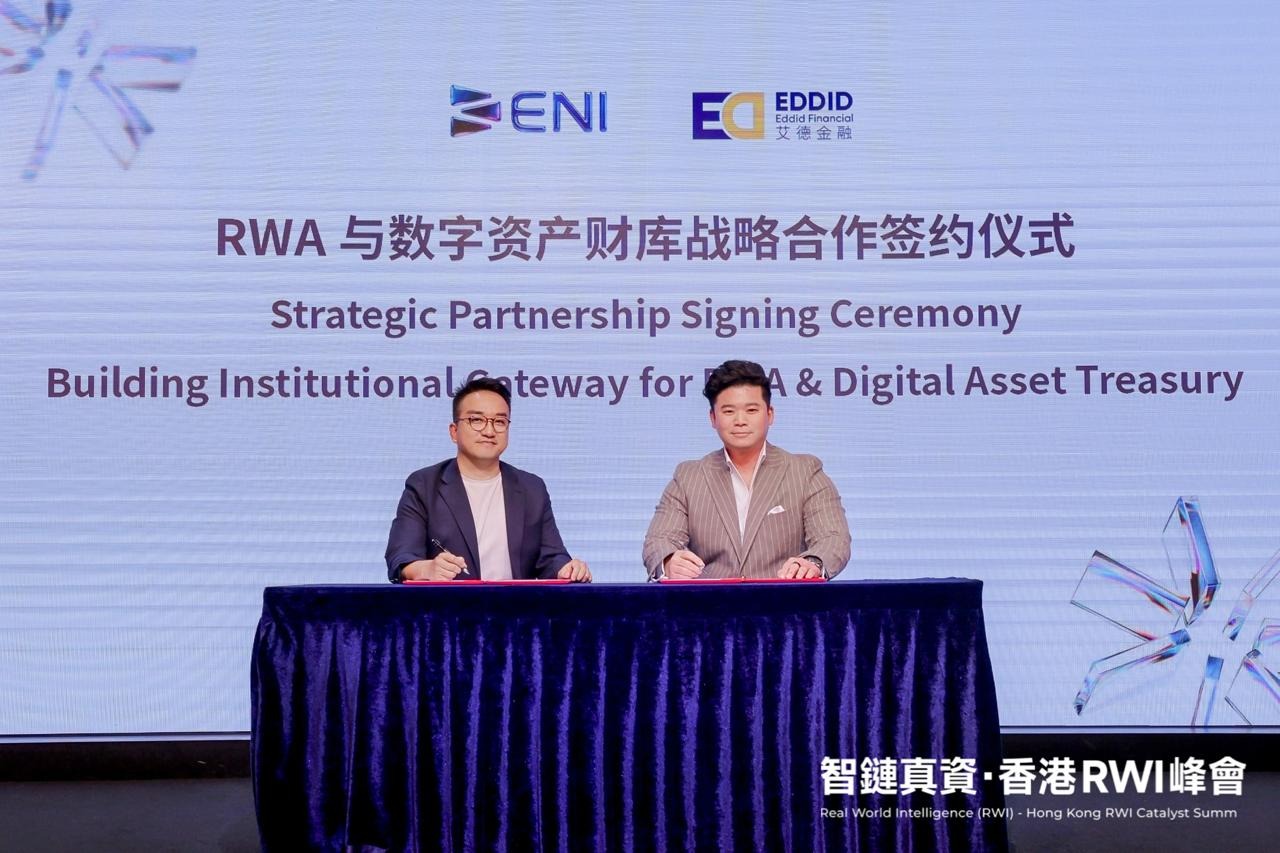
While the accelerator focuses on ecosystem breadth, ENI’s MOU with Eddid Financial represents a deep dive into institutional depth.

The partnership focuses on RWA restructuring, Digital Asset Treasury (DAT) management, and VA Fund technical support. As a leading licensed financial group with a public listing background, Eddid Financial provides the perfect TradFi counterpart to ENI’s Matrix architecture. The collaboration addresses the fundamental hurdle for giants: how to embrace Web3 securely and compliantly. By leveraging ENI’s "Chief Architect" capabilities, large enterprises can now achieve a frictionless transition of real-world assets into a digital-native, high-liquidity environment.
"Tomorrow runs on systems, not just chains." The RWI Summit was more than a flagship event; it was a catalyst. In the regulatory high-ground of Hong Kong, ENI is harmonizing technology, policy, and institutional trust. As RWA, AI, and global financial systems begin to resonate, we are witnessing more than a brand evolution—we are seeing the reconstruction of the global financial infrastructure.


Comments

All Comments

Recommended for you

  • Google (GOOG.O) Developing 'Frozen V2' Chip

    According to The Information: Google (GOOG.O) is developing a 'Frozen V2' chip to more efficiently serve its Gemini AI model. Google's new 'Frozen' chip is expected to be 6 to 10 times more efficient than its existing TPU. Google plans to deploy the Frozen V2 chip as early as 2028.

  • China Merchants Securities Terminates Primary Market Making for 6 Funds Including China-Korea Semiconductor

    Recently, the Shanghai Stock Exchange announced that, upon the filing application of China Merchants Securities Co., Ltd., China Merchants Securities will terminate its primary market making services for 6 QDII funds starting from July 20, 2026. In response, China Merchants Securities told reporters on the 20th that this is purely a commercial decision and does not involve any judgment on market direction.

  • Samsung, SK Hynix, and Micron Abandon In-House CXL Controller Development

    On July 20, according to South Korean tech media ZDNet Korea, Samsung Electronics, SK Hynix, and Micron Technology have all scaled back or abandoned commercialization plans for CXL expansion device controllers. Specialized chip design companies such as Montage Technology, Astera Labs, and PrimeMass are filling this void. This shift indicates a reshaping of the division of labor within the CXL ecosystem, where memory manufacturers will focus on production, while design leadership moves to independent chip design firms. For the capital market, this not only benefits relevant chip design companies but also means that the three major memory manufacturers will not engage in new competition around complete CXL solutions in the short term, with their core profit models still revolving around traditional DIMM memory products.

  • BitMine Adds 7,430 ETH Last Week, Buys Back Approximately 5.5 Million Common Shares

    As of July 19 Eastern Time, BitMine's total holdings of cryptocurrency, cash, and its 'Moon Project' amounted to $11.5 billion. BitMine holds 5,777,468 ETH (an increase of 7,430 ETH from the previous week), representing 4.8% of Ethereum's total supply of 120.7 million ETH. Additionally, it holds 207 BTC, $180 million in Beast Industries shares, $58 million in Eightco Holdings (Nasdaq: ORBS) shares, and $385 million in unencumbered cash. As of July 19, 2026, the total amount of ETH staked by Bitmine is 4,917,189 (valued at $9.2 billion based on ETH price of $1,879 per ETH). Bitmine Chairman Tom Lee stated, 'Bitmine repurchased approximately 5.5 million common shares last week at an average price of $15.6156 per share. We believe that repurchasing common shares will enhance shareholder value.'

  • U.S. Media: Trump Administration May Ban Advanced Chinese AI Models, Kimi's Rise Sparks Concerns

    On July 20, according to Axios, the Trump administration is signaling that it may ban advanced Chinese AI models—a significant move that could solidify the dominance of OpenAI and Anthropic. Sources familiar with the matter said that within the Trump administration, there had previously been attempts to impose a de facto ban on foreign open-source models. The rise of the Chinese large model Kimi last week has reignited these efforts.

  • Starmer Officially Steps Down as UK Prime Minister: My Work is Complete

    UK Prime Minister Starmer delivered a farewell speech at Downing Street, stating, "My work is complete. Over the past six and a half years, I have led our party out of the historic defeat of 2019, transforming it into a party capable of facing the nation, and we achieved an overwhelming victory in the 2024 election. Since then, it has been the honor of my life to serve as Prime Minister for you and this great country. I believe that today’s Britain is stronger and fairer than it was two years ago. However, what I will always remember is the humbling aspect of this job, which is being able to witness the greatest things of this country in action from the front row. Every day, I see countless acts of resilience—resilience, perseverance, integrity, and compassion from those who serve the nation." Starmer concluded, "We must remember the greatness of Britain. As we debate how to solve problems, there are certain things we inherit from our nation and character that give us the confidence to believe we can make the country better. We can create a Britain where every child can go further based on their talents, and if we do not succumb to division, we can unite different people under a common banner. Therefore, as I now pass the baton to Andy Burnham, I wish him all the best. He has my full support... I thank the people of Britain for the opportunity to serve. I leave with dignity, I leave with a smile, and I am proud of all we have achieved." (Jinshi)

  • Analyst: The Federal Reserve Needs to Tighten Monetary Policy

    According to analyst Bill Dudley, regardless of fluctuations in high-frequency data, there are still compelling reasons for the Federal Reserve to tighten monetary policy. First, given the current economic conditions and the asymmetry between the Fed's dual goals of achieving full employment and price stability, a tightening monetary policy is appropriate. On one hand, the unemployment rate has remained stable and is very close to the level that members of the Federal Open Market Committee consider to be full employment; on the other hand, inflation remains high, with various core inflation indicators generally between 2.4% and 3.3%. In this context, monetary policy should adopt a tightening approach. Second, there is almost no evidence that the current monetary policy is tight. The federal funds rate has been maintained at its current level or higher for nearly four years, and the unemployment rate has been quite stable, remaining at full employment levels for the past two years. If the policy were truly tight, we would theoretically expect to see an increase in the unemployment rate and a decrease in inflation. The current strong conditions in the financial markets also support this judgment. Third, the surge in AI investments supports further tightening of monetary policy. The spike in AI spending is driving real GDP growth and pushing up prices in several areas, such as electricity costs and semiconductor chip prices. Although AI is expected to enhance productivity and help reduce inflation in the long term, its current dominant role is still to stimulate demand and push up prices. Fourth, the credibility of the Federal Reserve is at risk. The inflation rate has exceeded the Fed's 2% target for more than five consecutive years. If the Fed hesitates, market participants may perceive Waller's tough rhetoric as mere 'bluster.' The Fed should not tighten monetary policy solely to enhance its anti-inflation credibility. However, the reality is that the risks faced by the Fed are asymmetric: if monetary policy is not sufficiently restrictive in the coming years and fails to bring inflation back to 2%, the costs will be greater than those of a slightly tight policy that later proves to be overly restrictive. Waller has consistently pledged to achieve price stability and maintain the independence of the Fed, but actions speak louder than words. Establishing working groups and proposing new ideas are commendable, but monetary policy cannot be outsourced to external experts or market participants. The Fed needs to intensify its efforts to tighten monetary policy. Bill Dudley expects that the Fed will maintain its current monetary policy at next week's meeting, but by autumn, the pressure to tighten monetary policy will become very significant.

  • Juchip Technology: Significant Progress in R&D of Second-Generation In-Memory Computing Technology

    On July 20, Juchip Technology announced that it has made significant progress in the R&D of its second-generation in-memory computing technology. Compared to the first-generation in-memory computing NPU, the second-generation technology greatly enhances computing power, supports larger model scales, and optimizes energy efficiency, utilization, and quantization accuracy across the board. SoC chips equipped with the second-generation in-memory computing NPU are set to enter formal tape-out this year, with mass adoption across multiple brands and categories expected next year. Additionally, the company is heavily investing in AI development tool platforms to build an ecosystem that helps customers efficiently adapt AI models. As the company's R&D efforts advance, the application scenarios for its edge AI chips will gradually expand beyond audio markets, continuously driving edge AI from a technological concept to a real consumer market within a diverse ecosystem of multiple brands, categories, and algorithms. (Jinshi)

  • WTI Crude Oil Falls Over 1% as U.S. and Brent Crude Prices Decline

    U.S. and Brent crude oil prices continue to decline, with WTI crude falling over 1% during the day, currently priced at $81.50 per barrel. Brent crude is down 0.64%, now at $86.19 per barrel. (Jin Shi)

  • Report Warns of Serious Financial Black Hole at OpenAI: Potential for AI Chain Reaction Collapse

    On July 20, according to Fast Technology, while global AI investments are booming, well-known analyst Ed Zitron recently issued a warning, pointing out that AI leader OpenAI is burdened with heavy debt. If it declares bankruptcy, it could trigger a series of chain reactions, potentially igniting the AI bubble. Zitron, in collaboration with the Financial Times, verified OpenAI's 2025 audited financial statements, which show that OpenAI's total revenue is projected to soar from $3.7 billion the previous year to $13.07 billion in 2025. However, total costs and expenses during the same period are expected to reach $34 billion, resulting in an annual operating loss of approximately $21 billion. After accounting for a massive one-time non-cash expense incurred from its transition from a non-profit to a for-profit entity (estimated by various sources to be between $30 billion and $41.6 billion), OpenAI's final net loss for 2025 could reach $38.53 billion. OpenAI is one of the largest buyers of NVIDIA's data center GPUs and a core customer of cloud service providers such as Oracle and CoreWeave, with SoftBank committing to invest up to hundreds of billions of dollars in OpenAI. If OpenAI fails to pay its infrastructure partners on time in the future, the impact will immediately affect these companies. Zitron further pointed out that once the AI investment boom subsides, memory demand will significantly decrease. The current shortage of HBM is largely driven by the enormous demand for AI training and inference, prompting memory giants like Samsung, SK Hynix, Micron, and SanDisk to shift production capacity towards HBM, squeezing traditional DRAM and NAND flash production. If OpenAI reduces its computing power investment or halts expansion, the decline in GPU demand will directly affect HBM, potentially alleviating the memory chip shortage and reverting these giants to their original state, leading to a reshaping of the entire industry landscape.