

In the current macroeconomic and technological cycle, the development of Artificial Intelligence (AI) is transitioning from the early phase of “large model hype” toward the era of infrastructure implementation and large-scale inference. At the same time, blockchain and crypto economics are providing innovative decentralized solutions to AI’s most critical bottlenecks — hash power scarcity and centralized control. However, as hash power networks and large model inference capabilities gradually mature, a deeper industry question is emerging: How can the massive AI hash power ecosystem be deeply integrated with Real-World Assets (RWA), creating a complete value loop between traditional finance and Web3?
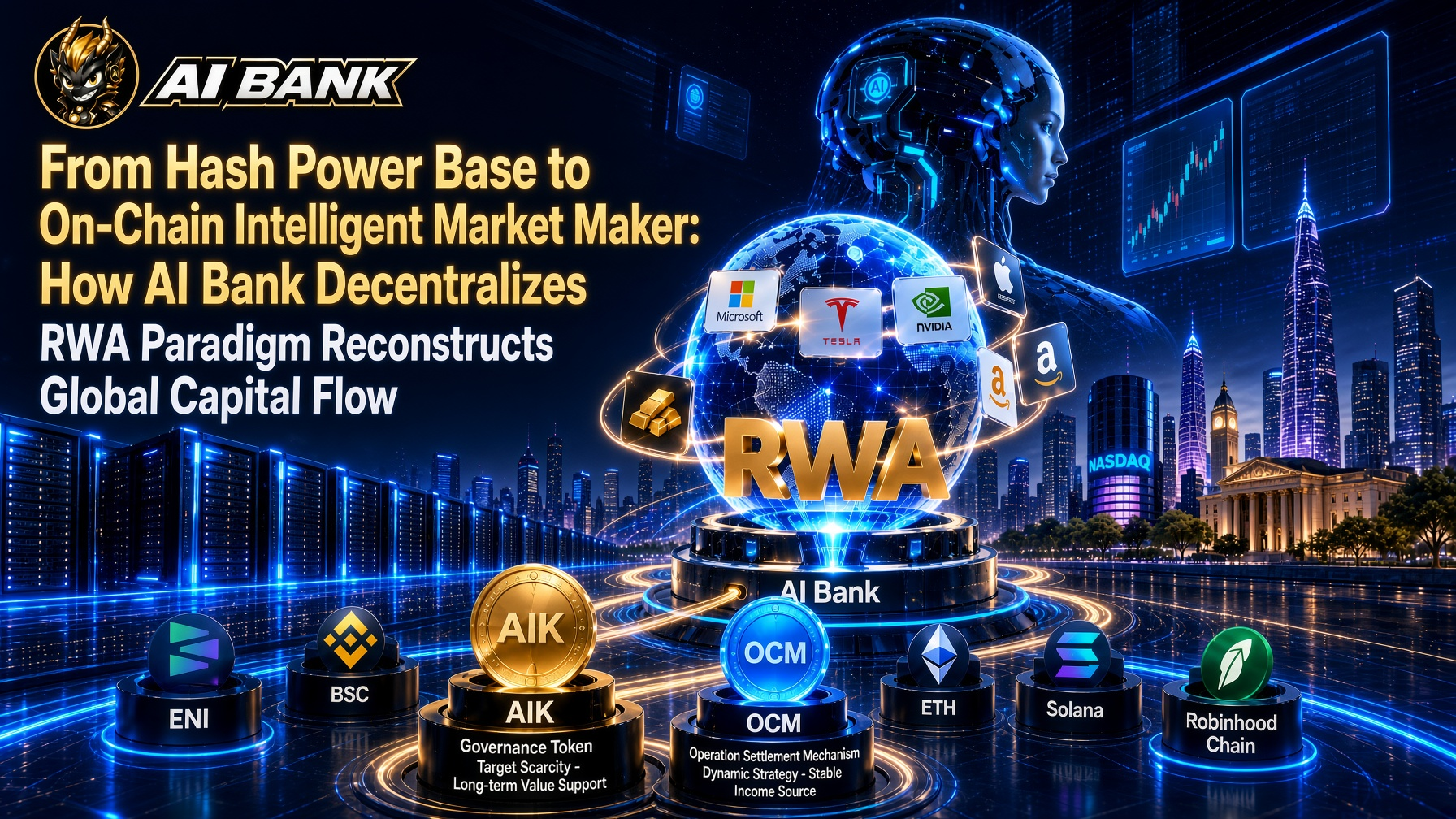
As a decentralized intelligent stock brokerage built for the Web3 era, AI Bank is delivering a groundbreaking solution to this industry challenge through disruptive innovations at the protocol layer.
I. From “Token Economics” to On-chain Assetization: Solving the Bottlenecks of Global Capital Circulation
In the current era of “Token Economics,” industry standards for measuring hash power and value circulation are shifting toward token-based microeconomic models. However, traditional cross-border securities markets have long been constrained by structural barriers such as complicated account opening procedures, high wire transfer costs, and strict capital controls, preventing the majority of global investors from accessing high-quality assets. Meanwhile, early Real-World Asset (RWA) narratives have largely remained focused on relatively simple models such as government bond anchoring, short-term notes, or synthetic asset derivatives. These models not only lack support from real-world industrial profits but also face challenges including liquidity fragmentation, high capital costs, and inefficient capital utilization.
AI Bank innovatively builds a complete closed-loop system covering asset on-chain deployment, settlement, and ownership verification, fundamentally reshaping the logic of global capital circulation:
- Entity Ownership Verification and RWA Upgrade:Relying on the underlying ecosystems of five major public chains, including ENI Chain, BSC, ETH, Solana, and Robinhood Chain, AI Bank directly connects with compliant funds and global listed companies, enabling high-quality stocks to achieve 1:1 on-chain spot mapping and transparent ownership verification. Users no longer need to go through complicated traditional brokerage account opening procedures; asset ownership is directly held through individual wallets, allowing global users to enjoy equal access to asset allocation opportunities.
- Synergy Between Intelligent Hash Power and Brokerage Ecosystem:The platform not only introduces decentralized hash power and intelligent agent (AI Agent) scheduling mechanisms but also deeply integrates AI-driven intelligent decision-making with an on-chain stock intelligent brokerage system, providing global users with a seamless, transparent, and 7×24-hour asset allocation channel, completely breaking the limitations of traditional finance caused by time zones and geographical boundaries.
II. Dual-Engine Driven: Multi-chain Liquidity Reserves and Token Co-Track Mechanism
Industry evolution has demonstrated that only by deeply integrating the real economic value creation capabilities of the physical world with the decentralized circulation advantages of blockchain can a truly sustainable Web3 financial infrastructure be established. AI Bank utilizes a scientific economic model and risk management framework to ensure the long-term growth and stability of its ecosystem:
- Ten-Million-Level Liquidity Guarantee:The platform has officially deployed withdrawal reserve pools across five major public chains, with a total reserve exceeding 20,000,000 USDT, ensuring that global users can enjoy a seamless experience featuring zero withdrawal fees and instant settlement under multi-chain heterogeneous clearing and high-frequency withdrawal scenarios, effectively mitigating risks caused by extreme market volatility.
- AIK and OCM Dual-Token Co-Track Mechanism:AIK serves as the ecosystem’s core deflationary and governance token. During the early stage, it implements a one-way redemption protection mechanism and a daily steady appreciation mechanism. Once the community size exceeds 100,000 users, AIK will fully enable free circulation through DEX. Combined with the OCM operating fuel mechanism, which provides dynamic fueling every 24 hours, the platform maintains optimal trading depth and financial resilience during market closure periods and extreme market conditions.
- Real Value Creation and Commercial Closed Loop:Each year, the platform selects high-quality listed companies for asset digitalization and mapping. Revenue generated from real-world transaction channel fees, market-making spreads, and management fees will be fully utilized for AIK buybacks and burns, forming sustainable long-term value support and moving beyond the speculative cycle of purely capital-driven models.
III. Moving Toward Maturity: Opening a New Era of Inclusive Trillion-Dollar Capital On-chain Transformation
With the grand opening of the NEXUS 2140 International Summit and the full launch of global public testing, AI Bank is accelerating the implementation of enterprise on-chain channels at the hundred-billion-dollar scale. This not only continuously injects endogenous real revenue into the entire crypto ecosystem but also marks the transition of decentralized finance from an early-stage growth phase into a mature development cycle characterized by institutional-grade automated risk management, deep multi-chain liquidity, and global asset accessibility.
Breaking boundaries and creating new possibilities, together building a new global capital paradigm. AI Bank invites global ecosystem partners to witness the future of decentralized intelligent brokerage and jointly explore the trillion-dollar RWA and AI integration landscape, opening a new era of on-chain asset allocation for global investors.


All Comments