

If we look only at model releases, September 2026 may seem like another familiar month of AI competition: who is stronger, faster, cheaper, or better at reasoning. But when the recent moves from OpenAI, Google, Anthropic, and global payment networks are viewed together, a deeper shift becomes visible. OpenAI is pushing Agents API and always-on agents toward persistent execution environments, cloud computers, browsers, tools, and sub-agent collaboration. Google is expanding enterprise infrastructure around Agent Gateway, Agent Registry, Skill Registry, Workflow Builder, and Agent Sandbox. Anthropic is moving Claude further into commerce, negotiation, and market-based interaction.
These developments point to a fundamental change in the unit of value in AI. In the past, the industry sold “model capability.” Now, the market is beginning to sell “what an Agent can actually complete.” The next step may go even further: the real objects of exchange will not simply be Agents, but the models, Skills, Workflows, data, tools, and execution outcomes behind them. AI is gradually evolving from a software tool industry into a new market for intelligent services.
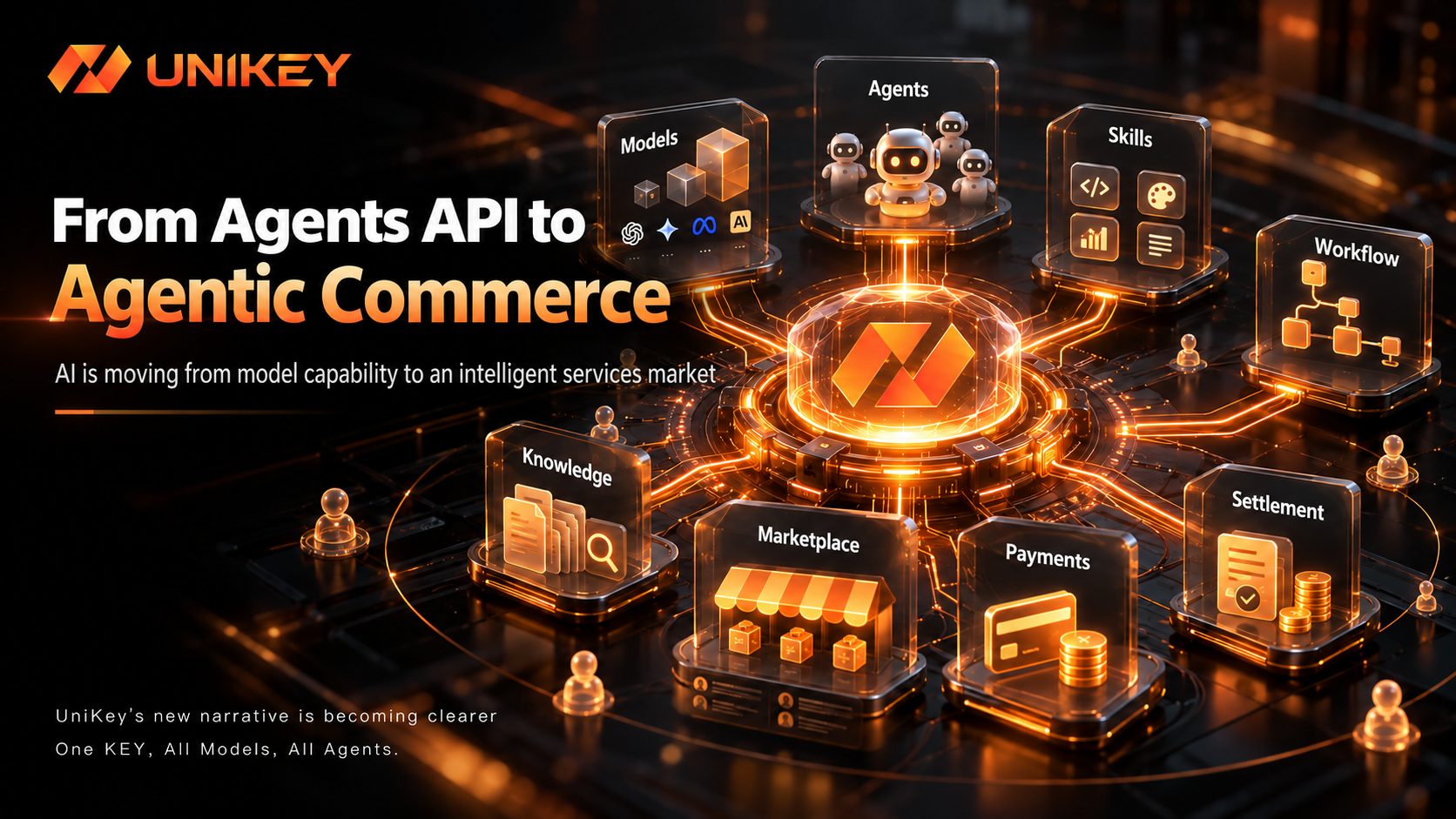
This is precisely why UniKey’s latest positioning has become more meaningful. UniKey is moving beyond the idea of being only a global AI gateway. Its emerging narrative is to become a global intelligent productivity market and settlement network—connecting global AI supply, organizing collaboration between intelligent agents, and eventually measuring and settling every unit of intelligent service value.
OpenAI Is Turning Agents from a Feature into Infrastructure
One of the clearest signals this month came from OpenAI. Its recent Agent infrastructure direction shows that a useful long-running Agent requires far more than a single model call. It needs a runtime that can manage context, use tools, coordinate sub-agents, access files, execute code, preserve intermediate state, and continue working for extended periods of time.
That shift matters because it changes the basic unit of AI interaction. A traditional chatbot completes one response. A true Agent may run for hours, use multiple models, invoke external APIs, work across files, call tools, and delegate subtasks to other Agents. Once AI enters this stage, the platform layer must manage not only model access, but also routing, task state, execution environments, workflow logic, tool access, and usage metering.
This is where UniKey’s recent expansion becomes important. AI Gateway and AI Router provide the intelligence supply and scheduling layer, while Agent Factory, Knowledge Base, Skills, and Workflow push the platform further into the execution layer. UniKey is therefore evolving from simply providing AI capabilities toward organizing AI work.
Google Is Standardizing Skills, Agent Registry, and Gateway Infrastructure
Google’s recent enterprise Agent architecture offers another strong signal. The introduction of centralized Skills Registry, Agent Registry, Agent Gateway, Agent Sandbox, and workflow infrastructure shows that the industry is beginning to treat intelligent capabilities as modular resources that can be registered, discovered, governed, and dynamically called.
The key idea is that an Agent does not need to own every capability internally. Instead, it can discover and load Skills as needed. A Skill becomes a reusable unit of intelligence that can be connected to many Agents, many workflows, and many business scenarios. This is similar to the evolution of cloud infrastructure: enterprises stopped building every technical component themselves and instead began assembling services from standardized building blocks.
That is closely aligned with UniKey’s direction. Models provide foundational intelligence, Skills provide specialized capabilities, Workflows orchestrate those capabilities, and Agents deliver the final task outcome. As the number of available Skills grows, the value of UniKey will depend less on how many model logos it displays and more on how many intelligent capabilities can be combined, reused, and circulated inside one network.
Anthropic Is Pushing Agents into Real Markets
Anthropic’s recent developments take the industry one step further. Its Commerce Agents direction is already moving Agents into real retail, travel, telecommunications, ticketing, and other commercial scenarios. These Agents are no longer limited to generating recommendations. They can help users search, compare, evaluate, negotiate, and participate in transaction flows.
The deeper implication is that the industry is beginning to ask a more advanced question. It is no longer simply, “Can AI work?” The question is now, “Can AI participate in markets?” When Agents begin making decisions, negotiating with other Agents, selecting services, and participating in transactions, they start functioning as economic actors rather than just productivity tools.
At the same time, global payment infrastructure is also preparing for this shift. Agentic payment systems are being explored to allow AI Agents to operate within predefined budgets, identity frameworks, authorization rules, and transaction limits. Once Agents can buy services, pay for tools, and interact with commercial systems, the AI industry begins to resemble a real economic network.
This Is Where UniKey’s Narrative Evolves from “Global AI Gateway” to “Global Intelligent Productivity Market”
The original UniKey story was easy to understand: One KEY, All Models. It addressed the fragmentation of global AI by providing a unified entry point for models, images, videos, APIs, and other capabilities.
But with Agent Factory, Knowledge Base, Skills, and Workflow now entering the platform, what UniKey connects is no longer limited to models. It is increasingly connecting a complete stack of intelligent productivity. The platform can serve users who want access to AI, developers who want to publish and commercialize Agents, Skills, and Workflows, enterprises that want to manage AI resources and budgets, and eventually Agents that need to call, collaborate, pay, and settle with other services.
This creates a much more complete structure. AI Gateway connects global models and multimodal capabilities. AI Router selects and schedules the most suitable intelligence. Knowledge Base provides proprietary context. Skills provide reusable capabilities. Workflow organizes execution. Agent Factory creates task-oriented intelligent workers. Together, these layers transform fragmented AI resources into services that can be called, combined, delivered, and eventually traded.
UniKey is therefore moving beyond the concept of a simple multi-model platform. Its position is increasingly becoming an AI usage layer, where upstream companies continue to produce intelligence while UniKey focuses on making that intelligence accessible, composable, usable, and economically transferable.
When Agents Start Consuming Services Autonomously, AI Credits and Settlement Become Core Infrastructure
The Agent era also introduces a problem that traditional AI pricing does not solve well. A single Agent task may call a fast model for data organization, a stronger model for reasoning, a search service for research, a Skill for domain expertise, an image model for visuals, a video model for production, and several external APIs before the task is complete.
In this environment, measuring AI consumption only by tokens becomes increasingly incomplete. Intelligent services will be consumed across models, tools, Skills, Workflows, and Agents. If every capability has its own account, balance, pricing system, and billing model, then the automation of Agents will be disrupted by financial and operational fragmentation.
This is where UniKey’s AI Credits model becomes strategically important. AI Credits can provide a unified metering system across models, image generation, video generation, Skills, Agents, APIs, and Workflows. KEY can then connect broader ecosystem value, service settlement, and participation mechanisms. With fiat payment access also expanding, ordinary users can enter the system without needing to understand crypto infrastructure first, while developers and ecosystem participants can continue to provide and monetize intelligent capabilities.
The more important point is what happens when Agents themselves become active consumers. An Agent may autonomously discover a Skill, call another Agent, purchase data, or use an external model. Every action creates real intelligent-service consumption. At that point, the important growth metrics are no longer just registered users or daily active users. They become the number of Agents working, Skills being called, Workflows being executed, Credits being consumed, and intelligent services being settled.
AI Is Moving from the Model Economy to the Agent Economy — and the Next Stage Is the Intelligent Services Network
The most important industry signal is that major companies are approaching the same architecture from different directions. OpenAI is solving how Agents can run continuously. Google is solving how Skills, Agents, tools, permissions, and execution environments can be organized. Anthropic is exploring how Agents can participate in markets and commerce. Payment networks are beginning to explore how Agents can hold authorization and complete transactions.
Taken together, the AI industry is gradually completing four layers: intelligence supply, capability organization, task execution, and value settlement.
This is why UniKey’s new narrative is becoming clearer. UniKey should not be understood only as a platform where users can access many AI models, and it should not stop at being an Agent creation platform. Its larger opportunity is to become a network connecting global intelligent supply with global demand.
Developers create models, Skills, Workflows, and Agents. Users and enterprises consume those intelligent services. Agents continue to call and collaborate with other services. AI Credits measure usage. KEY and the future Settlement Network connect value flow and service settlement.
The result is a more complete positioning:
Global AI Gateway + Intelligent Services Market + Agent Collaboration Network + Value Settlement Layer.
The Next Competition Is Not About Who Has the Smartest Model
In the past, models determined what AI could do. In the next phase, the more important question will be who can help those capabilities move efficiently across the market—who can make them discoverable, callable, composable, tradable, and settleable.
Once AI begins to truly work, the world will not only need more powerful models. It will need infrastructure capable of organizing global intelligent productivity.
That is where UniKey’s next stage is beginning to take shape.
One KEY, All Models, All Agents.
One network to connect global intelligence.
One market to access intelligent services.
One Credits system to measure every unit of AI consumption.
One settlement layer to distribute the value created by intelligent work.


All Comments