

Cointime

Download App
iOS & Android

Fed’s ‘third mandate’ may devalue dollar, send crypto soaring

Validated Individual Expert

A “third mandate” from the US Federal Reserve could change long-term monetary policy if actioned, which could be bad news for the dollar but good news for crypto.

The Fed has long been considered to have a dual mandate —  price stability and maximum employment — but President Donald Trump’s pick for Fed governor, Stephen Miran, cited a “third mandate” earlier this month, sparking speculation on the future of central bank monetary policy. 

The third mandate is a statutory requirement buried in the Fed’s founding documents, which states that the central bank actually requires three objectives: maximum employment, price stability and moderate long-term interest rates.

The Trump administration appears ready to use this forgotten statutory requirement as justification for more aggressive intervention in bond markets, potentially through yield curve control or expanded quantitative easing and money printing, Bloomberg reported on Tuesday.
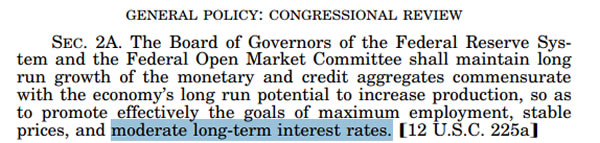
  The 1913 Federal Reserve Act notes a third mandate (highlighted) for moderate long-term interest rates. Source: US Government Publishing Office


Lowering long-term interest rates

This third goal has been largely ignored for decades, with most considering it a natural byproduct of achieving the first two, but Trump officials are now citing it as legal cover for potential yield curve control policies, where the Fed buys government bonds to target a desired interest rate.

Trump has long advocated for lower rates, calling Fed governor Jerome Powell “too slow” or “too late” in reducing them. 

The administration wants to actively suppress long-term interest rates, and potential tools include increased Treasury bill issuance, bond buybacks, quantitative easing or direct yield curve control. 

Lower long-term rates would reduce government borrowing costs as national debt hits a record $37.5 trillion. The administration also wants to stimulate housing markets by bringing down mortgage rates. 

Positive impact on crypto 

Christian Pusateri, founder of encryption protocol Mind Network, said on Wednesday that the third mandate is “financial repression by another name,” adding that it “looks a lot like” yield curve control.

“The price of money is coming under tighter control because the age-old balance between capital and labor, between debt and GDP, has become unstable,” he said. 

“Bitcoin stands to absorb massive capital as the preferred hedge against the global financial system.”

Outspoken BitMEX founder Arthur Hayes also said it was bullish for crypto, suggesting that yield curve control could send Bitcoin to $1 million.
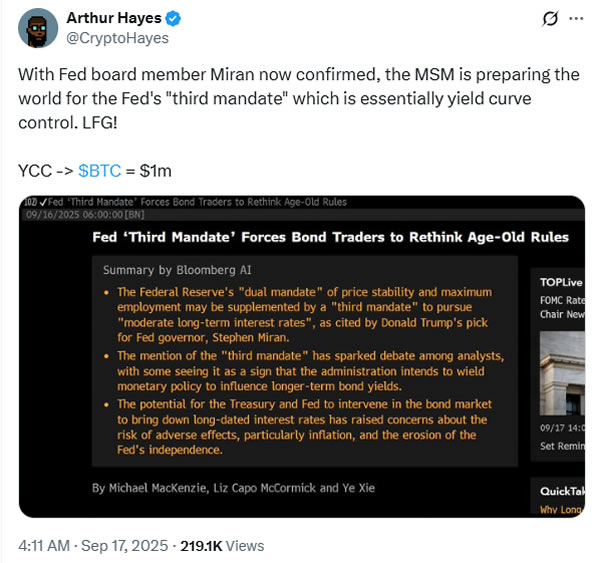
  Source: Arthur Hayes


Comments

All Comments

Recommended for you

  • Amazon Shares Surge 15.2%, Biggest Gain Since 2012

    On July 31, Amazon shares surged 15.2% to $271.255 per share, marking their biggest gain since 2012, with a total market value of $2.92 trillion.

  • US Treasury Secretary Bessent Vows to Track Down Iranian Assets Globally for Terror Victims

    US Treasury Secretary Bessent said the US will actively track down Iranian assets worldwide to ensure compensation funds for victims of Iran-backed terrorist activities. Bessent stated that the US government's military and economic blockade measures against the Iranian regime will continue and will not be relaxed. (Jinshi)

  • Apple Plunges Nearly 10%, Q4 Revenue Guidance Misses Expectations

    On July 31, Apple (AAPL.US) plunged nearly 10% to $300.33, marking its biggest drop since April 2025. In terms of fundamentals, Apple's third-fiscal-quarter revenue rose approximately 16% year-over-year to $109.42 billion, slightly above analyst expectations. Among the details, product revenue came in at $78.68 billion, beating the expected $77.25 billion. However, services revenue—a key driver of its valuation re-rating in recent years—totaled $30.74 billion, missing the consensus estimate of $31.36 billion. Additionally, Greater China revenue reached $18.82 billion, with year-over-year growth slowing to 22%, also below analysts' forecast of $19.58 billion. During the earnings call, Apple guided fourth-fiscal-quarter revenue growth in the range of 9% to 11%, overall below the 12.1% analysts had expected. CFO Parekh noted that component supply constraints would impact iPhone, Mac, and iPad businesses in the fourth fiscal quarter, with currency fluctuations also constraining growth.

  • Three Fed Officials Back Rate Hike, Hawkish Pressure Builds

    On July 31, three Federal Reserve policymakers said that dissenting votes in favor of a rate hike this week stemmed from stubborn inflationary pressures, highlighting rising internal pressure on Fed Chair Warsh to act. In statements released Friday morning, Hammack and Kashkari said they worry that although the current round of price increases may stem from short-term factors such as President Trump's tariff policies and the Iran war, the inflation situation already warrants Fed action. Logan also joined in, saying that even if inflation cools, if the Fed does not raise rates, inflation is unlikely to fully fall back to the Fed's 2% target; without any policy constraints, inflation could continue to run above target until an unexpected shock occurs. Kashkari said that if inflation remains persistently stubborn, he might support a series of rate hikes, not just a single increase, to prevent inflation from becoming further entrenched. He said: "A series of small policy adjustments may be preferable to waiting for developments to unfold and ultimately having to take more forceful action." Hammack said that if the Fed does not tighten policy, price increases could continue to accelerate. She said: "Inflation has been stubbornly above 2% for more than five years, and I have no confidence that it will return to our target on its own." (Jin Shi)

  • US 10-Year Treasury Yield Rises to 4.7388%, Highest Since January 2025

    On July 31, the US 10-year Treasury yield rose to 4.7388%, the highest level since January 2025.

  • Spot Gold Intraday Decline Widens to 2%, at $4,021.08 per Ounce

    On July 31, spot gold's intraday decline widened to 2%, reported at $4,021.08 per ounce.

  • BTC Falls Below $63,000

    Market数据显示,BTC has fallen below $63,000, currently reported at $62,985.99, with a 24-hour decline of 2.99%. Market volatility is significant, please exercise risk control.

  • Fed's Logan: Leaning Toward 25 Basis Point Rate Hike

    On July 31, Federal Reserve Governor Logan said she leans toward a 25 basis point rate hike, believing inflation has not yet entered a sustainable path back to the Fed's 2% target. Logan stated that taking moderate action now would reduce the risk of needing more aggressive tightening in the future, while emphasizing that the Fed cannot rely on unexpected shocks to achieve its inflation target.

  • Fed's Logan: Taking Modest Actions Now Reduces Likelihood of Needing Stronger Action Later

    On July 31, Dallas Fed President Lorie Logan said that taking modest actions in the near term would reduce the likelihood of needing to take stronger action in the future.

  • Philadelphia Semiconductor Index Erases 5% Gain, Turns Lower

    On July 31, U.S. chip and semiconductor stocks rapidly weakened, with the Philadelphia Semiconductor Index wiping out a 5% gain and turning lower. Micron Technology, which had risen 6%, is now down 4.2%. SanDisk, which had gained nearly 10%, is now down over 6%. SK Hynix and Seagate Technology, which had risen over 8%, are now down 2%. TSMC, which had gained 4%, is now down nearly 1%.
