


According to e-commerce data statistics from the past two years, the Taobao platform alone recorded a net reduction of more than 870,000 active merchants in a single year. High platform commissions, traffic restrictions and ranking downgrades, monopolization of privatized data, and marketing/traffic-acquisition costs as high as 50% are driving traditional e-commerce into a “the more you spend, the more you lose” developmental dead end. Small and medium-sized merchants—and even leading brands—have been completely reduced to “digital laborers” under the hegemonic rules of centralized platforms.
At a time when traditional e-commerce traffic dividends have peaked and involution is intensifying, PayDa Mall, registered in Singapore, together with its core settlement asset $STRIKE and the underlying algorithmic architecture of the AI.Claw Foundation, has officially launched a next-generation omnichannel Chain Commerce solution. It opens an independently controllable, multi-win path for physical merchants and consumers to break through.
I. Directly Addressing Industry Ills: PayDa’s Dimensional Reduction of Traditional E-commerce Pain Points
The core predicament of traditional e-commerce is concentrated in three dimensions: high platform commissions, merchants’ lack of private-domain assets, and poor user stickiness. Based on “Chain Commerce Theory,” PayDa systematically reshapes traditional commercial relationships through its technical foundation:
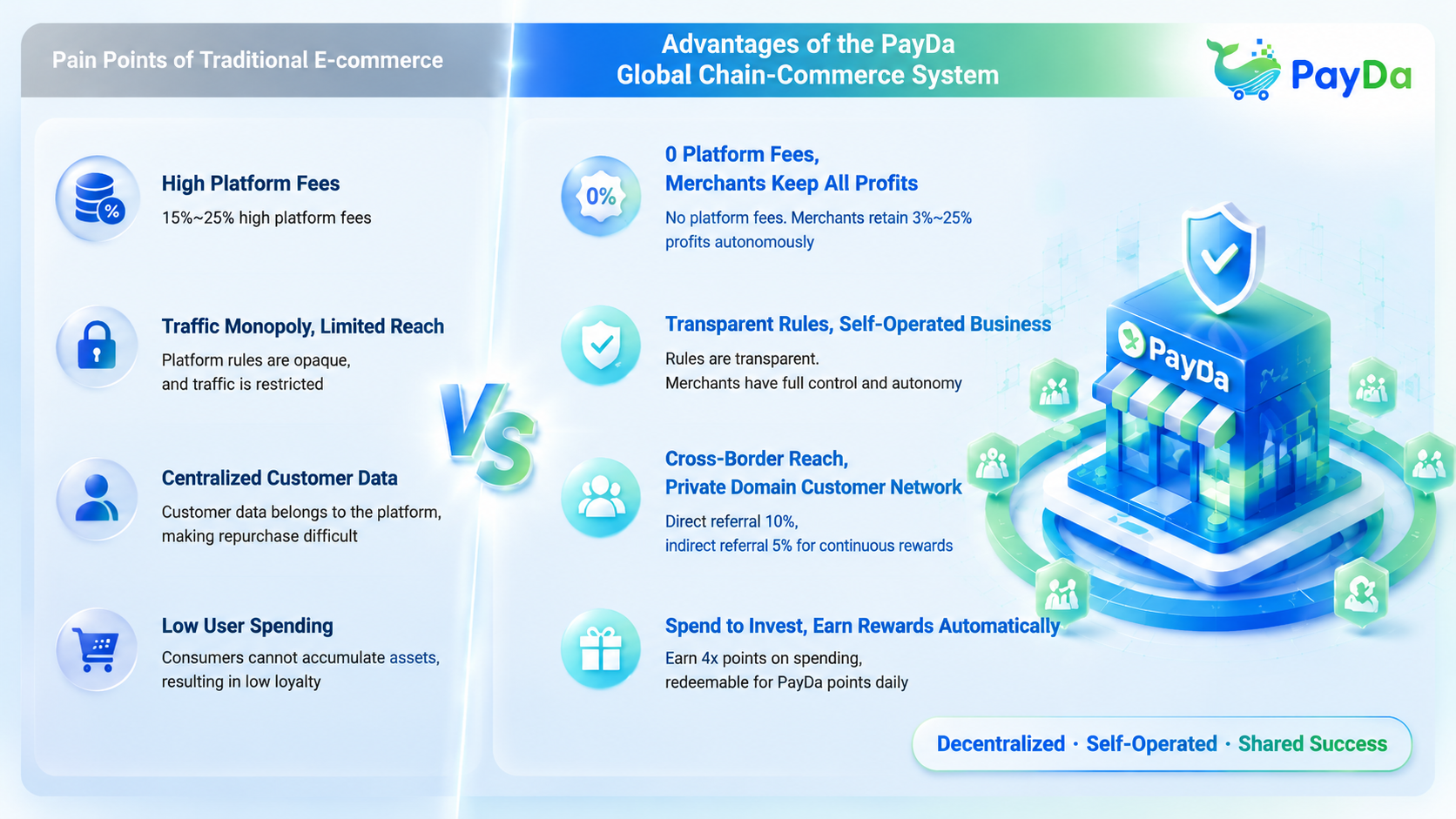
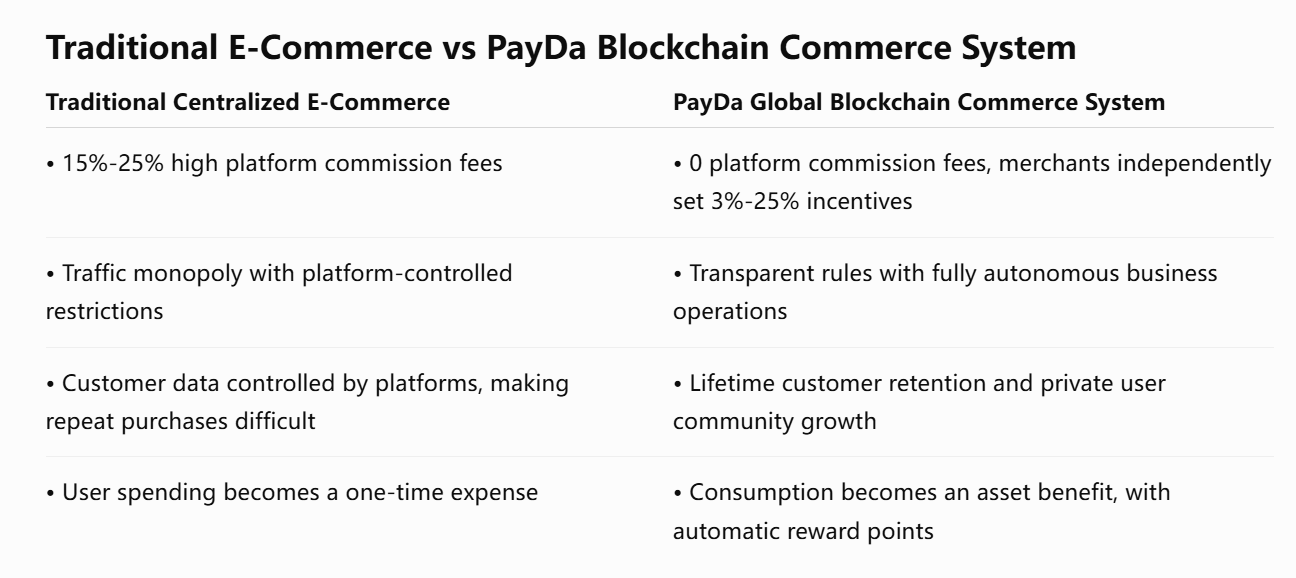
● Eliminating centralized commissions so merchants take full control: Completely breaks the 15%–25% high-commission barrier of centralized platforms. PayDa imposes no hegemonic rules or forced traffic restrictions and allows merchants to independently set a concession range of 3%–25% according to their own operating conditions, truly leaving profits with merchants and users.
● Lifetime cross-category customer lock-in, solving traffic privatization: After a merchant joins PayDa, whenever a referred customer makes a purchase at any other store on the platform, the original referring merchant can receive up to 10% in direct-referral and 5% in indirect-referral ongoing revenue sharing. This thoroughly changes the traditional e-commerce problem of one-time transactions and customer-base loss.
● Consumption equals investment, reshaping user loyalty: When users purchase real physical goods in the mall, they receive lightning-coin points equivalent to 4 times the merchant’s concession amount, which are released smoothly every day. Every expenditure is thereby converted into a lasting digital asset, activating repurchase intent at the root.
II. IRO + PayFi Dual Engines: Real-Economy Blood-Making and Automated Profit Distribution
Unlike virtual concepts that lack physical backing, PayDa relies on the dual underlying protocols of IRO (Asset Engine) and PayFi (Value Engine) and is deeply rooted in real-goods transactions:
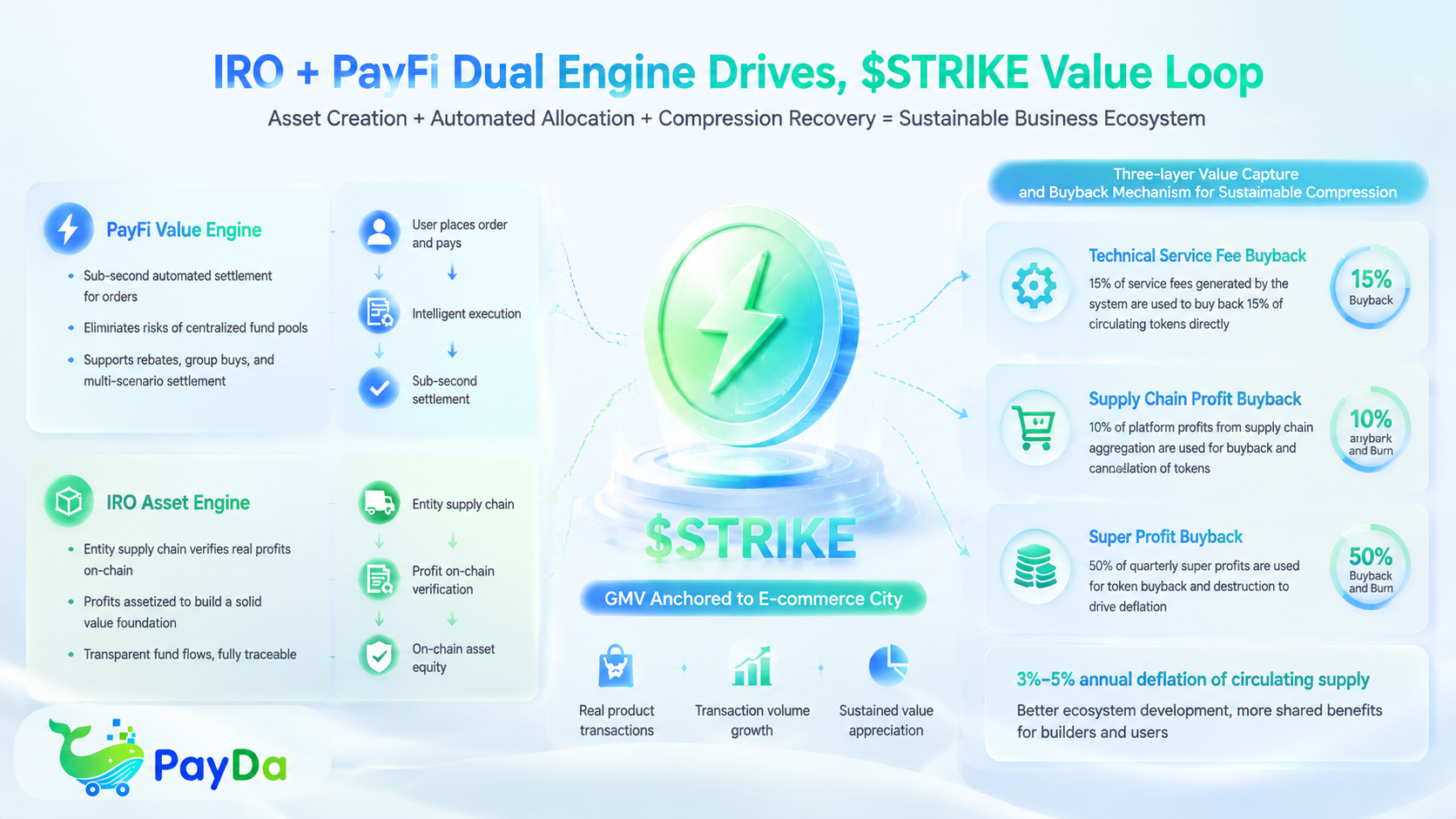
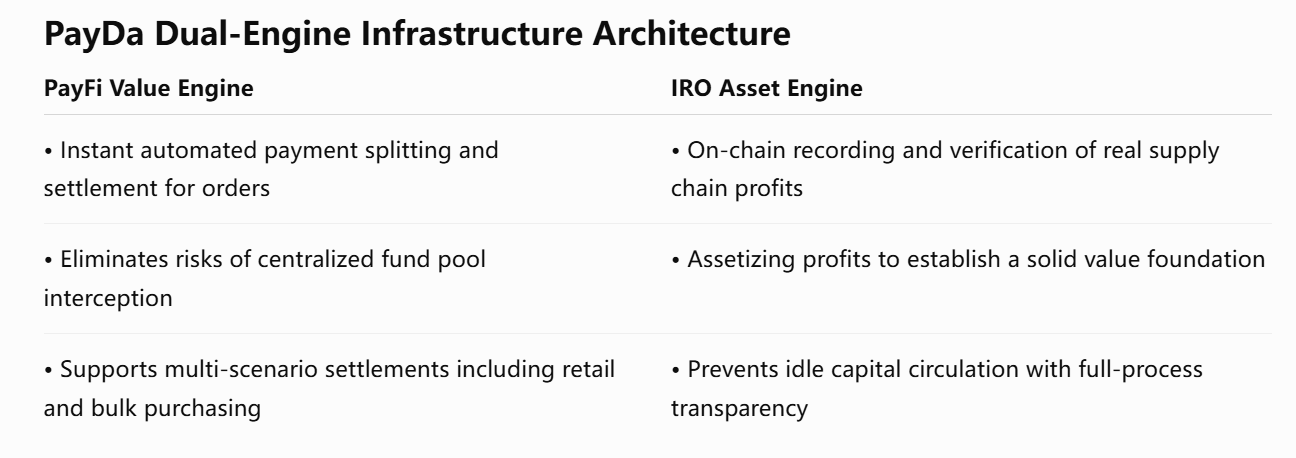
1. PayFi Value Engine — second-level automated profit sharing: Every consumption order is triggered directly by a smart contract. Payment is settled to the merchant in real time, and the concession portion automatically enters the distribution network, eliminating lengthy payment cycles and intermediary human intervention.
2. IRO Asset Engine — digitalization of real profits: Aggregating physical supply chains in 3C digital products, home furnishings, beauty and apparel, and global travel, it converts genuine product gross margins and supply-chain commissions into on-chain asset rights, giving the entire commercial network strong self-sustaining blood-making capacity.
III. $STRIKE: A Deflationary Asset Tightly Anchored to Mall Turnover
As the core all-scenario settlement instrument of PayDa Mall, the value logic of $STRIKE is directly anchored to the mall’s real transaction volume (GMV) and continuously contracts circulating supply through a three-layer buyback-and-burn mechanism:
● Technical service-fee burn: 15% of every service fee generated by the system is automatically extracted and publicly burned.
● Supply-chain profit buyback: 10% of the platform’s real net profit from supply-chain centralized procurement is regularly used for cash buybacks and burns on the open market.
● Excess-profit special burn: 50% of quarterly excess profits is specially allocated to buybacks and lock-ups, driving a steady net annual reduction of 3% to 5% in token supply.
The more abundant the mall’s actual transaction flow and the more frequent the product redemptions, the greater the quantity of tokens burned, allowing all ecosystem co-builders to genuinely share in the long-term dividends brought by the mall’s growth.
IV. Embracing a New Compliant Track and Reshaping the Global Commercial Value Internet
At the historical turning point where traditional e-commerce involution has peaked and millions of merchants are seeking transformation, the era of simply relying on rule monopolies and paid traffic acquisition has ended.
Standing on Singapore’s international compliance framework, PayDa deeply integrates mainstream international bank-card payment channels with high-performance underlying settlement technology, building a solid bridge for physical enterprises into the next generation of digital commerce.
From being passively constrained by platforms to independently controlling operations; from merely consuming traffic to accumulating assets across categories—PayDa is using genuine physical goods as its foundation and $STRIKE as its bond to open a new commercial civilization in which merchants, users, and the platform all win.


All Comments