

Key Takeaways
- Model Fragmentation Is an Inevitable Reality: There will never be a single dominant super model that unifies the entire AI industry. The coexistence, collaboration, and complementary strengths of multiple models represent the long-term path toward real productivity.
- UniKey’s Multi-Chain Intelligent Routing: UniKey is not a low-end API reseller. Instead, it leverages intelligent routing and deterministic quality control to precisely address the underlying volatility of heterogeneous computing resources.
- Native Intelligent Agent Payment Settlement: Traditional human billing systems cannot handle the high-frequency micro-interactions of Agents. The industry urgently requires an automated, full-stack settlement infrastructure built for the Agent economy.
- Breaking Through with the Jevons Paradox Effect: The decline in the marginal cost of AI will exponentially amplify real usage demand. Price competition will not collapse the ecosystem; instead, it will aggregate massive business execution flows into the UniKey settlement network.
- UniKey’s Real Business Model: Rejecting superficial narratives without substance, UniKey deeply connects its token economy with real AI computing value differentials and on-chain transaction flows, earning institutional-level trust through absolute transparency.
- Enterprise-Grade Compliance and Security Protection: Under global regulatory frameworks such as Dubai VARA, UniKey provides full-stack prompt protection and sensitive information desensitization, eliminating security concerns for enterprise-level applications.
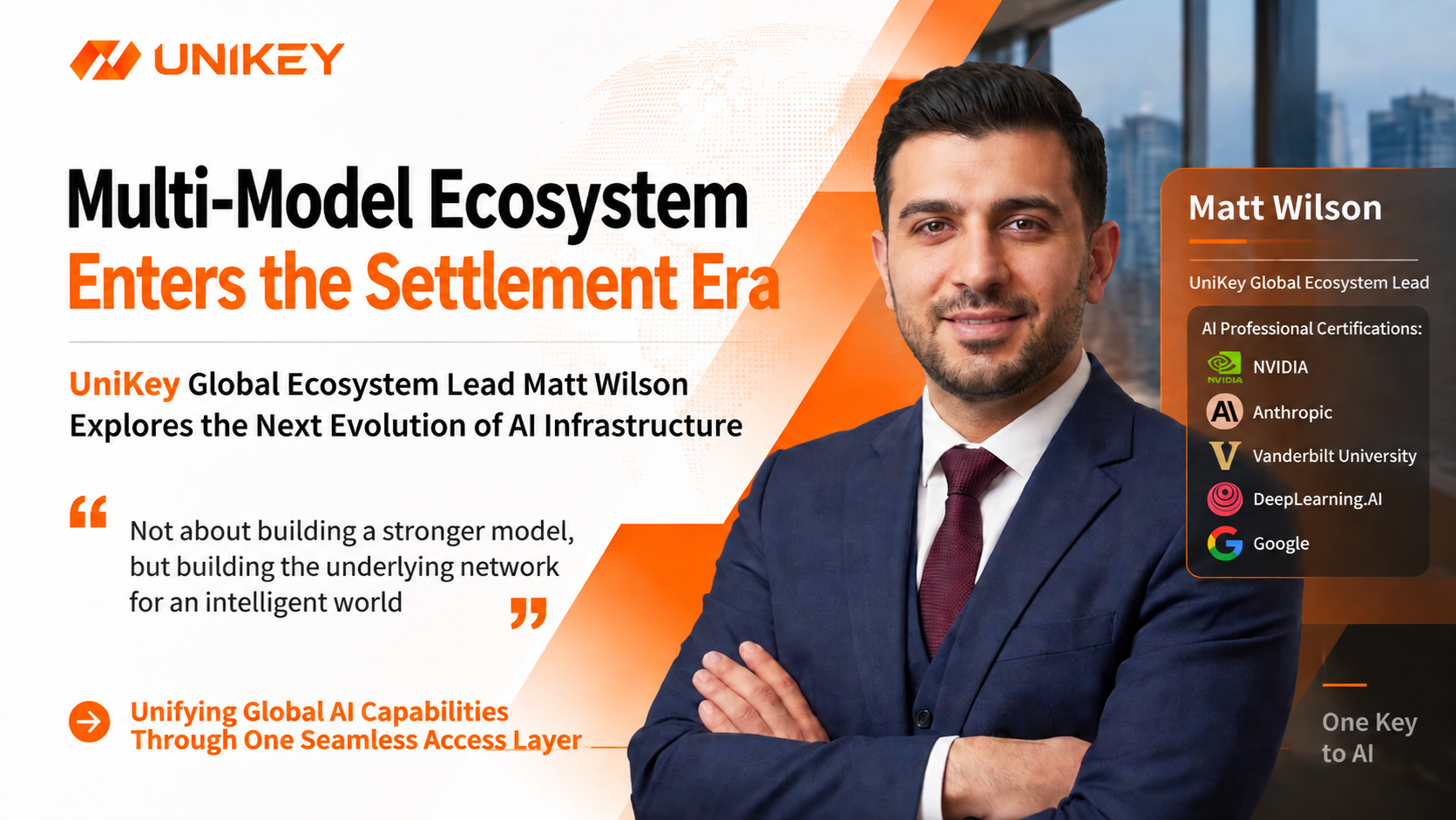
Matt Wilson: UniKey Global AI Strategy & Ecosystem LeadMatt Wilson has been deeply engaged in distributed computing power networks and the Agent ecosystem, possessing official certifications and practical implementation backgrounds from global top AI institutions and academic organizations including NVIDIA, Anthropic, Google, DeepLearning.AI, and Vanderbilt University. His technical landscape covers three major fields: AI infrastructure cluster scheduling, Agentic AI collaborative settlement, and responsible AI compliance governance. As the overall leader of UniKey’s global technology narrative and ecosystem expansion, Matt is dedicated to promoting “making global AI capabilities uniformly callable and enabling the intelligent economy to have its own settlement infrastructure”.
While the entire technology industry is still endlessly debating which large model can unify the market, the underlying logic of global artificial intelligence infrastructure and the Agent economy is undergoing a profound reconstruction.
When Alex Atallah, founder of OpenRouter, pointed out that multi-model coexistence and fragmentation will be a permanent destiny, another more brutal engineering reality has emerged: when global computing power is completely fragmented, when thousands of autonomous Agents begin to conduct millions of cross-boundary mutual calls, micro-payments, and task collaboration contracts per second in the background, who will provide a reliable metering and settlement foundation for all of this?
With this question directly targeting the industry’s key issue, we conducted an in-depth conversation full of intensity with Matt Wilson, UniKey Global AI Strategy & Ecosystem Lead. With a background in computing power cluster scheduling, large model applications, and top-level research on the Agent economy, Matt not only exposed the disguise of the current artificial intelligence intermediary market in this conversation, but also revealed for the first time in depth how UniKey is constructing a truly decentralized settlement network amid global regulatory compliance and the emerging Agent economy.
Introduction: When Super Large Model Worship Collides with the Brutal Reality of Fragmentation
Host: Welcome, Matt. Today, the entire technology industry, from Silicon Valley to the domestic venture capital circle, is falling into an almost religious frenzy. Everyone is watching when the next hundred-billion-parameter or trillion-parameter model will be released, as if once this ultimate model emerges, all software, all business models, and even the entire human society will be instantly reconstructed. But you and the UniKey team seem to have stood against this grand unified narrative from the very beginning. Let us start from this sharpest point: why do you believe that the pursuit of a unified model is the industry’s biggest collective self-deception?
Matt Wilson: Thank you. I am very glad to have this in-depth conversation with everyone without putting on a facade or talking about empty grand narratives.
The kind of frenzy you just mentioned, I call it the collective misconception of the large model myth. The outside world always believes that the ultimate destination of artificial intelligence is the emergence of a god-like super brain, and then everyone connects interfaces to it, solving everything once and for all. But this is completely a lack of understanding of engineering reality and a blind belief in capital narratives.
Let’s look at reality: computing power is severely fragmented, geopolitics is accelerating the construction of technological barriers, and different open-source weight models are rapidly iterating at an extremely high speed. More importantly, even for the same model, when you deploy it across different intelligent computing center nodes, its speed, latency, cost, and even partial logical performance can be completely different.
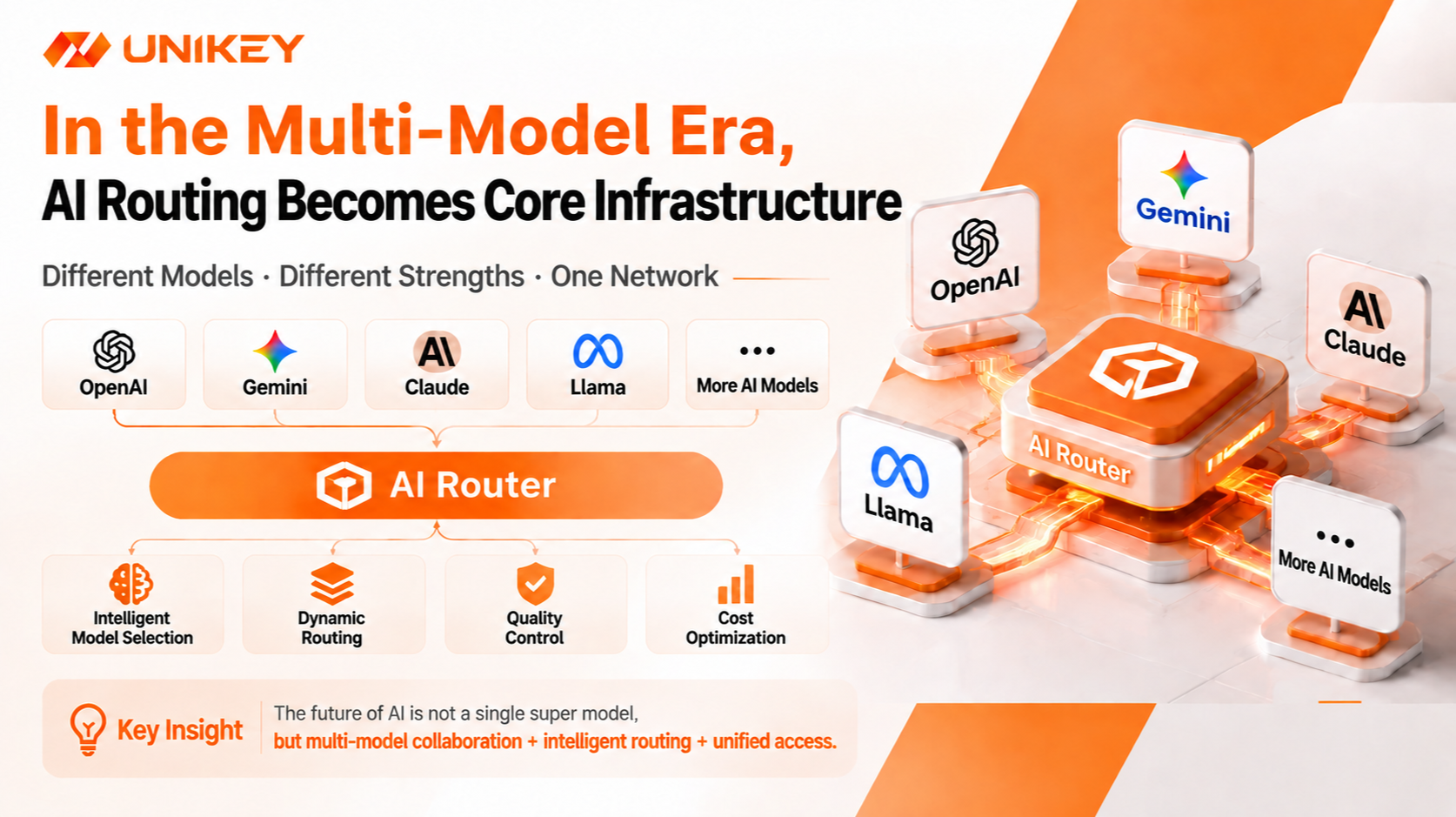
Large model providers would prefer you to believe in a unified model, because this allows them to capture monopoly rents across the entire industry chain. But for enterprises, developers, and future Agents, fragmentation is the permanent reality, while multi-model deployment and collaboration are the long-term norm. Attempting to use one model to dominate everything is not only economically unsustainable, but also an engineering dead end. This is the historical origin of UniKey’s creation — we are not here to build a single strongest model; we are here to lay the foundational rails for this fragmented and multi-polar intelligent world.
Act One: Breaking the Illusion of the API Gateway Mindset — Who Exactly Is UniKey Disrupting?
Host: Speaking of rails, there are currently many voices from the outside world categorizing UniKey simply as another aggregation gateway for large model distribution. There are countless projects in the market providing API intermediaries and multi-model distribution, and even many developers can build a routing system themselves with just a few lines of code. From the perspective of your professional experience, where does this understanding go wrong? What is the fundamental difference between aggregation and UniKey’s core work of decentralized settlement and routing?
Matt Wilson: Every time I hear someone call UniKey a large model reseller or an API intermediary, I feel that this is the biggest misunderstanding of current engineering.
What are most of those competitors who constantly promote themselves as aggregation gateways actually doing? They are simply connecting several public APIs from major providers, creating a slightly cheaper price difference, building a good-looking frontend interface, and then telling traffic stories to attract investors. Do they think this is the real barrier? That is too naive.
The true engineering challenge is not how to send requests to a certain large model company, but how to achieve deterministic quality control and millisecond-level settlement within the computing power black hole and harsh, constantly changing supply network.
Based on my previous hands-on experience in intelligent computing infrastructure operations, the current underlying computing power supply is highly non-standardized and volatile. When you call an open-source large model today, the underlying inference service provider may experience severe packet loss or speed reduction within a very short period due to computing power congestion. The same prompt, when executed on different nodes, can produce completely different content quality and response latency.
UniKey is absolutely not a traffic intermediary that simply helps you save money. What we are building is a decentralized computing power infrastructure and intelligent routing network. We do not produce models, but at the underlying layer, we weave together the world’s top-tier yet diverse open-source weight models and inference computing power through multi-chain intelligent routing. If traditional aggregation tools solve the problem of allowing developers to choose models at lower costs, then UniKey solves the problem of how to achieve millisecond-level, zero-trust computing power settlement and routing loops in a decentralized environment when these models are heavily invoked by thousands of Agents.
What we provide is not the price difference of a reseller, but deterministic control and settlement trust over global heterogeneous computing power and multi-model capabilities.
Act Two: Deconstructing the Agent Era — Why Will Traditional Billing Systems Completely Collapse?
Host: This is a very thought-provoking perspective. Following this logic, we must discuss another core field you have been deeply involved in — the Agent economy. What is the fundamental difference between the future Agent economy and interface-based billing in the traditional software era? Why do you dare to assert that traditional billing systems will completely disappear?
Matt Wilson: This is a question that directly targets the key issue of the industry. To understand why traditional billing systems will fail, we must first clearly see the fundamental transformation between the traditional era and the Agent era in terms of who the consumer is.
In the past, whether it was software services or traditional API calls, the consumer was always human. Humans had the patience to view monthly billing statements, humans had credit cards, and humans could understand that they purchased a fixed package this month. Therefore, the underlying billing system was designed for humans — it was macro-level, slow-paced, and periodic.
But look at what is happening in the Agent era. When future Agents complete a complex enterprise-level or personal task, what will happen in the background? They may automatically split into dozens or even hundreds of micro-calls within an extremely short period of time:
- It first calls an extremely lightweight and low-cost open-source model for preliminary text classification and intent recognition.
- When it discovers that complex financial compliance logic is involved, it instantly sends structured data to a costly frontier closed-source model for deep planning.
- During the planning process, it needs to call an externally packaged professional tool in real time.
- Finally, it may need to package all results and distribute them to three other vertical-domain sub-Agents for cross-validation.
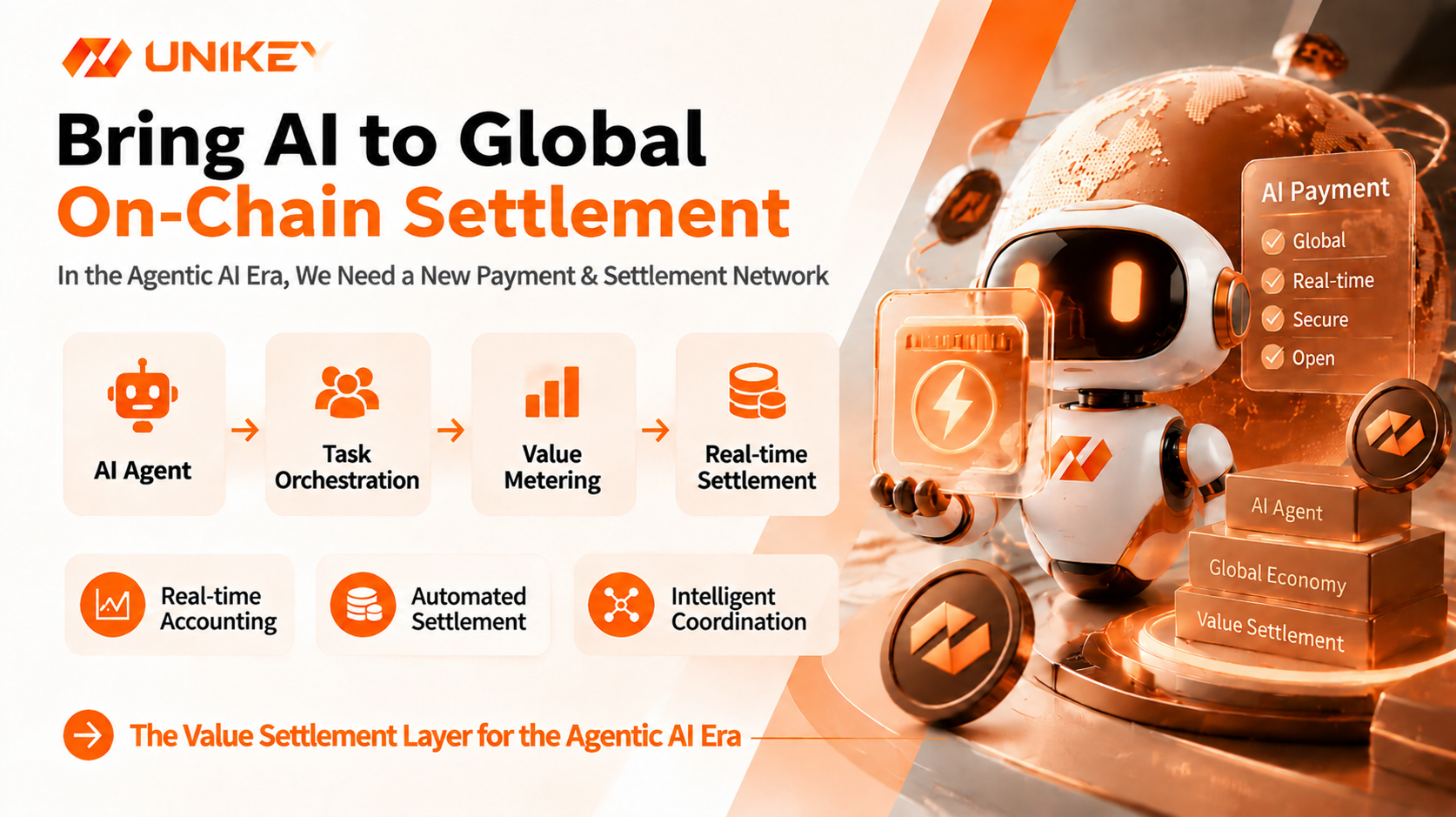
In this process, the calls are high-frequency, micro-scale, cross-boundary, and fully automated. The cost of each individual call may be extremely low, but millions of such interactions may occur every second.
Try running this through traditional payment billing and centralized settlement systems. Cross-system fees could directly drain the project, and the latency would be so high that Agents would time out and crash before even receiving the results. This is why traditional billing systems in front of Agents are like using horse-drawn carriages to transport high-speed rail cargo — they simply exist in completely different physical dimensions.
This is why UniKey must build an Agent payment settlement network. We are transforming AI consumption from traditional fixed depreciation into on-demand metered usage based on unified credits. We are equipping global intelligence with precise electricity meters, allowing every collaboration between Agents to be traceable and settled in real time.
Act Three: Cold Thinking Across Cycles — When the Price War Sweeps the Entire Industry, Where Does UniKey’s Confidence Come From?
Host: During this period, the price war in the global large model and inference market has become extremely intense, with unit prices dropping significantly. Many people are discussing the Jevons Paradox, and many are also concerned: when the profit margins of the intermediary layer are endlessly compressed by price competition, projects that rely on channel fees are disappearing in large numbers. Facing the turbulent waves of this macro cycle, what exactly is the moat of UniKey’s underlying business closed loop?
Matt Wilson: Good question. Those products that constantly complain and worry that price competition will eliminate them are essentially facing this problem because their business models are extremely superficial — they rely on collecting channel fees or purely narrative-driven cycles. Once prices decline, their revenue directly goes to zero, because they have no bargaining power over upstream providers and no stickiness with downstream users.
But UniKey sees a completely different macroeconomic logic.
When the cost of a key resource decreases, the actual usage demand released by the market often increases several times or even more. This is the real-world validation of the Jevons Paradox in the current era.
The further prices decline, the lower the marginal cost of artificial intelligence becomes, and the creativity of developers is truly unleashed. Complex business scenarios that people previously could not even consider because they could not afford expensive frontier models are now fully activated. Enterprises and Agents are beginning to aggressively explore various multi-model combinations and complex workflow orchestration that were previously too expensive to use.
The question is, when prices continue to decline and usage frequency grows exponentially, who will absorb this massive amount of micro-transactions?
UniKey is not carrying an empty bubble, but the actual business flow that is rapidly expanding. The lower the price, the faster Agents operate, and the larger the underlying business volume requiring settlement becomes. We use unified credits to support high-frequency consumption, while mainstream assets and ecosystem tokens support settlement and automatic revenue distribution. The price war has not broken our foundation; instead, it has become a powerful catalyst that drives the entire market’s traffic into our settlement network. While others are fighting desperately over tiny price differences, we have already captured the value flow of the entire Agent economy at the underlying layer.
Act Four: The Coming-of-Age Ceremony of Web3 — Rejecting the Passing of the Baton, Building Real Business-Driven Growth
Host: Since we have mentioned tokens and ecosystem settlement, we must directly address the most sensitive topic in the crypto industry, and also the issue most criticized by everyone. Many similar projects love to talk about grand narratives, writing whitepapers full of exaggerated visions, but once the industry enters a downturn, their true nature is exposed, leaving behind nothing but a pile of broken promises and bubbles. How does UniKey ensure that its token and underlying protocol do not become the next bubble? How do you prove your value to institutions and rational developers?
Matt Wilson: This is exactly where the entire industry needs to be awakened with a heavy strike, and where it needs to experience a coming-of-age ceremony.
Over the past few years, there has been a serious problem in this space: treating air as an asset, relying on pure narratives to pass the baton, and almost turning whitepapers into science fiction novels. What happens in the end? Once the cycle passes, project teams disappear with funds, leaving behind a pile of worthless tokens.
From the very beginning, UniKey has been immune to this kind of self-entertaining illusion. Why do we dare to put our confidence completely under the spotlight? Because we have chosen the most solid and least speculative path in the entire industry:
First, reject opaque operations and implement absolute on-chain transparency. We have built a fully open and transparent settlement middle layer on-chain. Every computing power consumption, every permission distribution, and every revenue flow are all recorded on-chain, and no one can manipulate them. Code is the rule, and transparency is trust.
Second, reject blind buybacks and insist on being 100% connected to real business-driven growth. Why have those traditional intermediaries in the market eventually disappeared? Because they have no real business revenue generation capability. The underlying revenue of UniKey comes from real hard revenue generated by global artificial intelligence businesses and computing power differentials. These revenues are fully used for burn and value return, continuously strengthening the token foundation. Currently, our Genesis Pool has officially exceeded two million US dollars. This is not a marketing gimmick, but the most direct vote of confidence from global rational markets and institutions in UniKey’s real business revenue generation capability.
We do not rely on blind community promotion; we rely on the real usage volume generated by every line of code and the real revenue flowing into the settlement infrastructure. This is the dignity that infrastructure should have.
Act Five: The Art of Walking the Tightrope — Breaking Through Under Global Compliance Frameworks and Responsible Development
Host: When discussing globalization and institutional-level trust, we cannot avoid a reality that must be faced: compliance and regulation. Especially when you are involved in multi-chain asset settlement, cross-border computing power scheduling, and integrating open-source and frontier models from different regions, you will inevitably face extremely strict compliance reviews from different countries and regions. In UniKey’s global expansion, how do you address highly stringent regulatory frameworks such as Dubai VARA and other regional regulations?
Matt Wilson: This is a life-and-death issue. Many projects completely collapse once regulatory requirements tighten because they have been engaging in non-compliant speculation and operating in gray areas from beginning to end.
But from the very first day, UniKey has embedded responsible governance and top-level compliance into its underlying foundation.
In terms of compliance, we have adopted two absolute non-negotiable hard tracks:
- Absolute Auditability and Enterprise-Grade Data Security: Why do enterprise customers hesitate to easily hand over core business to those unknown intermediary platforms? Because they are concerned that their core business secrets, prompts, and user privacy may be collected without proper control. UniKey provides full-chain prompt injection protection and sensitive information desensitization mechanisms for enterprise-level usage at the architectural level. We ensure that enterprise data remains absolutely secure, auditable, and controllable throughout the entire process. We do not steal data; we only provide the safest and most reliable settlement channel.
- Multi-Regional Compliance Framework Integration and Global Positioning: We actively align with the Virtual Assets Regulatory Authority framework in Dubai, UAE, and strictly regulate the access of global computing power nodes within the boundaries of compliance. At the same time, under the regulatory frameworks of North America and the Asia-Pacific region, we have established an international technology network with institutional-level trust.
We are not engaging in speculative activities in gray areas. We are building an international trust highway that complies with modern financial and technology regulatory standards for global mainstream intelligent computing centers, leading model laboratories, compliant enterprises, and academic institutions.
Act Six: The Final Battle of 2030 — The Invisible Infrastructure and Ultimate Vision
Host: Let us take a longer-term perspective. Based on UniKey’s overall vision, what kind of identity do you hope UniKey will leave behind during the peak era of the Agent economy in 2030? When people look back on this magnificent and transformative history, what role will UniKey ultimately have played?
Matt Wilson: I hope that by that time, people will no longer talk about blockchain, decentralized settlement, and these grand terms every day.
Just like today, no one constantly praises how useful water pipelines are, or repeatedly thanks the underlying protocols of the internet for how great they are. When an infrastructure truly becomes integrated into the veins of human civilization, it must be invisible, effortless, yet indispensable.
We hope UniKey can completely retreat behind the scenes and become the most fundamental, most invisible, and most indispensable water, electricity, and gas infrastructure of the entire Agent era.
Let us review UniKey’s overall vision once again:
- Through intelligent routing, enabling global artificial intelligence capabilities to be universally called;
- Through various markets, enabling services and digital labor to be freely traded;
- Through workflow networks, enabling complex enterprise-level automation processes to become reusable assets;
- Ultimately, through the payment settlement network, enabling Agents to have autonomous collaboration and payment capabilities, allowing the new economy to have its own settlement infrastructure.
This is not only a technological iteration, but also a correction of direction for this noisy industry.
Technological deflation will drive the accounting production cost of intelligence toward zero, but the measurement, routing, and full-chain settlement of intelligence will always remain scarce.
UniKey’s mission is to enable anyone to simply, easily, and conveniently utilize professional artificial intelligence, and to light the first never-extinguishing settlement lamp for billions of Agents around the world.
Installing Electricity Meters for Global Intelligence
In this in-depth conversation lasting several hours, Matt Wilson demonstrated the rare clarity and decisiveness of a top strategist.
In this intersection of bubbles and speculation, the majority of projects are still selling anxiety or creating empty narratives, while UniKey has chosen the most challenging, demanding, yet most defensible path for the final stage — directly facing the engineering challenges of multi-model fragmentation and confronting the physical limits of micro-payment settlement in the Agent era.
As Matt stated: “When artificial intelligence begins to work, the world needs a network that organizes, trades, and settles intelligent services.”
UniKey is proving through its code, ecosystem, and Genesis Pool that the underlying battle surrounding the Agent economy has only just begun its true opening chapter.


All Comments