

Cointime

Download App
iOS & Android

ENI Unveils Comprehensive Brand, Website, and Visual Identity to Kickstart a New Era of Globalization and Institutionalization

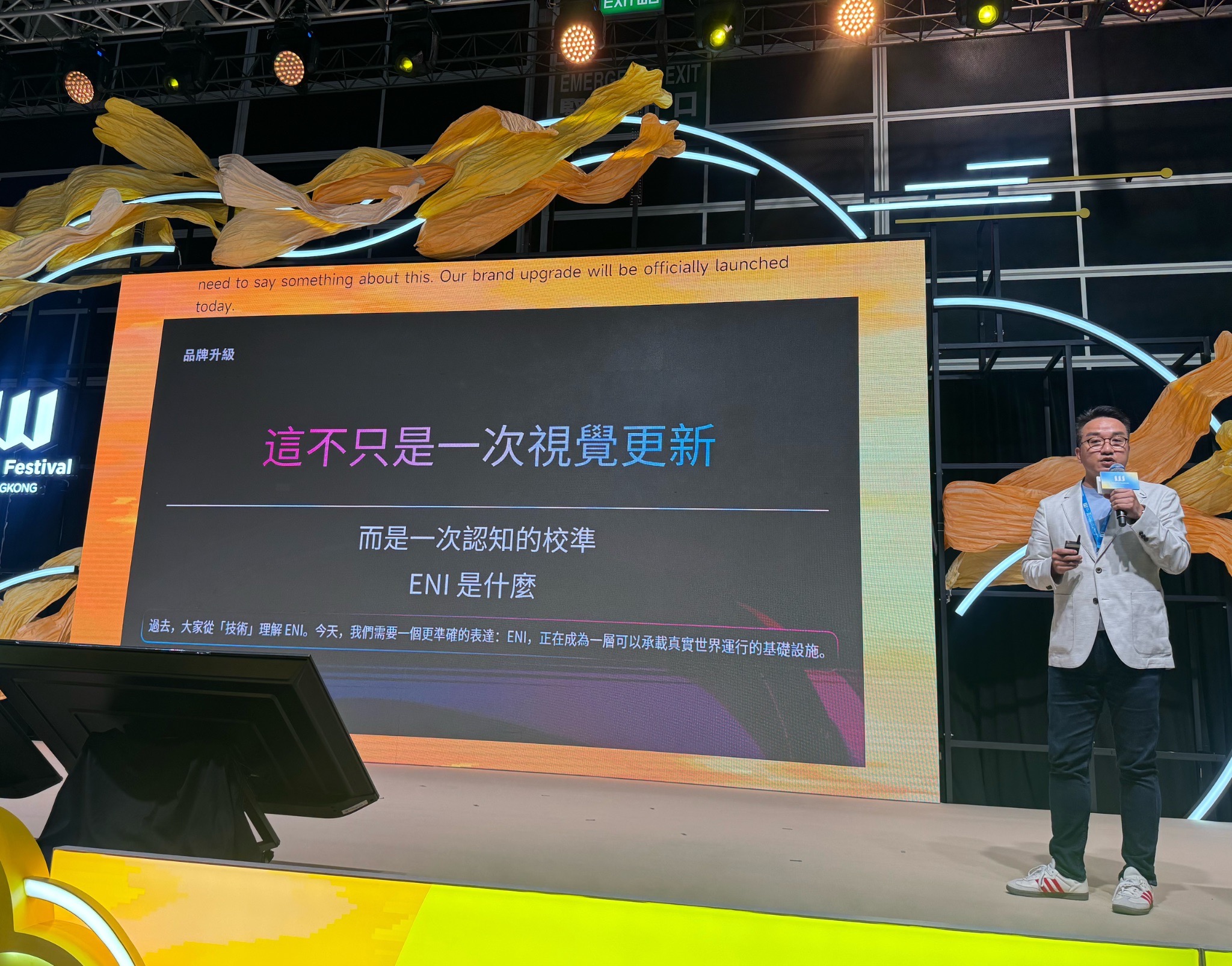
On April 20, 2026, at the Hong Kong Web3 Festival, ENI Founder and CEO Arion Ho delivered a pivotal keynote titled "Bridging TradFi and Web3: Building Infrastructure for Real-World Finance." During the address, Ho formally announced the synchronized launch of ENI’s new brand, official website, and visual identity system. This evolution represents more than an aesthetic leap. It is a milestone signal for ENI’s transition from an underlying technical L1 protocol to an enterprise on-chain BaaS (Blockchain-as-a-Service) platform. This shift marks ENI’s emergence as a more mature, globalized entity, redefining its position in the next phase of Web3 commercialization.

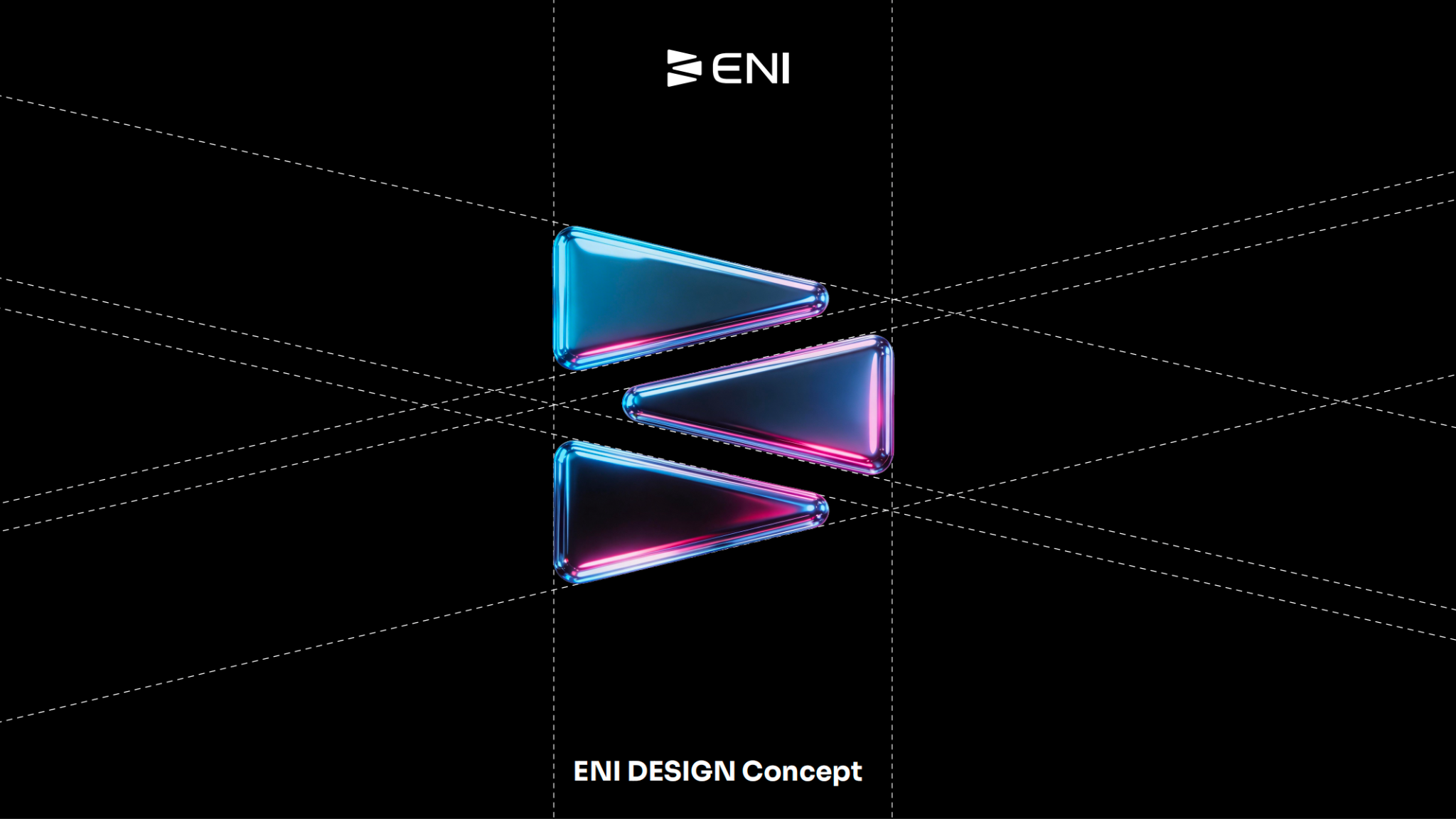
Mathematical Beauty: Defining "Precision in Micro-Adjustments" through 25-Degree Rigor

Throughout the brand upgrade, ENI interpreted the concept of precision in micro-adjustments. For an infrastructure project pursuing institutional-grade trust, such precision is not merely a visual requirement but the very foundation of its professional identity.

While preserving the triangular base module, the design team introduced a 25-degree tilt to the primary lines to create a symmetrical form with optimized visual proportions. The spacing between elements is strictly fixed at a 1:4 ratio relative to the height of the primary modules. This resonance between the 25% gap and the 25-degree angle establishes a modular order under a sophisticated aesthetic. This level of control over geometric logic was executed by an international design collective with pedigrees from Harvard, UPenn, UAL, and Parsons. Having previously serviced elite brands like Hermès and ByteDance, these designers fused the refined aesthetics of a global elite vision with the structural logic of financial engineering to grant ENI an international and credible visual texture.
From Protocol to System: Building a Bridge Between Technical Concepts and Commercial Reality

The core of this shift lies in ENI evolving beyond a mere underlying protocol toward becoming a comprehensive systemic standard. Ho emphasized that ENI is acting as a definitive bridge. This is the bridge between technical concepts and commercial reality, and the bridge between TradFi and Web3.

Operationally, ENI bridges the adoption gap through a dual-track strategy. For large institutions, ENI provides deeply customized architectural solutions to ensure Web3 capabilities are precisely embedded into complex business logic and organizational workflows, enabling a transition from isolated tools to system-level operational frameworks. For SMEs, ENI offers a standardized BaaS matrix and low-friction integration technologies for one-click on-chain deployment and efficient collaboration. This precision-engineered approach for diverse business scales effectively reduces the friction for global commerce to migrate seamlessly onto high-efficiency on-chain systems.
A Globalization Signal: Leading Web3 Commercialization with Maturity

Announcing this upgrade in Hong Kong, a global financial hub connecting East and West, sends a clear signal of ENI’s entry into its globalization and institutionalization phase. As the Web3 industry shifts from technical hype to commercial utility, institutional users are demanding infrastructure that has evolved from being functional to being stable and standardized.

The synchronized evolution of ENI’s brand and visual system is designed to meet these institutional standards. With a more logical design language and a refined BaaS matrix, ENI is positioning itself as a Chief Architect to provide reliable on-chain support for global enterprises. As articulated in Ho’s vision, ENI will serve as the bridge of on-chain standards to safeguard the robust migration of real-world assets and operations into the next-generation digital economy.


Comments

All Comments

Recommended for you

  • SpaceX drops over 4% in early US trading, hits record low

    On July 28, SpaceX dropped over 4% in early US trading, hitting a record low, with a decline of over 50% from its peak. SpaceX's stock price fell 20% from its IPO issuance price, and its market value evaporated $1.2 trillion from its peak market cap.

  • BTC Drops Below $63,000

    Market数据显示,BTC跌破63,000美元,现报62,901.05美元,24小时跌幅达3.76%,行情波动较大,请做好风险控制。

  • Apple's Market Cap Surpasses $5 Trillion for the First Time

    On July 28, Apple's share price rose 1% in early trading, hitting a new all-time high and officially breaking the $5 trillion market capitalization mark, making it the second publicly traded company globally to reach this milestone after Nvidia. Apple's stock has performed strongly recently, climbing from around $274 since late June, with a cumulative gain of over 20% in the past month, far exceeding the S&P 500's roughly 0.8% gain over the same period. Nvidia's current total market capitalization stands at about $4.7 trillion, ranking second among global listed companies by market value.

  • Morgan Stanley Launches Ethereum and Solana Exchange-Traded Products on NYSE Arca

    Market News: Morgan Stanley has launched Ethereum and Solana exchange-traded products on the NYSE Arca platform.

  • US President Trump: Now is a Good Time for Iran to Reach a Deal

    On July 28, US President Trump said that now is a good time for Iran to reach a deal; he hopes to avoid attacking Iran's bridges and power plants. Iran needs to formally declare that it does not possess nuclear weapons.

  • Bank of America: July Fed Rate Hike Would Be Unprecedented

    On July 28, although the market expects a small possibility that the Fed will raise rates in July, Bank of America still expects the Fed to keep rates unchanged. The bank said that if the Fed raises rates in July, it would be unprecedented: since 1994, the Fed has never raised rates when the market probability of a rate hike was below 60%. Bank of America believes that higher oil prices are the main inflation risk and remains bullish on the dollar. (Jin10)

  • Nasdaq Futures Fall 0.72%

    On July 28, U.S. stock index futures showed divergent trends, with Dow futures rising 0.8%, S&P 500 futures rising 0.07%, and Nasdaq 100 futures falling 0.72%.

  • Corning pre-market drops over 15%

    On July 28, Corning's U.S. stocks fell over 15% in pre-market trading. The company's Q2 core sales were $4.74 billion, up 17% year-over-year; core earnings per share were $0.78, up 30% year-over-year.

  • ChangXin Memory Technologies to Disrupt Global Storage Monopoly, Foreign Media Say

    On July 28, the Korea Composite Stock Price Index (KOSPI) plunged 10.84% to 6,023.63 points. Samsung Electronics closed down 13.39%, its biggest single-day drop in 18 years, while SK Hynix closed down 14.65%, nearly halving from its June high. Multiple South Korean media outlets interpreted this sharp stock market decline as the impact of the listing of China's largest semiconductor company, ChangXin Memory Technologies (CXMT). Market concerns have spread that CXMT will use the funds raised from its stock market listing to catch up with semiconductor companies such as Samsung Electronics and SK Hynix, leading to a dent in investor sentiment. According to earlier reports from CNBC, Peter Alexander, an analyst at Z-Ben Advisors, believes that following the development path of the steel and new energy vehicle industries, CXMT will quickly capture market share in the low-end memory chip segment and ultimately shake the monopoly of Samsung Electronics, SK Hynix, and Micron Technology in the global storage industry.

  • US Dollar Index (DXY) Rises to One-Month High, Reports 101.640

    The US Dollar Index (DXY) once rose to a one-month high, reported at 101.640.