

Cointime

Download App
iOS & Android

Curve Has Published a White Paper for Their Stablecoin — crvUSD

Validated Individual Expert

The community has been talking about launching its own Curve stablecoin for several months, but developers have been in no hurry to share any information with users for a long time. But a white paper has recently been released, which has become the official source of data on the work of the new stablecoin.

The Curve team highlights automatic self-liquidation as one of the most important features of its stable coin, namely the “Lending-Liquidating AMM Algorithm.” The algorithm helps to reduce risks and allows users to avoid instant liquidation.

“Within the $crvUSD universe, once you initially lend your collateral, your portfolio has a balance consisting 100% of this collateral. If the LLAMMA observes the price of this collateral is dropping, it automatically liquidates your portfolio into $crvUSD. If the price goes back up your collateral gets repurchased. Therefore, instead of an instantaneous liquidation, the process occurs smoothly over a continuous range.” — it is written in the document.

  The principle of operation “Lending-Liquidating AMM Algorithm”. Source: White paper by Curve


Another feature that Curve is calling a key is that the stablecoin will work in the LLAMMA ecosystem, in which each of the types of collateral is a publicly traded AMM.

“For example, the documentation references using ETH as collateral for $crvUSD. This will automatically create an $ETH / $crvUSD liquidity pool that traders can arbitrage and trade, featuring the same 24/7 uptime and resiliency that makes Curve v2 superior to other DEX/CEX offerings.” — the Curve team reported.
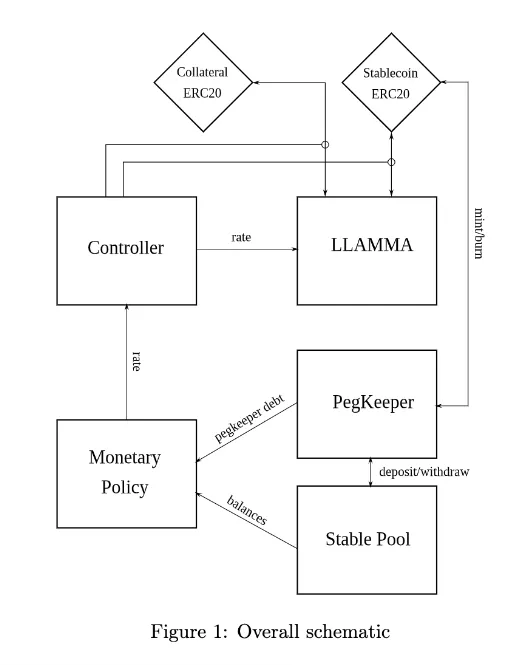
  The principle of operation LLAMMA ecosystem. Source: White paper by Curv


It seems that users also see the advantages that the special principles of crvUSD’s work give.

Users also note that providing a stable coin with other crypto assets makes the principle of operation of crvUSD similar to the stablecoin from DAI, which regulates MakerDAO.

However, Curve warned on Twitter that its white paper would probably be slightly changed and it recommends to keep an eye on updates.

Overall, the project seems to be an interesting implementation of automatic collateralized stablecoin — a concept that received much criticism after Terra/Luna collapse. We hope it will be successful and will continue to observe its developments.


Comments

All Comments

Recommended for you

  • Nvidia reportedly developing trillion-parameter open-source AI model Nemotron 4

    On August 11, Nvidia is developing a new generation of open-source artificial intelligence model, Nemotron 4, with an expected parameter scale of at least 1 trillion, aiming to compete with the world's leading open-source large models. Nvidia hopes to expand the application scope of AI through an open model ecosystem and further drive market demand for its GPU computing power. Nvidia has previously launched the Nemotron series of open-source models, including the Nemotron-4 340B series with 340 billion parameters, primarily used for large language model training data generation, model development, and enterprise AI applications.

  • Crypto-Friendly Bank Erebor Seeks $1.5B Funding with a16z Participation

    On August 11, Erebor Bank, a crypto-friendly bank co-founded by Oculus and Anduril founder Palmer Luckey and Palantir co-founder Joe Lonsdale, is seeking $1.5 billion in funding, with a pre-money valuation target of $8 billion. This valuation is nearly double the $435 million valuation the company had when it completed a $350 million funding round in December 2025. Erebor has already received support from investment institutions such as 8VC and Haun Ventures, and the new funding round is expected to attract participation from Lux Capital, Andreessen Horowitz (a16z), Human Capital, Valor Equity Partners, and SV Angel, among others. As AI infrastructure investment enters a phase of rapid expansion, Erebor is targeting the financing needs of AI companies. AI companies require substantial capital to purchase GPUs, build data centers, and secure energy supplies, while traditional financial institutions are gradually exploring financing models for AI infrastructure assets. However, whether Erebor can maintain rapid growth after the AI and crypto industry cycles cool down remains a key focus for the market. The funding round has not yet been finalized and is expected to be completed within the coming weeks.

  • Russia's Central Bank Adds Bitcoin, Ethereum, and USDT to Publicly Tradable Cryptocurrency List

    On August 11, the Central Bank of Russia included Bitcoin, Ethereum, and Tether (USDT) in the list of cryptocurrencies that can be publicly traded on domestic exchanges.

  • BTC Breaks Above $64,000

    Market data shows BTC has broken through $64,000 and is currently reported at $64,000.33, with a 24-hour decline of 1.53%. Market volatility is high, so please exercise caution and manage risks accordingly.

  • BTC Falls Below $64,000

    Market data shows BTC has fallen below $64,000, currently at $63,999.77, with a 24-hour decline of 1.89%. Market volatility is significant; please exercise risk control.

  • Vitalik Updates Ethereum Roadmap: Privacy, Post-Quantum Scaling, and Native Rollups Become New Priorities

    On August 10, Vitalik Buterin stated that he had compared the 2023 Ethereum roadmap with the current Strawmap. The overall direction still overlaps considerably, but some priorities and technical paths have been clearly adjusted, including raising the priority of quantum safety, downweighting VDF and some EVM improvements, and replacing old designs with solutions such as a unified binary tree, PBT, and new state types. He noted that the most notable change in the current Strawmap is the emergence of several new topics not included in the 2023 roadmap, reflecting a shift in Ethereum's R&D focus. These new priorities include: stronger native privacy support, aggressive scaling in a post-quantum context, specification streamlining for formal verification, Blob and Gas futures, native Rollups, and a more open design space for the future shape of the EVM. Vitalik also emphasized that Ethereum's scaling approach is shifting from 'expanding all activities comprehensively' to 'designing more scalable dedicated mechanisms for specific high-load scenarios,' and he regards STARK proofs and AI-accelerated formal verification as important foundations for the protocol's future. Overall, this update shows that the Ethereum roadmap is evolving toward quantum safety, privacy-first, censorship resistance, high performance, and simpler protocol design.

  • ETH Falls Below $1900

    Market数据显示,ETH has fallen below $1900, currently reported at $1899.19, with a 24-hour decline of 1.28%. The market is highly volatile. Please exercise risk control.

  • Microsoft Plans to Release Next-Gen MAIA 300 AI Chip in September

    On August 10, according to reports, Microsoft plans to release its next-generation MAIA 300 AI chip in September.

  • BitMine Adds 7,391 ETH and Buys Back 3 Million Shares Last Week

    As of August 9, Eastern Time, BitMine's total cryptocurrency + cash holdings + "Moonshot" initiative amounted to $11.6 billion. BitMine held 5,805,238 ETH (up 7,391 ETH from last week), representing 4.8% of the total Ethereum supply (120.7 million ETH). It also held 209 BTC, $180 million in Beast Industries shares, $69 million in Eightco Holdings (NASDAQ: ORBS) shares, and $104 million in unsecured cash. BitMine repurchased 3 million common shares last week, bringing the total common shares repurchased since early July to over 19 million. As of August 9, 2026, BitMine's total staked ETH was 5,067,309 (worth approximately $9.8 billion at $1,928 per ETH).

  • Strategy Sells 1,691 BTC in Past Week

    Regulatory filings show that Strategy sold 1,691 BTC over the past week, increasing its dollar reserves by $650 million.