

In May, the United States Congress voted in favor of two pieces of pro-crypto legislation for the first time, after years of political deadlock. Observers were struck by the support from leading Democrats — who acted in opposition to direction from the White House.
Combined with last week’s approval of Ether ETFs, and pressure from the suddenly pro-crypto Donald Trump, pundits are now wondering if crypto voters not only have enough power to affect November’s presidential election — but if they already have.
The Democrats’ sudden position shift — with the White House now saying it’s willing to negotiate on legislation — suggests they could be trying to stem any loss of votes on the issue.
The issue came to the fore in the Senate on May 16, when a bipartisan coalition of 60 senators, including Democratic Majority Leader Chuck Schumer, voted to overturn a Securities and Exchange Commission rule known as SAB-121, which made it prohibitive for banks to hold cryptocurrencies on behalf of their customers.
The move came as a big surprise for observers, who did not expect so many Democrats to defy President Joe Biden’s threat to veto the legislation.
Bipartisan shift: How crypto voters are redefining 2024 election strategies
Senator Cynthia Lummis, a Wyoming Republican and long-time champion for crypto industry, said on the Unchained podcast last week she believes the vote came as an unwelcome shock to Biden’s White House staff, and that the political seachange may provoke the White House to “reconsider” the president’s veto threat.
“I don’t think they anticipated how strong the bipartisan vote would be on this,” Lummis said, adding she believes there’s now a bipartisan majority in both houses to finally pass crypto legislation.
Lawmakers in the House seized the moment a week later, when Republicans spearheaded the passage of the Financial Innovation and Technology for the 21st Century (FIT21) Act with assistance from 71 Democrats, including former House Speaker Nancy Pelosi.
The legislation would allow cryptocurrency projects to “certify” that their tokens are commodities — moving them out of the SEC’s regulatory purview and over to the Commodity Futures Trading Commission.
The developments came as a big surprise, given that until May, all signs indicated that Democrats would not pass specific crypto legislation this year. Prominent Democrats opposed each proposal — including Massachusetts Senator Elizabeth Warren and California Representative Maxine Waters, the ranking member of the Financial Services Committee that produced FIT21. The White House said in a statement that it opposed FIT21, and Biden’s SEC chairman, Gary Gensler, voiced strident opposition to the proposal.
Gensler’s own agency produced the biggest headline of the month with its own shocking last-minute announcement that it would move forward on the approval process for eight Ether spot exchange-traded funds.
Crypto voters: the new battleground for 2024 presidential election
Some observers believe that growing political pressure forced Democrats to rethink their position on the cryptocurrency industry. Coinbase President Emilie Choi said at a May 21 JPMorgan event that “the tone from the SEC … changed literally overnight.” Choi speculated that agency officials had sensed “some panic, I guess, from parts of the administration.”
Ryan Eagan, the associate director of federal affairs for the Crypto Council for Innovation — an advocacy group in Washington, D.C. — concurred, telling Cointelegraph he believes Democrats are evolving on the issue due to public sentiment.
“It’s clear Democrats are hearing from their constituents,” Eagan said.
The crypto community’s desire for clear regulatory frameworks could influence both congressional races and the presidential race in states that have margins as small as tens of thousands of votes.”
Matt Hougan, the chief investment officer for Bitwise Asset Management, took a similar view on the Bankless podcast last week. “I think there was just a complete seachange in Washington,” noting that “Democrats crossed the aisle.”
“There’s clearly a political overlay on this,” he added.
But pro-crypto Democrats take a different view. Representative Wiley Nickel — a North Carolina Democrat who cosponsored both FIT21 and the repeal of SAB-121 — said in an interview with Cointelegraph that crypto is not a “partisan issue.”
“I think there are plenty of Democrats in the House and Senate who understand that we need to support the next generation of innovators for digital assets,” Wiley says.
He adds that the issue was “one where you’re going to see folks like myself and others — Nancy Pelosi — engaging in a bipartisan way.”
The impact of crypto voters on election outcomes
Despite suggesting the issue is a bipartisan one, Nickel acknowledges that the May votes are unprecedented, marking the “first time ever we’ve voted on regulation on crypto ever in our nation’s history.”
The SAB-121 vote marked a surprise turning point, particularly given that it came despite a veto threat from the president.
The newfound support for repeal from Democrats also came just days after a Digital Currency Group poll showed that one-quarter of swing-state voters considered crypto an important factor in their vote.
The veto threat — long-promised, according to Lummis — not only failed to convince those Democrats, but also caused the growing crypto community to harden its opposition to the party, with many publicly stating they would become single-issue voters against Biden.
Celebrity billionaire entrepreneur Mark Cuban endorsed Biden in 2020 and is supporting him again this year. But he was damning in his criticism of Gary Gensler’s approach to cryptocurrency and the threat it poses to Biden’s faltering reelection campaign. He wrote on X in early May:
Crypto is a mainstay with younger and independent voters. Gensler HAS NOT PROTECTED A SINGLE INVESTOR AGAINST FRAUD.”
The Shark Tank star wrote that it was “a warning to Congress” and advised Democrats to “solve this problem for Biden by passing legislation that defines registration that is specific to the crypto industry.”
Former Trump White House press secretary turned-Biden-supporter Anthony Scaramucci called the president’s threat to veto the repeal of SAB-121 the “latest” in a “string of unforced anti-crypto errors by the Biden-Warren administration that could cost them the election.”
In the past week he attributed the turnaround from Democrats on various crypto issues to the dawning realization there are few votes to be gained from being anti-crypto.
“I think the Biden administration is looking at polling data and recognizing that younger people, [the] Hispanic community, [the] African-American community are in crypto. You guys really want to go that hard against crypto? I don’t think it makes sense from [an] electoral perspective.”
Crypto’s influence on swing state voters
The Senate vote to repeal SAB-121 saw Majority Leader Chuck Schumer among the 11 Democrats who joined Republicans in voting for repeal — despite the president’s veto threat.
Five hailed from swing states: Pennsylvania Sen. Bob Casey; Arizona Sen. Mark Kelly; Michigan Sen. Mike Peters; Nevada Sen. Jackie Rosen; and Montana Sen. Jon Tester. Arizona Sen. Kyrsten Sinema — an independent who caucuses with Democrats — likewise voted in favor of the legislation.
Galaxy founder Mike Novogratz — who donated more than $1 million toward electing Biden in 2020, and supported Minnesota Rep. Dean Phillips’ ill-fated bid to defeat Biden in this year’s Democratic primary — said on an earnings call this month that the administration had created an “unfair” perception that most Democrats are against crypto.
“There are a ton of Democrats that are pro-crypto,” he said, but added that “power has been held by Elizabeth Warren on the Senate banking committee, Gensler and a few others.”
Former President Trump seizes crypto voters opportunity
Former President Donald Trump, who once called Bitcoin a “scam” and said crypto was a “disaster waiting to happen,” is among those who have had a change of heart in more recent days.
“The Democrats are very much against it [crypto],” Trump said at a May event in Mar-a-Lago, “but I’m good with it. If you like crypto in any form — and it comes in a lot of different forms — you better vote for Trump.”
He’s since doubled down, vowing to build a “pro crypto army” (a reference to Warren’s self-proclaimed “anti–crypto army”), attacked the Biden administration for wanting the industry “to die a slow and painful death,” and declaring his support for “the right to self-custody” for the United States’ 50 million crypto holders.
For good measure, he also promised to commute the sentence of Silk Road founder Ross Ulbricht, who was sentenced to life in prison in 2015 on charges related to drug trafficking on his former website. Releasing Ulbricht from prison has become a cause célebre among some crypto supporters.
Will crypto voters affect November’s election?
Recent surveys lend credence to the idea that crypto-friendly voters do actually have a chance to swing the presidential election. A Harris Poll conducted this month found that one in three voters considered a candidate’s stance on crypto and 77% believed presidential candidates should hold an “informed perspective” on cryptocurrency.
It backs up the findings of a nationwide survey of registered voters conducted in March by crypto firm Paradigm found that 24% of self-identified independents had bought crypto at some point in time — including 31% of minority voters and 29% of those aged 18-34, constituencies that traditionally skew left.
Separately, research released in May by The Harris Poll and the Digital Currency Group — a prominent venture-capital firm in the crypto industry — found that 26% of voters called crypto a “major issue I’m considering” in the 2024 elections. That survey included 1,201 registered voters in six swing states: Arizona, Michigan, Nevada, Ohio, Montana and Pennsylvania.
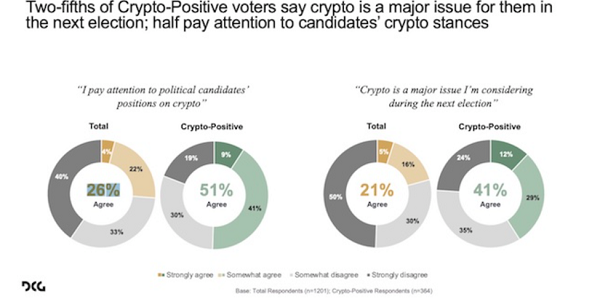
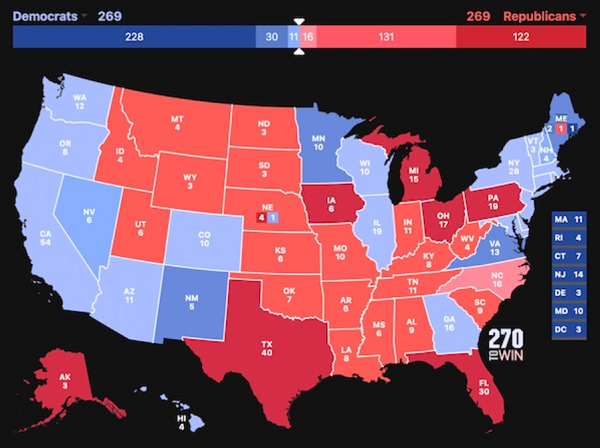
The numbers reveal the conundrum for Democrats: While Biden prevailed in four of those states in 2020, survey averages compiled by RealClearPolitics show former Trump leading in all six ahead of the 2024 election.
And he doesn’t even need them all in order to win: Merely flipping two — Pennsylvania and Michigan — and winning every state that he won in 2020 would result in a 269-269 tie of the Electoral College. That unprecedented scenario would result in House members elected in November selecting the next president in a process heavily favorable to Trump.
Will Trump keep his promises to crypto voters?
Would the regulatory environment for crypto be significantly different under another four years of Trump rather than Biden? Observers are divided on the answer to that question. Cuban’s fellow Shark Tank star, Kevin O’Leary, tells Cointelegraph that he’d want to know more about the finer details of Trump’s next administration.
“Show me who the secretary of commerce [would be] under Trump,” O’Leary says. “I think you have to get granular and start looking at the Cabinet positions in terms of how you’re going to integrate crypto into digital payment systems and the banking system.”
O’Leary declined to give his opinion on whether Cuban’s comments had played a role in prompting action from Cuban’s Democratic allies, saying with a chuckle, “We don’t agree on anything. That’s why Shark Tank works.”
Electoral ramifications notwithstanding, the Crypto Council’s Ryan Eagan indicated that crypto advocacy groups would like to see the issue become less politically divisive. “Overall, it is crucial to keep tech a nonpartisan issue,” he said.
Nickel echoed the sentiment and urged his colleagues to get on board with his message. “Democrats own crypto and want to see clear regulations,” Nickel said. “This is not a Republican issue.”


All Comments