

Cointime

Download App
iOS & Android

Crypto Market Makers Seek Transformation: Why Can DMDAO, as a Distributed Market-Making Protocol, Break Through Against the Trend?

Recently, in-depth industry analysis has pointed out that global crypto market makers are entering a collective wave of “transformation and adaptation.” As market competition intensifies, high-quality assets become increasingly scarce, and global regulations continue to tighten, the profit margins of traditional centralized market makers that rely on information asymmetry and liquidity premiums have been severely compressed. Many established market-making institutions are adjusting their strategies, gradually shifting toward full lifecycle consulting, asset management, and compliant investment banking services.

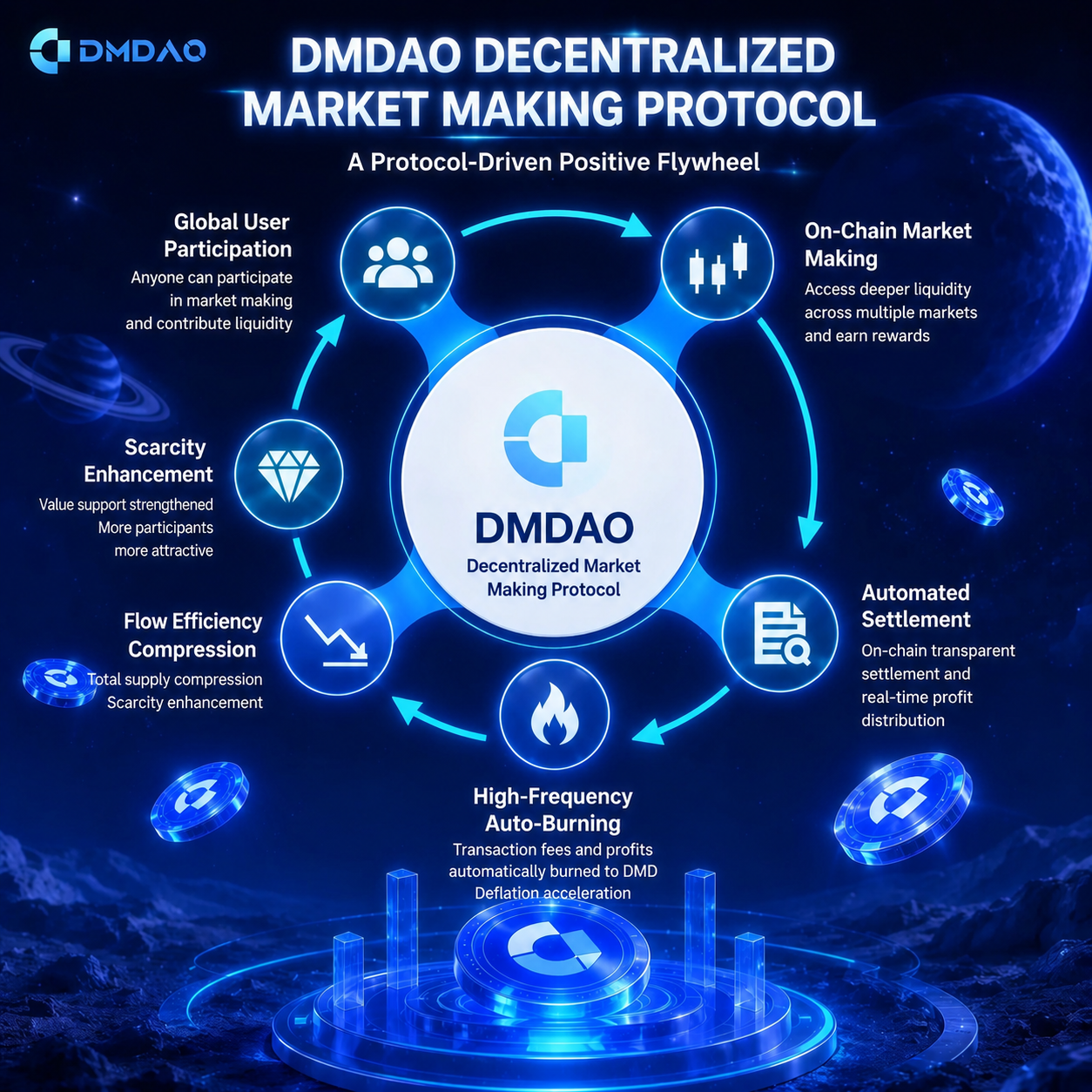
The industry’s profit margins are narrowing, and the reality that “market making is becoming increasingly difficult to profit from” has become undeniable. However, while traditional market-making institutions are undergoing a painful transformation phase through frequent mergers, acquisitions, and business expansion in search of breakthroughs, the decentralized distributed market-making protocol — DMDAO — is carving out a completely different high-growth trajectory through its unique on-chain medium- and long-term liquidity accumulation mechanism and extreme deflationary algorithmic logic.
The Industry Faces a “Liquidity Dilemma”: Traditional Market Makers Rely on Centralized M&A, While DMDAO Relies on Protocol Mechanisms

The core challenge currently facing the market-making industry lies in the imbalance between supply and demand: project teams’ market-making budgets have significantly declined, valuable high-quality projects have become increasingly scarce, and many assets are neither profitable nor capable of generating sustainable long-term growth.
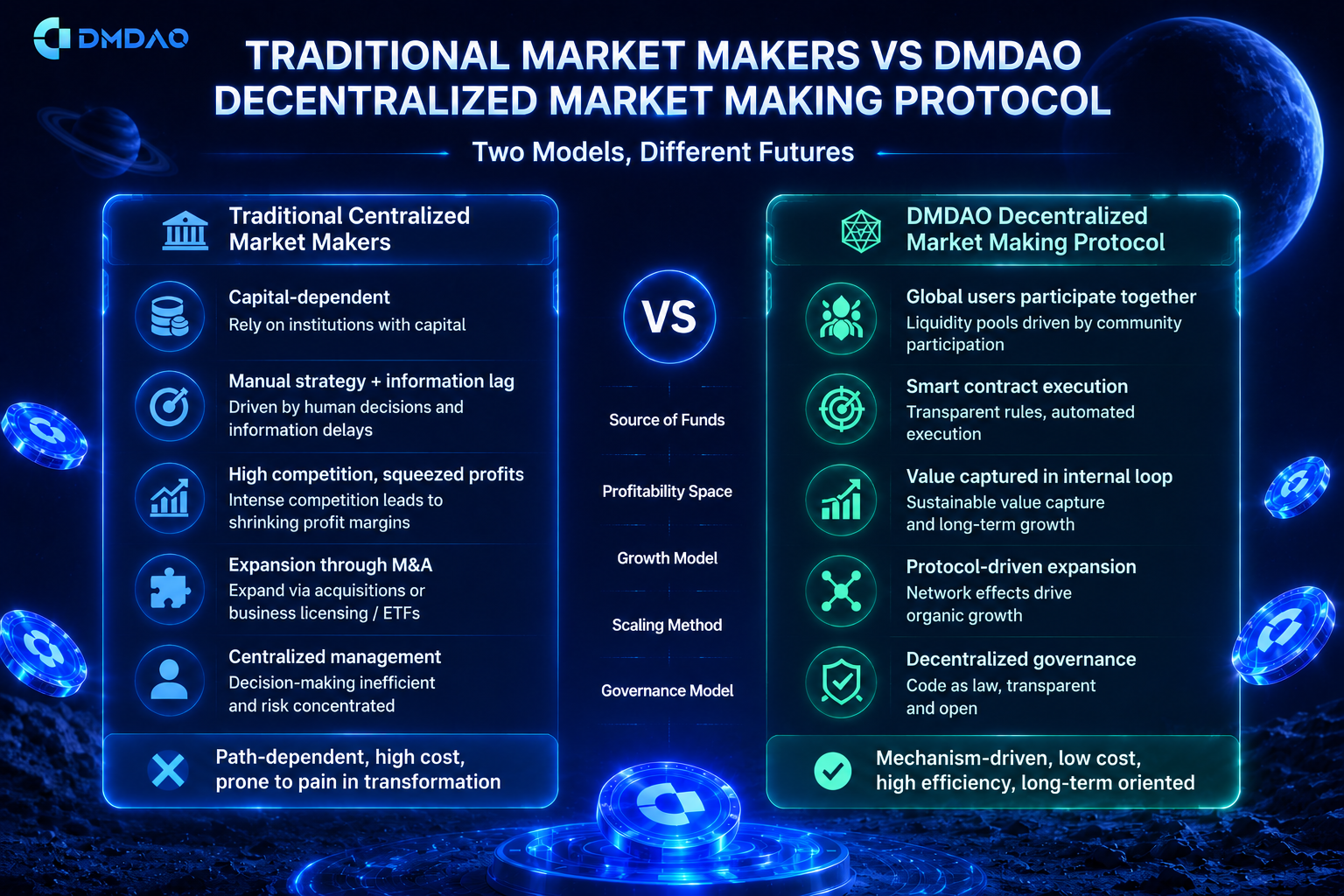
Many traditional centralized market makers have adopted a strategy of “moving services forward and extending services backward,” expanding their service chains by using substantial capital to acquire consulting firms, develop long-term asset management services, and enter ETF-related businesses.

Compared with centralized market makers that rely on large-scale capital acquisitions and institutional networks to piece together ecosystems, DMDAO, as a distributed market-making protocol, starts directly from underlying algorithms and organizational mechanisms. It returns market-making power and liquidity development to global users, using decentralized smart contracts to address the industry’s long-standing challenges of “insufficient long-term liquidity” and “unstable token structures.”

Previously, DMDAO officially launched the “D1 Pioneer Challenge.” Once introduced, the campaign attracted widespread attention across the industry. Unlike centralized market makers that rely on their own liquidity pools and matching networks, DMDAO, as a distributed market-making protocol, directly connects global ecosystem participants’ market-making activities with medium- and long-term cycles of 180 days or 360 days through clearly defined dual on-chain assessment indicators: “individual market making” and “associated market performance.”

Through this “exchanging time for space” locking mechanism, DMDAO has successfully transformed short-term speculative capital into long-term deep liquidity supporting ecosystem growth, proactively establishing a highly resilient distributed capital foundation on-chain.

Ecosystem Resilience Through Data: Over 36,000 DMD Burned in the Past 7 Days, Scarcity Builds a Distributed Value Moat

When competition intensifies, centralized market makers are often constrained by severe volatility in secondary markets. Extreme market conditions and the recent overall decline of certain token markets have eliminated many teams lacking systematic risk management capabilities.

The reason DMDAO’s distributed market-making protocol can maintain stable performance amid market fluctuations is not only the stable token structure created by medium- and long-term locking mechanisms, but also its powerful high-frequency on-chain automated burn mechanism.

According to the latest on-chain data monitoring report released by DMDAO, from July 17, 2026 to July 23, 2026, DMD’s on-chain burn mechanism maintained strong operational momentum, with a cumulative burn of 36,313.28 DMD over the past seven days.

This burn rate is driven by the efficient operation of its underlying Matrix Prime intelligent computing market-making protocol. While many projects are gradually becoming marginalized due to insufficient liquidity, DMD’s total circulating supply is steadily converging toward the ultimate target supply of 1,000,000 tokens.

As a distributed protocol, every market-making interaction drives automatic token burns, continuously strengthening the value structure of the remaining token supply. This technology-driven extreme deflation mechanism has become DMDAO’s strongest protective barrier in a volatile market.

Transparent Rules and Decentralized Auditing: Responding to the Demand for “Fairness and Trust”

As global crypto regulatory frameworks continue to take shape, compliance and risk management have become essential survival requirements. The market-making industry is being reshaped by both “client structures and asset models.”

In other words, market expectations for “trading fairness” and “data authenticity” have reached unprecedented levels, while the room for opaque operations among centralized market makers is being significantly reduced.

In this regard, DMDAO fully leverages the inherent advantage of distributed protocols: “code is law.”

During the “D1 Pioneer Challenge,” the protocol allocated a dedicated MMT reward pool to provide qualified market-making partners with 500 USDT-equivalent MMT token rewards per participant.
To prevent common issues in traditional market making, such as “wash trading” and malicious arbitrage, DMDAO’s technical team has clearly stated that all associated on-chain addresses will undergo comprehensive audit verification. Any violations, including splitting existing assets for self-trading or artificial volume manipulation, will result in disqualification.

At the same time, reward conversion will be fully based on the actual market price provided by on-chain oracles and decentralized exchanges (DEXs) at the campaign deadline. Rewards will be distributed rapidly through on-chain airdrops within 2 business days after the campaign concludes.

This operational model, where rules are written directly into code and decisions are determined by on-chain data, eliminates human intervention and earns the trust of global distributed market-making partners through genuine transparency.

Conclusion: A Pioneer Reshaping the Landscape

The rules of crypto market making have indeed changed. Traditional centralized approaches are becoming increasingly ineffective.

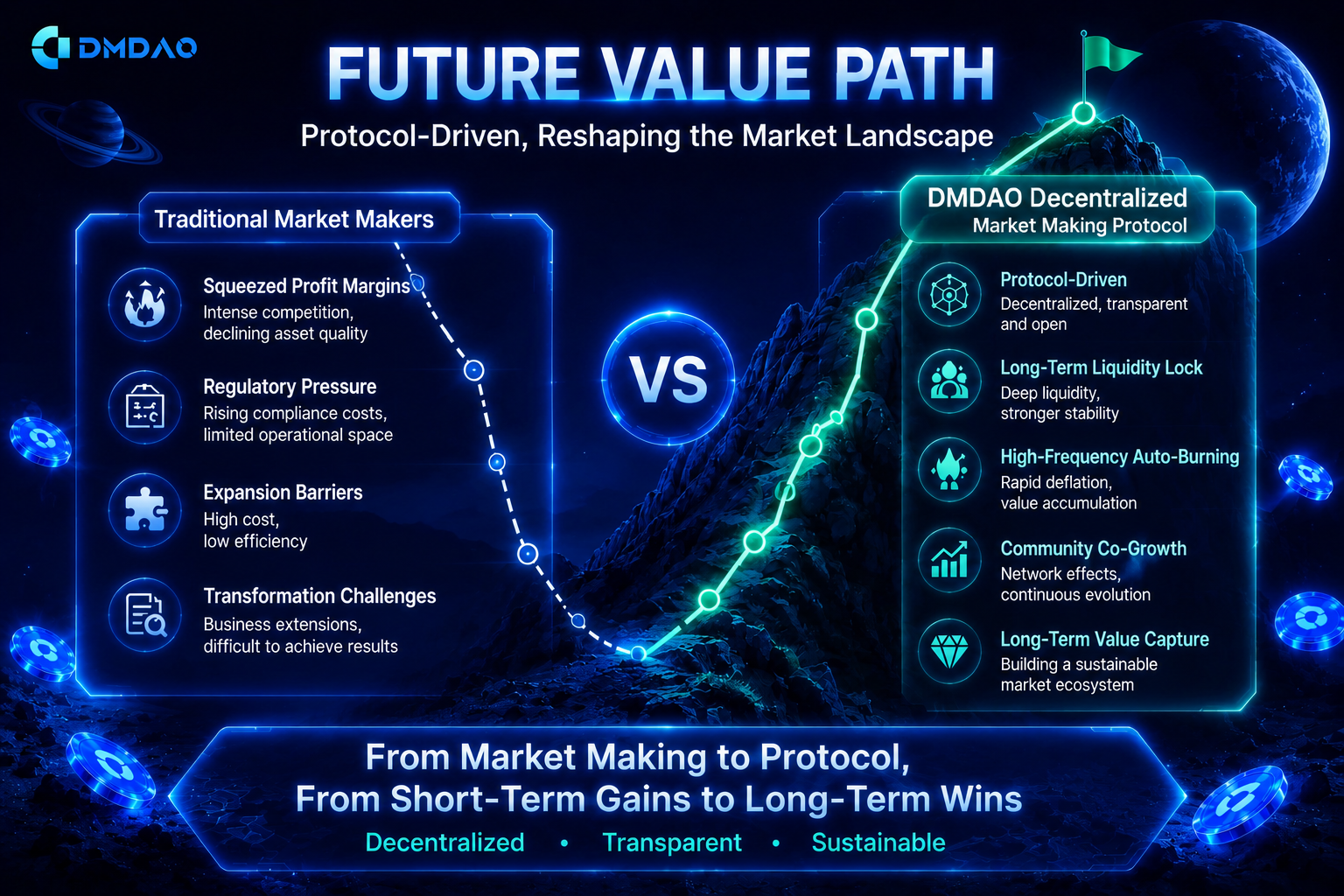
While industry participants are still struggling with shrinking profit margins and attempting to transition through traditional finance-style “investment banking models,” DMDAO has already delivered a compelling answer through the self-driven nature of distributed market-making protocols, powered by the dual engines of high-frequency deflation and medium- to long-term on-chain market making.

This is not merely a limited-time incentive program for outstanding market-making partners, but also a successful demonstration of how distributed market-making protocols can achieve sustainable and healthy long-term development.

As DMD’s scarcity continues to emerge and liquidity foundations continue to strengthen, DMDAO is using algorithms and code to demonstrate a more resilient and sustainable path forward for the entire decentralized finance industry.


Comments

All Comments

Recommended for you

  • Iran and Gulf States to Hold Meeting Next Week to Advance Strait of Hormuz Agreement

    On September 11, the Financial Times reported that foreign ministers from Gulf states plan to meet with the Iranian foreign minister in response to initiatives from Oman and Iran, seeking support for an agreement on the temporary management of shipping in the Strait of Hormuz. Meanwhile, countries in the region are looking for ways to ease the hostile situation surrounding this waterway. This meeting, proposed by Oman, will be the first between senior diplomats from the Gulf Cooperation Council, consisting of six member states, and Iranian officials since the outbreak of the U.S.-Iran conflict at the end of February. According to sources, the meeting is scheduled to take place next Monday in Salalah, a coastal city in Oman. Details have not been finalized, but several countries have confirmed that the meeting is expected to proceed as planned. If the meeting takes place, it will highlight the region's urgency to attempt to reopen the strait and ease U.S.-Iran tensions.

  • Iran and Gulf States to Hold Meeting Next Week to Advance Hormuz Strait Agreement

    On September 11, the Financial Times reported that foreign ministers from Gulf states plan to meet with the Iranian foreign minister in response to initiatives from Oman and Iran, seeking support for an agreement on the temporary management of shipping in the Hormuz Strait. Meanwhile, countries in the region are looking for ways to ease the hostile situation surrounding this waterway. This meeting, proposed by Oman, will be the first encounter between senior diplomats from the Gulf Cooperation Council, comprising six member states, and high-ranking Iranian officials since the outbreak of U.S.-Iran conflicts in late February. According to sources, the meeting is scheduled to take place next Monday in Salalah, a coastal city in Oman. Details have yet to be finalized, but several countries have confirmed their participation, and the meeting is expected to proceed as planned. If the meeting takes place, it will underscore the region's urgency in attempting to reopen the strait and de-escalate U.S.-Iran hostilities.

  • US Spot Bitcoin ETF Sees $282.7 Million Net Outflow

    According to monitoring data from Farside Investors, the US spot Bitcoin ETF experienced a net outflow of $282.7 million yesterday, September 11.

  • US Spot Bitcoin ETF Sees $282.7 Million Net Outflow

    According to monitoring data from Farside Investors, the US spot Bitcoin ETF experienced a net outflow of $282.7 million on September 11.

  • US Spot Ethereum ETF Sees Net Outflow of $29.9 Million Yesterday

    On September 11, according to monitoring data from Farside Investors, the US spot Ethereum ETF experienced a net outflow of $29.9 million yesterday.

  • US Spot Ethereum ETF Sees Net Outflow of $29.9 Million Yesterday

    On September 11, according to monitoring data from Farside Investors, the US spot Ethereum ETF experienced a net outflow of $29.9 million yesterday.

  • Sources: Bank of Japan Expected to Raise Rates by 25bps Next Week with No Predefined View on Terminal Rate

    On September 11, sources revealed that the Bank of Japan is expected to raise interest rates next week, most likely by 25 basis points, and may indicate a faster tightening pace if inflationary pressures increase. Raising rates to 1.25% would mark the highest policy rate for the Bank of Japan in 31 years. The move comes just three months after the last rate hike in June, signaling an acceleration in tightening measures. Many within the central bank believe that as the economy enters a moderate recovery and price pressures build, the conditions for another rate hike are becoming favorable. The central bank also anticipates that even if rates rise to 1.25%, financial conditions will remain accommodative. The market is closely watching Governor Ueda's comments after the meeting for any clues regarding the future pace of rate hikes and the potential peak rate in this tightening cycle. Sources indicated that the Bank of Japan may have no predefined view on the terminal rate, which will depend on how past rate hikes affect the economy and the extent to which businesses pass on rising costs to households. There is also no consensus within the Bank of Japan on the speed of rate hikes. Ueda is expected to avoid committing to a specific timeline for future rate increases but may reiterate the July statement that if financial conditions are deemed too loose, the Bank of Japan may accelerate rate hikes.

  • Sources: BOJ Expected to Raise Rates by 25bps Next Week Without Predefined Terminal Rate View

    On September 11, sources revealed that the Bank of Japan (BOJ) is expected to raise interest rates next week, most likely by 25 basis points, and may hint at a faster tightening pace if inflationary pressures increase. Raising the rate to 1.25% would mark a 31-year high for the BOJ's policy rate. This move comes just three months after the last hike in June, indicating a quicker tightening pace. Many within the central bank believe that conditions for another rate increase are forming as the economy enters a moderate recovery and price pressures build. The BOJ also anticipates that even with rates rising to 1.25%, financial conditions will remain accommodative. The market is closely watching Governor Kazuo Ueda for any clues regarding the future pace of rate hikes and the potential peak rate in this tightening cycle. Sources indicate that the BOJ may not have a predefined view on the terminal rate, as it depends on how past rate hikes affect the economy and the extent to which businesses pass on rising costs to households. There is also no consensus within the BOJ on the speed of rate hikes. Ueda is expected to avoid committing to a specific timeline for future rate increases but may reiterate his July statement that the BOJ could accelerate rate hikes if it believes financial conditions are too loose.

  • SEC Proposes Amendments to Transfer Agent Rules, Allowing Blockchain Ledgers as Official Records of Securities Ownership

    On September 11, the U.S. Securities and Exchange Commission (SEC) proposed a new rule that aims to comprehensively amend the transfer agent rules that have been in place for decades. For the first time, the proposal explicitly allows electronic databases, including blockchain ledgers, to serve as official records of securities ownership. If approved, blockchain could become the 'primary securities document,' replacing the off-chain parallel ownership records that tokenized securities currently rely on. Currently, many tokenized securities operate on two sets of records: an on-chain token ledger and an official shareholder register. Once the proposal is passed, issuers and transfer agents may no longer need to maintain duplicate records and reconcile them after each transfer, thereby reducing operational friction and the risk of inconsistencies between on-chain records and legally recognized records. Eli Cohen, Chief Legal Officer of the tokenized fund platform Centrifuge, stated that this proposal could transform the current 'two-step' process into a 'one-step' process, allowing the blockchain itself to act as the primary securities document. However, the proposal does not imply that tokenized securities will be completely 'permissionless.' Joris Delanoue, CEO of the SEC-registered on-chain transfer agent Fairmint, pointed out that while the blockchain can remain open, assets must still comply with ownership and transfer rules, and regulatory controls such as identity verification and transfer restrictions will still be embedded in the tokens. Transfer agents will still need to handle administrative matters such as shareholder death, inheritance, and legal notifications, with processing times potentially reduced from 3-5 days to 1 day. The 60-day public comment period for the proposal will end in early November.

  • SEC Proposes Amendments to Transfer Agent Rules, Allowing Blockchain Ledgers as Official Securities Ownership Records

    On September 11, the U.S. Securities and Exchange Commission (SEC) proposed a new rule last week aimed at comprehensively revising the transfer agent rules that have been in place for decades. For the first time, it explicitly allows electronic databases, including blockchain ledgers, to serve as official records of securities ownership. If approved, blockchain is expected to become the 'primary securities document,' replacing the off-chain parallel ownership records that tokenized securities currently rely on. Currently, many tokenized securities operate on two sets of records: an on-chain token ledger and an official shareholder register. Once the proposal is passed, issuers and transfer agents may no longer need to maintain duplicate records and reconcile them after each transfer, thereby reducing operational friction and the risk of inconsistencies between on-chain records and legally recognized records. Eli Cohen, Chief Legal Officer of the tokenized fund platform Centrifuge, stated that the proposal could transform the current 'two-step' process into a 'one-step' process, allowing the blockchain itself to serve as the primary securities document. However, the proposal does not mean that tokenized securities will be completely 'permissionless.' Joris Delanoue, CEO of Fairmint, a registered on-chain transfer agent, pointed out that while the blockchain can remain open, assets must still comply with ownership and transfer rules, and regulatory controls such as identity verification and transfer restrictions will still be embedded in the tokens. Transfer agents will still need to handle administrative matters such as shareholder death, inheritance, and legal notifications, with processing times potentially reduced from 3-5 days to 1 day. The 60-day public comment period for the proposal will end in early November.