

Cointime

Download App
iOS & Android

Crypto bills move forward after nine-hour stalemate on House floor

House Republican leaders have cut a deal to move forward with three crypto bills that were stuck in a record-long procedural vote after Republican hardliners refused to back down on central bank digital currencies.

A vote to set up floor debate on the bills was open for over nine hours — the longest in the House’s history. The measure eventually passed late on Wednesday with a vote of 217-212 in favor.

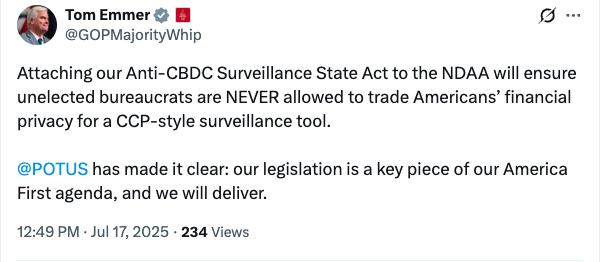
A group of Republican holdouts initially refused to support the vote unless a ban on central bank digital currencies (CBDCs) was guaranteed to pass, but House Majority Leader Steve Scalise told reporters on Wednesday that Republicans will now instead add a CBDC ban to a must-pass defense spending bill, the National Defense Authorization Act (NDAA).
  Source: Tom Emmer

House Republican leaders dubbed this week “Crypto Week” and are looking to pass a crypto market structure bill called the CLARITY Act, the CBDC-banning Anti-CBDC Surveillance Act and the stablecoin-regulating GENIUS Act — the latter of which President Donald Trump wants to sign before the weekend.

PunchBowl News reported that Scalise said the House would vote separately on the GENIUS Act and CLARITY Act as soon as Thursday, but Speaker Mike Johnson said votes on bills other than the GENIUS Act could be pushed to Friday or next week.

CBDC ban a sticking point

The anti-CBDC Republican holdouts also tripped up an earlier resolution on Tuesday for the three crypto bills. 

One of the Republican holdouts who later changed his vote, Representative Keith Self, earlier said that the GENIUS Act “will allow a back door to a CBDC.” 

Marjorie Taylor Greene was the sole Republican representative to vote with Democrats in opposing the measure.
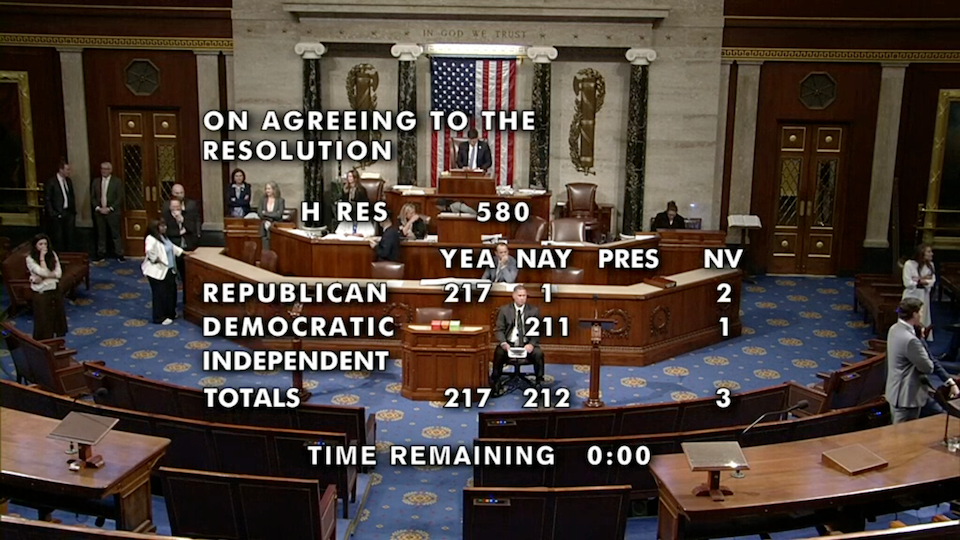
  The final vote of the resolution to hear debate on three crypto bills. Source: C-SPAN

The GENIUS Act, however, says the bill should not be interpreted as expanding the Federal Reserve’s authority to offer services directly to the public, which would include a CBDC.

CBDC ban could go in must-pass defense bill

House Republican leaders had promised the party’s hardliners to put a CBDC ban in the NDAA defense spending bill, which has always been passed.

Republican Representative Tim Burchett, who originally voted against moving the bills forward, said in a video posted to X earlier on Wednesday that the negotiations had involved moving the CBDC ban to the NDAA.

“If they adjust this [the GENIUS Act], they kill the bill if it goes back to the Senate, and so they’re thinking about trying to make some changes later,” he added.

Republican leaders, including Speaker Johnson, had suggested that the Senate wouldn’t pass the bills if they were all tied together in his push to pass them separately.

Record-long vote held open 

The vote dragged on for over nine hours and is the longest in the House’s history, beating a previous record set earlier this month during a vote for Trump’s tax and spending megabill, the One Big Beautiful Bill Act.


Comments

All Comments

Recommended for you

  • US Spot Bitcoin ETF Sees $189.3 Million Net Inflow Yesterday

    On August 19, according to monitoring data from Farside Investors, the US spot Bitcoin ETF experienced a net inflow of $189.3 million yesterday.

  • US Spot Ethereum ETF Sees $71.4 Million Net Inflow Yesterday

    On August 19, according to monitoring data from Farside Investors, the US spot Ethereum ETF experienced a net inflow of $71.4 million yesterday.

  • Binance Contracts to Launch with Yushu Technology

    On August 19, according to an official announcement, Binance contracts will be launched with Yushu Technology on August 19, 2026, at 10:45 AM.

  • Yushu Founder Wang Xingxing's Wealth Exceeds 130 Billion, Becomes New Richest Post-90s

    On August 19, Yushu Technology officially listed and began trading on the STAR Market, opening with a surge of over 500%, bringing its market value to over 350 billion yuan. According to the prospectus, Wang Xingxing, the chairman, general manager, and chief technology officer of Yushu Technology, directly holds 86.714964 million shares, accounting for 21.4395% of the company's total equity after the issuance. Before the issuance, Wang also indirectly held 9.5367% of the company's shares through the equity incentive platform Shanghai Yuyi. In total, his direct and indirect shareholding is approximately 30%, with a market value exceeding 100 billion yuan, making him the richest individual born after the 1990s. According to the 2025 list of post-90s entrepreneurs published by New Fortune magazine, Liu Jingkang, founder of Yingstone Innovation, became the new richest post-90s individual with a fortune of 20.2 billion yuan. (Source: Caixin)

  • Yushu Technology Listed on Shanghai Stock Exchange's STAR Market

    On August 19, Yushu Technology was listed on the Shanghai Stock Exchange's STAR Market. The total number of shares issued is 40.4464 million, with an IPO initial price of 150.80 yuan per share and an issuance price-to-earnings ratio of 219.23 times.

  • US Official: Trump Asks Negotiation Team to Pause Contact with Iran

    On August 19, it was reported that a U.S. official stated that Trump has requested senior government envoys to pause contact with Iran. Additionally, a source revealed that White House officials have recently communicated a shift in their strategy towards Iran to political allies—moving from a focus on 'quickly striking Iran' to a long-term strategy of 'choking Iran's throat.' U.S. officials indicated that Trump has instructed his negotiation team, which includes Vice President Pence, Special Envoy Hook, and Trump's son-in-law Kushner, to temporarily refrain from engaging with Iran. This directive came after some 'positive discussions' had previously taken place between the U.S. and Iran. There has been no response from the Iranian side regarding this matter.

  • SEC Approves Crypto Asset Regulation Proposal via Seriatim Voting

    On August 19, a Fox Business crypto reporter posted on the X platform that, according to an SEC spokesperson, the committee approved the proposal through 'seriatim' voting, meaning that commissioners voted separately outside of a public meeting. The committee had originally scheduled to review the 'Regulation Crypto Assets' in a public meeting last Friday but abruptly canceled it citing 'unforeseen scheduling issues.' According to the disclosed details, the framework will allow certain crypto asset issuances to raise funds without SEC registration, including small-scale issuances of up to $5 million over four years or an annual issuance limit of up to $75 million. The proposal will also establish a conditional safe harbor mechanism for certain crypto assets. Once the 'core management efforts' of the issuer are completed, the relevant crypto assets may no longer be subject to the same securities regulatory constraints.

  • Anthropic Expected to IPO in Weeks

    On August 19, it was reported that Anthropic expects to conduct an IPO in a few weeks. The company's revenue in the second quarter more than doubled compared to the first quarter.

  • SEC Proposes Exemption for Certain Digital Asset Offerings from Securities Registration

    On August 19, the U.S. Securities and Exchange Commission (SEC) proposed to exempt certain digital asset offerings from the requirement to submit securities registration statements, with exemption limits set at a maximum of $5 million and $75 million respectively. The proposal includes specific requirements for issuers, such as submitting financial statements and meeting ongoing disclosure obligations, while establishing safe harbor provisions to exclude the relevant assets from the definition of 'investment contracts' under securities law. This proposal comes at a time when landmark cryptocurrency legislation is stalled in Congress, with the SEC Chair emphasizing the need to develop 'forward-looking' rules that can protect the digital asset industry, while legislative action remains essential.

  • Spot Prices of Some Storage Chips Decline

    On August 18, according to 21st Century Business Herald, an unusual signal has emerged since the second quarter of this year—some spot distributors of storage chips are willing to lower prices for certain models of NAND storage chips. Third-party organizations in the flash memory market have pointed out that since July, there has been a continuous low-price sales phenomenon for multi-brand eMMC products, leading to a significant price inversion between spot and contract prices, with the spot price of 64GB eMMC already showing a downward trend. eMMC is the standard storage chip for consumer electronics such as set-top boxes, smart TVs, and entry-level smartphones. Against the backdrop of overall high prosperity in the storage industry, this price inversion in this category is particularly striking. This actually indicates that the current storage chip market is heading towards a polarized situation: some consumer markets are facing a scenario where downstream customers cannot bear the price increase of chips, especially evident in the entry-level spot market, where in recent months, distributors have been willing to exchange price for volume to obtain cash flow; meanwhile, the price increase trend in the cloud-side AI or enterprise-level storage market continues, influenced to some extent by the signing of long-term contracts.