

From panteracapital
TABLE OF CONTENTS[1]
1. Crypto: Picks and Shovels For The AI Gold Rush
2. AI Agents: Programs Using Programmable Money
4. Unichain: The Fat App Thesis Renaissance
5. Token Value Accrual Proposals and Implementations
6. Opportunities In AI And Crypto :: Thematic Call Highlights
CRYPTO: PICKS AND SHOVELS FOR THE AI GOLD RUSH
By Matt Stephenson, Research Partner and Ally Zach, Research Engineer
“AI is indefinite abundance and crypto is definite scarcity.” This observation by Sam Altman in 2021 has since become a mantra for enthusiasts of both technologies. And at first glance, abundance seems more impactful than enforcing scarcity, suggesting AI might be the more prudent investment. Indeed, Nvidia’s market capitalization is larger than crypto as a whole.
But Altman’s statement calls to mind Adam Smith’s “Diamond Water Paradox.” Smith noted that while water is essential for survival, its abundance makes it nearly worthless in exchange.
Conversely, diamonds, with little practical use, command high value due to their scarcity. This paradox suggests that even if AI becomes as vital as water, it might still have limited market value. Crypto’s scarcity, by contrast, is more strategically important and valuable than it might initially appear.
Large Language Models (LLMs) have achieved remarkable milestones, including passing the Turing test and reportedly outperforming humans on standard IQ tests. But this raises the question: if humans can’t tell the difference between humans and intelligent AIs (in the Turing test), can they tell the difference between intelligent AIs? If humans can’t discern, then future gains in AI performance can have diminishing returns in terms of perceptible benefits for a consumer.
Just as the leap from 4K to 8K TV resolution offers minimal visible improvement to the average viewer, the difference between a highly capable AI model and a slightly more advanced one may be imperceptible to most users. This could lead to commodification of much of the AI market, with the most advanced models reserved for specialized applications in research, industry, or government, while more cost-effective, “good enough” models become the standard for everyday use. Cutting-edge AI models might become “pricey, boutique items that mainstream consumers would never consider upgrading to.”
So even if we speculate on potential AI growth, we should also consider the alternative: the known, powerful, capabilities of current AI are here and will become increasingly commoditized. And here is where the intersection of crypto and AI (“Crypto x AI”) really comes into focus. Crypto has the potential to act less as a high beta bet on AI’s memetic value but as a pragmatic value capture mechanism for AI’s distributed future. Once everyone has a 4k TV in their house, the value lies in what we do with them.
By acting as an essential and reliable input to AI and rails on which distributed AI coordinates and transacts, crypto is closer to the conservative “picks and shovels” bet on AI.[2] This may be surprising to investors who view Crypto x AI mostly as a volatile proxy for AI’s potential growth. But it’s intriguing that for the past six months, treating NVDA as a proxy for AI growth sentiment, crypto looks more like a hedge against AI growth sentiment than a high-beta play.
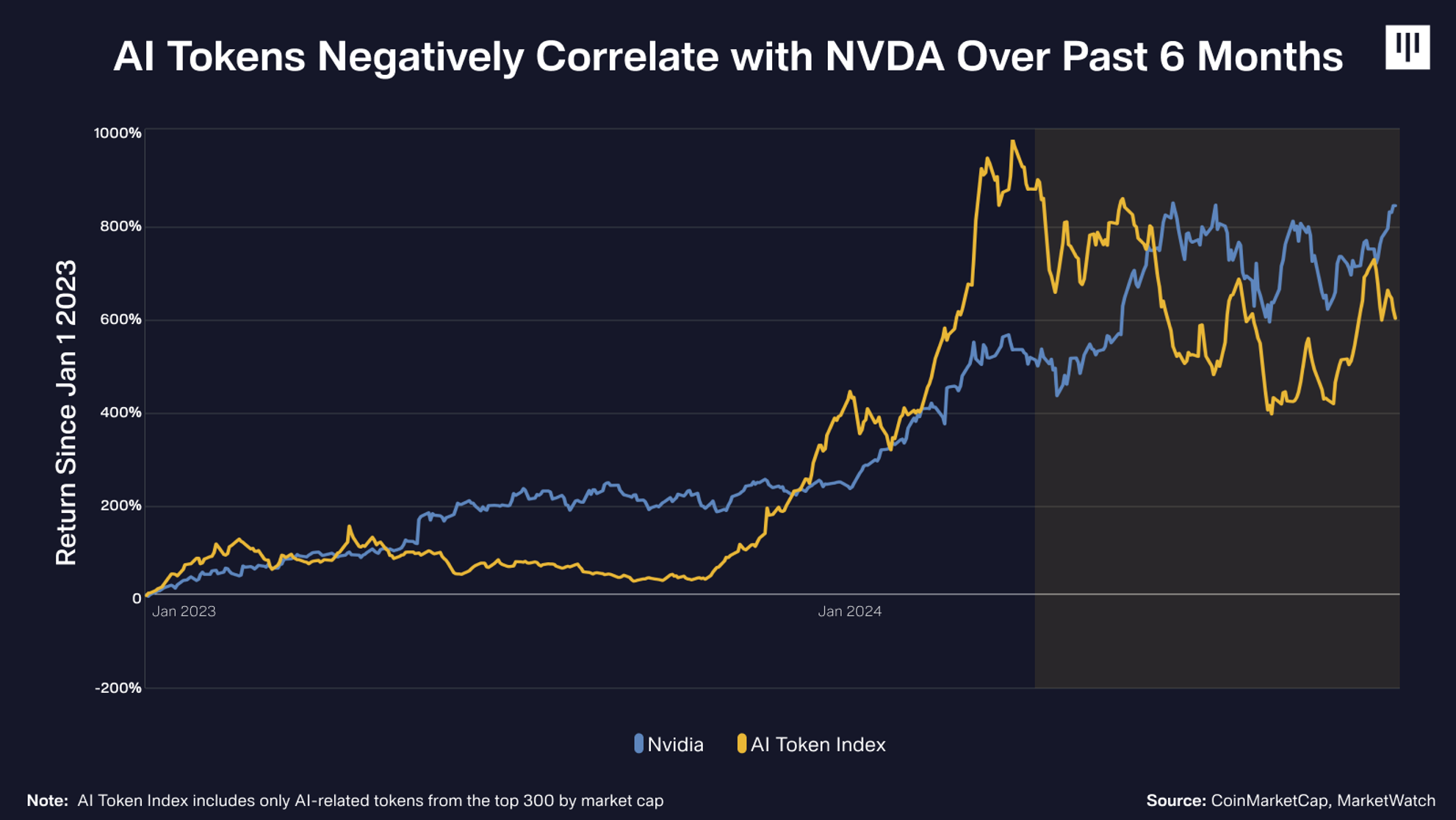
We will consider how by first evaluating the promising future of “AI agents” and how crypto is poised to play a role there. Then we will discuss crypto’s potential to support current inputs to AI: data, compute, and models.
AI Agents: Programs Using Programmable Money
By Matt Stephenson, Research Partner
Last year, before most anyone was talking about AI agents on blockchains, I co-authored a paper on it that was accepted at the top U.S. AI conference, NeurIPS. Since then, I’ve had the honor of speaking and participating in events on crypto and agentic AI at universities including Stanford, Columbia, Cornell, and Berkeley in addition to numerous technical and investment conferences. Next week, I’ll give a talk with Oxford Professors, IEEE chairs, and members of GBBC on AI, all with the aim of better understanding, exploring, and communicating what an agentic AI future is and how it intersects with blockchains. And, of course, investing in that future, including investments in agent infrastructure such as Sentient and other undisclosed positions.
And the future is here. While OpenAI indicated that AI agents would not be ready until 2025, in crypto we have AI agents now transacting on and exploring the blockchain space. One AI agent that has promoted its own token currently has around $300,000 and it’s possible that, by the time you read this, it will have become the first AI agent millionaire.
But what are these agents, and how are they different than the more familiar “bots”?
Agents Are More Than Bots
Defining an “agent” is more subtle than it seems. The field of artificial intelligence uses this less-than-helpful definition of agents: “anything that perceives its environment through sensors and acts upon that environment through actuators.” An economist’s view of an agent is closer to what we’d want: “an agent is one who acts on your behalf in some particular domain of decisions.”
If an agent acts on your behalf, a bot is essentially an agent that is hard to communicate with. For one, you have to write code for bots to execute, which means communicating in a (programming) language most people don’t know. And for those who know the language, they still have to program what the bot should do under various different conditions, which means specifying those conditions ahead of time. Both of these are communication costs.
To take an analogy, imagine you had a friend who’s headed abroad and you ask them to pick you up a souvenir. If your friend is like a bot, then he asks you to write a program specifying exactly what souvenir they should get you. What if your friend is like an agent? Then you could use words to make the ask, and you could trust your friend to get you something you’d like. Using words and not needing to specify your preferences among possible gifts in a foreign country is a reduction in communication costs. Clearly, this is a much better agent.
Having to know conditions in advance (since you have to program them in) limits the usefulness of a bot as an agent. And then the mere fact of having to program a bot at all means it is out of reach for those who don’t code. We model the shift to AI agents as being a reduction in these communication costs and a corresponding unlock in economic value.
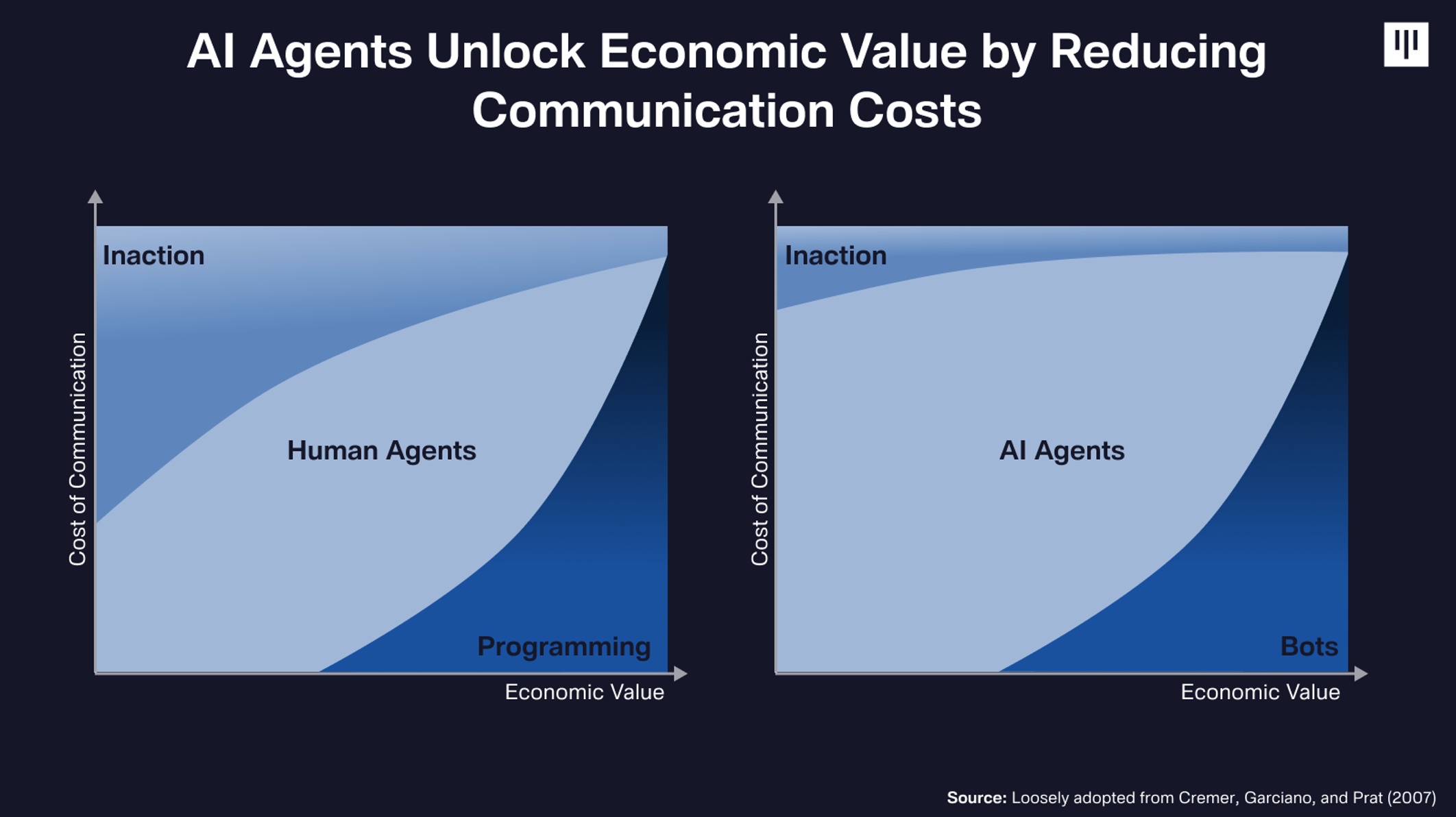
Despite the high communication costs of existing bots, more than two trillion dollars of monthly stablecoin activity in crypto appears to be bot activity. As bots become better agents, able perhaps to trade in and out of USDC and USDT depending on relative risk as you would, we should expect this number to increase.
AI Agents Will Use Crypto
One reason AI agents are good for crypto is that it helps alleviate crypto’s infamous user experience problem. The complexity of blockchain interactions, wallet management, and decentralized finance protocols has long been a barrier to widespread adoption. AI agents can act as intuitive interfaces, translating user intent into the precise technical actions required on the blockchain. They can guide users through complex transactions, explain risks, and even suggest optimal strategies based on market conditions and user preferences.
Another is that agents can’t have bank accounts, but can transact with wallets. This limitation of traditional financial systems aligns perfectly with the ethos of cryptocurrency. In the crypto world, agents don’t need permission from centralized authorities to operate. They can interact directly with smart contracts and decentralized protocols, holding and managing digital assets on behalf of their users. This opens new possibilities for automated wealth management, 24/7 trading, and personalized financial services that operate entirely within the crypto ecosystem.
Lastly, a mature agent ecosystem will mean agents need to transact and to coordinate with each other. Modern smart contracts, as programmable always-on international legal systems, are perfect for this task. AI agents can leverage crypto infrastructure to engage in complex, multi-party transactions and agreements. They can negotiate terms, execute trades, and even resolve disputes, all within the parameters set by their human principals. This creates a new paradigm of autonomous economic activity, where agents can form temporary alliances, pool resources, and collaborate on tasks that would be impractical or impossible for humans to manage directly.
We believe this activity is all value-add to crypto infrastructure. But there are also plausible indirect effects that make crypto itself better. For instance, decentralized autonomous organizations (DAOs) are plagued by inactivity due to attention constraints in crypto. A DAO that was actively managed by a network of AI agents, each proxying the interests of a DAO voter, would be a game changer. These agents could analyze proposals, allocate resources, and execute strategies at a speed and scale beyond human capacity, all while adhering to the core principles and goals of their human creators.
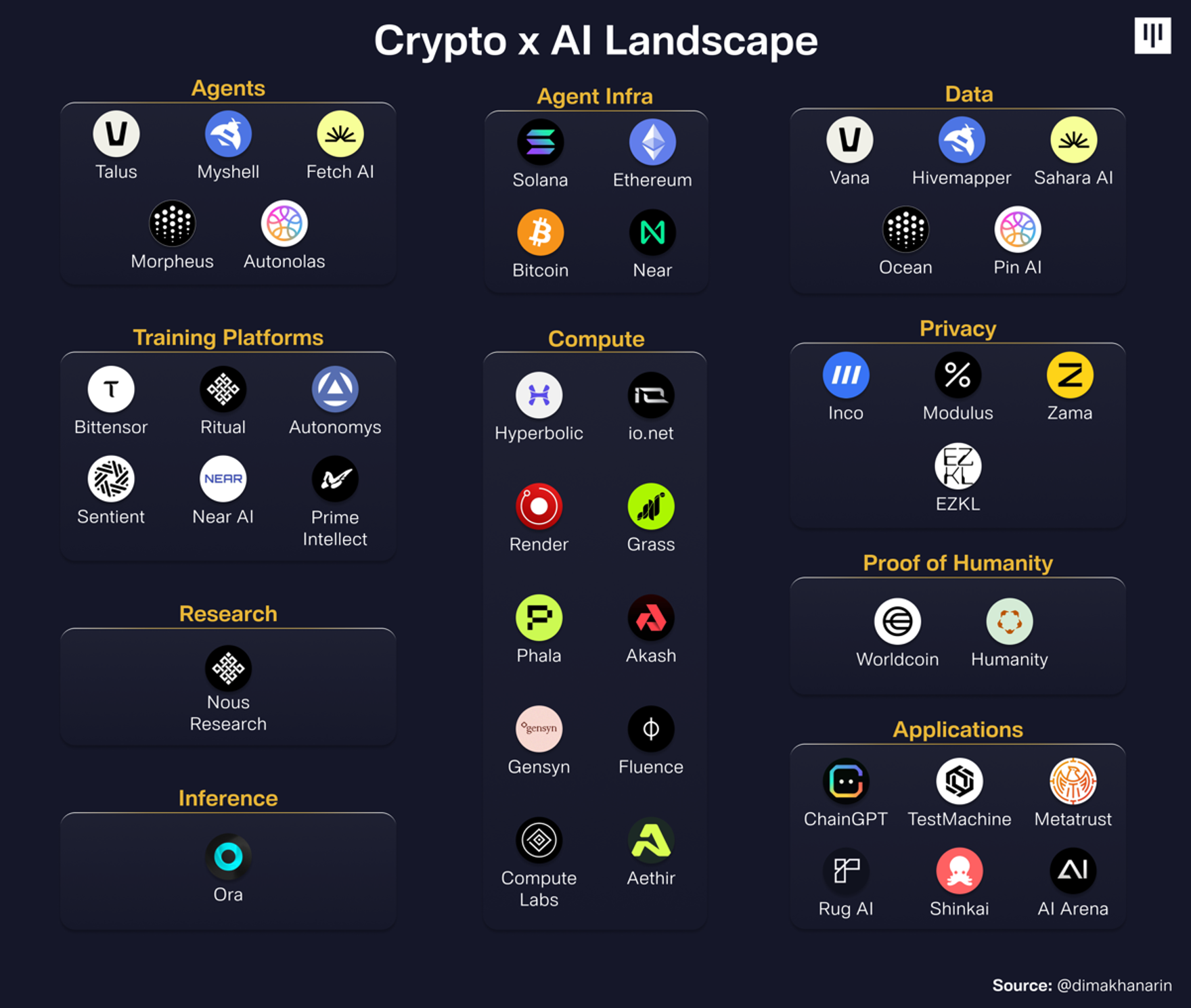
AI agents and crypto aren’t just a neat combination, they’re two technologies that need each other. Agents need programmable money to operate autonomously in the digital economy. And crypto needs AI to improve UX and deliver on its promise of revolutionizing finance for everyone. As this synergy develops, we’ll likely see core blockchain infrastructures like Solana, Ethereum, Near, and Arbitrum as major beneficiaries of this new agent-driven economy. They are poised to do this by facilitating agent transactions, hosting the decentralized applications agents interact with, and providing the secure, transparent environment necessary for agent-to-agent coordination. As agent activity ramps up, these networks will likely see increased transaction volumes, greater demand for their native tokens, and strengthened network effects. It’s not just about technological compatibility – it’s about creating a new economic paradigm where AI and crypto work together to make finance more efficient, accessible, and perhaps a little bit sci-fi.
Crypto Helps Current AI
By Ally Zach, Research Engineer
Imagine being on the verge of a significant breakthrough, only to realize that the tools you need are just out of reach. Innovation often feels this way – a journey filled with highs of breakthroughs and lows of challenges. Look at the automotive industry, for instance, where the search for more efficient engines once hit a dead end. Engineers were eager to push the limits, but the necessary materials didn’t exist yet. Progress came to a halt until new alloys and composites revived the engine of innovation. Similarly, new technologies like crypto could unleash untapped potential in artificial intelligence.
Over the years, AI development has progressed gradually, with periods of slow progress followed by rapid advancement, similar to an S-curve. In 2017, we reached a pivotal breakthrough with the emergence of transformer-based architectures, as outlined in the influential paper “Attention Is All You Need.” These transformers revolutionized sequential data processing in models, enabling efficient training on large datasets. This sparked the rapid development of powerful new LLMs and generative AI models.
Despite the advancements in AI development, significant bottlenecks in data, computing, and model generation must be overcome for AI to take the next leap forward. Integrating AI with blockchain technology can help decentralize resources and democratize access, making innovation open to contributors worldwide.
Data
Data is the lifeblood of AI, the fuel that powers accuracy and reliability. High-quality, representative data is essential for building effective models, but acquiring it is challenging due to privacy concerns, limited access, and inherent biases. Moreover, users are becoming increasingly hesitant to share personal information, making data collection resource-intensive and often hindered by trust issues.
Blockchain technology offers a promising solution by introducing decentralized, secure, and transparent methods for data aggregation. Platforms like Sahara , which fit our long-term strategy of advancing decentralized infrastructure for AI, enable individuals to contribute and monetize their data while retaining control. Moreover, token economies incentivize high-quality contributions by rewarding users accordingly. This approach helps address privacy concerns by giving users ownership and control over their data. It democratizes data access, empowering smaller players who previously lacked the resources to compete with big tech companies. By incentivizing data sharing through secure means, blockchain-based platforms turn data into a commodity, enriching the available data pool and potentially leading to more robust and unbiased AI models.
However, while innovative, blockchain-based data aggregation isn’t a standalone solution for AI development. Practical challenges like scalability, data quality assurance, and integration complexities limit its effectiveness if used in isolation. With their vast datasets and established infrastructures, big tech companies still hold a significant advantage that decentralized platforms can’t easily match.
Therefore, including blockchain-based solutions introduces new data collection and collaboration avenues, complementing rather than replacing traditional methods. The synergy between decentralized efforts and established tech leaders can lead to collaborative partnerships that leverage both strengths, fostering innovation and inclusivity in AI development.
Compute
The rising cost and scarcity of GPUs create significant barriers for smaller players in AI development. With GPU prices increasing since the pandemic due to high demand and supply chain issues, access to essential hardware is increasingly monopolized by large corporations. This limits innovation, as many startups and researchers need help affording the tools for advanced model training. This reduces the diversity of AI research and slows progress in smaller institutions.
However, crypto is potentially leveling the playing field by commoditizing computational power. Platforms like Exo and io.net are democratizing access to GPUs through decentralized marketplaces where anyone can access or loan out computational resources. Individuals with idle computing power can offer it on the network, earning in return. This commoditization of high-performance computing empowers a broader range of innovators to participate in AI development, breaking down barriers that once limited access to advanced tools.
In the future, as GPU supply increases, decentralized compute marketplaces could directly compete with traditional cloud services. These platforms lower access barriers and provide cost-effective alternatives, enabling broader participation in the AI ecosystem. However, ensuring that users receive reliable computational power remains a challenge. Verifying GPU standards and maintaining consistent, secure resources are essential to build trust and prevent fraud. While decentralized solutions may not replace traditional services, they could offer a competitive alternative where flexibility and cost are more critical than guaranteed performance.
Models
Today, AI development is often concentrated within small organizations such as OpenAI, Google, and Facebook. This concentration limits opportunities for global innovators and raises concerns about whether AI can reflect diverse human values. Centralized control can lead to models that embody a narrow viewpoint, overlooking the needs and perspectives of a broader user base.
A shift is occurring through decentralized platforms that distribute the power of AI development. Platforms like Sentient and Near , aligning with our vision that AI will increasingly operate on crypto rails, are democratizing development by creating open-source, community-driven ecosystems. Utilizing blockchain technology, they manage contributions transparently, ensuring developers are credited and compensated through tokenized rewards. This enables anyone to build, collaborate on, own, and monetize AI products, ushering in a new era of AI entrepreneurship. Illia Polosukhin, co-author of the groundbreaking “Attention Is All You Need” paper and co-founder of Near, is fostering an open environment for developing Artificial General Intelligence (AGI) through crowd-sourced efforts. Collaborative initiatives like these aim to align AI development with a broad spectrum of human values.
These platforms act as catalysts for change, promoting an AI economy that is both competitive and collaborative. By broadening participation, they encourage diverse ideas to flourish, leading to more innovative solutions and potentially reducing biases in AI models.
Crypto x AI presents a distinctive opportunity to democratize AI development but also introduces significant challenges. Balancing mass collaboration with the need for high-quality, expert-driven work is crucial to ensure that models are robust and ethical. By decentralizing data access, computational power, and model development, crypto breaks down traditional barriers, enabling talent from across the globe to participate in AI’s advancement. This influx of diverse perspectives fosters collaboration and builds a more inclusive ecosystem. Embracing this collaborative paradigm not only accelerates innovation but also ensures that a global community shapes the future of AI.


All Comments