

In the fields of internet and digital commerce, many platforms have long relied on conceptual marketing and capital subsidies, lacking genuine business-driven growth capabilities.
A global consumer market industry research report clearly indicates that many e-commerce platforms claiming to integrate new technologies generate almost no actual daily operating revenue. Platforms that rely solely on reward subsidies or rule loopholes for survival are gradually being eliminated by the market.
The research data also shows that emerging markets represented by Southeast Asia and Latin America do not lack high-frequency consumer users. Daily use of electronic payments and stable asset settlement has already become an essential demand.
The true pain point facing the industry is never user acquisition, but rather the lack of mature commercial infrastructure and the inability to transform massive user traffic into stable, long-term operating profits.
Targeting the global market, the Payda Marketplace uses Lightning Coin ($STRIKE) as its core settlement tool.
Relying on a mature technology development architecture, Payda has officially launched a new-generation global blockchain commerce service system, providing global physical retail and digital commerce with a compliant, transparent, and genuinely profitable settlement solution.
I. Maintaining Standardized Operations: Building on Compliance Frameworks and a Dual-Layer Business Architecture
Industry practice has demonstrated that platforms operating through regulatory gaps or non-standard channels will rapidly lose their ability to survive as market regulation continues to mature.
Only commercial platforms that genuinely integrate into mainstream regulatory and compliance systems can achieve long-term and stable development.
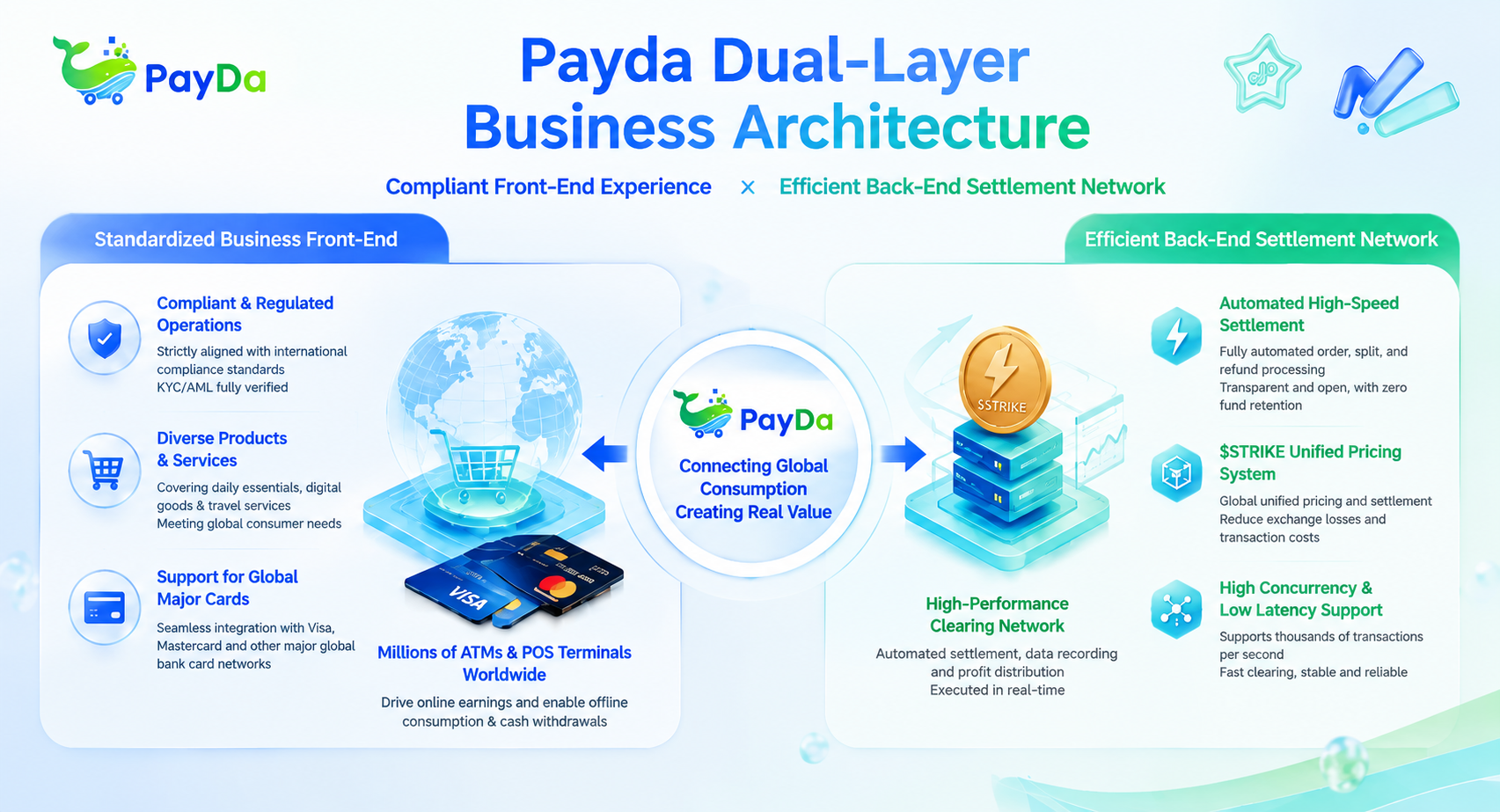
The most competitive business model is one that combines a standardized and compliant business front-end with efficient and transparent underlying settlement technology.
Payda has established its operational center in Singapore, an international financial hub, and strictly follows globally recognized compliance standards in its daily operations:
● Compliant Front-End Experience
Strictly implementing user identity verification and anti-money laundering compliance reviews.
Fully supporting fiat settlement channels, enabling physical enterprises and brand supply chains to enter and cooperate without barriers or compliance concerns.
● Global Bank Card Integration
Deeply connecting with mainstream international banking systems such as Visa and Mastercard.
Enabling marketplace earnings to be freely used for consumption and withdrawals through millions of ATMs and offline merchant POS terminals worldwide.
● Efficient Underlying Settlement
The backend adopts a high-performance settlement network capable of supporting tens of thousands of transactions per second with second-level settlement.
The entire process, including product order settlement, data recording, and profit distribution, is automatically executed by the system. This significantly reduces intermediary extraction and transaction costs in traditional cross-border settlement.
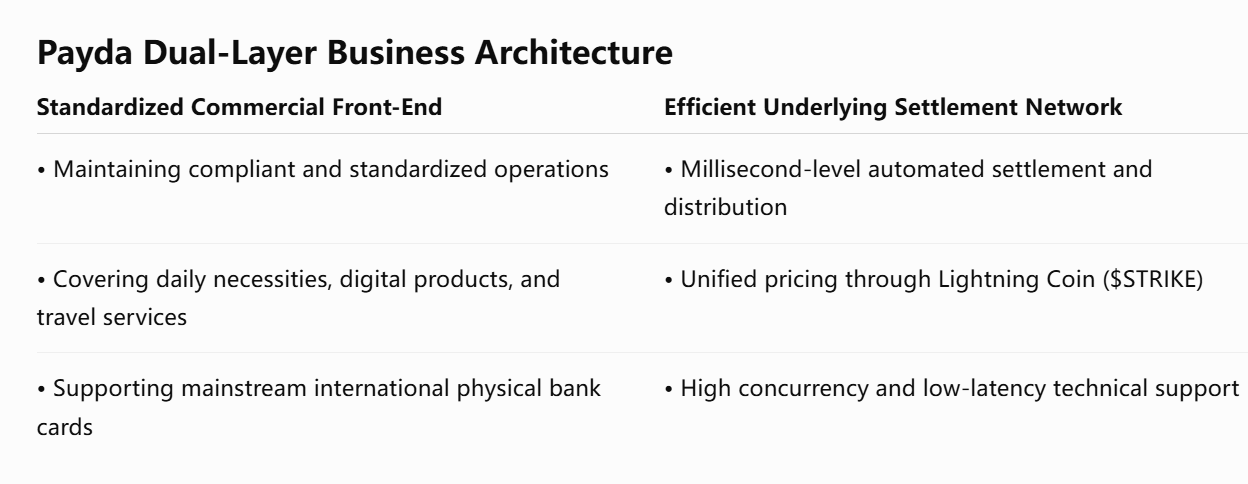
II. Dual Engines of Assets and Value: Supporting Digital Point Value Through Real Profit Generation
Traditional large-scale e-commerce platforms often charge merchants high platform commissions ranging from 15% to 25%, compressing merchant profit margins, while consumers can only receive limited promotional benefits.
At the same time, many emerging digital platforms have moved away from physical commerce transactions, falling into a state of digital circulation without real-world asset support.
Relying on mature blockchain commerce principles, Payda restructures the allocation of interests across production, circulation, and consumption through two underlying business engines:
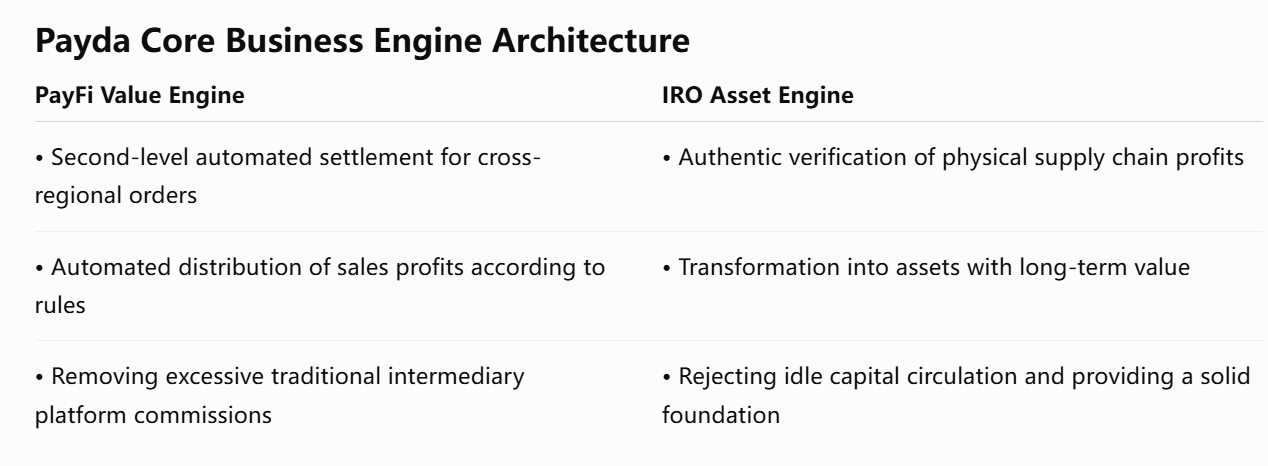
1. PayFi Value Engine — Second-Level Automated Profit Distribution
PayFi transforms every real transaction, including physical product retail, business travel, digital product purchases, and local lifestyle consumption, into a profit distribution trigger point.
Based on predefined business rules, the system completes merchant payment settlement, supply chain rebates, and ecosystem point distribution within seconds.
The entire process is transparent and publicly verifiable, with no centralized capital interception.
2. IRO Asset Engine — Digitalization of Physical Business Profits
Payda eliminates digital issuance models without actual business support. Through the system, the real net profits generated by physical merchants and supply chains are verified and digitally recorded.
Every point and benefit held by users is supported by real physical product sales and operational profits behind it. This fundamentally solves the challenge of platforms lacking actual profit support.
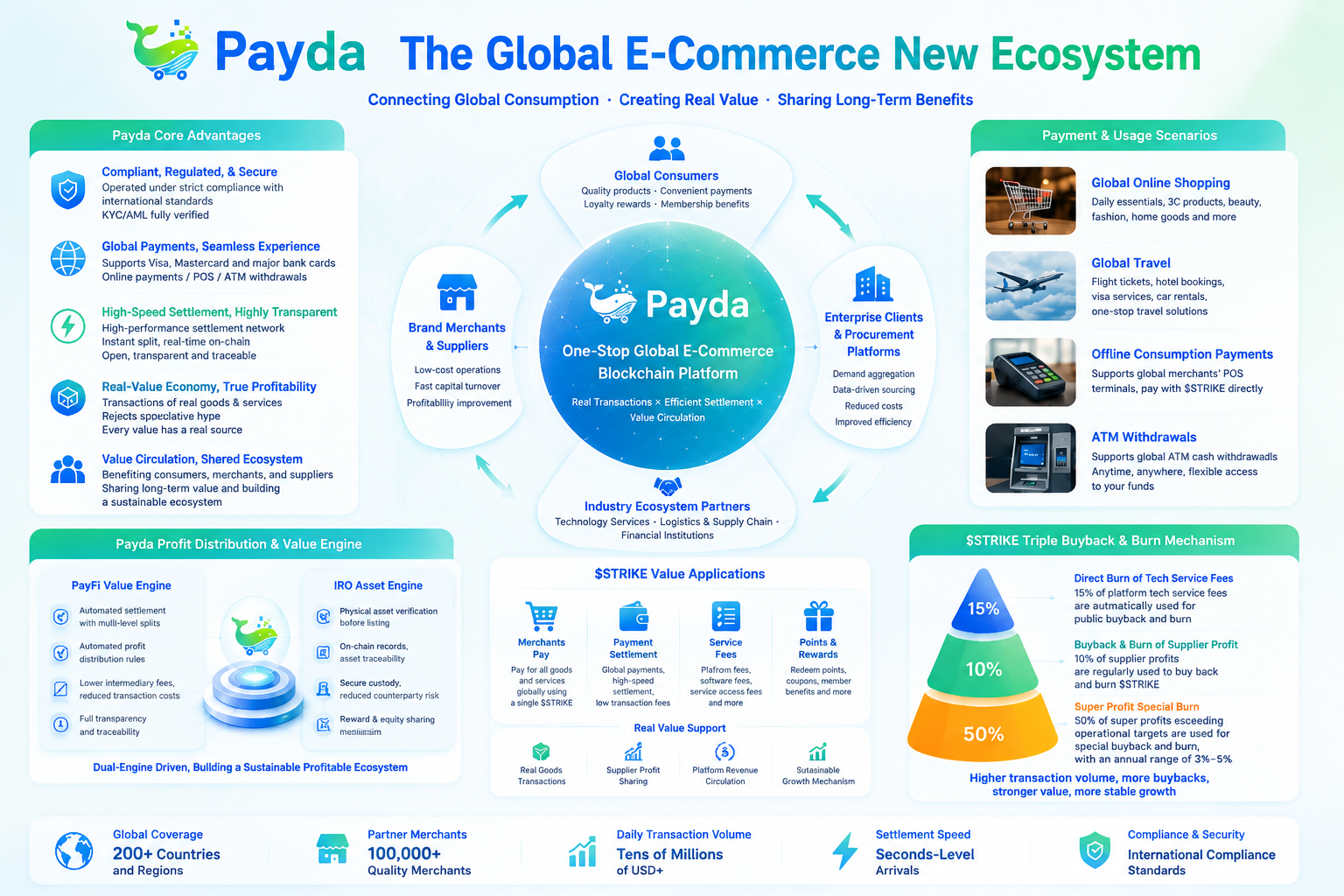
III. Comprehensive Coverage of Physical Scenarios and Global Settlement Network
To ensure that digital settlement is truly integrated into the real economy, Payda has established diversified application scenarios covering both high-frequency consumer spending and enterprise-level procurement.
● Global Brand Supply Chain Direct Procurement
Deeply integrating with source brand supply chains across categories including 3C electronics, household products, daily necessities, beauty and skincare products. Providing full-process logistics tracking and order verification.
● Global Business Travel and Mobility Procurement
Aggregating international flight bookings, premium hotel accommodations, and travel services. Providing enterprises and individuals with fast settlement without foreign exchange loss.
● Enterprise-Level Business Management Software Support
Providing merchants with free or low-cost digital tools, including inventory management, intelligent pricing adjustments, and automated financial settlement. Reducing the barriers for traditional physical merchants transitioning into digital retail.
By incorporating a large number of real and high-frequency daily consumption scenarios into the platform, Payda has successfully built a settlement service network covering more than 200 countries and regions worldwide.
This closely integrates digital settlement with the circulation of physical goods and services.
IV. Lightning Coin ($STRIKE): A Revenue-Linked Point Recovery Mechanism
Within Payda’s commercial ecosystem, Lightning Coin ($STRIKE) serves as the core circulation tool for: Product pricing. Payment settlement. Service verification. Benefit redemption.
Unlike virtual points without actual business support, the practical value of Lightning Coin is directly linked to Payda Marketplace’s real total transaction volume (GMV) and supply chain profits.
Through a three-layer recovery and permanent removal mechanism, the circulating supply continues to decrease:
● Direct Removal Through Technical Service Fees
Among the service fees collected by the platform for daily transactions and technical settlement, the system automatically allocates 15% into a publicly disclosed removal account for permanent locking.
● Periodic Repurchase and Removal Through Supply Chain Profits
The marketplace’s real operating profits generated from global product procurement and merchant services allocate a fixed 10% portion to repurchase Lightning Coin from the open market using cash and permanently remove it.
● Dedicated Removal Through Excess Operating Profits
As the platform scale expands, 50% of the net profits exceeding quarterly operating targets will be allocated into a dedicated fund for concentrated token repurchase and removal. This mechanism ensures that the total circulating supply maintains a steady annual net reduction of 3% to 5%.
The greater the actual transaction volume of the marketplace, the more frequent the business settlements become, and the greater the amount of tokens permanently removed.
This truly transforms the token into an indispensable circulation fuel within the entire commercial network.
V. Capturing the Opportunity of the Global Trillion-Dollar Payment and Consumer Market
The global payment market has exceeded $200 trillion in annual transaction volume, while daily digital settlement volume has reached trillions of dollars. More than 1.3 billion unbanked individuals worldwide are now accessing various digital commerce services through smartphones.
Facing the enormous global consumer market, conceptual speculation without physical business operations will eventually be eliminated.
Only platforms with:
● Standardized compliance qualifications
● Real product transaction volume
● Stable settlement infrastructure
can stand out in the market.
With a global vision, Payda Marketplace uses Lightning Coin ($STRIKE) as its commercial value carrier, supported by physical products and real operating profits.
It is building a healthy, transparent, and mutually beneficial new digital commerce ecosystem.
Transforming every consumer’s daily spending into long-term asset-based benefits represents the tangible value that the next generation of e-commerce systems brings to the development of the digital economy.


All Comments