

Cointime

Download App
iOS & Android

Blockchains may need 1B TPS to support AI agent future: Stripe

Financial technology firm Stripe says blockchains may need to process up to 1 billion transactions per second to support the future of artificial intelligence agents. 

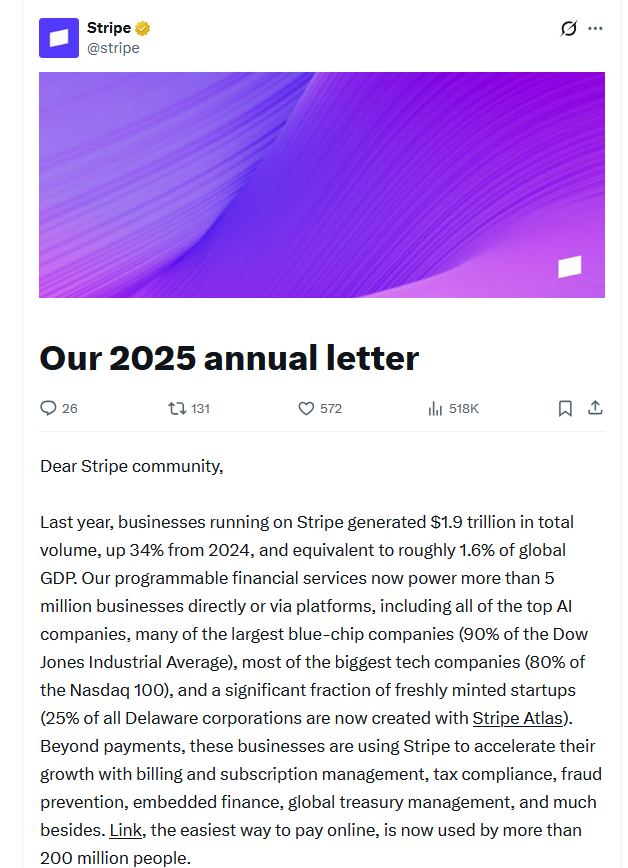
In an annual letter posted to X on Tuesday, Stripe CEO and co-founder Patrick Collison and co-founder John Collison gave a rundown of the firm’s performance over 2025, while also making some predictions for the near future. 

One of the key talking points was the adoption of AI agents and what widespread use could look like in the future. The duo argued that blockchain transaction activity could increase significantly as AI agents gradually become the primary conductors of online transactions. 

However, the Stripe co-founders said there is a significant infrastructure gap in blockchain and said significant scaling improvements would be required to meet this incoming demand. 

“Last year, a memecoin trading frenzy on one of the major blockchains delayed payouts for one Bridge user by over 12 hours and spiked per-transaction prices 35x. While such operational issues are already significant, they will only intensify, for we expect the appetite for transactions to grow a great deal,” they wrote, adding: 

“In our view, agents will most likely soon be responsible for most internet transactions, and we will likely need blockchains that support more than one million — or even one billion — transactions per second.” 
  Source: Stripe


According to data from Chainspect, Internet Computer Protocol and Solana are currently the top two blockchains by transaction speed, with roughly 1,196 and 1,140 transactions per second (TPS), respectively. 

They are the only two on the market currently processing more than 1,000 TPS, and at their peak, they have processed 25,621 TPS and 5,289 TPS, respectively.

As it stands, both networks have a theoretical maximum of only 209,708 TPS and 65,000 TPS, respectively. 

AI commerce is past the “hype phase”  

Alongside their predictions on the incoming demand, the Stripe execs also outlined what the main kinds of use cases AI agents will be serving online. Currently, they said that AI agents have moved beyond a phase of “pure hype” into a time of building and “real-world experimentation.”

They outlined five levels of AI agent capabilities. The first two levels include: completing web forms and descriptive search — being able to find results for users based on descriptions of situations rather than specific attributes.   

According to the Stripe execs, AI agents are “hovering on the edge” of levels one and two.  

The next three levels include: persistence — remembering user information, requirements, and preferences; delegation — handling tasks like grocery shopping on your behalf; and anticipation — being able to provide solutions to problems or schedules without being prompted. 

“As with the early internet, the future success of agentic commerce is contingent on universal interoperability. Our ascent through the five levels depends on our ability to work together,” they wrote, adding: 

“If all goes well, the little critters won’t be cooped up in walled gardens, but will be zooming down the wide-open protocol highways.”


Comments

All Comments

Recommended for you

  • Central Bank: Gradually Increase the Frequency of Overnight Reverse Repo Operations to Enhance Policy Rate Transmission

    On August 12, the Central Bank released the 2026 second quarter report on China's monetary policy implementation. The report stated that moving forward, the People's Bank of China will continue to steadily and orderly promote the reform and improvement of the monetary policy operation framework. It will flexibly and accurately carry out various operations, maintain the total liquidity at an appropriate level, and better guide the stable operation of short-term interest rates in the money market. In response to the needs of primary dealers, the frequency of overnight reverse repo operations will be gradually increased to further enhance the transmission of policy rates to market rates.

  • Sources: No Discussions on Extending Ceasefire

    On August 12, according to Reuters, a senior Iranian source stated: "There are currently no discussions between Iran and the United States regarding the extension of the ceasefire. From Iran's perspective, the ceasefire does not have an effective date, so there is no need for an extension. The United States violated the temporary agreement 48 hours after it was reached and withdrew from the agreement a few days later. One of the issues currently being discussed is the U.S. return to the memorandum of understanding and determining a timeline for the U.S. to fulfill its commitments, but there has been no progress on this issue so far." (Jinshi)

  • Central Bank: Current Social Financing and M2 Growth Rates Exceed Nominal GDP Growth, Monetary Environment Remains Relatively Loose

    On August 12, the People's Bank of China released the 2026 second quarter report on the implementation of China's monetary policy. The report states that social financing scale and broad money M2 are macro financial aggregate indicators with a wide coverage. These two indicators approach the financial and real economy, as well as assets and liabilities, from different perspectives, encompassing a diverse range of financing channels and providing a comprehensive view of financial aggregates. It is also necessary to objectively and scientifically assess their trends. Mathematically, as bond financing increases, the growth rates of M2 or deposits may naturally differ from those of loans, which does not indicate insufficient financial support for the real economy or idle capital. Compared to the growth rate of nominal GDP, the current growth rates of social financing and M2 still exceed that of nominal GDP, indicating a relatively loose monetary financial environment.

  • Central Bank: Timely Planning of Practical Incremental Policies to Strengthen Counter-Cyclical Regulation

    On August 12, the Central Bank released the 2026 second quarter report on the implementation of China's monetary policy. The People's Bank of China will timely plan and implement practical incremental policies, enhance counter-cyclical regulation, and strengthen the expansion of domestic demand and optimization of supply to promote sustained and improved economic development. It will steadfastly follow the path of financial development with Chinese characteristics, further deepen financial reform and high-level opening-up, accelerate the construction of a strong financial nation, improve the central banking system, and build a scientific and robust monetary policy system along with a comprehensive macro-prudential management system, ensuring smooth transmission of monetary policy mechanisms. (Jin Shi)

  • U.S. Stock Index Futures Rise Short-Term, Nasdaq 100 Futures Up 0.7%

    U.S. stock index futures have risen short-term, with Nasdaq 100 futures up 0.7%. U.S. Treasury bonds have increased, and the yield on the 10-year Treasury note has fallen by 3 basis points to 4.66%.

  • Musk: AI to Account for 99% of SpaceX Valuation, Aiming for 10 GW Computing Power by End of Next Year

    On August 12, Musk stated in his latest remarks that AI revenue will surpass all other business revenues of SpaceX by September, and he predicts that within five years, AI will account for 99% of SpaceX's valuation. Musk mentioned that SpaceX has established 'the world's most powerful AI training cluster' and plans to increase its current computing power by about tenfold by the end of next year, targeting 10 gigawatts, which corresponds to a potential annual revenue of $300 billion to $500 billion. He also anticipates that Starlink could handle over 90% of global internet traffic in the future.

  • WTI Crude Oil Declines 1.00% to $81.37 per Barrel

    WTI crude oil has decreased by 1.00% today, currently priced at $81.37 per barrel.

  • South Korea to Require New Investors in Single Leveraged ETFs to Complete Simulation Trading Exercises

    South Korea will require new investors in single leveraged exchange-traded funds (ETFs) to complete simulation trading exercises, further tightening regulatory measures on this high-risk product that exacerbates market volatility. The Financial Services Commission of South Korea announced that new investors must complete at least five days of simulation trading, totaling at least five hours, before purchasing single leveraged ETFs. The new regulation will take effect on August 19 and applies to both domestic and overseas investments.

  • Yen Fluctuations: Major Currencies Experience Sharp Decline Against Yen

    On August 12, the yen suddenly strengthened, causing major non-USD currencies to collectively drop sharply against the yen. The British pound against the yen fell nearly 80 points in a short time, the euro against the yen (EUR/JPY) dropped over 60 points, the Swiss franc against the yen fell nearly 60 points, the Canadian dollar against the yen decreased by nearly 50 points, and the Australian dollar against the yen dropped nearly 40 points.

  • Duan Yongping Increases Stake in Pop Mart from 5.55% to 7.70%

    On August 12, according to disclosures from the Hong Kong Stock Exchange, H&H International Investment, LLC, managed by Duan Yongping, increased its stake in Pop Mart (09992.HK) from 5.55% to 7.70% as of August 6. (Jin Shi)