

The idea of Bitcoin drawing ideas from another blockchain may seem absurd. Bitcoin is the one that began it all. It was copied by and served as the inspiration for Litecoin , Dogecoin , Monero , Ethereum , to name a few.
But a lot has changed over the last 15 years. While Bitcoin’s dominance has remained constant, the industry has moved past simple “buy and hold” coins whose profitability is reliant on others buying in. Today, there are numerous ways to deploy digital assets to earn yield, generate revenue and simply have fun.
While much of this innovation has emanated from Ethereum and the multi-token, multi-chain landscape it’s spawned, the pendulum is swinging back to Bitcoin. Now equipped with its own layer-2s, native tokens, nonfungible tokens (NFTs) and decentralized finance (DeFi) protocols, Bitcoin has the opportunity to experience explosive growth in active users, total value locked (TVL), and active wallets.
Can Bitcoin replicate the explosive growth trajectory that Ethereum experienced in 2017 and 2020, fueled by the frenzy of initial coin offerings and DeFi? By taking a leaf out of the Ethereum playbook, Bitcoin has the potential to witness exponential growth over the years ahead — if Bitcoin developers work to adopt certain features of Ethereum.
Ethereum’s selling points
Chief among these is interoperability. Ethereum multi-tokenism has been so successful partly thanks to universal standards. ERC-20s work everywhere by default and are easily transferred between EVM chains. Bitcoin, in comparison, is beset by competing token and inscription standards whose acceptance is at the discretion of each platform.
Some prefer the BRC-20 standard. Others prefer Runes, developed by Ordinals creator Casey Rodarmor. Cursed Inscriptions are an entirely different offshoot. Bitcoin has a host of competing and overlapping standards for token issuance, and its L2 ecosystem is equally complex.
Stacks is the largest Bitcoin L2, unless you count Lightning Network, but there are now dozens of other networks competing to become the preeminent Bitcoin scaling solution including EVM implementations. Some are sidechains, some are L2s, and some appear to have only a tangential connection to Bitcoin at best. It’s all very confusing.
If Bitcoin is to become a home for DeFi, NFTs, real-world assets (RWAs), and all the other on-chain use cases developers are trying to foist upon it, it needs to become more like Ethereum. That doesn’t mean gravitating to proof-of-stake or changing its underlying codebase every six months. Rather, it calls for sensible adoption of universal standards that will allow value to flow freely between chains.
If Bitcoin developers can work together rather than formulate ideas in isolation, its ecosystem has the potential to grow exponentially across every meaningful metric, from daily active users to TVL. Achieve that and the Bitcoin of 2025 won’t just be the world’s largest cryptocurrency — it will be the world’s largest multi-token ecosystem.
Total Value Locked (TVL) describes the value of assets that exist on a blockchain protocol for staking and DeFi and is a good place to start when comparing Ethereum and Bitcoin’s respective ecosystems. TVL is an inexact metric, since there’s scope for “double counting” assets that have been restaked in multiple protocols. Nevertheless, it provides a baseline for gauging network activity and overall liquidity.
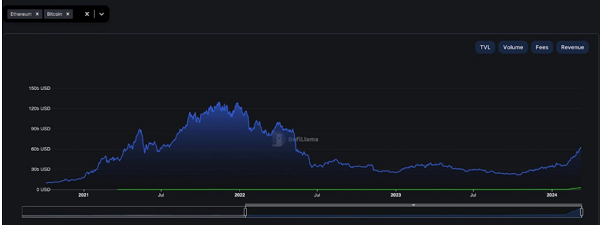
Bitcoin’s $1.15 billion TVL is dwarfed by the more than $65 billion on Ethereum — and that’s not counting the billions on other EVM chains, all tightly integrated with the mainchain. Zoom out, however, and it’s evident that Bitcoin’s TVL currently stands at the same level as Ethereum four years ago, just before "DeFi summer" unleashed a Cambrian explosion of economic activity and inspired crazes such as yield farming, algorithmic stablecoins, and novel token and liquidity models like Ampleforth and Ohm.
History doesn’t repeat, but it rhymes
Ethereum was at the height of its ICO craze in 2016 — but none of the new assets that launched that year did so on Ethereum. Twelve months later, that figure had risen to more than 50%, with more than 75% of the value of all crypto assets in existence by mid-2017 based on Ethereum. The temptation to compare the current growth of Bitcoin assets with Ethereum tokens from that period is overwhelming.
By 2020, Ethereum ICOs had largely died off as regulators began to clamp down on token sales. But Ethereum reinvented itself, conceiving decentralized finance (DeFi) and also becoming the network of choice for another emerging craze: NFTs.
In 2024, Ethereum’s NFT sector has declined significantly in value and volume, exacerbated by high network fees and growth in L2s, giving users cheaper ecosystems in which to ply their trade. But as the success of Bitcoin Ordinals has shown, NFTs aren’t dead: they’ve simply rebranded. The most popular Bitcoin Ordinals collection, NodeMonkes, now has a market cap of more than $150 million, and the Ordinals sector recorded more than $50 million in volume on March 3, a yearly high.
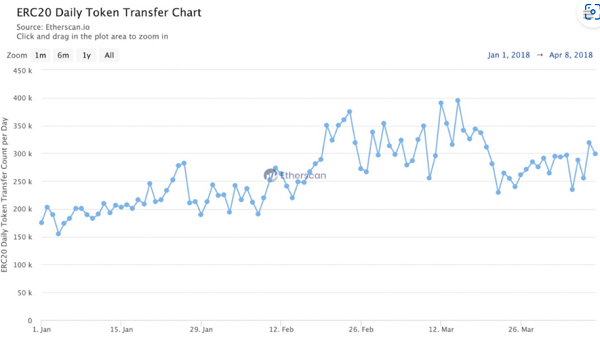
For a long time, the crypto community has perceived BRC-20 tokens as insignificant compared to Bitcoin. However, with the increasing number of these digital assets, network activity is also rising. Drawing parallels with Ethereum's history, we can anticipate a similar surge in transaction demand.
Today’s data on daily BRC-20 token transactions bears a resemblance to the statistics and trading activity patterns of ERC-20 tokens in 2018, with an average daily transaction volume standing at around 300,000. The average ETH price for that period was approximately five times lower than this year’s average.
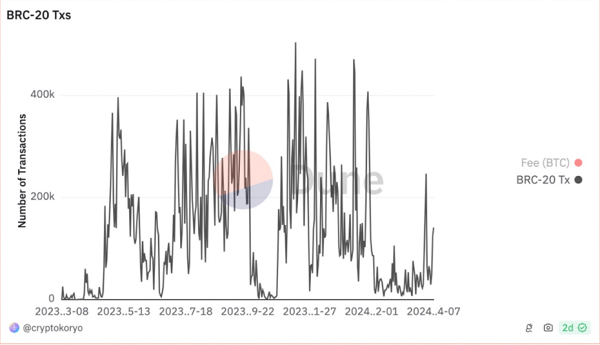
The existence of 14,000 tokens built on this technology adds value to BTC in users' eyes. This factor may outweigh the influence of the speculative component and multiply the wealth of BTC holders.
Bitcoin is on the cusp of a parabolic breakout
Could Bitcoin stand on the cusp of a similar parabolic breakout? Current on-chain metrics make a compelling case. The market cap for all BRC-20 tokens now stands at more than $2 trillion, an increase of more than 250,000% in less than a year. Meanwhile, growth in inscriptions — the process by which unique assets such as Ordinals are created on the Bitcoin blockchain — has been equally meteoric.
More than 66 million inscriptions have been recorded on the Bitcoin chain to date with more than 6,8 BTC spent in fees in the process — that’s over $466 million. The total number of inscriptions has doubled since October. It’s easy to spot analogies between Bitcoin assets and the ICO craze that saw Ethereum’s multi-token era kick off in earnest in 2017.
ETH experienced a tenfold increase in price from early 2020 (below $200) to mid-2021 ($2,000 and beyond) thanks to the burgeoning DeFi sector’s development. Subsequently, a positive feedback loop emerged: the growth of ETH made DeFi more attractive, thereby stimulating demand for this cryptocurrency. Judging by the TVL chart data, Bitcoin is now where Ethereum began its active growth in 2020. As decentralized finance increasingly adopts BRC-20 tokens, which can start to displace competitors, Bitcoin will react to these shifts positively due to increased demand.
Despite Bitcoin's higher capitalization, it may not experience growth as meteoric as ETH did in 2020, given the absence of a low base effect and stricter regulatory conditions. However, even a weak surge could still produce a big change in value.
Bitcoin developers would do well to copy Ethereum’s homework by heeding the innovations that served as catalysts for that blockchain over most of the last decade.


All Comments