

Cointime

Download App
iOS & Android

Bitcoin’s Price Dynamics: Federal Reserve Policies and Economic Shifts in Focus

From CoinShares Research Blog by James Butterfill

This year, the factors influencing Bitcoin’s price shifted away from the interest rate narrative when spot Bitcoin ETFs were approved in the US in January. Since then, Bitcoin’s prices have re-aligned with market expectations on interest rates, now that ETF flows have diminished. The Federal Reserve is confronted with a challenging dilemma: it needs to control persistent inflation while also supporting a weakening U.S. economy. Over the long term, this predicament could turn out to be advantageous for Bitcoin.

The year began euphorically for Bitcoin, marked by the approval of spot Bitcoin ETF applications that led to over US$13 billion in inflows during the first quarter. This surge decoupled Bitcoin’s prices from the recent historical relationship with interest rate expectations, pushing prices above US$75,000. However, this euphoria appears to have subsided, with current data indicating a decoupling between Bitcoin prices and US ETF fund inflows. Following recent outflows, it seems the market has now realigned with US interest rate expectations.

The chart above illustrates a close correlation with expectations for interest rate cuts until mid-January, at which point the launch of spot Bitcoin ETFs led to a marked deviation.

We believe that the majority of the price movements observed over the past week are primarily related to macroeconomic factors. A closer examination of the last 40 trading days reveals an increased alignment with the interest rate expectations for June. A similar trend was observed in 2023.

Firstly, the GDP growth figures released last week were significantly lower than anticipated. At the same time, the core PCE, a key measure of inflation, was much higher than expected, fueling fears of stagflation. This situation was further worsened by data from the Institute for Supply Management (ISM), which showed that growth in the services sector has stalled, while the prices paid component was well above expectations, indicating that significant price pressures remain.

This situation led to expectations that the Federal Reserve (Fed) would maintain a hawkish stance in its Wednesday meeting, consequently causing notable declines in Bitcoin prices. However, it appears that the Fed is in a difficult position: it cannot raise interest rates without stifling growth prospects, nor can it cut rates due to concerns over inflation. Despite these challenges, the Fed’s announcement of tapering quantitative tightening (QT) in June came as a dovish surprise, not only because of its timing but also in the magnitude of the reduction. While the market had anticipated a cut from $60 billion to $30 billion, the actual reduction was to $25 billion.

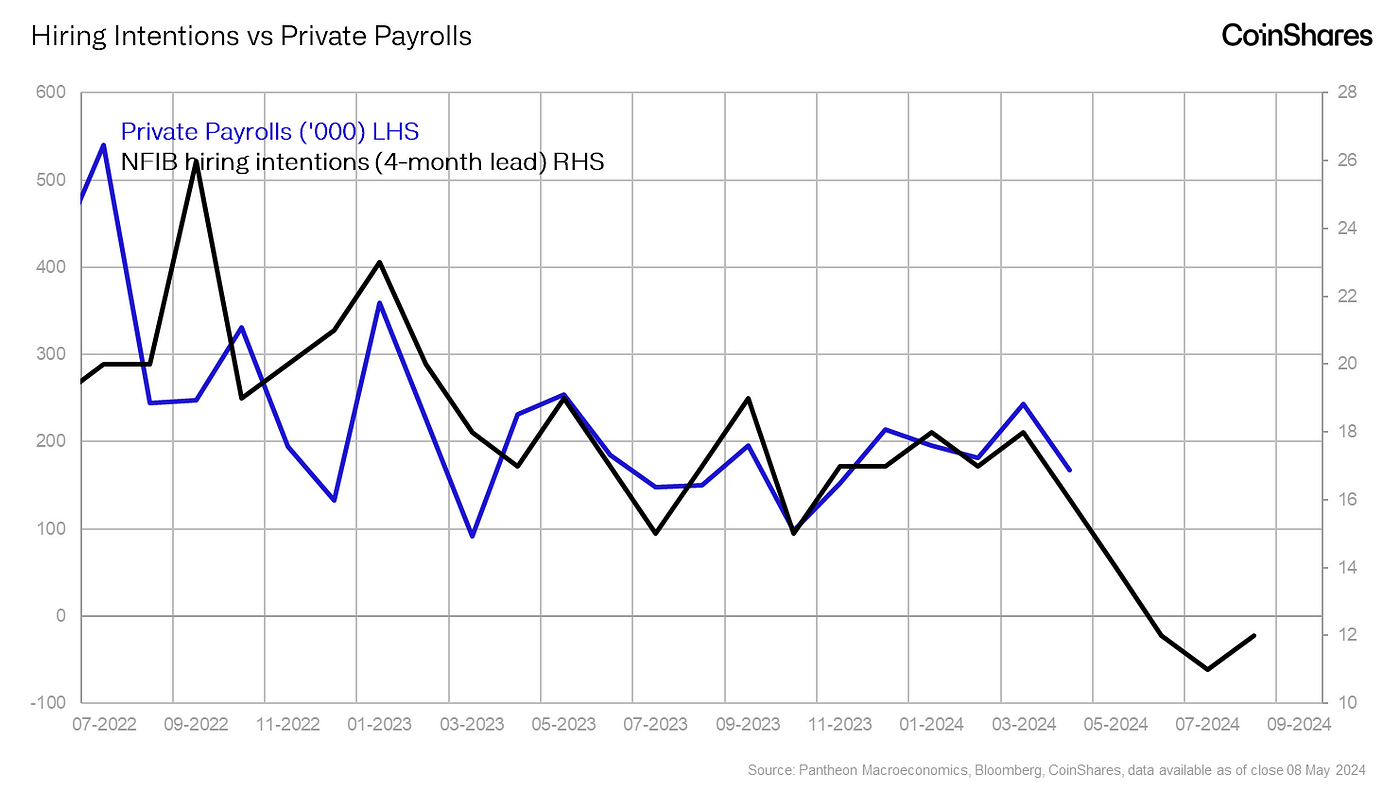
Keeping front-end rates elevated while simultaneously tapering QT can be likened to both applying the brakes to a car and accelerating at the same time. If one were cynical, it might seem that the US Treasury has nearly reached its limit in shifting debt issuance to shorter durations, with the only lever available to them now being QT. Fed Chair Powell has noted that a sudden weakening in the employment market could lead to a decrease in interest rates, we therefore now expect the Fed to cut interest rates later this year and it be a knee-jerk reaction to weaker economic data, increasing the chances of a rate cut being late, but greater than expected. We do believe that weaker jobs growth is highly likely, as indicated by the recent trend between private payrolls and hiring intentions.
The recent decline in prices has led to substantial outflows from US spot Bitcoin ETFs, with the average investment in US spot Bitcoin ETFs made at around US$62,000. This drop in prices likely triggered sell orders, further exacerbating the recent downturn and appearing to be a knee-jerk reaction to unexpectedly positive short-term economic data. At this juncture, a quote by John Steinbeck seems fitting:

“During the dry years, the people forgot about the rich years, and when the wet years returned, they lost all memory of the dry years. It was always that way.”

It appears that broader markets are primarily focused on economic data that is more reflective of past trends and its impact on short-term growth, rather than considering the longer-term outlook, which suggests weaker growth and an escalating government debt problem. With Bitcoin’s fixed supply and high immutability, when the Fed eventually cuts rates — likely by a greater amount and later than anticipated — it is probable that this tumultuous situation will support Bitcoin prices.


Comments

All Comments

Recommended for you

  • Amazon Shares Surge 15.2%, Biggest Gain Since 2012

    On July 31, Amazon shares surged 15.2% to $271.255 per share, marking their biggest gain since 2012, with a total market value of $2.92 trillion.

  • US Treasury Secretary Bessent Vows to Track Down Iranian Assets Globally for Terror Victims

    US Treasury Secretary Bessent said the US will actively track down Iranian assets worldwide to ensure compensation funds for victims of Iran-backed terrorist activities. Bessent stated that the US government's military and economic blockade measures against the Iranian regime will continue and will not be relaxed. (Jinshi)

  • Apple Plunges Nearly 10%, Q4 Revenue Guidance Misses Expectations

    On July 31, Apple (AAPL.US) plunged nearly 10% to $300.33, marking its biggest drop since April 2025. In terms of fundamentals, Apple's third-fiscal-quarter revenue rose approximately 16% year-over-year to $109.42 billion, slightly above analyst expectations. Among the details, product revenue came in at $78.68 billion, beating the expected $77.25 billion. However, services revenue—a key driver of its valuation re-rating in recent years—totaled $30.74 billion, missing the consensus estimate of $31.36 billion. Additionally, Greater China revenue reached $18.82 billion, with year-over-year growth slowing to 22%, also below analysts' forecast of $19.58 billion. During the earnings call, Apple guided fourth-fiscal-quarter revenue growth in the range of 9% to 11%, overall below the 12.1% analysts had expected. CFO Parekh noted that component supply constraints would impact iPhone, Mac, and iPad businesses in the fourth fiscal quarter, with currency fluctuations also constraining growth.

  • Three Fed Officials Back Rate Hike, Hawkish Pressure Builds

    On July 31, three Federal Reserve policymakers said that dissenting votes in favor of a rate hike this week stemmed from stubborn inflationary pressures, highlighting rising internal pressure on Fed Chair Warsh to act. In statements released Friday morning, Hammack and Kashkari said they worry that although the current round of price increases may stem from short-term factors such as President Trump's tariff policies and the Iran war, the inflation situation already warrants Fed action. Logan also joined in, saying that even if inflation cools, if the Fed does not raise rates, inflation is unlikely to fully fall back to the Fed's 2% target; without any policy constraints, inflation could continue to run above target until an unexpected shock occurs. Kashkari said that if inflation remains persistently stubborn, he might support a series of rate hikes, not just a single increase, to prevent inflation from becoming further entrenched. He said: "A series of small policy adjustments may be preferable to waiting for developments to unfold and ultimately having to take more forceful action." Hammack said that if the Fed does not tighten policy, price increases could continue to accelerate. She said: "Inflation has been stubbornly above 2% for more than five years, and I have no confidence that it will return to our target on its own." (Jin Shi)

  • US 10-Year Treasury Yield Rises to 4.7388%, Highest Since January 2025

    On July 31, the US 10-year Treasury yield rose to 4.7388%, the highest level since January 2025.

  • Spot Gold Intraday Decline Widens to 2%, at $4,021.08 per Ounce

    On July 31, spot gold's intraday decline widened to 2%, reported at $4,021.08 per ounce.

  • BTC Falls Below $63,000

    Market数据显示,BTC has fallen below $63,000, currently reported at $62,985.99, with a 24-hour decline of 2.99%. Market volatility is significant, please exercise risk control.

  • Fed's Logan: Leaning Toward 25 Basis Point Rate Hike

    On July 31, Federal Reserve Governor Logan said she leans toward a 25 basis point rate hike, believing inflation has not yet entered a sustainable path back to the Fed's 2% target. Logan stated that taking moderate action now would reduce the risk of needing more aggressive tightening in the future, while emphasizing that the Fed cannot rely on unexpected shocks to achieve its inflation target.

  • Fed's Logan: Taking Modest Actions Now Reduces Likelihood of Needing Stronger Action Later

    On July 31, Dallas Fed President Lorie Logan said that taking modest actions in the near term would reduce the likelihood of needing to take stronger action in the future.

  • Philadelphia Semiconductor Index Erases 5% Gain, Turns Lower

    On July 31, U.S. chip and semiconductor stocks rapidly weakened, with the Philadelphia Semiconductor Index wiping out a 5% gain and turning lower. Micron Technology, which had risen 6%, is now down 4.2%. SanDisk, which had gained nearly 10%, is now down over 6%. SK Hynix and Seagate Technology, which had risen over 8%, are now down 2%. TSMC, which had gained 4%, is now down nearly 1%.