

Cointime

Download App
iOS & Android

Alabama, Minnesota lawmakers join US states pushing for Bitcoin reserves

Lawmakers in the US states of Minnesota and Alabama filed companion bills to identical existing bills that if passed into law, would allow each state to buy Bitcoin.

The Minnesota Bitcoin Act, or HF 2946, was introduced to the state’s House by Republican Representative Bernie Perryman on April 1, following an identical bill introduced on March 17 by GOP state Senator Jeremy Miller.

  Meanwhile, on the same day in Alabama, Republican state Senator Will Barfoot introduced Senate Bill 283, while a bi-partisan group of representatives led by Republican Mike Shaw filed the identical House Bill 482, which allows for the state to invest in crypto, but essentially limits it to Bitcoin.

Twin Alabama bills don’t explicitly name Bitcoin

Minnesota’s Bitcoin Act would allow the state’s investment board to invest state assets in Bitcoin and other cryptocurrencies and permit state employees to add crypto to retirement accounts.

It would also exempt crypto gains from state income taxes and give residents the option to pay state taxes and fees with Bitcoin.

The twin Alabama bills don’t explicitly identify Bitcoin, but would limit the state’s crypto investment into assets that have a minimum market value of $750 billion, a criterion that only Bitcoin currently meets.

26 Bitcoin reserve bills now introduced in the US

Introducing identical bills is not uncommon in the US and is typically done to speed up the bicameral legislative process so laws can pass more quickly.

Bills to create a Bitcoin reserve have been introduced in 26 US states, with Arizona currently the closest to passing a law to make one, according to data from the bill tracking website Bitcoin Laws.

  Pennsylvania was one of the first US states to introduce a Bitcoin reserve bill, in November 2024. However, the initiative was reportedly eventually rejected, with similar bills also killed in Montana, North Dakota, South Dakota and Wyoming.
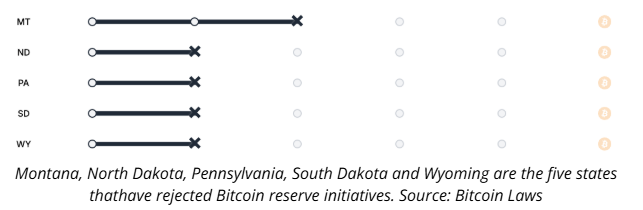
According to a March 3 report by Barron’s, “red states” like Montana have faced setbacks to the Bitcoin reserve initiatives amid political confrontations between the Democratic Party and the Republican Party.

Additional reporting by Helen Partz.

Comments

All Comments

Recommended for you

  • Japanese listed company ANAP Holdings increased its holdings of Bitcoin by 127.73.

    according to market sources, Japanese listed company ANAP Holdings has disclosed an increase in its Bitcoin holdings by 127.73 coins. As of now, the company's total Bitcoin holdings have reached 1,346.58 coins, valued at approximately 118 million USD.

  • Changpeng Zhao: Binance Wallet now supports identifying malicious addresses; you will receive a warning if you transfer funds to them.

    Zhao Changpeng posted on Binance Plaza stating, "The cryptocurrency industry should be able to completely eradicate address poisoning attacks and protect users. All wallets should simply check whether the receiving address is a poisoned address and block the user.This is a blockchain query. Wallets should not even display these junk transactions anywhere. If the value of the transaction is very small, filter it out. Security alliances in the industry should maintain a real-time blacklist of these addresses so that wallets can check before sending transactions. Binance Wallet is already doing this. If a user tries to send to a malicious address, they will receive a warning.

  • Bitcoin spot ETFs saw a total net outflow of $189 million yesterday, marking the fourth consecutive day of net outflows.

     according to SoSoValue data, the total net outflow of Bitcoin spot ETFs is 189 million USD.The Bitcoin spot ETF with the largest single-day net outflow yesterday was Blackrock's ETF IBIT, with a single-day net outflow of 157 million USD. Currently, IBIT's total historical net inflow has reached 62.34 billion USD. The second is Fidelity's ETF FBTC, with a single-day net outflow of 15.2979 million USD. Currently, FBTC's total historical net inflow has reached 12.189 billion USD. As of the time of writing, the total net asset value of Bitcoin spot ETFs is 114.289 billion USD, with the ETF net asset ratio (market value as a proportion of Bitcoin's total market value) reaching 6.53%, and the cumulative historical net inflow has reached 57.076 billion USD.

  • BTC falls below $88,000

     market shows BTC fell below $88,000, currently at $87,997.85, 24-hour decline reaches 0.88%, market volatility is significant, please manage your risk accordingly.

  • The U.S. spot Ethereum ETF saw net inflows of $84.59 million yesterday.

     according to Trader T monitoring, the US spot Ethereum ETF had a net inflow of 84.59 million USD yesterday.

  • ETH breaks $3,000

     the market shows ETH breaking through $3000, currently at $3000.08, with a 24-hour decline of 0.38%. The market is highly volatile, please manage your risk accordingly.

  • Binance Wallet launches "secure auto-signature" service

     according to the official announcement, Binance Wallet has launched the "Secure Auto Sign" (SAS) service: it now supports mnemonic/private key wallets to trade on Binance Wallet (web version).

  • Circle minted 500 million USDC on the Solana network.

    according to Onchain Lens monitoring, Circle has minted 500 million USDC on the Solana network. Since October 11, Circle has issued a total of 18 billion USDC on the Solana network.

  • Sources familiar with the matter: JPMorgan Chase is considering offering cryptocurrency trading services to institutional clients.

    according to Bloomberg, as major global banks deepen their involvement in the cryptocurrency asset class, JPMorgan Chase is considering offering cryptocurrency trading services to its institutional clients. A knowledgeable source revealed that JPMorgan is evaluating what products and services its market division can offer to expand its business in the cryptocurrency field. The source stated that these products and services may include spot and derivatives trading.

  • Federal Reserve Governor Milan: We believe that the policy rate will eventually be lowered.

    Federal Reserve Board member Mylan stated that due to the US government shutdown, there were some anomalies in last week's inflation data; he believes that the US will not experience an economic recession in the near term, but if policies are not adjusted, the US will face an increasing risk of economic recession. We believe that policy interest rates will eventually be lowered.
