

- From grayscale LAST UPDATE 02/09/2024
- Supply Impact: Bitcoin's issuance will halve around April 2024. Despite miner revenue challenges in the short term, fundamental onchain activity and positive market structure updates make this halving different on a fundamental level.
- Miner Positioning: Facing reduced block reward revenue and high production costs, miners have prepared by raising funds through equity/debt issuances and selling reserves, in an attempt to mitigate short-term financial strains.
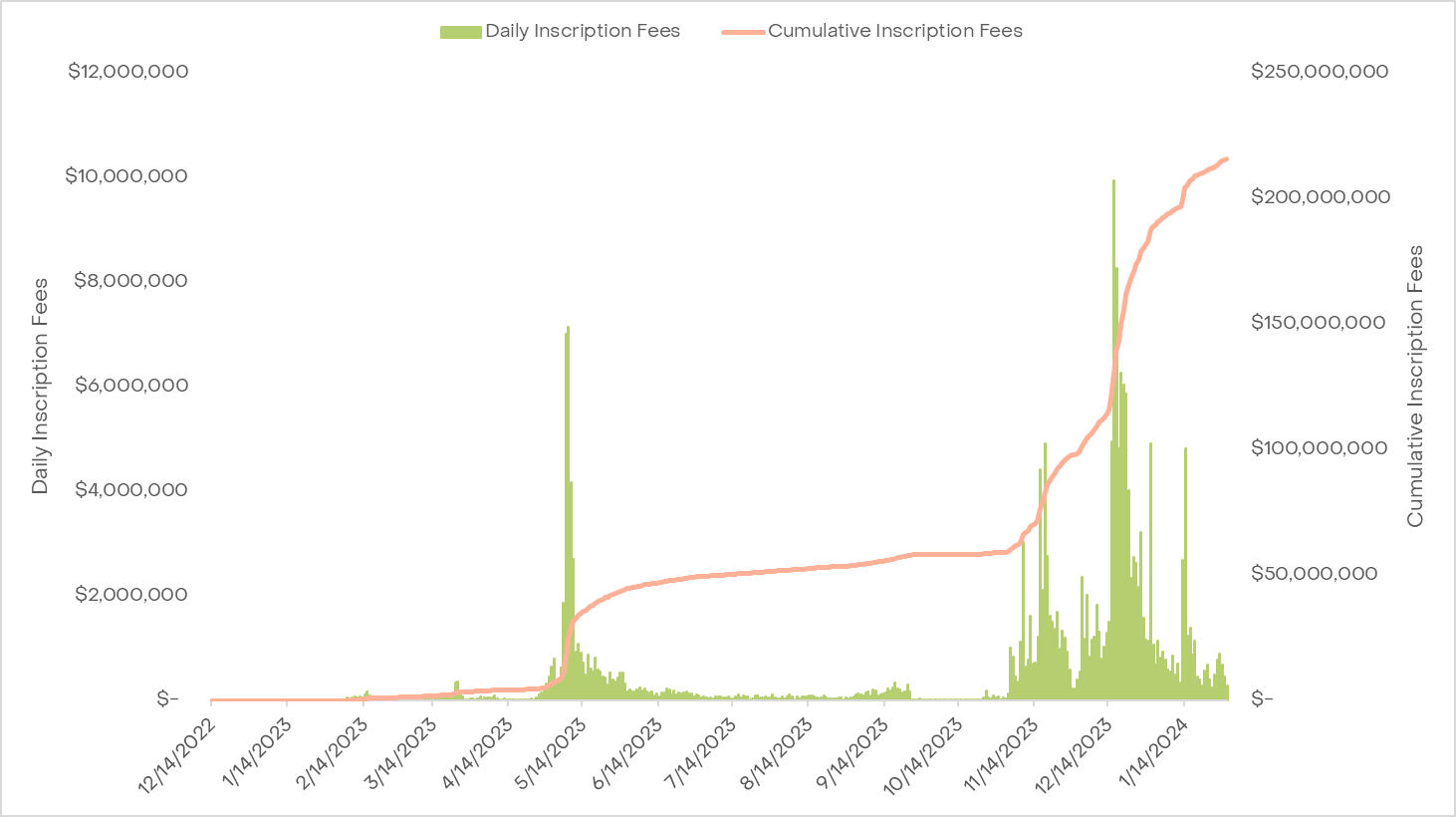
- Sustained Onchain Activity Growth: The advent of ordinal inscriptions has revitalized onchain activity, with over 59 million Non-Fungible-Token-like (NFT) collectibles inscribed, generating upwards of $200 million in transaction fees for miners as of February 2024. This trend is expected to persist, bolstered by renewed developer interest and ongoing innovations on the Bitcoin blockchain.
- Bitcoin ETFs' Market Impact: The continued adoption of Bitcoin ETFs could significantly absorb sell pressure, potentially reshaping Bitcoin's market structure by providing a new, steady demand source, which is positive to price.
As we get closer to the 2024 halving, Bitcoin is not just surviving; it's evolving. Following the landmark approval of spot Bitcoin ETFs in the United States and changing flows, the very structure of Bitcoin's market is evolving. In this piece, we'll dive into the halving—what it is, why it matters, and its historical impact on Bitcoin's performance. Then, we'll examine Bitcoin’s current landscape, and why it looks so much different than just a year ago.
What are halvings?
New Bitcoins are generated through a process known as “mining,” where computers solve computationally intensive problems to earn block rewards in the form of new Bitcoin. The issuance of Bitcoin is limited by design—approximately every four years, the mining rewards are “halved,” effectively halving the issuance of new tokens as well (Exhibit 1).
Exhibit 1: Bitcoin’s Supply Schedule
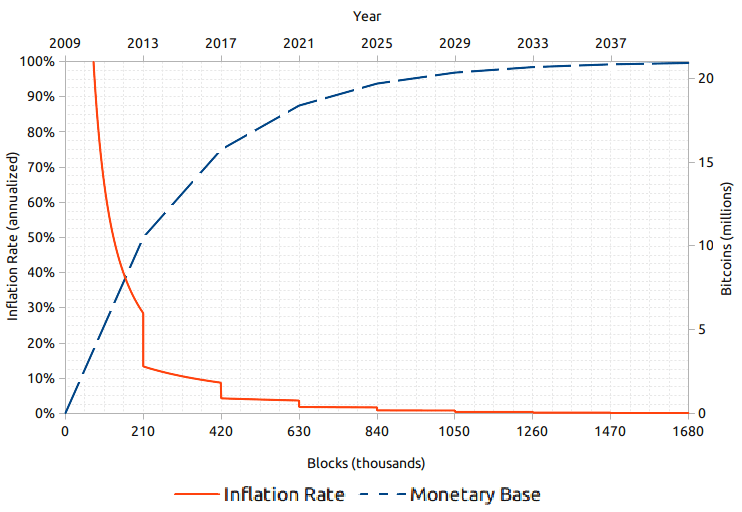
Source: Bitcoinblockhalf.com. Bitcoin’s supply schedule has remained unchanged since its inception. Provided for illustrative Purposes Only.
This disinflationary characteristic stands as a fundamental appeal for many Bitcoin holders. While the fiat money supply depends on central banks, and the precious metal supply is subject to forces of nature, Bitcoin's issuance rate and total supply have been prescribed by its underlying protocol since its inception. The combination of a fixed total supply with a gradually decreasing inflation rate not only creates scarcity but also embeds a disinflationary feature into Bitcoin.
Beyond the obvious supply impact, the notable excitement and anticipation around Bitcoin halvings also stems from their historical association with Bitcoin price increases (Exhibit 2):
Exhibit 2: Bitcoin’s Price Tends to Increase Post-Halving
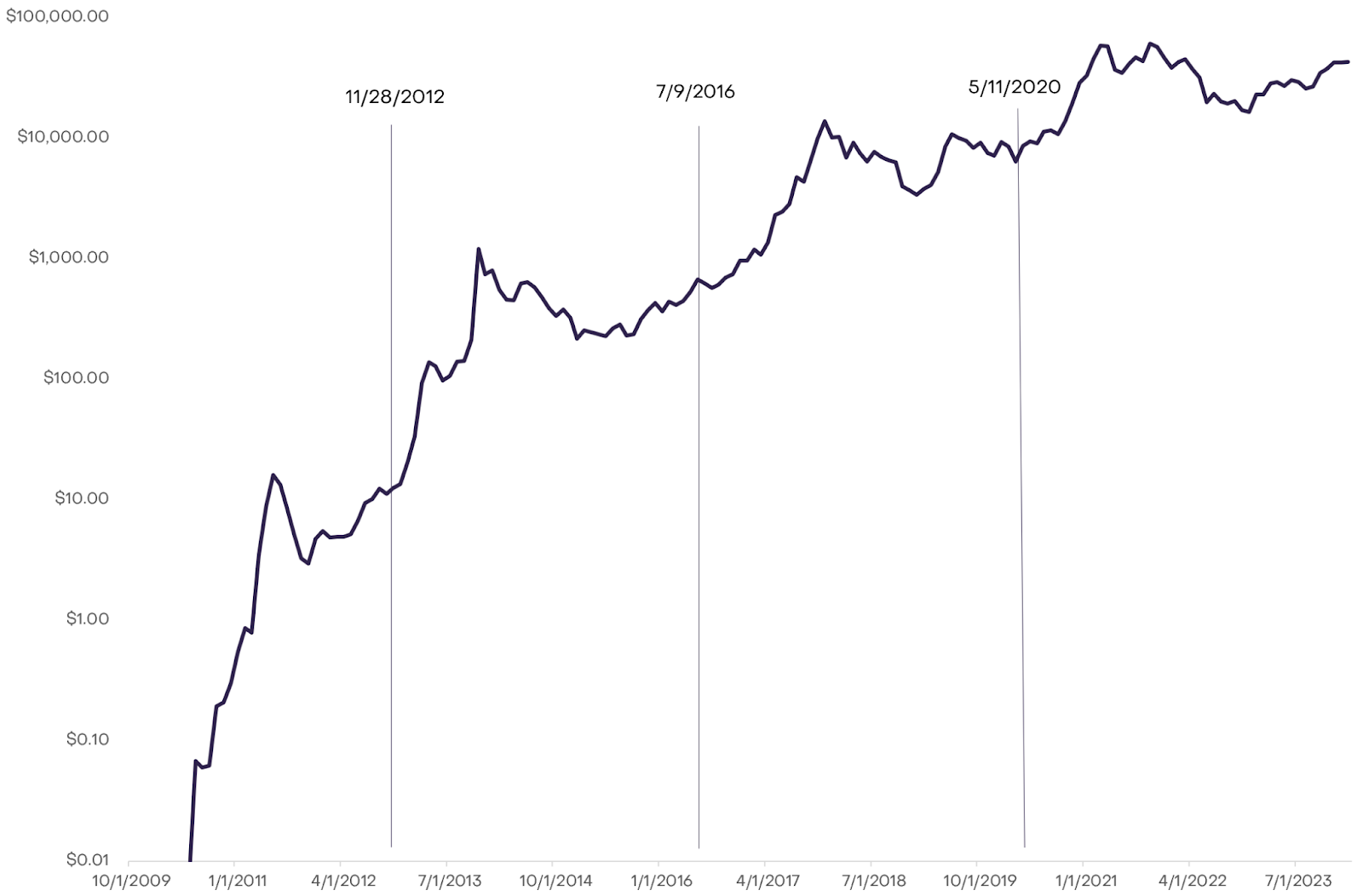
Source: Glassnode, as of 2/6/2024, Past performance is not indicative of future results. Provided for illustrative purposes only.
However, it's important to understand that a Bitcoin price increase post-halving is not guaranteed. Given the highly anticipated nature of these events, if a price surge were a certainty, rational investors would likely buy in advance, driving up the price before the halving occurs. This brings into question frameworks like the Stock-to-Flow model. While it creates visually appealing charts by correlating scarcity with price increases, the model overlooks the fact that this scarcity is not only predictable but also widely known in advance. This is corroborated by looking at other cryptocurrencies with similar halving mechanisms, such as Litecoin, which has not consistently seen price appreciation post-halving. This suggests that while scarcity does sometimes influence price, other factors also play a role.
Rather than attributing the post-halving price increases solely to the halvings themselves, it seems that these periods coincided with significant macroeconomic events. For instance, in 2012, the European debt crisis highlighted Bitcoin's potential as an alternative store of value amidst economic turmoil, contributing to its price surge from $12 to $1,100 by November 2013. Similarly, the Initial Coin Offering boom in 2016—which funneled over $5.6 billion into altcoins—indirectly benefited Bitcoin as well, pushing its price from $650 to $20k by December 2017. Most notably, during the 2020 COVID-19 pandemic, expansive stimulus measures heightened inflation fears, potentially driving investors towards Bitcoin as a hedge, which saw its price escalate from $8,600 to $68k by November 2021. These instances of macroeconomic uncertainty and the search for alternative investment options seem to align with periods of increased interest in Bitcoin, coincidentally around the times of the halvings. This pattern suggests that while the halvings contribute to Bitcoin's scarcity narrative, the broader economic context and its impact on investor behavior can also critically impact Bitcoin's price.
While the future macroeconomic environment remains uncertain (though we have our thoughts), one certainty is the halving's impact on Bitcoin's supply structure. Let's delve into this.
Miner Threat
The halving presents a challenge for Bitcoin miners. With Bitcoin issuance decreasing from 6.25 to 3.125 BTC per block, miner income from block rewards is effectively getting cut in half. In addition, expenses are also increasing. The hash rate, a measure of the total computational power used to mine and process transactions on the Bitcoin network, serves as a proxy for mining difficulty and is a key input for calculating miners’ expenses. In 2023, the 7-day average hash rate soared from 255 exahashes/second1 (EH/s) to 516 EH/s—a 102% increase, significantly outpacing 2022’s growth of 41% (Exhibit 3). This surge, driven partly by Bitcoin's rising price throughout 2023 and the acquisition of more efficient mining equipment by companies in response to positive market conditions, highlights the escalating challenges for miners. A combination of declining revenue and increasing costs could put many miners in a tense position in the near term.
Exhibit 3: Hashrate in 2023 Hit All Time Highs
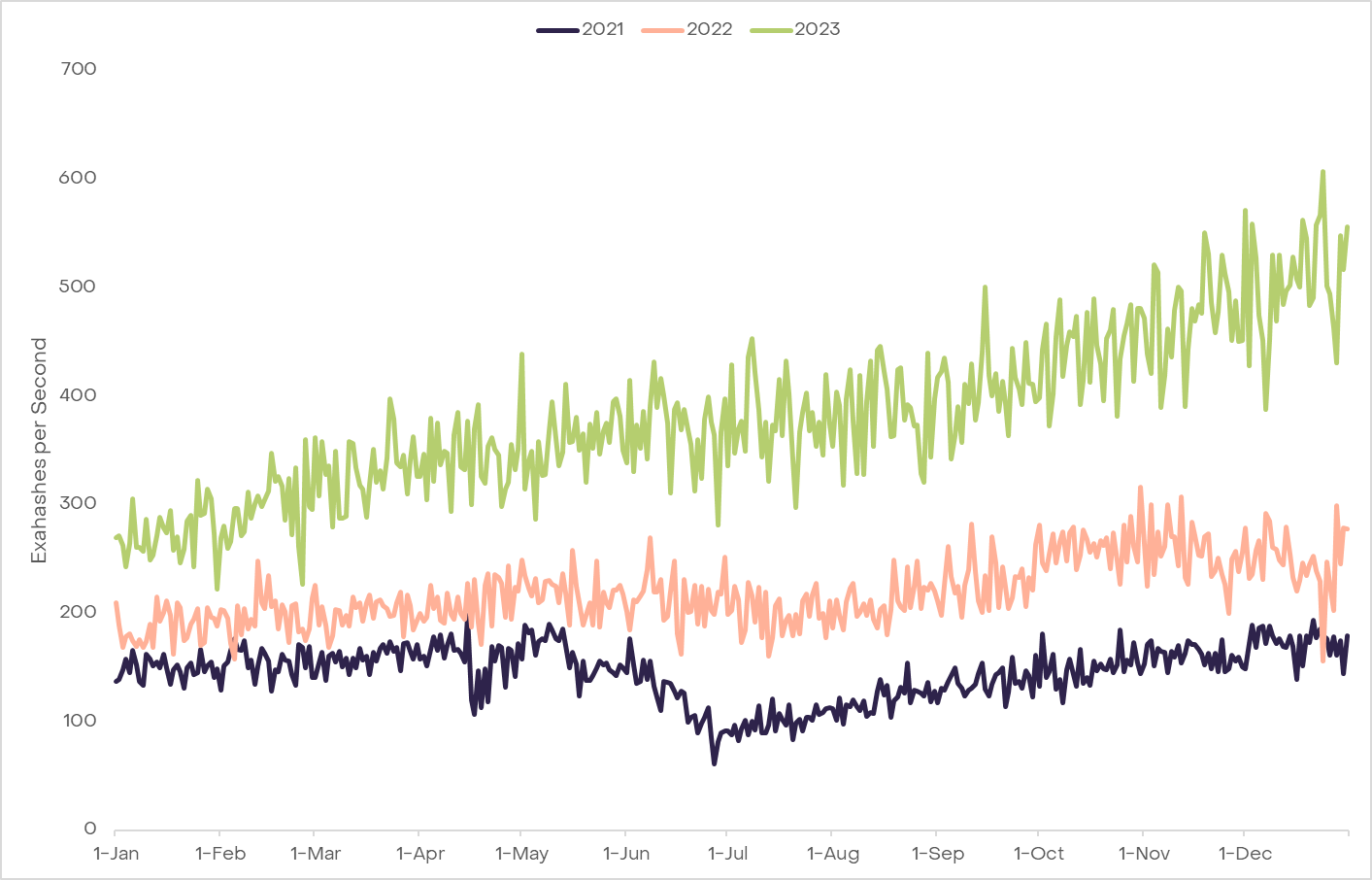
Source: Glassnode, as of 12/31/2023. Provided for illustrative purposes only.
While the scenario might seem dire, there’s evidence that miners have long been preparing for the financial repercussions of the halving. There was a noticeable trend of miners selling their Bitcoin holdings onchain in Q4 2023, presumably building liquidity ahead of the reduction in block rewards (Exhibit 4). In addition, significant fundraising efforts, such as Core Scientific's $55 million equity offering, Stronghold's $15 million equity raise, and Marathon Digital's ambitious $750 million hybrid equity raise, underscore the industry's proactive stance in bolstering reserves. These measures collectively suggest that Bitcoin miners are well-positioned to navigate the upcoming challenges, at least in the short term. Even if some miners exit the market entirely, the resulting decrease in hashrate could lead to an adjustment in mining difficulty, potentially lowering the cost per coin for the remaining miners and preserving the network's equilibrium.
Exhibit 4: Miner Net Position Change (30D Change in Bitcoin Held in Miner Addresses)
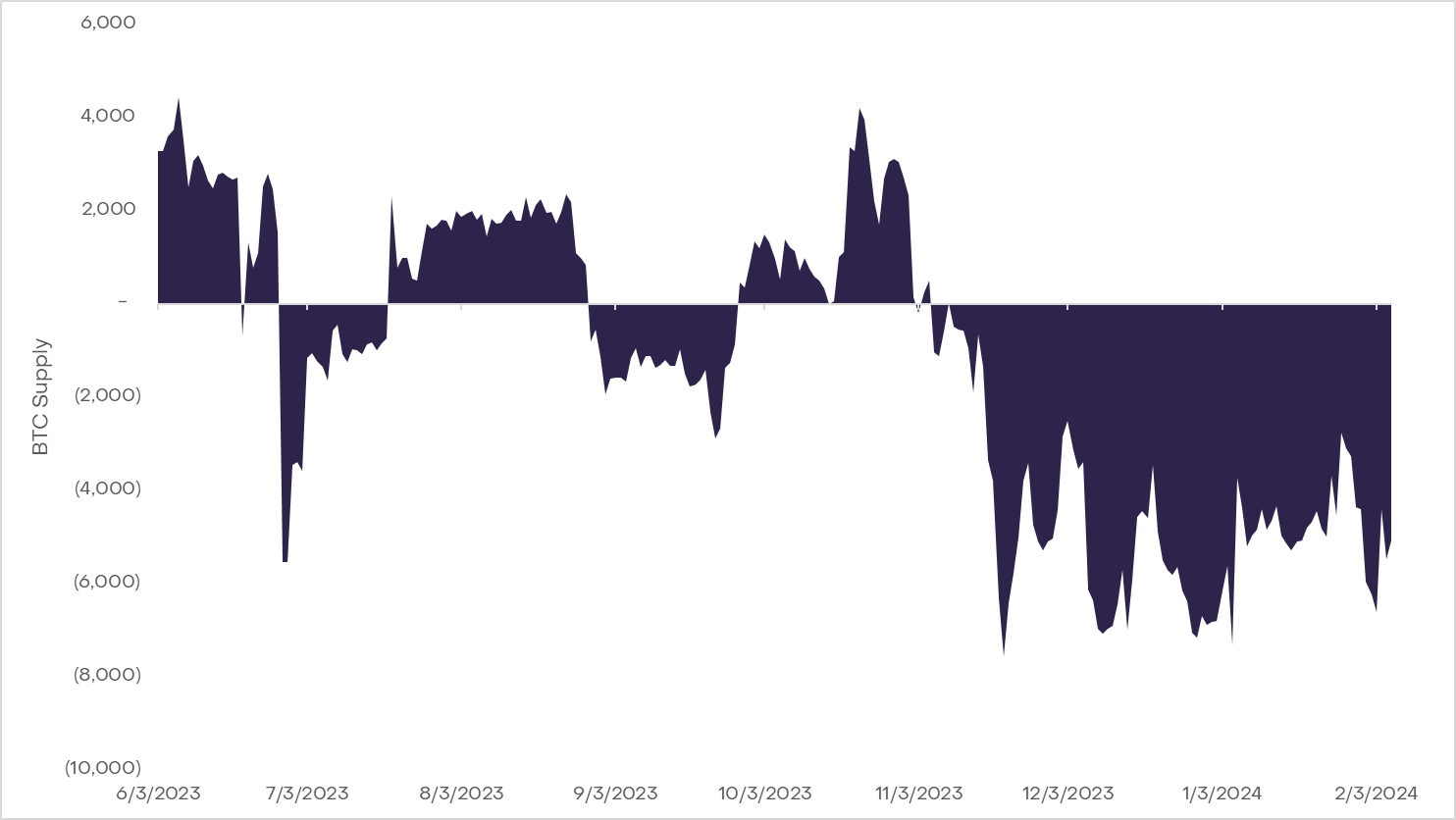
Source: Glassnode, as of 2/7/2024 Provided for illustrative purposes only.
While the reduction in block rewards poses a challenge, the growing roles of ordinal inscriptions and Layer 2 projects within the Bitcoin ecosystem have recently emerged as promising use cases. These innovations may offer a silver lining for miners by potentially both enhancing transaction throughput and increasing transaction fees for the network.
Ordinal Inscriptions
As we've explored previously, Ordinal Inscriptions (“ordinals”) represent a groundbreaking innovation within the Bitcoin ecosystem. Digital collectibles ranging from simple images to custom “BRC-20” tokens can be uniquely "inscribed" onto specific satoshis (the smallest units of Bitcoin, as each Bitcoin is divisible into 100 million satoshis). This new dimension to Bitcoin's utility has spurred remarkable growth: to date, over 59 million assets have been inscribed, generating more than $200 million in transaction fees for miners (Exhibit 5).
Exhibit 5: Daily and Cumulative Inscription Fees ($)
Source: Glassnode, as of 2/7/2024, Provided for illustrative purposes only.
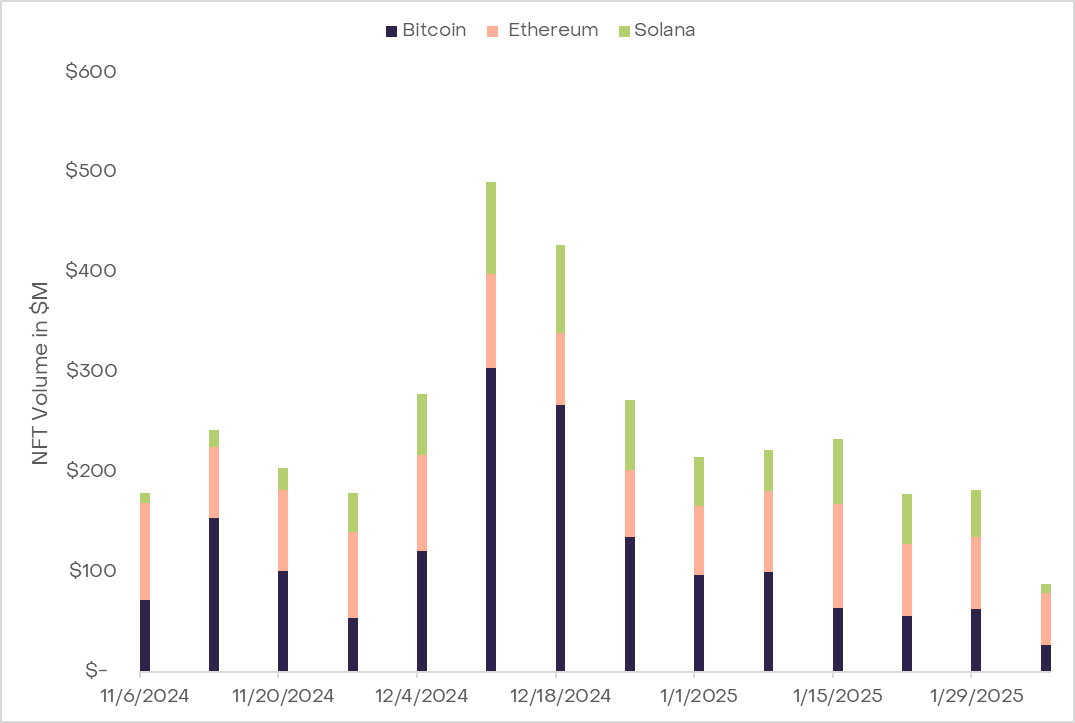
This surge in network fees has had a profound impact, notably on November 20, 2023, when transaction fees on the Bitcoin network exceeded those on the Ethereum network for the first time in recent history. Since the advent of ordinals, there have been multiple times when miners have derived over 20% of their transaction fees from inscription fees themselves. Even compared to the total NFT volumes across other chains, Bitcoin emerged as the dominant leader in NFT volume through November and December 2023 (Exhibit 6), a development few would have expected in late 2022.
Exhibit 6: NFT Trade Volume by Chain
Source: The Block, Cryptoslam, as of 2/7/2024. Provided for illustrative purposes only.
The success of ordinals has had its own effects on the Bitcoin network. As block rewards diminish over time, the question of how miners will be incentivized to secure the network becomes more pressing. With transaction fees from ordinals already constituting approximately 20% of total miner revenue, this emerging trend of ordinal activity presents a new path toward sustaining network security through increased transaction fees, for now.
However, this success also brings to light scalability challenges because users will have to shoulder those higher transaction fees. This could deter users from engaging in basic transactions like transfers. Additionally, Bitcoin's architecture limits programmability, which poses further constraints on developing complex applications that could use these ordinals. This scenario emphasizes the need for scaling solutions that can accommodate both increased throughput for efficient transactions and expanded use cases, such as trading NFTs and BRC20 tokens.
In response, the community is exploring avenues similar to those undertaken by Ethereum, such as Layer 2 rollups, to enhance scalability and usability. The growing interest in taproot-enabled wallets (Exhibit 7), which offer greater programmability through enhanced privacy and efficiency features, indicates a collective move toward addressing these challenges. As transaction fees on the Bitcoin mainchain swell, the development of layer 2 networks emerges as a possible step forward.
Exhibit 7: Taproot Adoption (%)

Source: Glassnode, as of 2/7/2024. Provided for illustrative purposes only.
As we discussed in our previous piece on ordinals, the resurgence of ordinals and the introduction of BRC-20 tokens have catalyzed a cultural shift within the Bitcoin community, attracting a new wave of developers intrigued by the expanding possibilities of the network. This shift is arguably one of the most significant developments for Bitcoin, as it not only diversifies the ecosystem but also reinvigorates the community with fresh perspectives and innovative projects going forward.
Among the existing Layer 2 (L2) solutions, some have been quietly laying the groundwork for this evolution for years. Stacks stands out as a platform that has introduced fully expressive smart contracts to Bitcoin. It has fostered the development of various decentralized applications (dApps) that leverage Bitcoin's security, enabling functionalities ranging from DeFi to NFTs. These dApps represent the forefront of Bitcoin's transition into a multi-faceted ecosystem, capable of supporting a wide array of blockchain-based applications.
ETF Flows
Beyond generally positive onchain fundamentals, Bitcoin’s market structure looks beneficial to price post-halving. Historically, block rewards have introduced potential sell pressure to the market, with the possibility that all newly mined Bitcoin could be sold, impacting prices. Currently 6.25 Bitcoin mined per block equates to approximately $14 billion annually (assuming Bitcoin price is $43K). In order to maintain current prices, a corresponding buy pressure of $14 billion annually is needed. Post-halving, these requirements will decrease by half: with only 3.125 Bitcoin mined per block, that equates to a decrease to $7 billion annually, effectively easing the sell pressure (Exhibit 8).
Exhibit 8: Halving Decreases Issuance by $7B

Source: Grayscale Research, as of 2/7/2024
ETFs, in general, create access to Bitcoin exposure to a greater network of investors, financial advisors, and capital market allocators, which in time could lead to an increase in mainstream adoption. Following US spot Bitcoin ETF approvals, the initial net flows into these newly launched products amounted to approximately $1.5 billion in just the first 15 trading days, absorbing nearly the equivalent of three months' worth of potential post-halving sell pressure. While the explosion in net flows in the first few days was likely attributable due to initial excitement and pent up demand, assuming a steady state of net inflows alongside continued bitcoin ecosystem adoption and maturation, ETF flows could serve as a counterbalance to the ongoing sell pressure from mining issuance. A sensitivity analysis of daily net inflows ranging from $1 million to $10 million suggests that at the higher end, the reduction in sell pressure could mirror the effects of another halving, fundamentally transforming Bitcoin's market structure in a positive way2.
Conclusion
Bitcoin has not only weathered the storm of the bear market but has also emerged stronger, challenging outdated perceptions with its evolution in the past year. While it has long been heralded as digital gold, recent developments suggest that Bitcoin is evolving into something even more significant. Propelled by a surge in onchain activity, bolstered by significant market structure momentum, and underscored by its inherent scarcity, Bitcoin has shown its resilience. The Grayscale Research team will be closely tracking its development leading up to and following the halving in April 2024, as we believe Bitcoin's future shines brightly.


All Comments