


This article shares some trends and related projects to watch in 2023Q1.
Making money is the fundamental demand of crypto. Crypto remains an industry where 95% of the participants come here to try to make (a lot of) money. The quicker, the better. The more, the merrier.
Projects that help people make money satisfy that fundamental demand. They are most likely to survive in a bear market and thrive in a bull market.
For example, centralized exchanges help people execute trades, which are essential, making them the most profitable businesses. Analytic tools help people make decisions but are optional, so they are struggling.
On the other hand, paid alpha groups are mainly pump-and-dump scams, but there will always be people willing to pay for the "intel" on the next 100x project.
The entire space is like a gigantic Play-to-Earn game. No matter how shitty the mechanisms/graphics are, people will play as long as it makes money.
And the success of all crypto projects depends eventually on the value of the underlying assets, that is, the bitcoin price.
With that in mind, I share some trends I am bullish on in 2023 Q1 and their related projects.
LSD
As the Ethereum Shanghai upgrade is scheduled for March, the Liquid Staking Derivatives will continue to gain traction. Our previous article discusses how the Shanghai Upgrade might affect Ethereum price and staking rate. More people will stake their ETH after Shanghai and want to make money off their staked ETH, where Liquid Staking Derivatives (LSD) come into play.
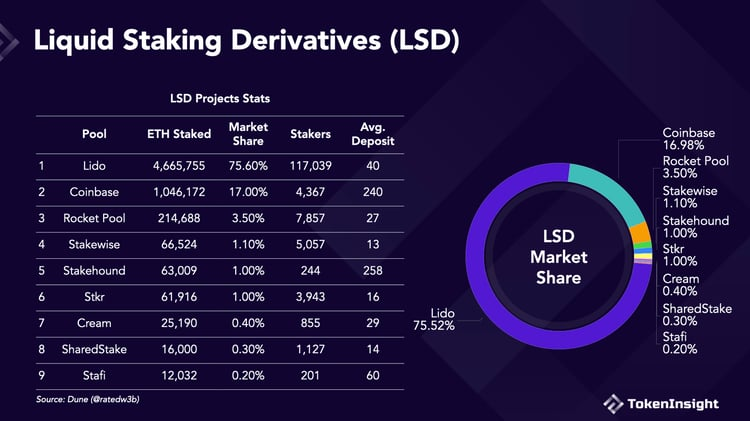
Lido has a commanding lead among LSD projects. Coinbase, Rocket Pool, and Stakewise rank 2-4.
$LDO
Lido lets users stake their ETH while making staked ETH liquid, such as allowing staked ETH to participate in on-chain activities like lending.
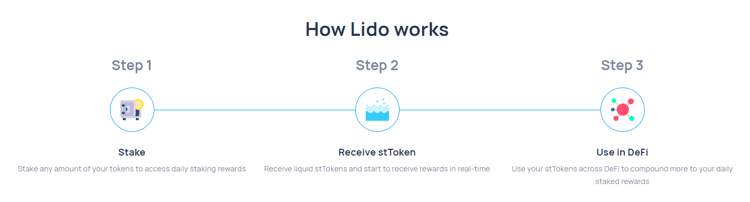
$LDO is the governance token of the Lido DAO. It is issued on Ethereum. The Lido DAO governs the Lido protocol and decides on key parameters such as fees. $LDO holders enjoy voting rights within the Lido DAO, and their voting power increases as their holding increases.
$RPL
Rocket Pool is a base layer protocol built to allow anyone to trustlessly stake as little as 0.01 $ETH to a network of decentralized node operators.
$RPL is the utility token in the Rocket Pool ecosystem. For example, node operators must stake $RPL as insurance, and Oracle DAO members put up $RPL as bonds. $RPL also grants DAO governance rights to its holders.
$SWISE
StakeWise allows users to stake ETH and earn rewards. $SWISE is the governance token of Stakewise DAO.
$FXS
Frax differs from the other LSD projects because it offers much more than simple ETH staking.
For example, $FRAX is a stablecoin with parts of its supply backed by collateral and parts of the supply algorithmically stabilized. The stablecoin (FRAX) is named after this hybrid fractional-reserve system.
The Frax Price Index ($FPI) stablecoin is the first stablecoin pegged to a basket of consumer goods, creating its own unit of account separate from any nation-state-denominated money.
Frax Share ($FXS) is the governance token of the entire Frax ecosystem of smart contracts, which accrues fees, revenue, and excess collateral value.
Real Yield
The real yield narrative, which started in the second half of 2022, will gain more popularity in 2023. Tokens that distribute income to holders will trump tokens that only grant voting rights. If a protocol generates passive income for its token holders, the holders will be its loudest supporters. Such free marketing will boost protocol usage and increase revenue, creating a growth flywheel.
Notable projects are summarized below. However, the real yield narrative may cause the market to employ more realistic valuation frameworks for crypto projects, lowering their ceilings, which is not good.
$SNX
Synthetix is a decentralized synthetic asset issuance protocol built on Ethereum and Optimism. Synthetix allows users to convert Synths directly with the smart contract, avoiding the need for counterparties. This mechanism solves the liquidity and slippage issues experienced by DEX. If you want to learn more, our previous article explains how Synthetix works using Kwenta as a case study.
Crypto Synths on Ethereum are shown below.
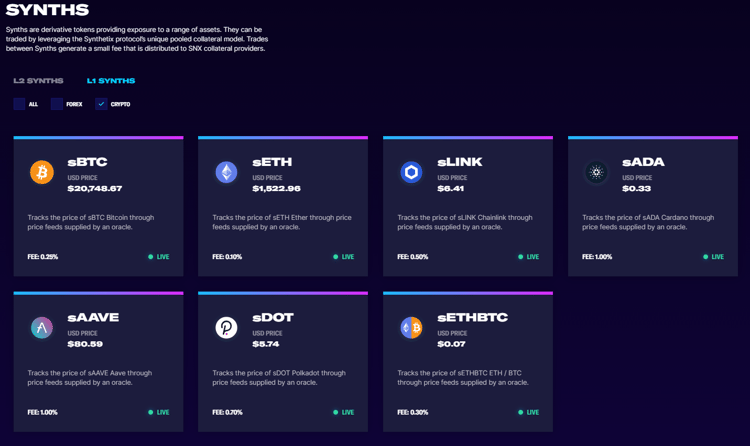
$SNX is the primary collateral backing the synthetic assets in the Synthetix protocol. Its stakers are entitled to fees generated by Synth trades on Synthetix.Exchange.
$GMX
GMX is a decentralized perpetual exchange that allows users to trade BTC, ETH, AVAX, and other top cryptocurrencies with up to 50x leverage directly from their wallets.
GMX has a dual-token system. $GMX is the governance and utility token that entitles holders to 30% of GMX fees. $GLP consists of an index of assets used for swaps and leverage trading. $GLP holders provide liquidity to the protocol and act as counterparties to trades placed on GMX.
The GMX model became widely popular. A lot of the projects mentioned below base their tokenomics design on the GMX model.
$DPX
Dopex is a decentralized options protocol that aims to maximize liquidity, minimize losses for option writers and maximize gains for option buyers - all in a passive manner for liquidity-contributing participants.
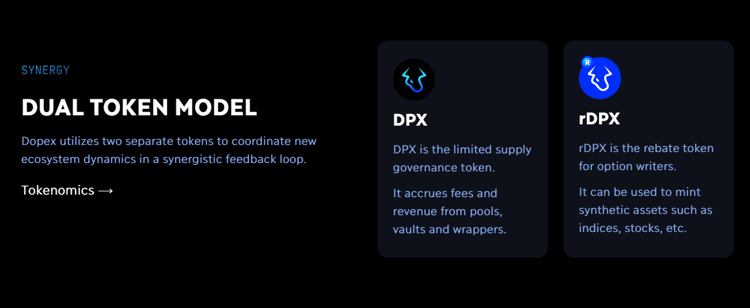
Dopex makes use of two tokens. $DPX is the native governance and protocol fee accrual token, and $rDPX is the rebate token. $rDPX is minted and distributed for any losses incurred by pool participants.
70% of Dopex fees go to depositors (option pool liquidity provider), 5% to delegates, 5% to $rDPX burning, and 15% to governance staking.
$GNS
Gains Network develops gTrade, a decentralized leveraged trading platform. Their synthetic design makes gTrade capital efficient and allows a wide range of leverages and pairs: up to 150x on cryptos, 1000x on forex, 100x on stocks, and 35x on indices.
It has seen steady growth since launching in July 2022.

40% of the fees from market orders and 15% from limit orders on gTrade are allocated to $GNS stakers. Users may also stake their NFTs to boost staking rewards.
$OPX
OPX is a decentralized spot and perpetual exchange that supports low swap fees and zero price impact trades on the Optimism chain.
$OPX is the native and governance token of OPX Finance, earning 35% of the fees and granting voting rights. $OLP stakes accrue 60 - 70% of the platform's fees in the form of WETH.
$MVX
Metavault Trade is deployed on Polygon. It allows users to trade with spot swaps and limit orders and perps with up to 50x leverage. 30% of swap and leverage trading fees are converted to $MATIC and distributed to the accounts staking $MVX, while the rest goes to $MVLP holders.
$BFR
Buffer Finance is a non-custodial options trading platform built on Arbitrum. It allows users to trade short-term price volatility and hedge the risk of high-leverage positions.
$BFR is the utility and governance token that accrues up to 40% of the fees generated by the platform. $BLP is the token issued to liquidity providers and accrues up to 60% of the fees generated by the platform.
$MMY
Mummy Finance is a swap and perpetual DEX built on Fantom Opera. Fees collected by the platform in the form of the network's native token ($FTM) are distributed as follows. $MLP stakers receive 60%, $MMY stakers receive 30%, and 10% are used for $MMY buyback and liquidity in the $MMY/$USDC pair.
$MCB
MUX Protocol is a decentralized leveraged trading protocol that offers zero slippage and up to 100x leverage. Similar to GMX, MUX users trade against the MUXLP pool.
MUX also operates a leveraged trading aggregator that automatically selects the most suitable liquidity route and minimizes the composite cost for traders while meeting the needs of opening positions. The aggregator can also supply additional margin for traders to raise the leverage up to 100x on aggregated underlying protocols.
$MCB is the protocol's main token. Users can lock MCB to receive veMUX, which entitles them to protocol income and MUX rewards.
The protocol income collected from trading fees and DEX mining yield will be allocated as follows (POR is the rate of Protocol Owned Liquidity):
Total Income * 0.7 * POR: veMUX holders (in ETH)
Total Income * 0.7 * (1 - POR): MUXLP stakers (in ETH)
Total Income * 0.3: MUXLP purchase to add as protocol-owned liquidity
$UNIDX
UniDex is a DeFi platform that aims to provide a hub for traders to access the best rates for financial instruments within the ecosystem.
$UNIDX is the exchange token for the UniDex trading terminal. 50% of all trading fees are distributed automatically and daily to token holders.
$GMD
GMD Protocol is a yield-optimizing and aggregating platform built on existing applications. GMD employs delta-neutral or pseudo-delta-neutral strategies to aggregate yields from an index pool or an LP to its constituent assets, eliminating their risks of impermanent loss or exposure to unwanted assets.
$GMD is the utility and governance token that accrues 70% of the platform's generated fees. The protocol was recently launched, and the numbers looked good.

$STFX
STFX is a marketplace for investable trades built on Optimism. Users can deposit money to copy-trade their favorite traders or follow the strategies they like.
Managers of the vaults will earn 15% of the profits, and protocol will keep 5%. Out of that 5%, 80% will be redirected to token holders and 20% to the STFX DAO.
No-VC Projects
Community-funded projects without predatory VC unlocks usually outperform their VC-funded counterparts.
The Cosmos ecosystem is likely to outcompete Polkadot. And $CANTO and the upcoming $BERA chain stand out among the Cosmos crowd.
$CANTO
Canto is a permissionless general-purpose blockchain running the Ethereum Virtual Machine (EVM) built on Cosmos.
Canto provides Tendermint consensus secured by Canto validator nodes and an EVM execution layer via Cosmos SDK in addition to core financial primitives designed to support the Free Public Infrastructure (FPI).
These primitives include:
- Canto DEX — a zero-fee DEX for liquidity providers
- Canto Lending Market (CLM) — a pooled lending Compound v2 fork
- $NOTE — a fully collateralized unit of account token issued by the CLM which also serves the ecosystem as a USDC/USDT soft-pegged stablecoin
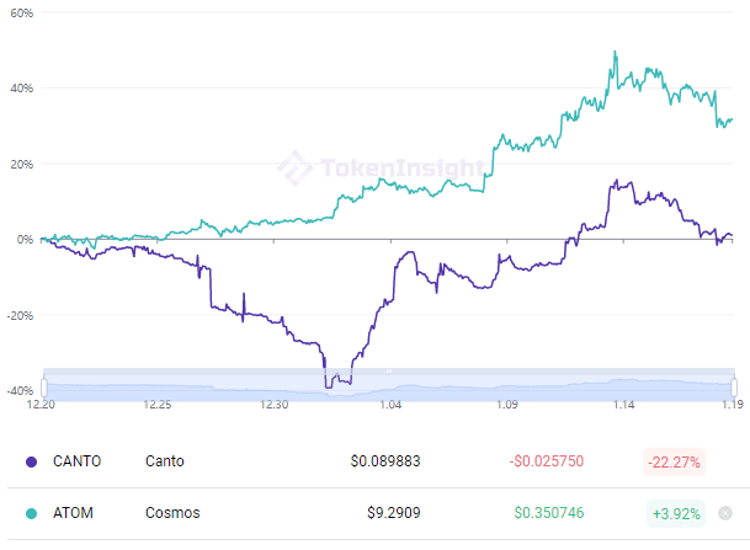
But I must point out that $ATOM outperformed $CANTO recently.
$BERA
The Bera Chain is a DeFi-focused EVM-compatible L1 built on the Cosmos SDK, powered by Proof of Liquidity Consensus. The chain’s economics are tied together through a tri-token structure, composed of a gas token $BERA, the native stablecoin $HONEY, and the Bera Governance Token $BGT.
The chain has not been released yet.
Better User Experience
Crypto is still too complicated for the average John Doe. The seed phrase is difficult to remember, and it's a nightmare to navigate across blockchains.
Many projects emerged to create a better user experience.
DappOS
DappOS is an operating protocol designed to lower the barrier of interacting with crypto infrastructures. It hopes to make dApps as user-friendly as mobile apps.
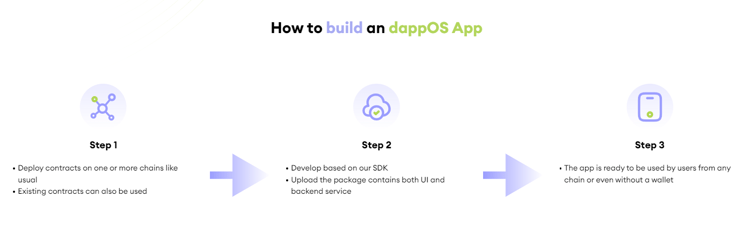
DappOS develops a middle layer between users and crypto infrastructures. Users only need to interact with dappOS, and dappOS will relay user instructions to crypto infrastructures and execute workflows automatically.
Developers can also easily utilize dappOS to build their own user-friendly apps.
Closing Thought
The list above is, of course, incomplete and new trends emerge every day. Follow us on Twitter and download our app on iOS or Android to stay ahead of what is happening in crypto.
Read more: https://tokeninsight.com/en/research/market-analysis/2023q1-trends-to-watch-and-related-projects


All Comments