

Cointime

Download App
iOS & Android

Hash Power as Sovereignty, Reshaping Web4.0: How DMDAI Builds a New Foundational Paradigm for Global Asset Allocation Through AI Hash Power and RWA

Amid the profound transformation of global macroeconomic and financial markets, hash power and underlying infrastructure are rapidly evolving from conventional technology hardware into core long-term financial assets that will support economic activity for decades to come. As trillions of dollars in global AI infrastructure investment continue to be deployed, alongside the accelerating trend toward hash power assetization and infrastructure securitization, hash power is opening up a new pathway connecting real-world macro capital with efficient digital returns. However, the barriers of traditional finance, institutional concentration of hash power, and centralized market-making privileges continue to exclude the vast majority of retail participants from accessing advanced yield opportunities and the broader benefits of this emerging era.
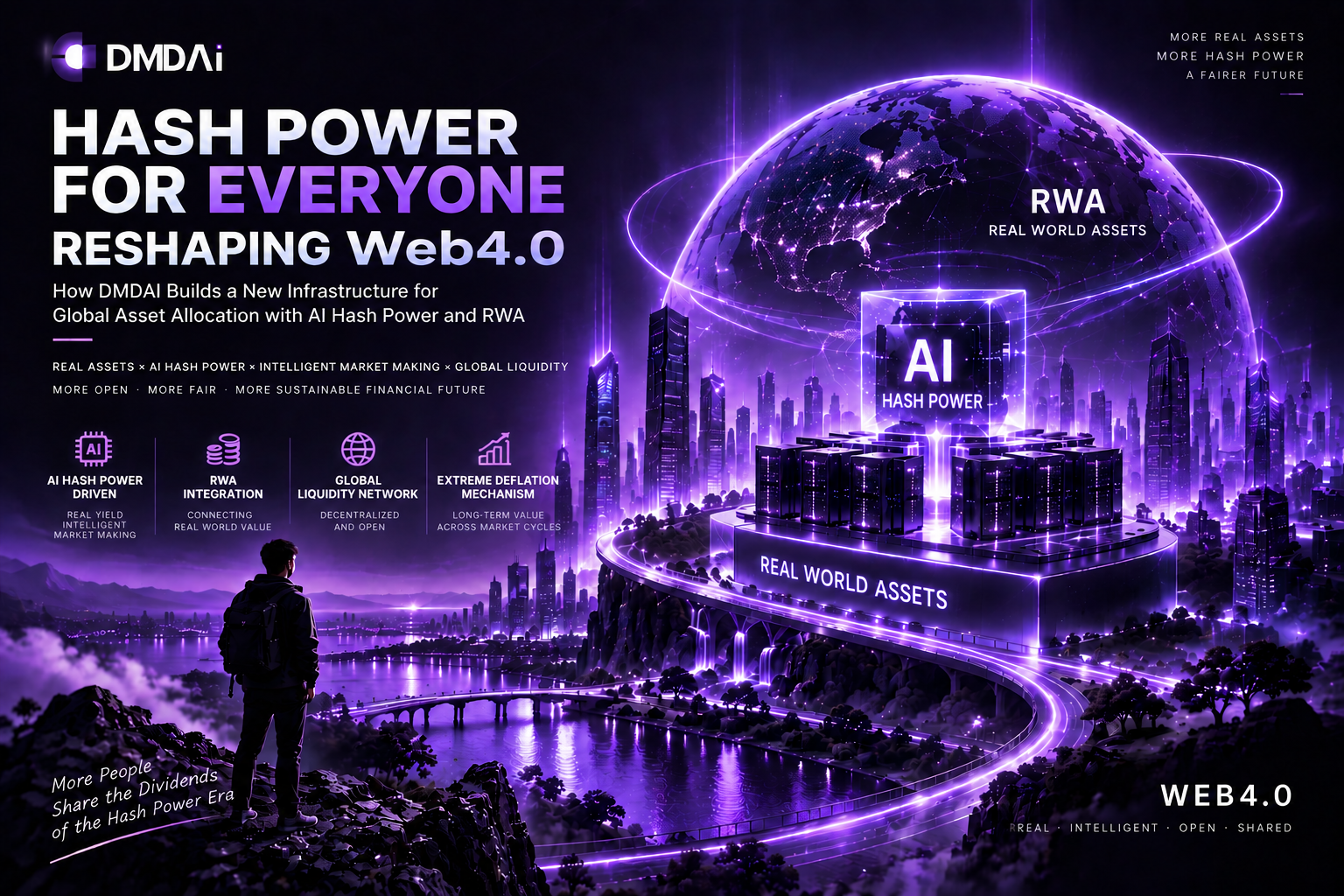
It is against this sweeping backdrop of technological and financial transformation that DMDAI has emerged. As an AI-native liquidity network serving global crypto-asset and RWA (Real-World Asset) markets, DMDAI integrates cutting-edge hash power assetization concepts with an intelligent market-making architecture, seeking to drive a transformative evolution toward broader on-chain asset participation and sovereignty-level financial infrastructure worldwide.

1. Aligning with the Macro Trend: From Hash Power Infrastructure to Inclusive Asset Allocation

Looking across the evolution of global technology and finance, hash power is no longer merely a supporting component of the technology industry. It is increasingly positioned as a new form of information infrastructure with strategic importance comparable to electricity and other foundational infrastructure. According to recent industry insights, as global token consumption continues to increase exponentially, inference compute capacity and infrastructure investment are becoming key areas of focus for global capital. However, retail participants often lack compliant and efficient channels for directly accessing advanced hash power opportunities and capturing cross-market spreads.

DMDAI seeks to capitalize on this historical opportunity. The project deeply integrates the Binance core blue-chip ecosystem with high-quality real-world assets (RWA), including tokenized equity assets such as NVDA, transforming capital-intensive infrastructure investment, high-frequency arbitrage, and complex asset packaging—traditionally dominated by major institutions—into an on-chain financial infrastructure designed for broader participation.

2. Dual-Core Engine: Closing the Loop Between Distributed Hash Power Ownership and Intelligent Market Making

DMDAI's architectural design moves beyond the single-dimensional model of traditional wealth management and market making by establishing a powerful dual-core framework centered on distributed hash power ownership and intelligent compute-driven execution:

Distributed Hash Power Ownership 1 USDC = 1 TOPS: Users participate in the ecosystem through intelligent hash power allocation or long-term ve-Token locking mechanisms, receiving hash power boost multipliers ranging from 200% to 350%. Within this framework, hash power serves not only as the primary participation credential for DMD mining and ecosystem governance, but also as a core carrier of sovereignty-level liquidity participation and ecosystem voting rights.

3. Deflationary Architecture and Long-Term Protection: Building a Sustainable Wealth Flywheel Across Market Cycles

In response to long-term scrutiny regarding the sustainability of high-yield projects, DMDAI has established a comprehensive risk-balancing and dynamic deflationary adjustment framework at the protocol-design level, creating multiple layers of protection for the ecosystem:

● Progressive Smooth Release and Multi-Dimensional Burns: DMD follows a strict three-year linear release schedule, combined with a scheduled daily 0.5% burn from the underlying liquidity pool, 100% destruction of DMD used for hash power purchases, and secondary defensive buybacks funded by excess treasury returns, forming a comprehensive dynamic deflationary mechanism.

● Yield Aggregator Compounding and Internal Freeze-Tax Recycling: User yields are transferred into the Yield Aggregator in real time, with flexible unlock periods and compounding strategies available at the user's discretion. Through a structured freeze-tax allocation mechanism, funds are recycled into ecosystem governance and development funds, supporting the protocol's long-term internal growth cycle.

● Three Principles Governing Treasury Fund Flows: Strictly implementing a framework of 50% automatically allocated to strengthen the ecosystem foundation, 30% for value mapping and community incentives, and 20% reserved for extreme-market risk provisions, with the objective of maintaining strong resilience and recovery capacity during severe macro-market volatility.

● 

4. Conclusion: Becoming Digital Market-Making Whales and Sharing the Benefits of Hash Power Sovereignty

The barriers of traditional finance are gradually being dismantled by cryptography and decentralized protocols, while the deep integration of hash power and RWA is helping define a new direction for global financial infrastructure over the coming decade. By deeply integrating distributed hash power, AI-powered intelligent market making, and a deflationary flywheel, DMDAI seeks not only to establish a new pathway for global participants to engage in asset allocation, but also to advance global liquidity toward greater sovereignty, intelligence, and accessibility.

Move beyond subjective market speculation and connect to a distributed intelligent computing system. DMDAI invites every forward-looking member of its community to embark on the Web4.0 journey together and participate in the emerging era of hash power sovereignty.


Comments

All Comments

Recommended for you

  • Telegram Renames Gram Wallet to Money and Launches for All Users

    On October 9, Telegram officially renamed its previously limited-access wallet service 'Gram wallet' to 'Money' and launched it to over one billion users across the platform. 'Money' is an integrated wallet for the Gram token, supporting storage, transfers, and purchases of platform gifts and collectible usernames. Additionally, the accompanying trading platform 'Walt' offers services for over 300 assets, including tokenized stocks, precious metals, perpetual contracts, and wealth management projects. Users can make instant transfers from 'Walt' to the 'Money' wallet without incurring network fees. The official statement also cautions that investing in crypto assets carries associated risks.

  • Blockchain.com Seeks Approval for Prediction Markets and Cryptocurrency Derivatives Trading

    On October 9, the crypto asset platform Blockchain.com submitted an application to the U.S. Commodity Futures Trading Commission (CFTC) seeking to obtain licenses for a designated contract market (DCM) and a futures commission merchant (FCM) to offer event contracts (prediction markets) and cryptocurrency derivatives trading services to U.S. users.

  • US May Seize Approximately $1 Billion in Cryptocurrency Related to Iran This Week

    U.S. Treasury Secretary Bencet stated at the NPolicy Summit held by Newsmax in Washington on Thursday that we may seize $1 billion in cryptocurrency this week, adding, "We know where it is, and we are isolating them." Bencet noted that the Trump administration's approach to Iran has shifted from 'maximum pressure' to 'absolute isolation,' with measures including maritime blockades, restrictions on air travel, and the cutting off of land routes. The UAE and Oman are cooperating with the U.S., which is also working with Pakistan and Turkey to cut off all land routes in and out of Iran.

  • Zcash Development Team Plans to Introduce Quantum-Resistant Signatures in January

    The development team of the privacy cryptocurrency Zcash (ZEC) plans to introduce post-quantum signature opcodes to the network in January next year, supporting hash-based signature technology to defend against potential quantum computing attacks. This solution primarily targets the transparent (public) payment pool, where approximately 70% of ZEC is currently stored. Although the developers have set January as the target deadline, the specific network activation time has not yet been finalized. This upgrade aims to prevent attackers from using existing public keys to reverse-engineer private keys and forge payment authorizations. Additionally, the Zcash node validator Zakura has launched a wallet tool based on Private Information Retrieval (PIR), allowing users to query balances across multiple addresses without revealing the correlation between those addresses to the server. Previously, Ethereum researcher Justin Drake warned that artificial intelligence could accelerate the cracking of traditional encryption algorithms and urged cryptocurrency holders to prepare for potential security threats.

  • BTC Surpasses $83,000

    Market data shows that BTC has surpassed $83,000, currently priced at $83,017.3, with a 24-hour increase of 0.66%. The market is highly volatile, so please ensure proper risk management.

  • Central Committee and State Council: Comprehensive Implementation of 'AI+' Initiative

    On October 9, the Central Committee of the Communist Party of China and the State Council issued the 'Opinions on Developing New Quality Productive Forces.' The opinions mention the comprehensive implementation of the 'AI+' initiative. This includes promoting the transformation of traditional industries through artificial intelligence, accelerating the development of new-generation intelligent terminal applications such as smart connected new energy vehicles, AI smartphones and computers, and humanoid robots. It aims to speed up innovation in digital intelligence technologies like artificial intelligence, break through foundational theories and core technologies, and strengthen the efficient supply of computing power, algorithms, and data. The strategy involves tailored approaches based on local conditions and industry-specific policies to layout national pilot bases for AI industry applications and high-value application scenarios, vigorously promoting the application of AI across various sectors. Additionally, it emphasizes the establishment of a technology monitoring, risk warning, and emergency response system to ensure that artificial intelligence is safe, reliable, and controllable.

  • U.S. Government-Related Wallet Deposits 17,733 BTC and 750 WBTC to Coinbase Prime

    On October 9, according to monitoring by Lookonchain, wallets associated with the U.S. government have deposited 17,733 BTC (worth $1.48 billion) and 750 WBTC (worth $62 million) into Coinbase Prime over the past three days. According to tagging data from Arkham, these wallets currently hold cryptocurrency assets valued at $25.4 billion, with Bitcoin alone valued at $25.3 billion.

  • ETH Falls Below $2500

    Market data shows that ETH has fallen below $2500, currently priced at $2499.87, with a 24-hour decline of 2.55%. The market is experiencing significant volatility, so please ensure proper risk management.

  • ETH Surpasses $2500

    Market data shows that ETH has surpassed $2500, currently priced at $2500.13, with a 24-hour decline of 2.21%. The market is experiencing significant volatility, so please ensure proper risk management.

  • BTC Surpasses $82,000

    Market data shows that BTC has surpassed $82,000, currently priced at $82,002.01, with a 24-hour decline of 1.47%. The market is highly volatile, so please ensure proper risk management.