

Cointime

Download App
iOS & Android

As Layer2s Evolve Into Appchains: Mint Blockchain Shapes a Diverse NFT Ecosystem

Since the rise of Rollup technology, the Layer2 narrative has long revolved around scalability and cost reduction. However, as the Ethereum ecosystem expands rapidly, expectations for Layer2s are quietly evolving. In the age of Ethereum scaling, the Layer2 narrative is shifting from pure scaling to application-specific use cases.

No longer satisfied with generic utility, more and more Layer2 projects are now focusing on vertical application scenarios — developing ecosystems tailored to industry demands, protocol-level innovations, and distinct user experiences. Among them, Mint Blockchain stands out by specializing in the NFT space, building a diverse, interoperable NFT world for global users and AI agents alike.

The demand for Ethereum scalability led to the emergence of Layer2s: Optimistic Rollups, ZK Rollups, Validiums, and more. These technologies brought faster and cheaper operations to blockchain users. But as user needs have grown more complex and vertical use cases more diverse, the limitations of general-purpose Layer2s have become more apparent:

  • They lack deep protocol-level optimization for specific asset types like NFTs, RWAs, or DeFi.
  • Resources such as gas, computation, and storage must still compete across various applications, compromising performance in specialized scenarios.
  • Insufficient verticalization forces developers to “reinvent the wheel” at the application layer, reducing efficiency and innovation speed.

The rise of modular development stacks has lowered technical barriers. Meanwhile, customizable economic models and deep optimizations for specific sectors offer better UX. This signals a new phase where Layer2 competition is no longer about raw scalability — but fit for purpose. It’s not just a technical shift — it’s a sign of blockchain’s business logic maturing. When one-size-fits-all doesn’t work, vertical application chains are the smarter choice.

Three core drivers are powering this transition:

1.Explosive growth of vertical demand

Each sector — DeFi, RWA, NFTs, on-chain gaming, social — has distinct technical needs, economic models, and user expectations. A single general Layer2 can’t optimize for all of them. Naturally, specialized Layer2s are emerging to meet these distinct demands.

2. Maturation of modular Layer2 tech stacks

With frameworks like OP Stack, zkStack, and Polygon CDK, the barrier to launching custom Layer2s has dramatically decreased. Builders can now easily spin up purpose-built chains while still benefiting from ecosystem-wide interoperability.

3. Growing demand for interoperability

No single Layer2 can serve all of Web3. The future will be a network of interconnected, use-case-specific Layer2s — where liquidity and state are shared seamlessly across chains.

Mint Blockchain is a Layer2 network purpose-built for the NFT economy. Its mission: to be “the Layer2 that connects NFTs to global consumers.”

Built on the Optimism Superchain and powered by the OP Stack, Mint is both a core member of the Superchain and an infrastructure tailored for NFT-centric development. This gives Mint the best of both worlds — cross-chain interoperability with Ethereum and other OP chains, and deep customization for NFT-native performance.

NFTs are one of the most dynamic asset classes on-chain, spanning art, collectibles, games, tickets, social identities, and RWAs. Yet, the NFT space still faces several unresolved challenges:

  • Lack of standardization across NFT assets
  • Poor liquidity for NFT trading
  • Fragmented data rights and ownership
  • Disjointed user experience with no unified consumer-facing entry point

These issues have hindered user growth and developer enthusiasm. Mint Blockchain aims to fix this by providing a high-performance Layer2 infrastructure optimized for NFT development, deployment, circulation, and consumption — offering developers a decentralized, secure, and agile environment to build in.
Mint is unlocking the full potential of NFTs across multiple fronts:

  • Diversified Application Dimensions

NFTs will move beyond static collectibles into everyday digital life — covering payment, identity, social, gaming, asset management, and more.

  • Liquidity and Interoperability

Liquidity is still the core challenge in NFT markets. Mint is integrating protocols like Chainlink CCIP to bridge liquidity across chains, and exploring connections between NFTs and off-chain real-world assets (RWA), allowing NFTs to act as a universal asset layer between the virtual and physical worlds.

Thanks to Optimism Superchain’s interoperability, Mint also shares assets, users, and states with other OP Stack chains — expanding the reach and utility of NFT applications.

  • Applications and Ecosystem Use Cases

Mint is not just developer-friendly — it’s user-focused. It offers diverse applications built for consumers:
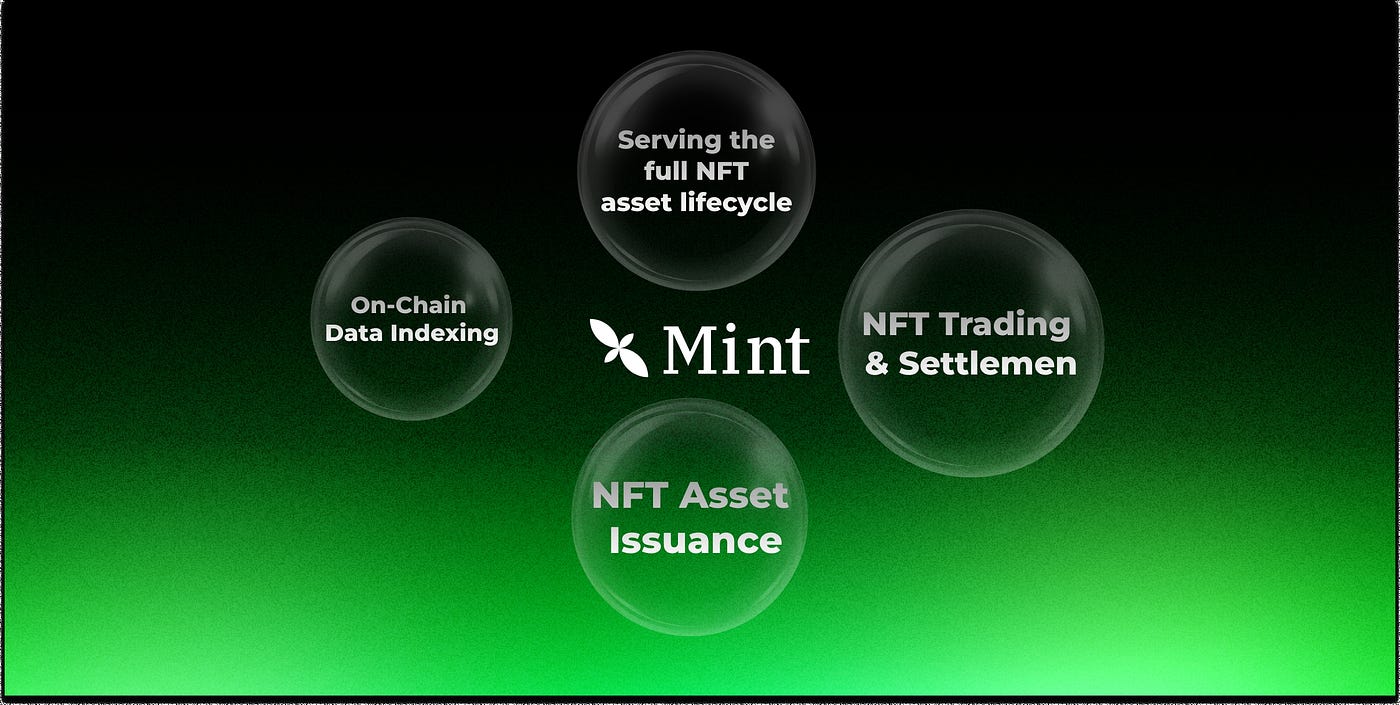
Currently, 100+ decentralized applications are live on Mint across various verticals. Mint is also building a full-stack decentralized NFT infrastructure — from issuance and trading to data indexing and lifecycle services.

In a multi-chain, application-driven Web3 world, Mint Blockchain is at the frontier — crafting a future connected through NFTs. Here, NFTs are not just digital artifacts; they’re global assets, usable by people and AI agents alike. Mint believes the true vision of NFTs is open and diverse — empowering both individuals and intelligent systems, and serving as a bridge between the real and virtual worlds.

As Layer2s evolve beyond scaling tools into engines of decentralized ecosystems, Mint stands out by focusing on NFTs with clarity and innovation. We’re only at the beginning — this is where real transformation begins.


Comments

All Comments

Recommended for you

  • US Spot Bitcoin ETF Sees $517.2 Million Net Inflow Yesterday

    On August 20, according to monitoring by Trader T, the US spot Bitcoin ETF experienced a net inflow of $517.2 million yesterday.

  • U.S. Spot Bitcoin ETF Sees Net Inflow of $517.2 Million Yesterday

    On August 20, according to monitoring by Trader T, the U.S. spot Bitcoin ETF experienced a net inflow of $517.2 million yesterday.

  • US Spot Ethereum ETF Sees $189.14 Million Net Inflow Yesterday

    On August 20, according to monitoring by Trader T, the US spot Ethereum ETF recorded a net inflow of $189.14 million yesterday.

  • US Spot Ethereum ETF Sees Net Inflow of $189.14 Million

    On August 20, according to monitoring by Trader T, the US spot Ethereum ETF saw a net inflow of $189.14 million yesterday.

  • Trump Announces Most Severe Economic Sanctions Against Iran

    On August 20, U.S. President Trump stated, 'I have given Iran more opportunities to reach an agreement than anyone else. Unfortunately, they missed that opportunity. Therefore, today, I am announcing the most severe economic sanctions ever imposed on Iran, which will be an unprecedented economic war and isolation. Iran's navy has disappeared, its air force has been destroyed, military factories are now in ruins, its currency is worthless, and the entire nation is in a precarious situation. Any country that allows its financial institutions, businesses, airports, or government entities to provide any form of assistance to Iran will face significant economic consequences. Oil smuggling, swap quotas, cash transfers, currency exchange agencies, ship registrations, shell companies—all of these must stop immediately. This will be the 'Economic D-Day,' and we need all allies to stand with the United States to isolate and defeat the threat posed by Iran. Iran will never possess nuclear weapons.' (Jinshi)

  • Trump Announces Most Severe Economic Sanctions Against Iran in History

    On August 20, U.S. President Trump stated, 'I have given Iran more opportunities to reach an agreement than anyone else. Unfortunately, they missed that chance. Therefore, today, I am announcing the most severe economic sanctions against Iran in history, which will be an unprecedented economic war and isolation. Iran's navy has vanished, its air force has been destroyed, military factories are now in ruins, its currency is worthless, and the entire nation is in a precarious situation. Any country that allows its financial institutions, businesses, airports, or government entities to provide any form of assistance to Iran will face significant economic consequences. Oil smuggling, swap quotas, cash transfers, currency exchange agencies, ship registrations, shell companies—all of these must stop immediately. This will be the 'Economic D-Day,' and we need all allies to stand with the United States to isolate and defeat this threat from Iran. Iran will never possess nuclear weapons.' (Jinshi)

  • Trump Urges Fed to Cut Interest Rates Again

    On August 20, Trump once again urged the Federal Reserve to lower interest rates as soon as possible, stating that the cost of interest rates borne by the U.S. is too high. He noted that each 1 percentage point reduction in rates equates to a cost reduction of about $600 billion and criticized the current interest rate system as 'unfair.' Trump stated that the Fed Chairman is performing well but is influenced by the 'politicization of the Federal Reserve Board.'

  • Trump Urges Fed to Cut Interest Rates Again

    On August 20, Trump once again urged the Federal Reserve to cut interest rates as soon as possible, stating that the cost of interest rates borne by the U.S. is too high. He noted that a 1 percentage point reduction in rates would equate to a cost reduction of about $600 billion, and criticized the current interest rate system as "unfair." Trump acknowledged that the Fed Chairman is performing well but is influenced by the "politicization of the Federal Reserve Board."

  • U.S. Federal Debt Exceeds $40 Trillion

    On August 20, as the U.S. government borrows at an unprecedented pace, the total national debt has surpassed $40 trillion. Despite Trump's promise to control government spending, the ever-expanding debt continues to raise concerns among investors regarding the state of U.S. public finances. According to data released by the U.S. Treasury on Wednesday, the federal debt crossed the $40 trillion threshold on Tuesday. Over the past year, the debt has increased by $3 trillion, marking the fastest growth rate in history, excluding the pandemic period. "It's like a huge warning light on a car engine," said Mark Goldwyn, senior policy director at the Committee for a Responsible Federal Budget. "This doesn't mean the engine will burn out tomorrow, but it is a clear signal that things have gotten out of control. The issue is not just the sheer size of the debt, but the speed at which we reached this level." Over the past two decades, the national debt of the United States has surged dramatically, rising from less than $6 trillion at the turn of the century to its current level. Massive public spending during the financial crisis and the COVID-19 pandemic has exacerbated the widening budget deficit. In just the past decade, the overall debt has doubled. The Congressional Budget Office projects that the federal debt held by the public will exceed 106% of GDP around 2030, surpassing the historical peak set in 1946 after World War II, and will further climb to 120% by 2036.

  • U.S. Federal Government Debt Exceeds $40 Trillion

    On August 20, as the U.S. government borrows at an unprecedented pace, the total national debt has surpassed $40 trillion. Despite Trump's promise to control government spending, the ever-expanding debt continues to raise concerns among investors regarding the state of U.S. public finances. According to data released by the U.S. Treasury on Wednesday, the federal debt crossed the $40 trillion threshold on Tuesday. Over the past year, the debt has increased by $3 trillion, marking the fastest growth rate in history when excluding the pandemic period. 'It's like a huge warning light on a car engine,' said Mark Goldwyn, senior policy director at the Committee for a Responsible Federal Budget. 'This doesn't mean the engine will burn out tomorrow, but it is a clear signal that things have gotten out of control. The issue is not just the size of the debt, but the speed at which we've reached this level.' Over the past two decades, the national debt of the United States has surged dramatically, rising from less than $6 trillion at the turn of the century to its current level. Massive public spending during the financial crisis and the COVID-19 pandemic has exacerbated the widening budget deficit. In just the past decade, the overall debt has doubled. The Congressional Budget Office projects that the publicly held federal debt-to-GDP ratio will exceed the post-World War II record of 106% set in 1946 around 2030, and will further climb to 120% by 2036.