

Cointime

Download App
iOS & Android

2022 Electric Capital Developer Report

Validated Venture

Updated: Jan 17, 2023

We fingerprinted 250 million code commits across open-source repositories to create the 2022 Developer Report.

Executive Summary

We are 14 years into the creation of open-source crypto. In the first 7 years, 1,000 monthly active developers wrote code. In the last 7 years, crypto gained over 22,000 monthly active developers.
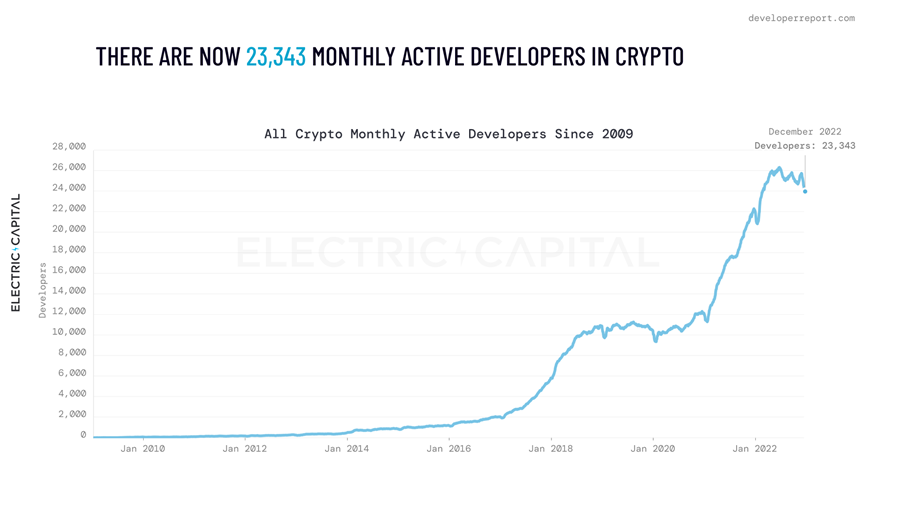
There are now 23,343 crypto monthly active developers in crypto.1. Monthly active developers grew +5% year-over-year, despite 70%+ decline in prices.

  • 23,343 monthly developers as of December 2022.
  • 471,000+ monthly code commits are made monthly toward open-source crypto.
  • +8% YoY growth in Full-Time developers. Full-Time developer growth is the most important growth signal to track because they contribute 76% of code commits.
  • All-time high of 61,000+ developers contributed code for the first time in 2022.

2. Crypto network value is back to January 2018 levels, but monthly active developers have increased +297% since 2018. Comparing the previous crypto winter to today:

  • 3x growth in Bitcoin monthly active developers, from 372 to to 946.
  • 5x growth in Ethereum monthly active developers, from 1,084 to 5,819.
  • Solana, Polkadot, Cosmos, & Polygon grew from fewer than 200 devs to 1,000+ developers.

3. Major ecosystems are emerging beyond Bitcoin and Ethereum.

  • 72% of monthly active devs work outside the Bitcoin and Ethereum ecosystems.
  • Solana, NEAR, and Polygon grew 40% YoY and have 500+ total monthly active developers.
  • Sui, Aptos, Starknet, Mina, Osmosis, Hedera, Optimism, and Arbitrum grew 50%+ YoY and have 100+ total monthly active developers.
  • 3,901 developers work in DeFi every month across multiple chains, +240% since DeFi summer. 50% of DeFi developers are outside of Ethereum.
  • 900+ developers write code monthly in NFTs across chains, +299% since 2021.

Why Developers?

An early and leading indicator of value creation in emerging platforms is developer engagement. Developers build killer applications that deliver value to end users, which attracts more customers, which then draws more developers.Because crypto is significantly open source, we have a unique and unprecedented ability to understand an emerging industry that may be worth many trillions.

300+ Contributors: Tracking the Crypto Developer Community is an Open-Source Effort

In the first Developer Report published in 2019, we only tracked 3,000 crypto ecosystems and 21,000 repos. This year we tracked over 9,000 ecosystems and over 163,000 repositories specifically dedicated to crypto, comprised of over 124 million lines of code.

  View Full PDF:https://github.com/electric-capital/developer-reports/blob/master/dev_report_2022.pdf


Comments

All Comments

Recommended for you

  • BTC Surpasses $78,000

    Market data shows that BTC has surpassed $78,000, currently priced at $78,009.99, with a 24-hour increase of 1.57%. The market is experiencing significant volatility, so please ensure proper risk management.

  • Reuters: Yangtze Memory Technologies IPO Expected to Raise 33 Billion Yuan

    On August 24, Reuters reported that Yangtze Memory Technologies Co., Ltd. (YMTC), China's largest flash memory chip manufacturer, has had its IPO application accepted by the Shanghai Stock Exchange's Sci-Tech Innovation Board. The market anticipates that the company will go public next year. This IPO is expected to raise 33 billion yuan (approximately 4.9 billion USD). CCSH plans to issue between 1.98 billion and 2.43 billion new shares. According to the prospectus, the company's revenue for the first quarter of 2026 (January to March) is projected to reach 47 billion yuan, nearly five times year-on-year growth; net profit is expected to be 33.38 billion yuan, more than double the net profit of 14.21 billion yuan for the entire year of 2025. Meanwhile, YMTC's factories are currently operating at near full capacity and are continuing to expand sales in the tightening NAND flash memory market. The average selling price of NAND flash memory in the first quarter of 2026 is expected to reach 2.73 times the average level of 2025, with gross margin rising significantly from 35.3% in 2025 to 76.8%. CCSH plans to allocate 20.8 billion yuan of the funds raised from this listing to expand production lines, and another 12.2 billion yuan for research and development of next-generation NAND flash memory and high-speed storage products.

  • Reuters: Yangtze Memory Technologies Corporation's IPO Expected to Raise 33 Billion Yuan

    On August 24, Reuters reported that Yangtze Memory Technologies Corporation (YMTC), China's largest flash memory chip manufacturer, has had its IPO application accepted by the Shanghai Stock Exchange's Sci-Tech Innovation Board. The market anticipates that the company will go public next year. This IPO is expected to raise 33 billion yuan (approximately 4.9 billion USD). CCSH plans to issue between 1.98 billion and 2.43 billion new shares. According to the prospectus, the company's revenue for the first quarter of 2026 (January to March) is projected to reach 47 billion yuan, nearly five times year-on-year growth; net profit is expected to be 33.38 billion yuan, more than double the net profit of 14.21 billion yuan for the entire year of 2025. Meanwhile, YMTC's factories are currently operating at near full capacity and are continuing to expand sales in the tightening NAND flash memory market. The average selling price of NAND flash memory in the first quarter of 2026 is expected to reach 2.73 times the average level of 2025, with gross profit margins rising significantly from 35.3% in 2025 to 76.8%. CCSH plans to allocate 20.8 billion yuan of the funds raised from this listing to expand production lines, and another 12.2 billion yuan for research and development of the next generation of NAND flash memory and high-speed storage products.

  • BTC Falls Below $77,000

    Market data shows that BTC has fallen below $77,000, currently priced at $76,992.31, with a 24-hour increase of 1%. The market is experiencing significant fluctuations, so please ensure proper risk management.

  • BTC Drops Below $77,000

    Market data shows that BTC has fallen below $77,000, currently priced at $76,992.31, with a 24-hour increase of 1%. The market is experiencing significant volatility, so please ensure proper risk management.

  • BTC Falls Below $77,000

    Market data shows that BTC has fallen below $77,000, currently priced at $76,996.84, with a 24-hour decline of 0.28%. The market is experiencing significant volatility, so please ensure proper risk management.

  • BTC Falls Below $77,000

    Market data shows that BTC has fallen below $77,000, currently priced at $76,996.84, with a 24-hour decline of 0.28%. The market is experiencing significant volatility, so please ensure proper risk management.

  • ITI Opposes FCC's Inclusion of Optical Modules in Covered List

    According to the authoritative U.S. communications media Communications Daily, the Information Technology Industry Council (ITI) formally expressed its opposition to the Federal Communications Commission (FCC) last week, urging the FCC not to include foreign-manufactured optical modules in the restricted list. This represents the latest stance of the U.S. technology industry organization on this issue, further reducing the likelihood of a blanket inclusion of optical modules in the Covered List. In its latest submission to the FCC, ITI explicitly recommended that the Covered List should continue to adopt a 'precise, risk-based' approach, focusing on entities or products with clear ties to foreign adversaries, rather than broadly covering entire categories of technology from trusted companies. More importantly, ITI specifically stated that optical transceivers should not be included in the Covered List, particularly opposing the inclusion of all foreign-produced optical modules in the restrictions.

  • ITI Opposes FCC's Inclusion of Optical Modules in Covered List

    According to the authoritative U.S. communications media Communications Daily, the Information Technology Industry Council (ITI) formally expressed its opposition to the Federal Communications Commission (FCC) last week, urging the FCC not to include foreign-manufactured optical modules in the restricted list. This represents the latest statement from the U.S. technology industry organization on the matter, further reducing the likelihood of a blanket inclusion of optical modules in the Covered List. In its latest submission to the FCC, ITI explicitly recommended that the Covered List should continue to adopt a 'targeted, risk-based' approach, focusing on entities or products with clear ties to foreign adversaries, rather than broadly covering entire categories of technology from trusted companies. More importantly, ITI specifically stated that optical transceivers should not be included in the Covered List, particularly opposing the inclusion of all foreign-produced optical modules in the restrictions.

  • Ulanqab Plans 12.5GW, Surpassing OpenAI's Stargate Target

    According to Goldman Sachs, Ulanqab, a prefecture-level city in Inner Mongolia, has committed to a total data center capacity of approximately 12.5GW, which exceeds OpenAI's initial target of 10GW for Stargate. However, only about 1.2GW is currently operational. This expansion has primarily occurred in the past year, with over 70% of the capacity commitments made in this timeframe. DeepSeek plans to build approximately 1GW of data centers, while Xiaohongshu is reportedly considering a project of around 600MW. Companies like ByteDance and Alibaba have also entered the market. The area benefits from low land and electricity costs, cold weather, and proximity to Beijing. Dedicated fiber optics have reduced the average latency from Ulanqab to Beijing to under 5 milliseconds.