

Cointime

Download App
iOS & Android

Acting AG Todd Blanche confirms ‘code is not a crime’ in DOJ pivot

Acting US Attorney General Todd Blanche said the US Department of Justice and FBI are no longer targeting blockchain developers over platforms used for illegal activity, instead shifting focus to the users engaged in financial crime.

Speaking at a Bitcoin conference in Las Vegas alongside FBI Director Kash Patel and Coinbase chief legal officer Paul Grewal on Monday, Blanche said that the approach to enforcement has significantly changed under the Trump administration.

The acting attorney general explained that as long as developers have nothing to do with illicit activity, the DOJ and FBI have no reason to go after them, noting that "we have fundamentally changed the game when it comes to our investigations."

“The basic principle is that if you are developing software, if you are a coder, if you are part of that process and you are not the third-party user, and you are not helping and knowing the third party is using what you developed to commit crimes, you are not going to be investigated and not going to be charged,” he said.

The comments mark a shift in tone from the US government, which had taken strong action against the developers of platforms like Tornado Cash. The crypto mixer and privacy protocol faced significant enforcement action over illicit activity facilitated on the platform, such as money laundering and sanctions evasion.

Tornado Cash was sanctioned by the Office of Foreign Assets Control in August 2022 before the sanctions were lifted in November 2024. Developers Roman Storm and Roman Semenov were indicted in August 2023; Storm was convicted in August 2025, while Semenov remains at large. Storm has denied any wrongdoing.
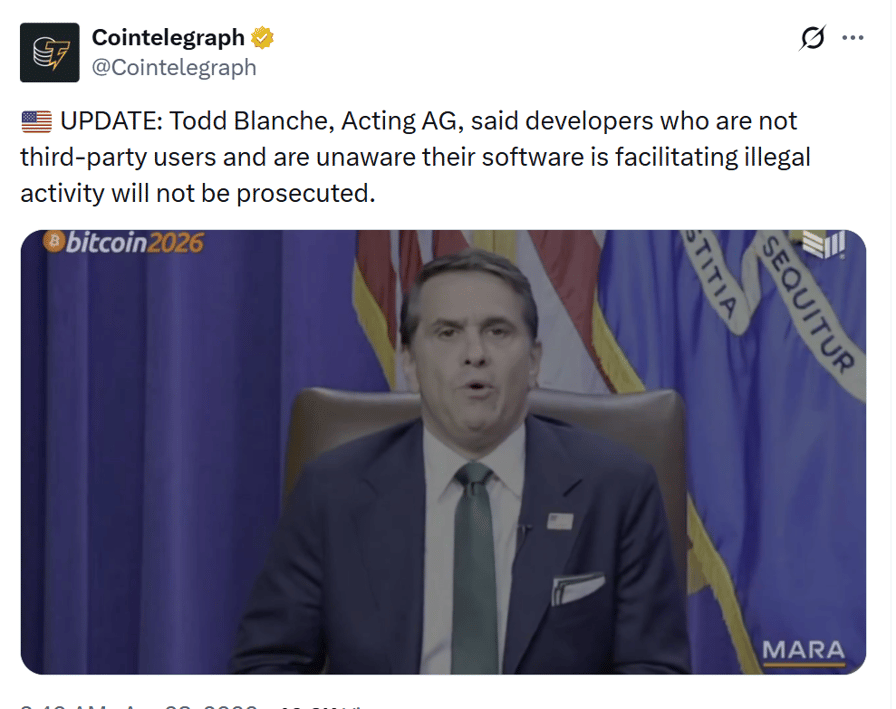
  Source: Cointelegraph

Doubts remain over DOJ’s approach

Blanche's comments were seen as positive within the crypto community, but some argued that more work needs to be done to provide developers with clarity. 

Responding to Blanche on X, Coin Center executive director Peter Van Valkenburgh said it was a “better message than developers have heard from DOJ in recent years,” but the message still leaves room for doubt. 

“But the real question is where [the] DOJ draws the line between publishing noncustodial software and ‘helping’ or ‘knowing’ about a bad user,” he said. 

Van Valkenburgh pointed to a court case in which developer Michael Lewellen sued the DOJ for pre-enforcement clarity on whether publishing his Ethereum-based crowdfunding tool constituted money transmission.  

The case was dismissed in late March, with a Texas court finding that Lewellen had failed to demonstrate that there was a credible threat of enforcement from the DOJ. 

“DOJ is publicly acknowledging that developers are still sleeping with one eye open. At the same time, DOJ is telling the courts that Lewellen should not be allowed to ask for legal clarity because there is no credible threat,” he said, adding:  

“If the law is so clear why are devs sleeping with one eye open? If the law is so clear why fight to have the case dismissed?”

The DOJ's change in approach has been taking shape for more than a year. In April 2025, Blanche released a memo explaining how the DOJ would handle enforcement differently going forward.

The memo outlines a commitment to “ending regulation by prosecution,” under which developers will not be targeted for the actions of users of their platforms or for unwitting regulatory violations.

“I do not want any platform to look at the Department of Justice or the FBI as somebody who's going to just cause them a lot of problems,” Blanche said at the Las Vegas conference. 

Comments

All Comments

Recommended for you

  • Russian Foreign Minister Lavrov: Meeting with U.S. Secretary of State Rubio Scheduled for Tomorrow

    On July 22, Russian Foreign Minister Lavrov stated that the meeting with U.S. Secretary of State Rubio has been scheduled for tomorrow.

  • Supermicro Surges Over 14% Pre-Market as Q4 Gross Margin Doubles Guidance, New Orders Exceed $60 Billion

    On July 22, AI server manufacturer Supermicro (SMCI.US) surged over 14% in pre-market trading to $29.17. On the news, the company released preliminary results for the fourth fiscal quarter ended June 30. The company's GAAP and non-GAAP gross margins are expected to be between 15% and 17%, nearly double the previously guided range of 8.2% to 8.4%. Management attributed this better-than-expected performance to favorable customer structure and product mix. Meanwhile, the company's total new orders for the quarter exceeded $60 billion, a record high.

  • US Optical Communication Stocks Fall in Pre-market, Marvell Down Over 2%

    On July 22, US optical communication concept stocks fell collectively in pre-market trading, with Astera Labs, Coherent, Credo Technology, Ciena, AXT Inc, and MaxLinear falling more than 3%, and Fabrinet, Lumentum, Corning, Applied Optoelectronics, Tower Semiconductor, Marvell Technology, POET Technologies, and GlobalFoundries falling more than 2%.

  • US AI chip stocks fall pre-market, Intel down 3%

    On July 22, US stock market AI chip stocks generally fell before the market open, with Intel down 3%, TSMC, AMD, and Qualcomm down over 2%, Broadcom down nearly 2%, and NXP and Nvidia down over 2%.

  • Russia Develops 150nm Lithography Machine, Performance Comparable to Pentium 4 from 20 Years Ago

    On July 22, according to Fast Technology, Russia's Green City Nanotechnology Center (ZNTC) has successfully developed a prototype of an electron beam lithography machine (ELL) with a design standard of 150nm. The project is a key research and development task under the framework of Russia's national plan for scientific and technological development, codenamed Progress ELL 150. This device is mainly used for manufacturing photomasks, and can also directly draw circuit patterns on substrates without using masks. The 150nm process roughly corresponds to the performance level of Intel's Pentium 4 from 20 years ago. In 2025, ZNTC demonstrated a similar device with 350nm resolution, and has now advanced to 90nm and 130nm technology nodes. Industry experts point out that such equipment is only suitable for small batch production of specialized chips in fields such as aerospace and defense.

  • Beijing State-owned Capital: Nearly 10 Billion Yuan Allocated to Stock Market from Own Funds

    On July 22, Beijing State-owned Capital Operation and Management Co., Ltd. announced that, as of now, it has allocated nearly 10 billion yuan from its own funds to invest in the stock market. Going forward, the company will continue to support listed company stocks using its own funds and through its subsidiaries, including securities firms and public funds, while also backing the development of the Beijing Stock Exchange. Rooted in its functional role as a state-owned capital operator, the firm is committed to safeguarding the strategic value of core assets of listed companies and contributing to the stable and healthy growth of the capital market through concrete actions, as a state-owned enterprise based in Beijing. (Beijing State-owned Capital)

  • U.S. Stock Futures Fall, Major Indices Decline

    U.S. stock futures are lower, with Nasdaq 100 futures down 1%, S&P 500 futures down 0.4%, and Dow futures down 0.3%.

  • Japan's Two-Year Government Bond Yield Rises to 1.47%, First Time Since 1995

    Japan's two-year government bond yield rose to 1.47%, the first time since 1995.

  • WTI and Brent Crude Surge Over 4%

    On July 22, international oil prices surged rapidly. WTI crude oil futures rose over 4% to $87.77 per barrel; Brent crude oil futures rose over 4% to $94.71 per barrel.
