

Author: Stella L ([email protected])
Data Source: Footprint Analytics Chains Research Page
January saw total market capitalization grow 7.2% to $2.8 trillion, despite mixed performance across major networks. While Bitcoin strengthened its market dominance to 71.3%, emerging platforms showed resilience amid shifting market sentiment influenced by new regulatory developments and technological breakthroughs in AI infrastructure.
Starting at $94,577, Bitcoin closed the month at $102,180, posting an 8.0% gain. Meanwhile, Ethereum showed relative weakness, declining 1.8% from $3,353 to $3,292, leading to its lowest ETH/BTC ratio since September 2024.

Major policy developments significantly influenced the crypto market’s trajectory. The Trump administration’s executive order on cryptocurrency regulation provided unprecedented clarity for the industry, particularly emphasizing the protection of self-custody rights and support for stablecoin development. However, market sentiment was tempered in the final week as new international trade tariffs raised concerns about global economic growth.
The memecoin sector experienced extraordinary volatility following the launch of $TRUMP and $MELANIA tokens on Solana. This surge in speculative activity notably diverted attention and capital from other crypto sectors, including blockchain gaming.
Technological developments also shaped market dynamics, particularly following DeepSeek’s breakthrough in artificial intelligence. This advancement accelerated interest in decentralized AI infrastructure within the crypto ecosystem, with AI-related tokens seeing an increase during the month.
January 2025 saw total blockchain market capitalization climb 7.2% to $2.8 trillion, with Bitcoin strengthening its market dominance to 71.3%. Ethereum’s share continued its downward trend to 14.0%, while Solana solidified its position ahead of BNB Chain, capturing 4.0% market share compared to BNB Chain’s 3.4%. The remaining chains collectively accounted for 7.4% of the market.
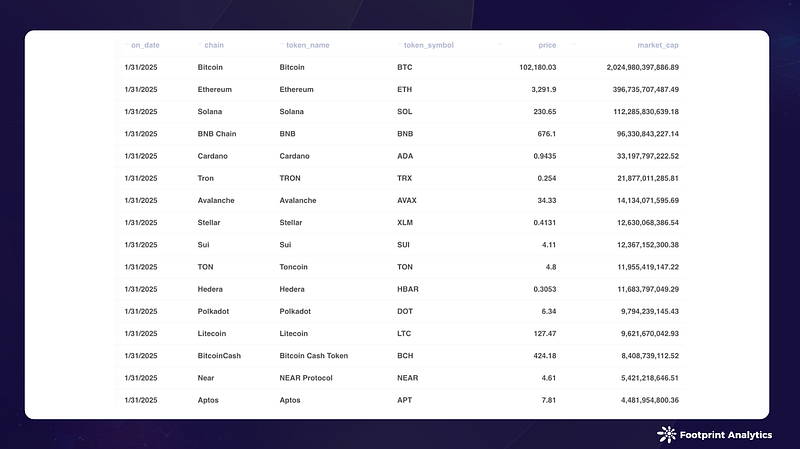
Solana continued its strong performance with a 22.0% increase in market cap to $112.3 billion, cementing its position as the third-largest blockchain by market capitalization.
Among the top 20 chains, Stellar showed notable strength with a significant market cap increase to $12.6 billion, while Litecoin and Monero posted impressive gains of 23.5% and 21.6% respectively. Cardano demonstrated resilience with an 11.9% increase in market cap to $33.2 billion.
Emerging platforms maintained their momentum, with Sui holding steady around $12.4 billion market cap despite increased competition. TON experienced a moderate decline of 14.0% to $12.0 billion market cap, though maintaining its position among the top 10 chains. Hedera showed promising growth with a 14.2% increase to $11.7 billion market cap.
Traditional Layer 1 platforms like Polkadot, Near, and Aptos faced modest pressure, with market caps declining between 3.7% and 7.5%.
January 2025 saw Bitcoin Layer 2s and sidechains maintain their growth trajectory, with total TVL reaching $2.6 billion, marking a 5.2% increase from December.
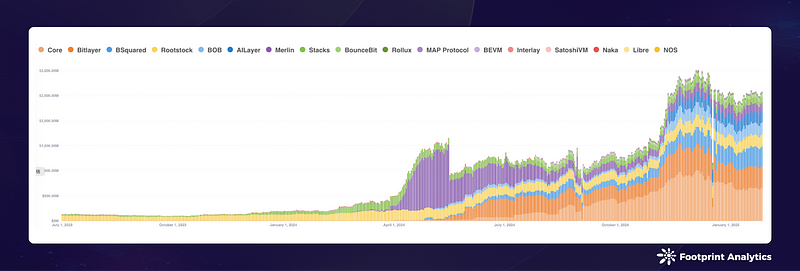
Core maintained its position as market leader with $655.1 million TVL, though experiencing a 9.3% decline from December. Despite this pullback, Core commanded 25.3% of the market share. Bitlayer strengthened its position with a 15.2% increase to $433.6 million TVL (16.8% market share), while BSquared showed impressive momentum with a 19.7% surge to $396.9 million TVL (15.3% market share).
Rootstock and BOB rounded out the top five, with TVLs of $245.7 million and $237.2 million respectively, both showing healthy growth of 10.8% and 8.9%. Notably, AILayer emerged as a significant player, achieving 13.2% growth to reach $226.9 million TVL.
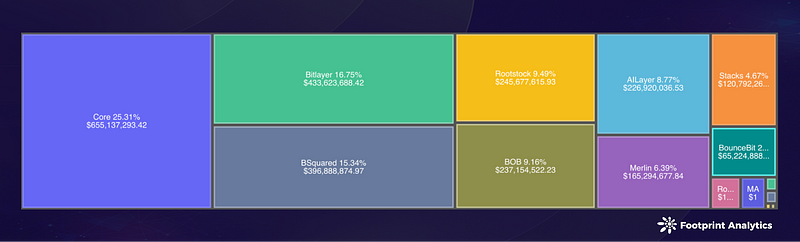
Among mid-tier platforms, Merlin experienced a modest 3.7% decline to $165.3 million TVL, while Stacks maintained steady growth with a 4.0% increase to $120.8 million. Smaller platforms showed mixed results, with BounceBit achieving 7.3% growth while newer entrants like SatoshiVM and Naka faced declines of 11.6% and 14.9% respectively.
January 2025 brought notable shifts in the Ethereum Layer 2 landscape, with total TVL reaching $18.3 billion, marking a 6.7% decrease from December. The ecosystem witnessed significant redistribution of capital as market leaders showed divergent performances.
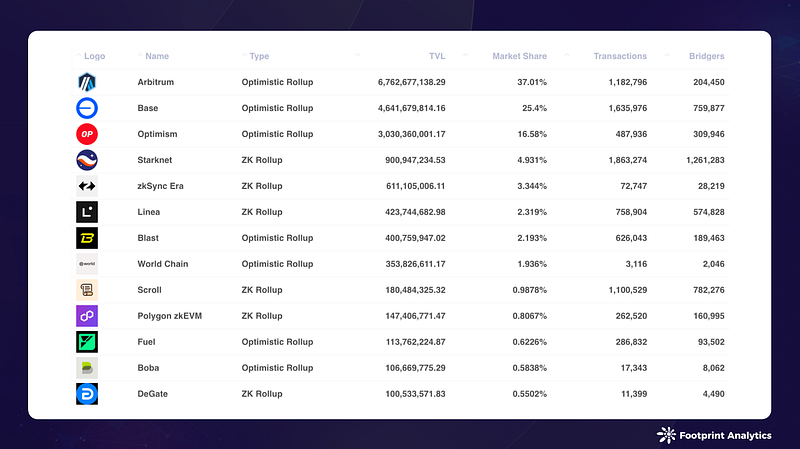
Arbitrum maintained its leadership position with $6.8 billion TVL despite a substantial 20.4% decline from December. Base continued its impressive trajectory, growing 14.0% to reach $4.6 billion TVL and solidifying its second-place position. Optimism held steady in third place with $3.0 billion TVL, showing minimal change with a 0.5% decrease.
Among the top performers, World Chain demonstrated remarkable growth with a 27.6% increase to $353.8 million TVL, while Paradex surged 50.3% to $37.2 million. ZK Rollups showed resilience, with Starknet and zkSync Era growing by 7.4% and 12.2% respectively, reaching $900.9 million and $611.1 million TVL.
Notable challenges faced some established platforms, with Blast experiencing a 33.8% decline to $400.8 million TVL and Fuel dropping 47.3% to $113.8 million. Linea and Scroll also saw modest decreases of 5.7% and 5.2% respectively.
The ecosystem’s competitive dynamics continued to evolve, with optimistic rollups and ZK rollups showing varying levels of success. Newer entrants like Metal joined the landscape, while established platforms focused on consolidating their market positions through enhanced functionality and user experience improvements.
Data for this report was obtained from Footprint Analytics’ Chains Research Page, an easy-to-use dashboard containing the most vital stats and metrics to understand the public chain industry, updated in real-time.
About Footprint Analytics
Footprint Analytics is a comprehensive blockchain data analytics platform that simplifies complex analysis for businesses and projects in the Web3 ecosystem. It offers tailored solutions that eliminate the need for extensive expertise and infrastructure maintenance. The platform provides long-term growth tools designed to help build and manage communities step by step, emphasizing sustainable growth and user loyalty. By combining powerful analytics with community management tools, Footprint Analytics enables projects to leverage blockchain data effectively for decision-making and growth strategies across various sectors including GameFi, NFT, and DeFi.
Website | X(Twitter) | Growthly | Reports | Blog | Telegram | Discord


All Comments