

Cointime

Download App
iOS & Android

Bitcoin gets ‘highly favorable’ cues as DXY sets 21-year weakness record

Key points:

  • The US Dollar Index (DXY) is below its yearly moving average and more than six points below its 200-day equivalent.
  • Bitcoin should stand to benefit from the trend thanks to its traditional inverse correlation to DXY.
  • BTC price action has yet to follow historical precedent on the dollar.

Bitcoin stands to benefit from US debt and dollar weakness as the greenback sets a two-decade record. 

New research from onchain analytics platform CryptoQuant on Tuesday reaffirms Bitcoin’s inverse correlation with the US Dollar Index (DXY).

BTC price tailwinds stack up as DXY sags

BTC price strength continues to receive a tailwind from the US dollar, which this month bounced off its lowest levels versus trading-partner currencies since early 2022.

DXY fell to 96.377 on July 1, data from Cointelegraph Markets Pro and TradingView shows — a level not seen in over three years, with the dollar strength yardstick down over 10% year-to-date.

The dubious achievements, however, do not end there; CryptoQuant reveals that versus its 200-day moving average (MA), DXY is circling a zone which it last visited more than 20 years ago.
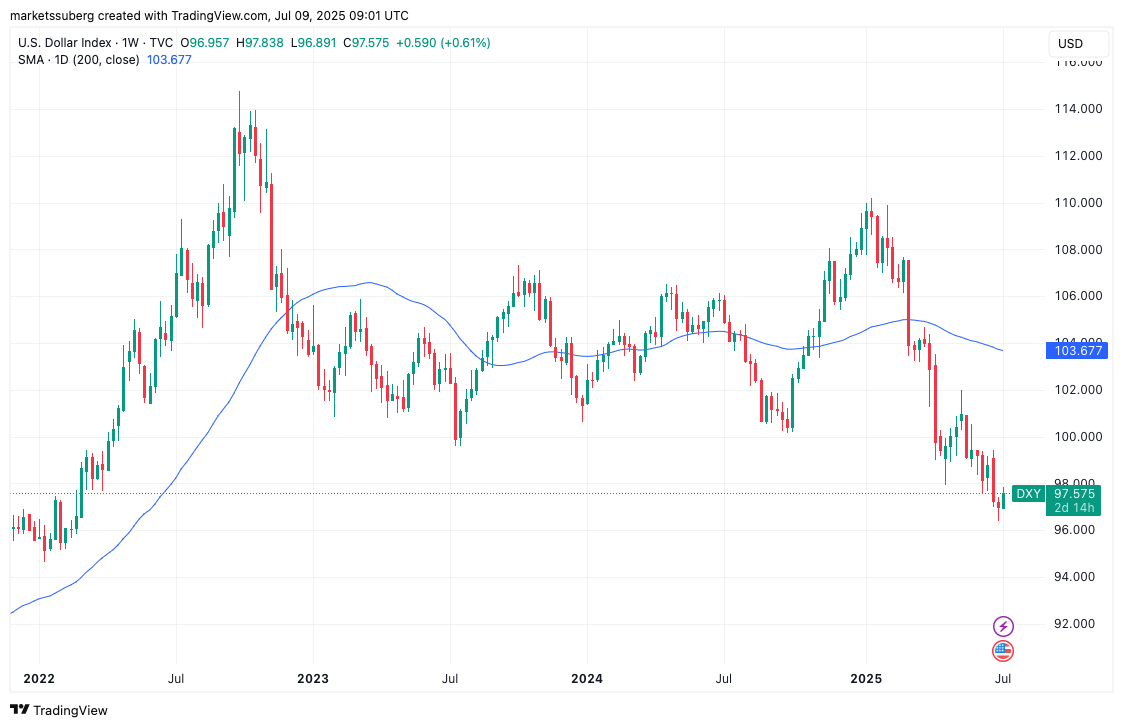
“While the US debt reaches a new all-time high, the DXY has just hit a historically weak level, currently trading 6.5 points below its 200-day moving average, marking the largest deviation in the past 21 years,” contributor Darkfost summarized in a Quicktake blog post.

“Although this may appear alarming at first glance, it actually tends to benefit risk assets like Bitcoin.”

Bitcoin has regularly demonstrated inverse correlation to DXY over its lifespan, but in recent years, the relationship has become less clear-cut.

Darkfost argued that the trend remains part of a broader risk-asset investment pattern.

“As the dollar weakens and loses its safe-haven appeal, investors reassess their portfolio allocations and shift capital toward alternative asset classes,” he said.

An accompanying chart showed the relationship between BTC price performance and the relationship of DXY to its 365-day MA.

“This chart illustrates that phenomenon by highlighting periods where the DXY trades below its 365-day moving average,” Darkfost said. 

“Looking at historical data, it becomes clear that such periods have been highly favorable to BTC. We are currently in a phase where the weakness of the DXY could fuel a new rise in BTC but the price didn't react yet.”
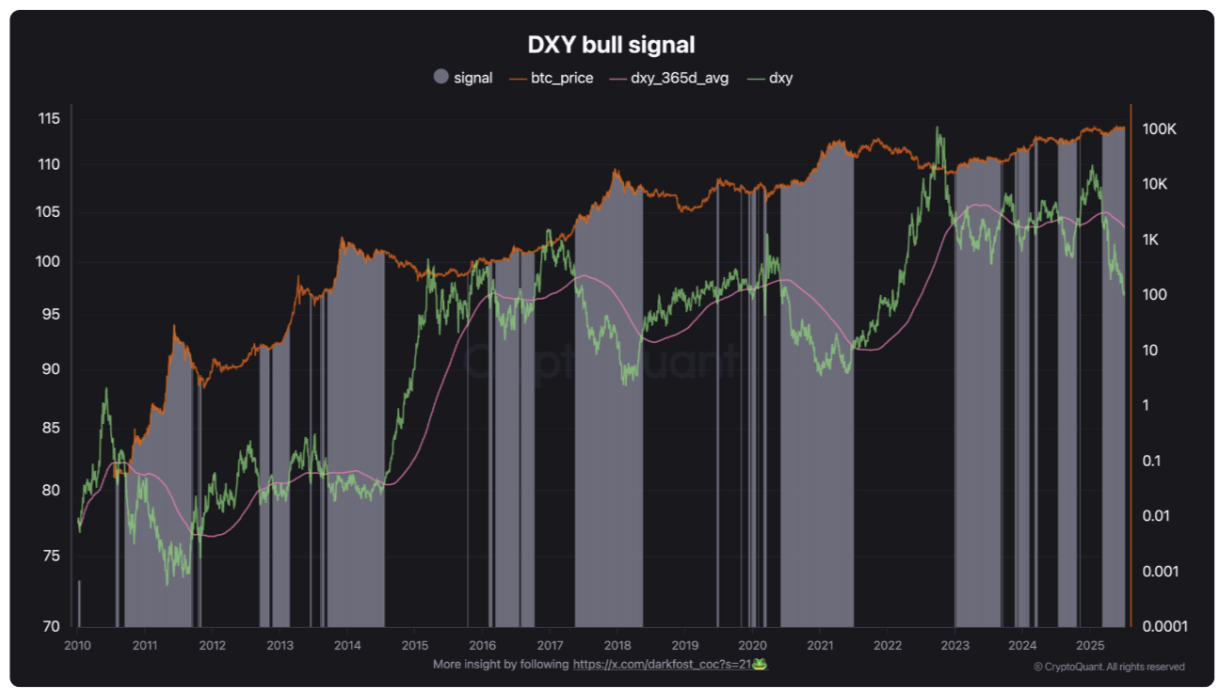
US Dollar Index (DXY) vs. BTC/USD (screenshot). Source: CryptoQuant

Dollar makes the case to own Bitcoin

As Cointelegraph reported, US dollar weakness has accelerated thanks to the implementation of US trade tariffs.

For Bitcoin proponents, it is fiat currency in general that is ceding prowess to crypto.

“If the dollar’s very strong, it makes the case to own it,” economist Lyn Alden told Cointelegraph last week on Bitcoin’s “main competition.”

“If total credit in the system and total dollars in the system are going to keep increasing over the next five, seven, ten years, that’s one of the macro factors that makes Bitcoin useful to own.”


Comments

All Comments

Recommended for you

  • U.S. July Nonfarm Payrolls Fall by 23,000, Missing Market Expectations

    On August 7, U.S. nonfarm payrolls decreased by 23,000 in July, compared with market expectations of an increase of 80,000, and the previous value was an increase of 57,000.

  • US May and June Nonfarm Payroll Additions Revised Down by 103,000 Combined

    On August 7, the US Bureau of Labor Statistics: May nonfarm payroll additions were revised down from 129,000 to 63,000; June nonfarm payroll additions were revised down from 57,000 to 20,000. After the revisions, the combined additions for May and June were 103,000 lower than previously reported.

  • U.S. Rate Futures Market Sees Lower Odds of Fed September Hike

    On August 7, the probability of a Fed rate hike in September as priced by U.S. interest rate futures declined.

  • New York Gold Futures Top $4,400 per Ounce

    New York gold futures topped $4,400 per ounce, up 2.36% on the day.

  • Japan Finance Minister: FX Market Affected by Moves Not Driven by Actual Demand

    Japanese Finance Minister Satsuki Katayama said she and U.S. Treasury Secretary Bessent agreed that the foreign exchange market has been affected by moves not driven by actual demand.

  • BTC Breaks Through $65,000

    Market data shows BTC has broken through $65,000, currently reported at $65,007.44, with a 24-hour increase of 0.6%. The market is highly volatile, please exercise risk control.

  • Brent Crude Drops 2.00% Intraday to $81.07/Barrel

    Brent crude oil fell 2.00% during the day, now at $81.07 per barrel. (Jin Shi)

  • Trump: Data Centers May Be More Important Than Oil

    August 7 news, U.S. President Trump said in an interview with Punchbowl News, "I saw the other day that Texas seems to be opposed to building data centers. I think that's a mistake. I'm not taking a position—I just think it's a mistake, because there are other communities that want to build data centers. When a community is willing to accept data centers, it means a lot of money will flow into that community. I don't think they're ugly. Some of the data centers I've seen are the most incredible buildings I've ever seen. They are very important to the economy. If Texas says no to data centers, that's a mistake, because data centers may be more important than oil."

  • Trump to Meet with Mining Executives

    On August 7, according to CCTV International News, US President Trump will convene executives from some of the world's largest mining companies at the US State Department on August 7 local time, in an effort to take action to 'secure critical mineral supplies for the US and its allies.' Reuters reported that the US urgently needs critical minerals to replenish weapons inventories depleted during the war against Iran. During the more than five-month war with Iran, the US military expended large quantities of precision-guided missiles and air defense interceptors. US defense officials and lawmakers have warned that given existing production capacity constraints, replenishing some stockpiles could take years—although the Trump administration has denied reports of a so-called 'severe shortage of ammunition stockpiles.' According to Pentagon officials and defense companies, supplies of minerals such as rare earths, tungsten, germanium, and scandium are essential for manufacturing precision-guided missiles, fighter jets, armored vehicles, infrared sensors, and other advanced weapons systems. Expected attendees include industry giants such as global mining giant Rio Tinto Group, Australia's BHP, US Freeport-McMoRan, US Mountain Pass Materials, US Rare Earths, US Energy Fuels, and Canada's Metals Company. According to sources, the Trump administration plans to announce multiple deals and memorandums of understanding.

  • US Regulators Systematically Review Chinese AI Firms' Third-Country Computing Power Leasing

    August 7 news, according to Bloomberg, people familiar with the matter revealed that the U.S. government department responsible for investigating chip export control violations is reviewing Chinese AI companies' leasing of computing power in third countries to obtain Nvidia advanced chips.