

Cointime

Download App
iOS & Android

Bitcoin’s illiquid supply could hit 8.3M by 2032: Fidelity

Around 42% of Bitcoin’s current circulating supply, or 8.3 million Bitcoin 

BTC$115,140, could be “illiquid” by 2032 at the current rate of Bitcoin treasury firm buying, according to asset management firm Fidelity. 

In a report published on Monday, Fidelity identified two groups whose supply could be considered illiquid, with the criteria being that their Bitcoin supply has ticked up each quarter or at least 90% of the time for the last four years.

Based on this, it found two cohorts: Long-term Bitcoin holders and publicly-traded companies with at least 1,000 Bitcoin, the latter of which have been growing this year. 

Bitcoin’s illiquid supply means there is less available on the open market, which could be positive for the price of Bitcoin. 

“We estimate that this combined group will hold over six million Bitcoin by the end of 2025 — or over 28% of the 21 million Bitcoin that will ever exist,” said Fidelity.

It found that long-term Bitcoin holders, defined as those who have not moved Bitcoin from their wallet in at least seven years, have not witnessed any decrease in supply since 2016.

The second group, publicly traded companies holding at least 1,000 BTC, has also generally held strong on their Bitcoin holdings, only witnessing a single quarter of supply decrease in Q2 2022. 

This cohort may also increase in the future, as there are currently 105 publicly traded Bitcoin holding companies. Currently, the publicly traded companies hold more than 969,000 BTC, amounting to 4.61% of Bitcoin’s total supply, according to data from Bitbo.
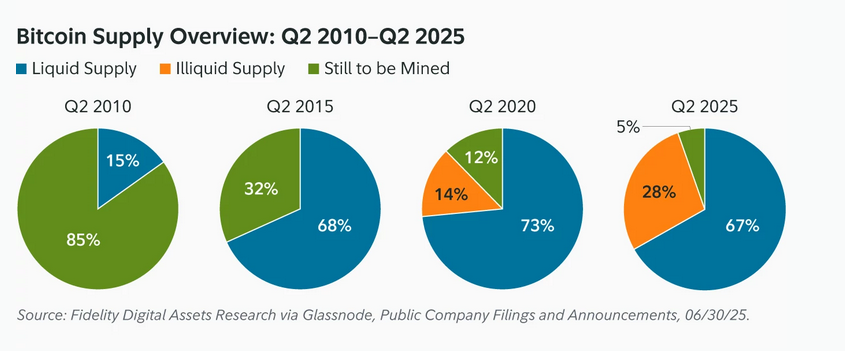
  Bitcoin’s supply has changed drastically in the past 15 years. Source: Fidelity

42% of Bitcoin supply to become illiquid

Looking ahead, Fidelity predicts that 8.3 million BTC could become illiquid by the second quarter of 2032.

The firm arrived at the figure by assuming that the group of wallets holding BTC for at least seven years will continue to increase their supply at the same rate as in the past ten years. 

The firm did not factor in additional supply shortages created by additional public companies.

“At the close of Q2 2025, Bitcoin’s circulating supply stood at roughly 19.8 million. Of that, we estimate that nearly 42% — or over 8.3 million Bitcoin — will be considered illiquid by Q2 2032.”

Potential sell-off by the whales

The report highlighted that the two groups combined now hold Bitcoin worth $628 billion at an average price of $107,700, double last year, at the end of the second quarter.

This raises the question of what will happen to the price of Bitcoin should whales start selling their BTC stack.

Bitcoin whales have collectively sold BTC worth nearly $12.7 billion in the past 30 days, which is the largest sell-off since mid-2022. Meanwhile, the price of Bitcoin has decreased by 2% in the past 30 days, according to CoinGecko.

Comments

All Comments

Recommended for you

  • US Spot Ethereum ETF Sees Net Outflow of $82.18 Million

    On June 24, according to monitoring by Trader T, the US spot Ethereum ETF experienced a net outflow of $82.18 million yesterday.

  • US Spot Bitcoin ETF Sees Net Outflow of $113.79 Million Yesterday

    On June 24, according to monitoring by Trader T, the US spot Bitcoin ETF experienced a net outflow of $113.79 million yesterday.

  • BTC Surpasses $63,000

    Market data shows that BTC has surpassed $63,000, currently priced at $63,003.99, with a 24-hour decline of 1.47%. The market is experiencing significant volatility, so please ensure proper risk management.

  • BTC Surpasses $63,000

    Market data shows that BTC has surpassed $63,000, currently priced at $63,006.88, with a 24-hour decline of 1.52%. The market is highly volatile, so please ensure proper risk management.

  • Zuckerberg Directs Meta to Develop Prediction Market Application

    On June 24, The New York Times reported that Zuckerberg has instructed Meta to develop a prediction market application. The internal name for the application is 'Arena', which is similar to Polymarket or Kalshi.

  • U.S. Senate Passes Resolution Aiming to Limit Trump's War Powers Against Iran

    On June 24, the U.S. Senate passed a resolution regarding war powers related to Iran, with 50 votes in favor and 48 against, following a similar approval by the House of Representatives. This marks the first time such a resolution has been approved by both chambers of Congress. The resolution calls for the president to end military actions against Iran without a declaration of war or authorization of force from Congress. However, since this resolution is a joint resolution of Congress, it is not legally binding and does not require the president's signature, thus serving mainly a symbolic purpose.

  • AI Smart Terminals Experience Full Explosion

    On June 23, according to CCTV Finance, at the fourth Chain Expo, the original "Digital Technology Chain" was upgraded to the "Smart Technology Chain." This change in wording reflects that artificial intelligence is becoming the main character in the industrial chain. A newly established AI zone at the event gathered leading AI companies from both domestic and international markets, showcasing the entire chain from data and computing power to applications. Various AI products were on display, including AI glasses, smart cars with digital chassis, and humanoid robots that can play soccer. CCTV Finance reporters observed that the integration of artificial intelligence into the physical world is transitioning from mobile phones and computers to various new smart terminals. This year, the application of AI agents has also experienced a full explosion. Qian Kun, Senior Vice President of Qualcomm, stated that the empowerment of AI agents is leading to a significant upgrade cycle for existing terminal devices. China's industrial chain is very complete, and through continuous collaboration with Chinese partners, their products can quickly reach the market and gain global acceptance. Liu Xiangwen, Vice President of Alibaba Cloud Intelligence Group, noted that AI has evolved from mere chatting to becoming a productive force. The development of all stacks, whether GPU cloud or CPU, is progressing rapidly, and there is still greater potential ahead.

  • U.S. Stock Indices Experience Short-Term Rally

    On June 23, the Dow Jones Industrial Average rose by 0.07%; the S&P 500 index narrowed its decline to 0.77%, having previously fallen over 1.5%; the Nasdaq Composite index also reduced its drop to 1.17%, after having been down more than 2.3% at one point.

  • Vitalik: Ethereum Foundation Budget Cut by 40%, Shifting to Long-term Fund Model

    On June 23, Vitalik Buterin revealed that the Ethereum Foundation (EF) will reduce its budget by approximately 40% this year. According to its previously announced financial management plan, EF is transitioning from a model where it spends about 15% of its remaining funds annually to a model where it will spend about 5% annually after 2030, moving towards a long-term donation-oriented organization. To this end, EF will adjust its multi-client model, relying more on AI-assisted formal verification. The PSE privacy and scalability exploration team will shift from 'exploration' to a focus on building around zero-knowledge proofs. The scale and losses of Devcon events will be reduced, and large projects beyond Ethereum itself will also decrease. EF's institutional work will focus on smaller-scale, replicable CROPS-friendly deployment cases.

  • Huo Qigang: In the AI Era, Our Own Judgment is Key

    On June 23, according to CCTV Finance, Huo Qigang stated that over the past year, the topic of AI has been overwhelming, shifting from 'not using AI' to 'having to use AI,' making him acutely aware that 'not participating will lead to elimination.' As a father, Huo Qigang candidly expressed the dilemma of whether parents should 'control' or 'assist' when their children use AI. He mentioned that he has already begun to assist with AI in his work, but emphasized that using AI does not mean bypassing the thinking process; one must rely on their own experience, thought, and logical judgment, and cannot simply replicate AI outputs.
