

Cointime

Download App
iOS & Android

Court rejects dev’s bid to shield software from money transmitter laws

A Texas court has dismissed a lawsuit filed by crypto developer Michael Lewellen, seeking a declaratory judgment that his software, Pharos, which facilitates donations to charitable crowdfunding campaigns, won’t be prosecuted for violating money-transmission laws. 

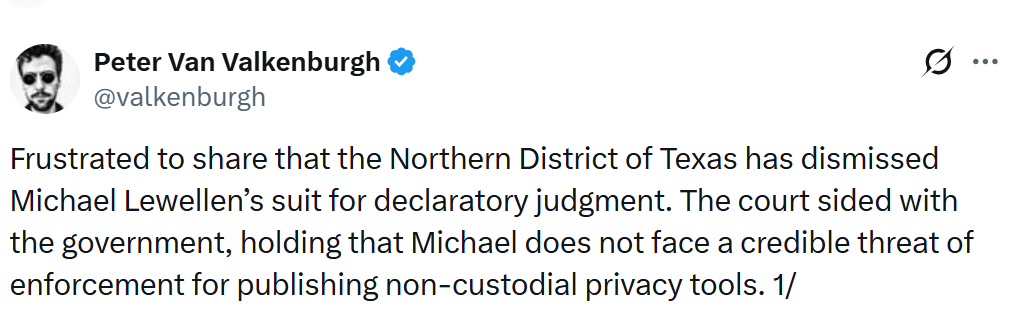
Chief US District Judge Reed O’Connor dismissed the case on Wednesday, finding that Lewellen had failed to demonstrate a credible threat of imminent prosecution. 

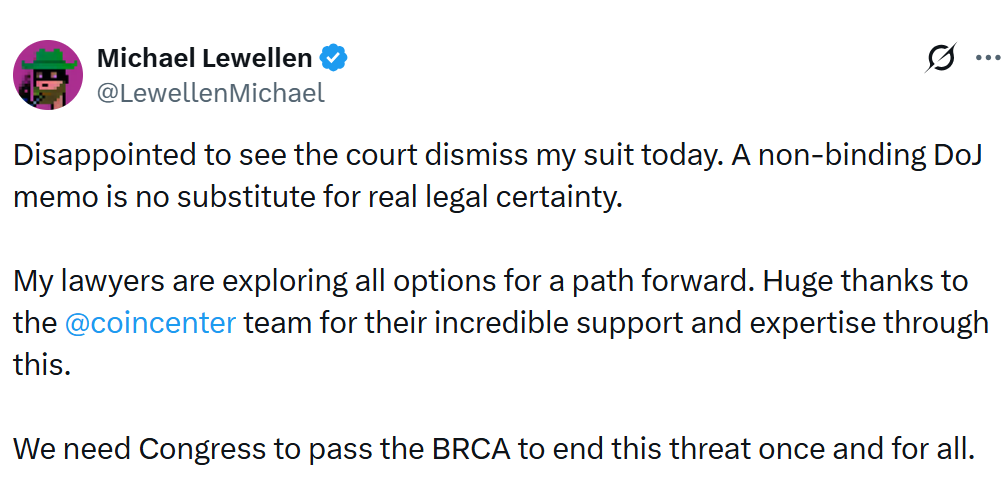
“Disappointed to see the court dismiss my suit today,” said Lewellen on X on Wednesday. 

In its dismissal, the court also cited a Department of Justice memo stating that it will no longer target virtual currency exchanges, mixing and tumbling services or offline wallets for the acts of their end users or for unwitting violations of regulations.

“A non-binding DoJ memo is no substitute for real legal certainty,” added Lewellen.

Crypto software developers are increasingly seeking legal protections to shield themselves from criminal liability over the software they create.

Other crypto software developers prosecuted 

Lewellen, a fellow at crypto advocacy group Coin Center, which backed the suit, argued in his legal complaint last January that developers of software similar to his product, such as those behind Tornado Cash and Samourai Wallet, have faced prosecution under these laws.
  Source: Michael Lewellen


Tornado Cash co-founder Roman Storm was convicted last year on charges of conspiracy to operate an unlicensed money-transmitting business. The co-founders of privacy-focused Bitcoin wallet Samourai Wallet were found guilty on the same charge — both cases cited by Lewellen as evidence of a real legal threat to developers like himself.

However, Judge O’Connor argued that the “core conduct of those cases is money laundering.” 

“By contrast, the core conduct here would be running a business. And Lewellen disclaims any knowing transmission of criminal funds, which is central to the prosecutions he invokes,” Judge O’Connor wrote.

Case dismissed for now but it might not be over  

Lewellen said his lawyers are exploring all options for a path forward. 

Judge O’Connor dismissed the case without prejudice, meaning Lewellen could pursue the same action again with certain corrections or modifications.

Peter Van Valkenburgh, the executive director at Coin Center, said the memo cited by Judge O’Connor “has not provided meaningful protection to developers, given the outcomes in the Tornado Cash and Samourai Wallet cases.”

Both Valkenburgh and Lewellen have now called for Congress to pass the Blockchain Regulatory Certainty Act of 2026.

Introduced by Senator Cynthia Lummis in January, the legislation aims to clarify that developers and providers of non-custodial software who do not control user funds are not subject to money transmitter laws.
  Source: Peter Van Valkenburgh


“So while I hope the court is right that non-custodial software developers are not at real risk, the Blanche memo is not enough to secure their rights. It is a vague enforcement signal, not a durable limit on government power,” Valkenburgh added.

“Worse, the court has now used that vague signal as a reason not to provide actual judicial clarity on the scope of developer liability. Instead of a clear rule, developers get a revocable memo and a court telling them not to worry.” 

Comments

All Comments

Recommended for you

  • Russian Foreign Minister Lavrov: Meeting with U.S. Secretary of State Rubio Scheduled for Tomorrow

    On July 22, Russian Foreign Minister Lavrov stated that the meeting with U.S. Secretary of State Rubio has been scheduled for tomorrow.

  • Supermicro Surges Over 14% Pre-Market as Q4 Gross Margin Doubles Guidance, New Orders Exceed $60 Billion

    On July 22, AI server manufacturer Supermicro (SMCI.US) surged over 14% in pre-market trading to $29.17. On the news, the company released preliminary results for the fourth fiscal quarter ended June 30. The company's GAAP and non-GAAP gross margins are expected to be between 15% and 17%, nearly double the previously guided range of 8.2% to 8.4%. Management attributed this better-than-expected performance to favorable customer structure and product mix. Meanwhile, the company's total new orders for the quarter exceeded $60 billion, a record high.

  • US Optical Communication Stocks Fall in Pre-market, Marvell Down Over 2%

    On July 22, US optical communication concept stocks fell collectively in pre-market trading, with Astera Labs, Coherent, Credo Technology, Ciena, AXT Inc, and MaxLinear falling more than 3%, and Fabrinet, Lumentum, Corning, Applied Optoelectronics, Tower Semiconductor, Marvell Technology, POET Technologies, and GlobalFoundries falling more than 2%.

  • US AI chip stocks fall pre-market, Intel down 3%

    On July 22, US stock market AI chip stocks generally fell before the market open, with Intel down 3%, TSMC, AMD, and Qualcomm down over 2%, Broadcom down nearly 2%, and NXP and Nvidia down over 2%.

  • Russia Develops 150nm Lithography Machine, Performance Comparable to Pentium 4 from 20 Years Ago

    On July 22, according to Fast Technology, Russia's Green City Nanotechnology Center (ZNTC) has successfully developed a prototype of an electron beam lithography machine (ELL) with a design standard of 150nm. The project is a key research and development task under the framework of Russia's national plan for scientific and technological development, codenamed Progress ELL 150. This device is mainly used for manufacturing photomasks, and can also directly draw circuit patterns on substrates without using masks. The 150nm process roughly corresponds to the performance level of Intel's Pentium 4 from 20 years ago. In 2025, ZNTC demonstrated a similar device with 350nm resolution, and has now advanced to 90nm and 130nm technology nodes. Industry experts point out that such equipment is only suitable for small batch production of specialized chips in fields such as aerospace and defense.

  • Beijing State-owned Capital: Nearly 10 Billion Yuan Allocated to Stock Market from Own Funds

    On July 22, Beijing State-owned Capital Operation and Management Co., Ltd. announced that, as of now, it has allocated nearly 10 billion yuan from its own funds to invest in the stock market. Going forward, the company will continue to support listed company stocks using its own funds and through its subsidiaries, including securities firms and public funds, while also backing the development of the Beijing Stock Exchange. Rooted in its functional role as a state-owned capital operator, the firm is committed to safeguarding the strategic value of core assets of listed companies and contributing to the stable and healthy growth of the capital market through concrete actions, as a state-owned enterprise based in Beijing. (Beijing State-owned Capital)

  • U.S. Stock Futures Fall, Major Indices Decline

    U.S. stock futures are lower, with Nasdaq 100 futures down 1%, S&P 500 futures down 0.4%, and Dow futures down 0.3%.

  • Japan's Two-Year Government Bond Yield Rises to 1.47%, First Time Since 1995

    Japan's two-year government bond yield rose to 1.47%, the first time since 1995.

  • WTI and Brent Crude Surge Over 4%

    On July 22, international oil prices surged rapidly. WTI crude oil futures rose over 4% to $87.77 per barrel; Brent crude oil futures rose over 4% to $94.71 per barrel.
