

Cointime

Download App
iOS & Android

Satoshi-era Bitcoin investor cashes out 80,000 BTC for $9B via Galaxy Digital

An early Bitcoin investor has sold 80,000 BTC through Galaxy Digital, in what the digital asset company described as one of the largest notional transactions in crypto history, though details regarding the date and execution price were not disclosed.

Galaxy Digital’s disclosure of the sale first appeared on PR Newswire late Friday, followed by a post on the company’s official blog about 30 minutes later. Cointelegraph reached out to Galaxy Digital for further details on the transaction, and although the company declined to comment further, they did confirm the authenticity of the press release.

Galaxy did not reveal the client’s identity but stated that the “transaction was part of the investor’s broader real estate planning strategy.”

The announcement came on a day of heightened volatility for Bitcoin, with the price briefly dipping below $115,000 on Friday, according to Cointelegraph.

Data from Lookonchain indicated several large transactions from Galaxy Digital throughout the day, totaling nearly 30,000 BTC, with most of the funds sent directly to exchanges.
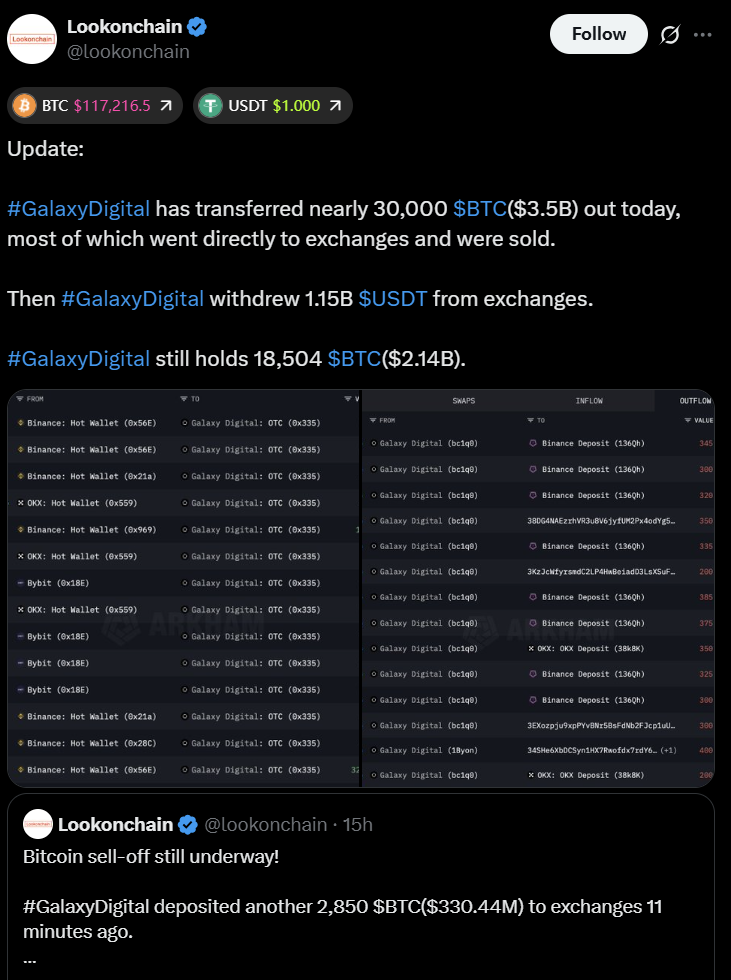
  Source: Lookonchain

These transactions were tied to a Bitcoin investor who moved 80,009 BTC from a dormant wallet earlier this month — coins that were later transferred to Galaxy, according to Lookonchain data from July 16–17.
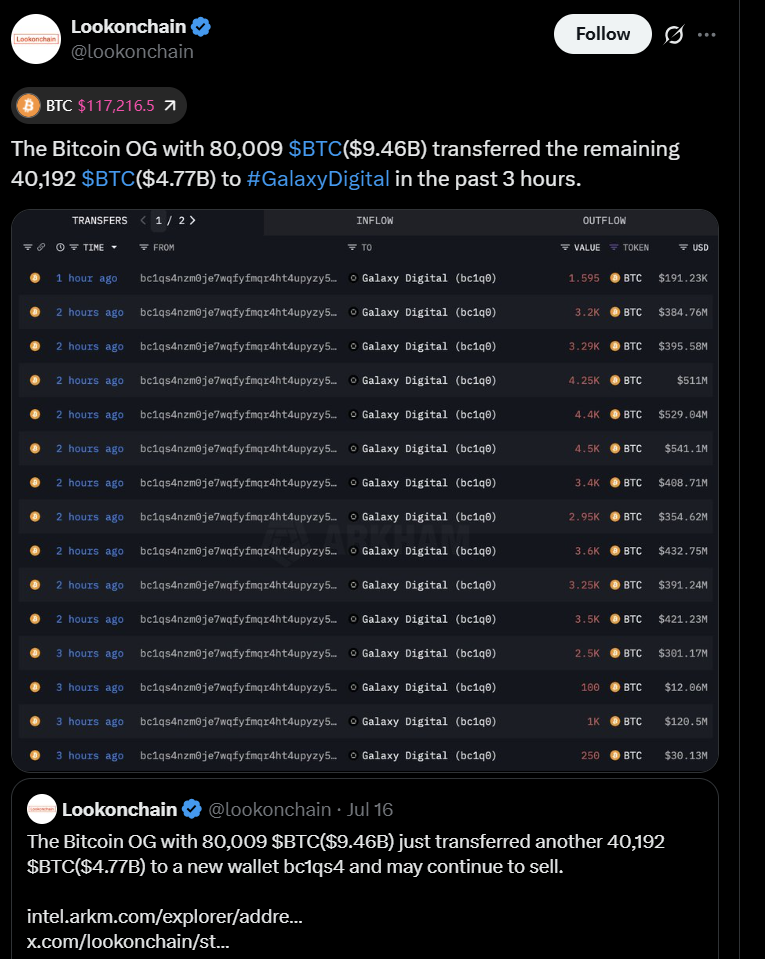
    Source: Lookonchain

Despite heightened volatility, sold coins have been “fully absorbed,” analysts say

After a brief drop of nearly 4% on Friday, Bitcoin’s price quickly rebounded and was last seen trading above $117,300, according to Cointelegraph. 

Jason Williams, analyst and author of Bitcoin Hard Money, noted that the entire sale has already been “fully absorbed by the market,” suggesting that prices are poised to move significantly higher.

“80,000 BTC, over $9 billion, was sold into open market order books, and bitcoin barely moved,” wrote Joe Consorti, head of growth at Theya, a Bitcoin custody infrastructure company.

Bitcoin’s price has surged this year, recently reaching a new all-time high above $123,000, driven by strong exchange-traded fund inflows, growing adoption in corporate treasuries and favorable regulatory developments in the United States.

Comments

All Comments

Recommended for you

  • Waller: Whether AI Causes Inflation Depends on the Federal Reserve

    On July 15, Federal Reserve Chairman Waller stated that he expects artificial intelligence to raise observable price levels in the next 12 months, and whether AI will lead to inflation depends on the Federal Reserve. He believes that AI is a long-term job creator and may have disruptive effects. Regarding the short-term impact of AI, Waller mentioned that it cannot be guaranteed that there will be no job disruptions, nor can it provide reassurance on employment issues. 'The price surge triggered by artificial intelligence is real, and I do not want to downplay it,' he said. (Jinshi)

  • Waller: Recent Inflation Data Does Not Fully Reflect Real Pressures; AI Investment Beneficial for Employment in Short Term

    On July 15, Federal Reserve Chairman Waller stated during the "Federal Reserve Semiannual Monetary Policy Report" hearing that recent inflation data does not perfectly reflect underlying inflation conditions. He noted that any central bank would be pleased when data moves in the right direction. One-off price changes do not necessarily lead to inflation. Regarding the impact of artificial intelligence, he expressed that in the short term, AI investment is beneficial for employment, and AI will trigger disruptive changes. AI investment could be very favorable for employment as the U.S. is building infrastructure. Waller mentioned that he is seeking access to a range of new AI models, and currently observes that the impact of AI on demand is faster than its impact on supply.

  • U.S. May Intend to Apply Comprehensive Economic Pressure on Iran

    Mehran Kamrava, a professor of government at Georgetown University in Qatar, pointed out that the Iranian government is "deliberately" announcing the deaths of seven soldiers in a U.S. military attack, attempting to rally national sentiment and solidify public support during wartime. He stated that Iran is experiencing a resurgence of nationalism, with authorities emphasizing the soldiers' sacrifice for the country to maintain public support for the regime. This support is crucial as Iran is deeply mired in high inflation, high unemployment, and economic losses amounting to $270 billion. Kamrava believes that Iran is aware it cannot compete militarily with the U.S., and is therefore shifting the focus of the conflict to the economic realm, with attacks on shipping being a manifestation of this strategy. The U.S. may also respond with similar measures. He noted, "Revolutions cannot occur in hunger. When the public begins to worry about their next meal, basic safety, and housing, the U.S. may attempt to exhaust Iran's economic resilience." (Jinshi)

  • Dell (DELL.N) Shares Drop 13%, Largest Intraday Decline Since April 2025

    Dell (DELL.N) shares have fallen by 13%, marking the largest intraday decline since April 2025.

  • Philadelphia Semiconductor Index Drops Over 3%

    On July 15, the Philadelphia Semiconductor Index fell by more than 3%. Among the component stocks, Micron Technology dropped nearly 8%, while Intel and AMD fell over 5%. KLA and Lam Research declined by over 4%, and Applied Materials decreased by nearly 4%. GlobalFoundries dropped nearly 3%, and Texas Instruments, Microchip Technology, and ON Semiconductor fell over 2%. TSMC, Qualcomm, NVIDIA, and ASML all dropped over 1%.

  • U.S. Stock Market Sees Major Drop in Memory Chip Stocks: SanDisk Falls Over 13%, SK Hynix Drops Over 10%

    On July 15, memory chip stocks in the U.S. market experienced a significant decline, with SanDisk falling over 13%, SK Hynix dropping over 10%, Seagate Technology down by 9%, Western Digital decreasing by over 8%, Micron Technology and Nanya Technology both falling over 7%, and Rambus dropping over 4%.

  • Microsoft Executive VP: Anthropic's Product Slower and Less Accurate than Copilot

    Jacob Andreou, Microsoft's Executive Vice President, compared the company's flagship AI assistant Copilot with Anthropic's Claude used in Microsoft Office products. He stated that Anthropic's product is slower, less accurate, and lacks proper safety integration. During the presentation, Andreou said, 'We know that everyone here is competing daily with products from OpenAI and Anthropic.' He added that his team is working to make the Copilot application more competitive. (Bloomberg)

  • Sources: Apple Reportedly Seeking to Acquire AI Chip Business

    On July 15, sources familiar with Apple's operations indicated that the company is looking to acquire a chip company to bolster its efforts in building server chips for artificial intelligence. In recent months, the iPhone manufacturer has been in discussions with bankers regarding potential deals. The sources also mentioned that Apple has reached out to semiconductor startups to gauge their interest in selling. This move to acquire chips comes amid performance issues with the company's internal AI servers.

  • SK Hynix ADR Declines Narrowed to 3.3%

    On July 15, SK Hynix's stock price decline narrowed to 3.3%, trading at $187.445 per share, with a total market capitalization of $1.37 trillion. At one point during the early trading hours, SK Hynix's U.S. stock fell by as much as 9%.

  • U.S. Stock Decline in Memory Chip Sector Worsens: SanDisk Drops 10%, Micron Falls Over 5%

    On July 15, the decline in U.S. memory chip stocks further intensified, with SanDisk plummeting by 10%. Western Digital and Seagate Technology both fell by over 7%, SK Hynix dropped by over 6%, and Micron Technology decreased by over 5%.
