

Cointime

Download App
iOS & Android

Polymarket drops USDC.e for USDC-backed token in exchange overhaul

Prediction platform Polymarket is overhauling its exchange infrastructure in the coming weeks, introducing a new collateral token and upgraded trading system that give the platform greater control over settlement and risk as it moves toward closer alignment with US regulatory expectations.

In an announcement on Monday, Polymarket said it will deploy new exchange contracts — dubbed version 2 — designed to simplify how orders are structured and matched. The upgrade is intended to make trading more efficient and to make it easier for developers to connect apps and trading bots to the platform.

The new system will also support EIP-1271, an Ethereum standard that allows smart contract-based wallets, such as multisigs and automated trading systems, to sign transactions, expanding compatibility beyond traditional wallets.

A central component of the upgrade is the introduction of Polymarket USD, a new collateral token that will replace USDC.e, the bridged version of USDC previously used on the platform. The new token is fully backed 1:1 by USDC, giving Polymarket more direct control over its settlement layer while reducing reliance on bridged assets.

For most users, the transition will be handled automatically through the platform’s interface, requiring only a one-time approval.

The upgrade is expected to roll out over the next few weeks, though the company has not provided a specific timeline.

  Source: Polymarket


US regulatory approval shapes Polymarket expansion

The move follows Polymarket’s broader efforts to curb manipulation and insider-trading risks, as it seeks to strengthen market integrity and align more closely with US regulatory standards.

In November, Polymarket received approval from the Commodity Futures Trading Commission to operate an intermediated trading platform in the United States, clearing the way for its return after previously exiting the market.

Following that approval, Polymarket said it plans to onboard brokers and customers directly and facilitate trading through regulated US venues.

Interest in prediction markets has continued to grow, with users increasingly turning to these platforms to trade on real-world outcomes tied to politics, markets and policy. Industry data shows Polymarket’s fee revenue increasing in recent weeks after the platform expanded trading fees.
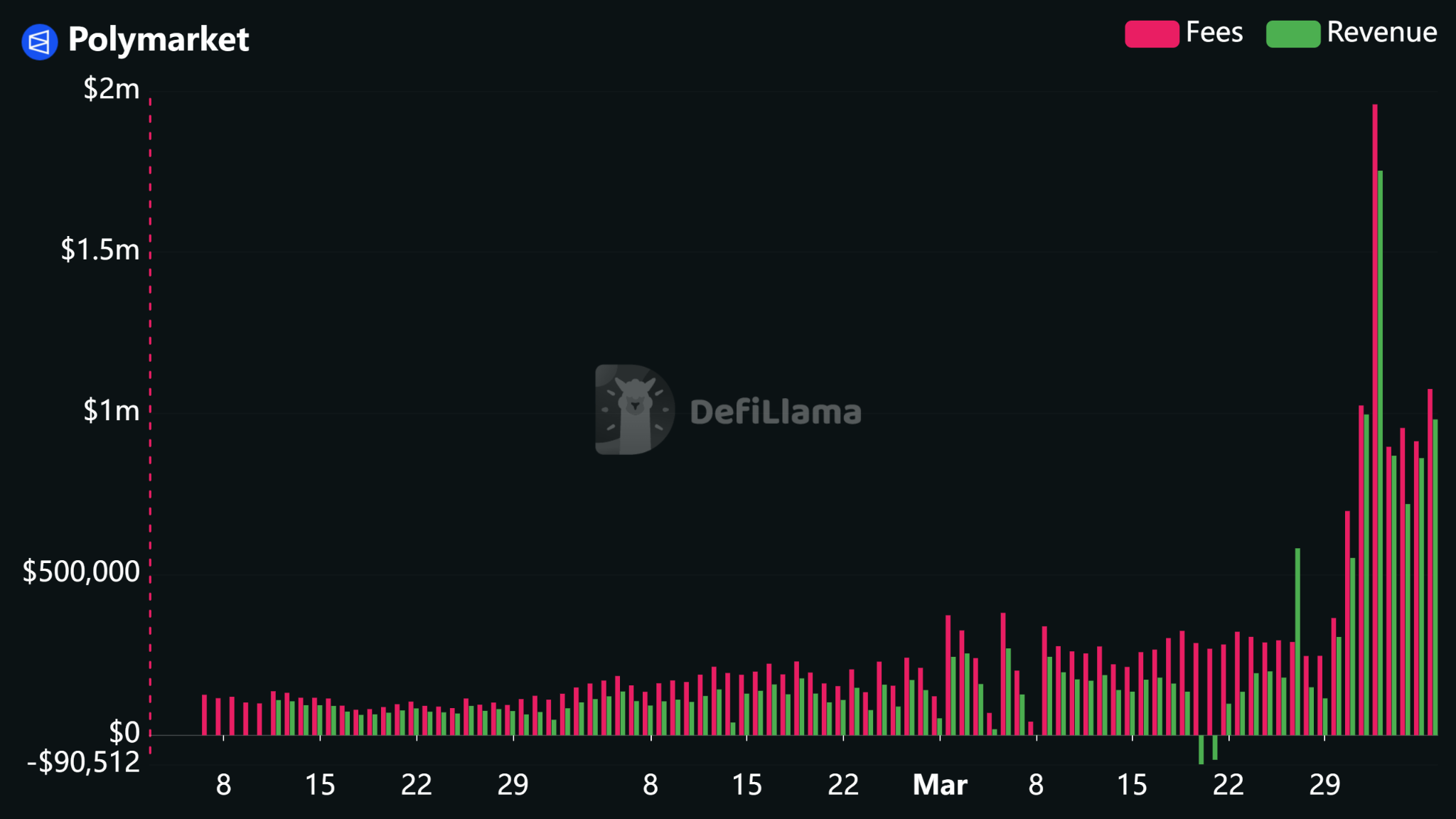
  Polymarket’s fees and other revenue have climbed sharply since the end of March. Source: DeFiLlama
Comments

All Comments

Recommended for you

  • US Spot Bitcoin ETF Sees Net Outflow of $120.2 Million Yesterday

    On September 10, according to monitoring data from Farside Investors, the US spot Bitcoin ETF experienced a net outflow of $120.2 million yesterday.

  • US Spot Bitcoin ETF Sees Net Outflow of $120.2 Million Yesterday

    On September 10, according to monitoring data from Farside Investors, the US spot Bitcoin ETF experienced a net outflow of $120.2 million yesterday.

  • US Spot Ethereum ETF Sees $34.7 Million Net Inflow Yesterday

    On September 10, according to monitoring data from Farside Investors, the US spot Ethereum ETF saw a net inflow of $34.7 million yesterday.

  • Iran Announces Escalation of Strikes in Response to U.S. Attacks

    On September 10, it was reported that an Iranian official stated that Tehran is prepared to engage in a more intense conflict with the United States if necessary. The official indicated that Iran would respond to U.S. attacks with escalated strikes. Iran views this conflict as a 'battle for survival.' The official remarked that Iran has 'no choice but to fight.'

  • Iran to Intensify Strikes in Response to U.S. Attacks

    On September 10, it was reported that an Iranian official stated that Tehran is prepared to engage in a more intense war with the United States if necessary. The official indicated that Iran will escalate its strikes in response to U.S. attacks, viewing this conflict as a 'battle for survival.' The official remarked that Iran has 'no choice but to fight.'

  • U.S. Treasury Announces Debt Buyback Size: Up to $6 Billion

    On September 9, the U.S. Treasury will buy back up to $6 billion in long-term bonds on Thursday. Previously, the U.S. Treasury indicated that before November 4, the size of a single long-term bond buyback would at least double to $4 billion.

  • U.S. Treasury Announces Debt Buyback Size: Up to $6 Billion

    On September 9, the U.S. Treasury will buy back up to $6 billion in long-term bonds on Thursday. Previously, the U.S. Treasury stated that before November 4, the size of a single long-term bond buyback would at least double to $4 billion.

  • Bank of America Reports Sixth Largest Weekly Inflow into US Stocks Since 2008, Driven by Institutions and Hedge Funds

    Data from Bank of America shows that last week, the US stock market recorded its sixth largest weekly inflow since 2008, marking the largest scale since mid-July. Bank of America strategist Jill Carey Hall noted that this round of inflows was primarily driven by institutional investors and hedge fund clients, with net purchases of US stocks for the second consecutive week. The funds mainly flowed into individual stocks and equity ETFs. In terms of sectors, 8 out of the 11 sectors in the S&P 500 saw net inflows, with the technology sector leading the gains, and the communication services sector receiving inflows for the first time in five weeks. The industrial sector experienced the largest outflow, facing selling pressure for the fifth consecutive week, with Hall stating that this sector is the most competitive and has the highest costs. In terms of stock preferences, clients favored large and mid-cap stocks while selling small-cap stocks. In contrast to professional institutions, retail clients have been net sellers of stocks for six consecutive weeks.

  • Bank of America Reports Sixth Largest Weekly Inflow into US Stocks Since 2008, Driven by Institutions and Hedge Funds

    Bank of America data shows that last week the US stock market recorded its sixth largest weekly inflow since 2008, marking the largest scale since mid-July. BofA strategist Jill Carey Hall noted that this round of inflows was primarily driven by institutional investors and hedge fund clients, with net buying of US stocks for the second consecutive week, focusing mainly on individual stocks and equity ETFs. In terms of sectors, 8 out of the 11 sectors in the S&P 500 saw net inflows, with the technology sector leading the gains, while the communication services sector recorded its first inflow in five weeks. The industrial sector experienced the largest outflow, facing selling for the fifth consecutive week, with Hall stating that this sector is the most competitive and has the highest costs. In terms of stock preferences, clients favored large and mid-cap stocks while selling small-cap stocks. In contrast to professional institutions, private clients have been net sellers of stocks for the sixth consecutive week.

  • U.S. Department of Justice and Treasury Target Xinbi, Seizing $52 Million in Crypto Assets

    On September 9, the U.S. Department of Justice and the Treasury took law enforcement action against the illegal scam service market Xinbi, seizing and restricting the disposal of over $52 million in cryptocurrency assets. This brings the total assets restricted by the task force to approximately $938 million. Tether assisted in the investigation. The Justice Department accused Xinbi of operating via Telegram, providing investment scam websites and money laundering services to scam groups. Law enforcement has seized its Telegram channel and two wallets holding about $12 million in cryptocurrency, and restricted the disposal of an additional 47 related wallets. The U.S. Treasury's Office of Foreign Assets Control has designated Xinbi as a significant transnational criminal organization and sanctioned two related entities. The task force also assisted Madagascar in shutting down 13 scam hubs, processing over 3,200 electronic devices, and arresting nearly 400 individuals.
