

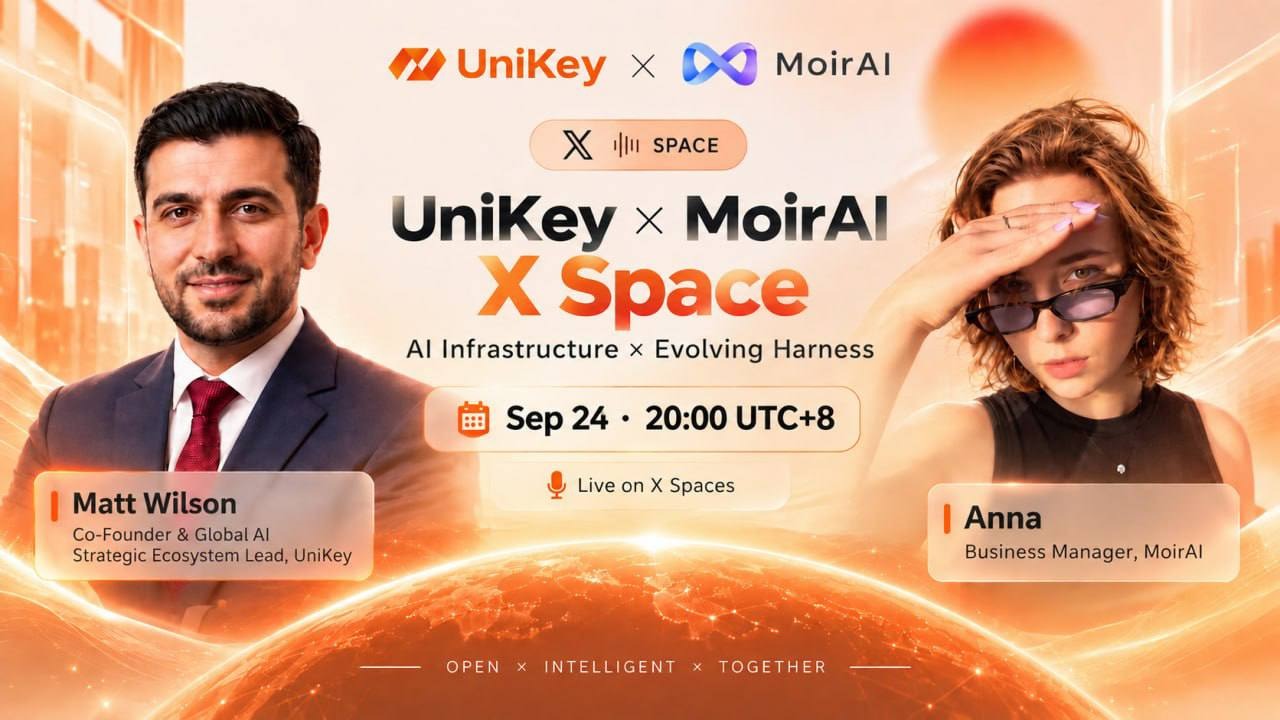
On September 24, UniKey and MoirAI hosted a joint X Space under the theme “AI Infrastructure × Evolving Harness.” The conversation featured Matt, Co-Founder and Global AI Strategic Ecosystem Lead at UniKey, and Anna, Business Manager at MoirAI. Together, they explored the evolution of AI infrastructure, AIGC, Agents, Harnesses, Bittensor’s distributed evolution model, and the broader transition toward next-generation AI production systems.
Rather than focusing on a single product announcement, the discussion centered on a larger structural shift taking place across the AI industry. As language models, image and video generators, multimodal APIs, coding agents, browser agents, MCP tools, and increasingly complex workflows continue to expand, the central question is moving beyond “Which model is better?” The more important question is becoming: how can all of these capabilities be organized into systems that are actually capable of completing real work?
As Models Multiply, Execution Becomes the Scarce Layer
For the past several years, most AI narratives have revolved around models: larger context windows, stronger reasoning, better coding, higher image quality, longer video generation, and more powerful multimodal understanding. But the practical problem facing users is beginning to change. A creator, an enterprise, or an autonomous Agent often needs several different models and tools to complete a single task. Each platform introduces its own prompt structure, API format, billing system, context limits, file formats, and workflow logic. As model capabilities expand, the production stack can actually become more fragmented rather than simpler.
MoirAI focuses on the layer above individual models. Instead of building another isolated generation tool, MoirAI is developing an evolving AIGC Harness that organizes Agents, Models, Tools, and Workflows within a unified execution environment. The user should not have to begin by deciding which model to open. The process should begin with the outcome they want to achieve. From there, the system can interpret the objective, create a blueprint, choose the right Agents, models, and tools, generate candidates, manage targeted refinements, and ultimately deliver finished outputs. This is the idea behind MoirAI’s core expression: From one sentence to finished work.
Harness Is Emerging as the Execution Layer of the Agent Era
One of the key discussions during the Space focused on the relationship between Models, Agents, and Harnesses. A model provides intelligence. It can reason, write, generate images or video, produce code, understand multimodal inputs, and use tools. An Agent represents a more goal-oriented execution unit. But real tasks usually require far more than a single model response. They require persistent context, session management, tool calls, failure recovery, candidate comparison, multi-Agent coordination, and reliable information transfer across many different stages of a workflow.
This is where the Harness becomes critical. In AIGC, the need is especially obvious. A 30-second commercial may require concept development, script writing, storyboarding, reference images, video generation, voice, subtitles, and multiple rounds of editing. Those capabilities are often distributed across different models and tools. The future creative experience will therefore not be defined by a single image generator or video generator, but by AI-native production systems that can understand a project, coordinate capabilities, preserve context, and support continuous refinement. Models provide intelligence; the Harness turns that intelligence into execution.
UniKey × MoirAI: From Capability Access to Workflow Execution
This is where the strategic relationship between UniKey and MoirAI becomes especially clear. UniKey is building a unified AI Gateway that combines model access, AI Router, Credits, Agent capabilities, Skills, Workflows, Marketplace infrastructure, and Settlement. The long-term objective is not simply to aggregate hundreds of models, but to make AI capabilities accessible, programmable, composable, and eventually economically interoperable across users, developers, enterprises, and autonomous Agents.
MoirAI takes those capabilities into the next layer: orchestration and execution. During the Space, the collaboration was summarized through a simple flow: Models & AI Capabilities → UniKey Gateway → MoirAI Harness → Agents & Workflows → Finished Work. UniKey provides access to a broader intelligence layer, while MoirAI determines how that intelligence should be organized into executable Agents, Tools, and Workflows around a specific task. In this model, the user experience evolves from “choose a model” toward “describe an outcome,” while the underlying complexity is increasingly absorbed by infrastructure.
Distributed Evolution Turns the Network Into Part of Product Development
Another defining aspect of MoirAI is the way its product evolution model is connected to Bittensor Subnet 115. The AI Harness ecosystem is evolving extremely quickly. Projects such as OpenClaw, DeepSeek Harness, Hermes Agent, OpenCode, NemoClaw, and Codex Harness continue to introduce improvements across session persistence, sandboxing, MCP integration, context management, delegation, browser automation, model adapters, and long-running Agent reliability. A small centralized team cannot realistically discover, evaluate, and integrate every valuable development at the speed the ecosystem is moving.
MoirAI therefore brings capability discovery and capability validation into a distributed network. Miners can propose new Workflows, Tools, Model Adapters, AIGC Templates, Agent capabilities, or improvements inspired by other open-source Harness projects. Validators then test whether those proposals create measurable value in real tasks. Do they improve task completion? Are they stable? Do they produce better workflows? Only capabilities that demonstrate real value should move forward. This creates the evolution loop MoirAI describes as PROPOSE → VALIDATE → MERGE → EVOLVE. The long-term objective is not to release a static “finished” product, but to make the network itself part of the product development process.
AIGC Is Moving From Generators to Production Systems
Anna highlighted three major changes shaping the next phase of AIGC. The first is the shift from one-shot generation toward controllable creation. Early image generation largely relied on writing prompts and selecting from randomized outputs. Today, creators expect reference images, identity preservation, product consistency, localized editing, outpainting, style control, and consistent asset generation. Video is moving along the same path, with greater emphasis on character consistency, camera movement, scene continuity, first- and last-frame control, environment, and duration.
The second shift is the rise of multimodal orchestration and persistent creative environments. A complete campaign may include text, images, video, voice, music, presentations, landing pages, and social content, and no single model will always be the best choice for every task. At the same time, image platforms are adding editing, video platforms are becoming timelines and workspaces, and language models are increasingly generating documents, presentations, applications, and interfaces. Eventually, creators may stop thinking in terms of “using an image generator” and instead work inside AI-native production environments. The role of the Harness is to make those different models and tools collaborate continuously inside the same project context.
From a Model Economy to an AI Capability Economy
Matt extended the discussion by describing a future AI Capability Economy. A Model is a capability. An Agent is a capability. A Workflow is a capability. A Skill is a capability. As the AI ecosystem becomes increasingly modular, these capabilities will be discovered, invoked, combined, paid for, and settled dynamically. UniKey’s work around Credits, AI Router, Marketplace infrastructure, and Settlement is being developed around this longer-term direction.
MoirAI adds the layer that turns those capabilities into production. The most important question is not whether one particular model remains the strongest forever. Models will change. Tools will change. Agents will change. What matters is whether infrastructure can continuously absorb better capabilities without forcing users to rebuild their workflows every time the technology stack changes. UniKey aims to make the capability layer increasingly open and accessible, while MoirAI aims to make the Harness continuously better at organizing and executing those capabilities. The shared goal is simple: the user expresses the objective, and the infrastructure handles the complexity.
Keep the Complexity in the Infrastructure, and the Outcome With the User
The Space ultimately returned to one central conclusion: the next stage of AI competition will not take place only at the model layer. Models will continue to provide Intelligence, but real AI production requires infrastructure capable of connecting, routing, organizing, executing, and eventually settling the value generated by those capabilities. UniKey is building the Gateway and Capability Infrastructure, while MoirAI is building an evolving Harness that organizes Models, Agents, Tools, and Workflows into an execution system.
Truly mature AI infrastructure should allow the technology underneath to become more sophisticated while the user experience becomes simpler. Users should not need to understand how many models were called, which tools were used, or which Agents completed each step. They should be able to express a goal while the system manages everything from Idea to Workflow to Finished Work. That is the shared direction captured at the end of the Space: Connect Intelligence. Orchestrate Capabilities. Deliver Work.


All Comments