

Preface: Beyond TPS — Seeking “Certainty” in On-Chain Finance
In the landmark research article Enabling the future of onchain markets: The role of predictability published by leading venture firm a16z, the authors advance a piercing diagnosis of the industry’s core pain point: for decentralized finance, the “predictability” of transactions is far more critical than raw “throughput (TPS).”
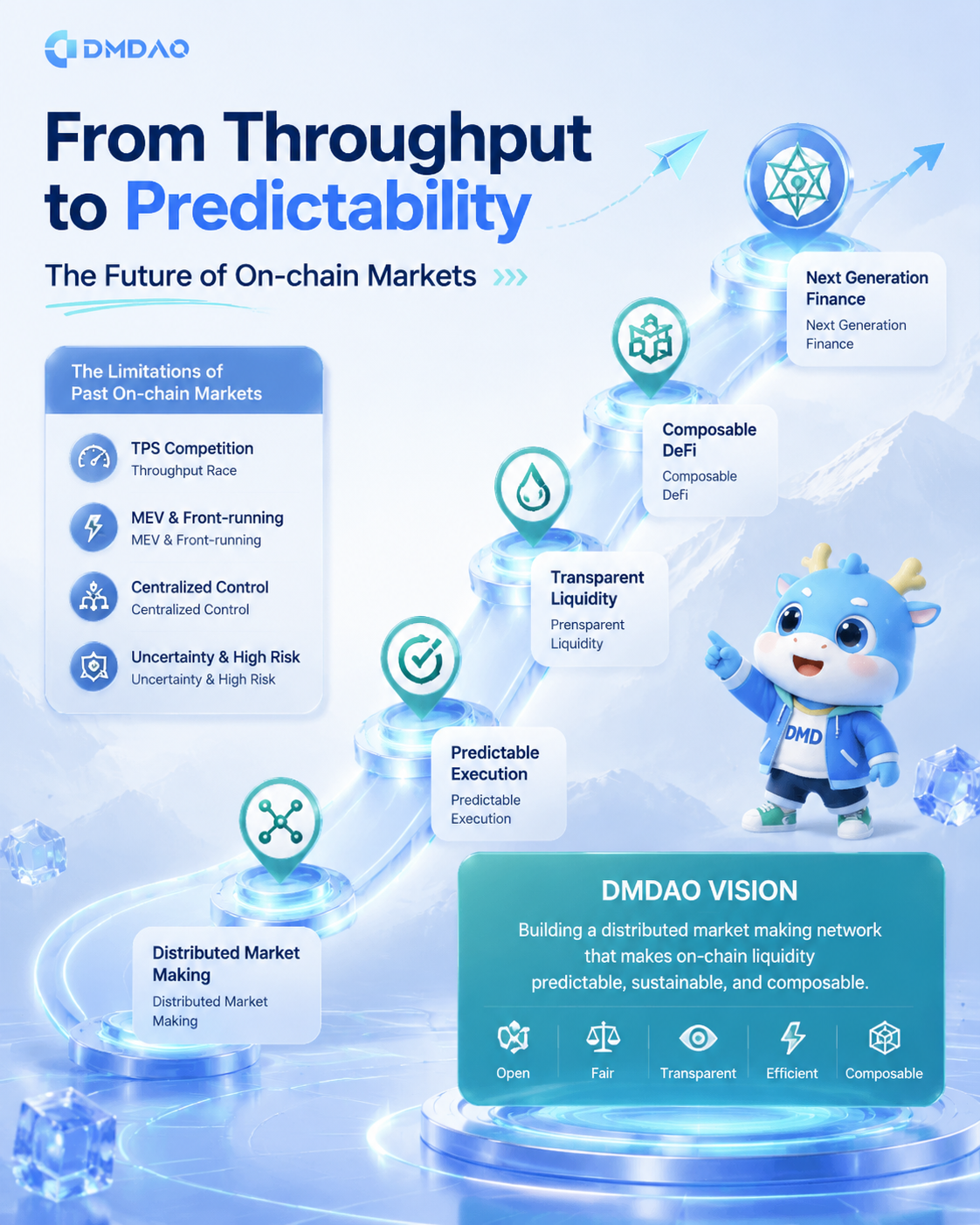
For far too long, the blockchain sector has fallen into the trap of blindly stacking TPS while neglecting the most fundamental logic of financial markets — the certainty and fairness of trade execution. Under the traditional single-leader block-production model, validators possess the privilege to censor transactions, front-run orders, or extract MEV (Maximal Extractable Value). This “second-level uncertainty” forces professional market makers providing liquidity on-chain to confront severe adverse-selection risk, compelling them to widen bid-ask spreads and ultimately eroding the competitiveness of the entire on-chain financial ecosystem.
How can this systemic impediment arising from concentrated privilege be dismantled? DMDAO is delivering a definitive answer through algorithms and distributed protocol design.
I. The DMDAO Distributed Market-Making Protocol: Inherent Censorship Resistance and Inclusion Guarantees
The a16z article identifies the first core objective for next-generation on-chain financial infrastructure as “short-term censorship resistance” — ensuring that valid user transactions are packed indiscriminately within an extremely short window, free from delay or exclusion caused by the malicious behavior of any single node.
This is precisely the foundational design philosophy of the DMDAO Distributed Market-Making Protocol.
Traditional DEX models frequently rely heavily on centralized order matching or a single block-producing node, rendering market makers’ order cancellations and placements highly vulnerable to interception by sandwich bots or block producers. From day one, DMDAO discarded the single-point-of-control mindset. Through a decentralized network of distributed market-making nodes working in deep coordination with the Matrix Prime intelligent computing system:
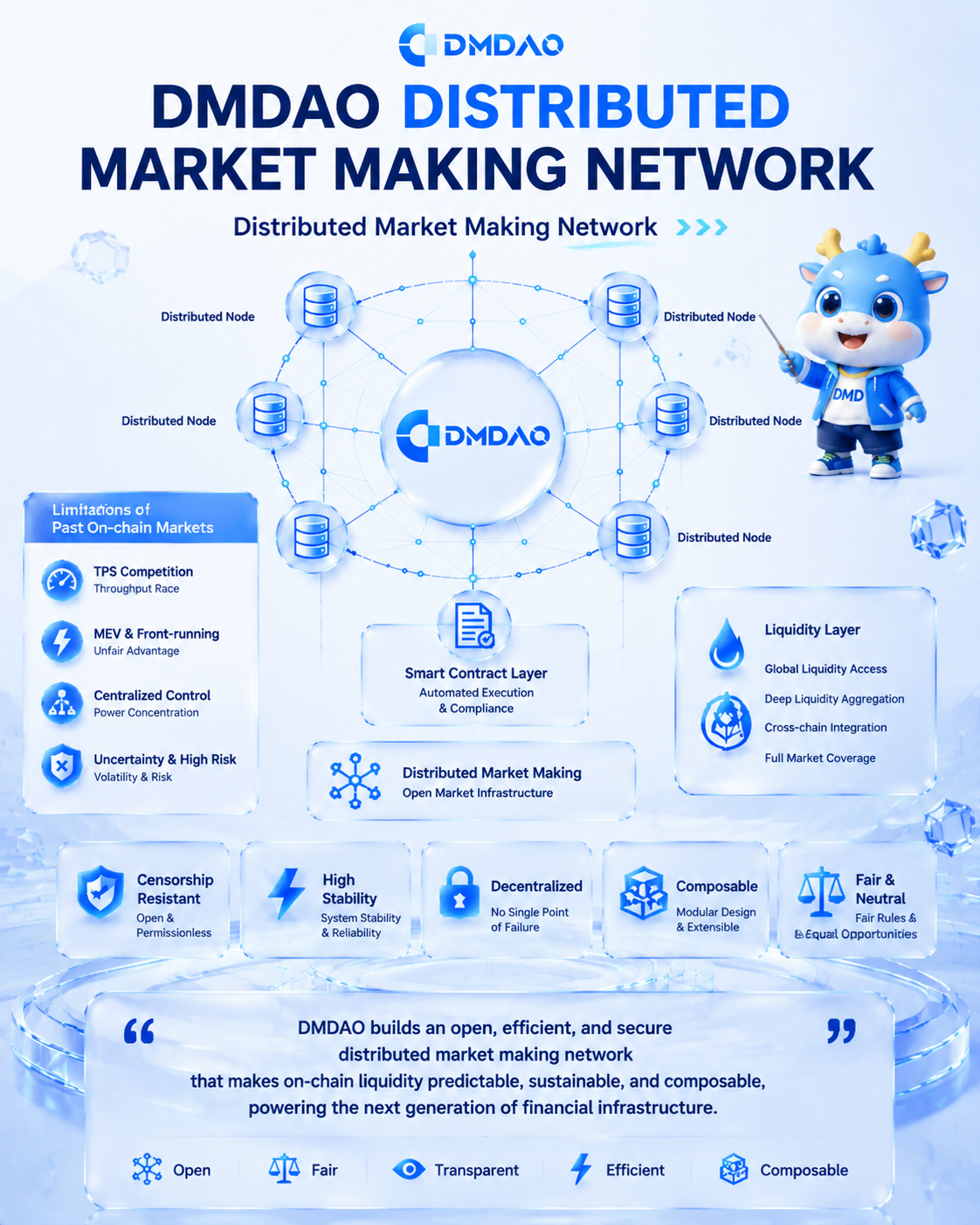
- Parallel interaction among distributed nodes: Breaking the monopoly of a single leader over transaction ordering, market-making and order interactions are distributed across the network’s core nodes. This guarantees that liquidity injection and cancellation instructions achieve ultra-fast, highly deterministic on-chain settlement.
- Algorithmic contractual constraints: Transparent on-chain contracts replace human governance and the “benevolent privilege” of any single node, thoroughly eliminating the soil in which MEV sandwiches and artificial delay/censorship can survive.
II. Extreme Deflation and MMT Value Accrual: Eliminating Price Uncertainty Through Mathematics
a16z’s research further emphasizes that market “predictability” is manifested not only in the speed of transaction inclusion but, more importantly, in the deterministic anchoring of asset value by market mechanisms.
In conventional liquidity models, collusion between arbitrageurs and block producers often forces market makers to underwrite “uncertainty,” resulting in sharp fluctuations in asset value. DMDAO leverages its unique economic model to construct a powerful value moat for on-chain liquidity:
- Matrix Prime high-frequency automatic burn mechanism: As the latest on-chain data demonstrates, between 24 July and 30 July 2026 alone — a mere seven days — DMDAO executed high-frequency burns totaling 35,936.41 DMD. This normalized, predictable extreme deflationary logic mathematically tightens circulating supply and injects robust value certainty into DMD.
- MMT Strategic Reserve Pool (liquidity foundation): Serving as the underlying value bearer of the distributed market-making protocol, MMT assets are deeply bound to high-frequency on-chain market making. Rather than depending on opaque off-chain permissioned matching, it builds an impregnable deep liquidity capital base through fully public and transparent on-chain mechanisms, rendering every market-making revenue stream and burn logic clearly visible.
III. Rejecting the “Off-Chain Refuge”: DMDAO Upholds True DeFi Composability
a16z warns of a dangerous trend: many DeFi protocols, seeking to evade the uncertainty of on-chain block production, have migrated critical auction and matching logic off-chain (for example, Dutch auctions or off-chain batch matching). This severely undermines DeFi’s most essential advantage — composability — and introduces new trust assumptions.
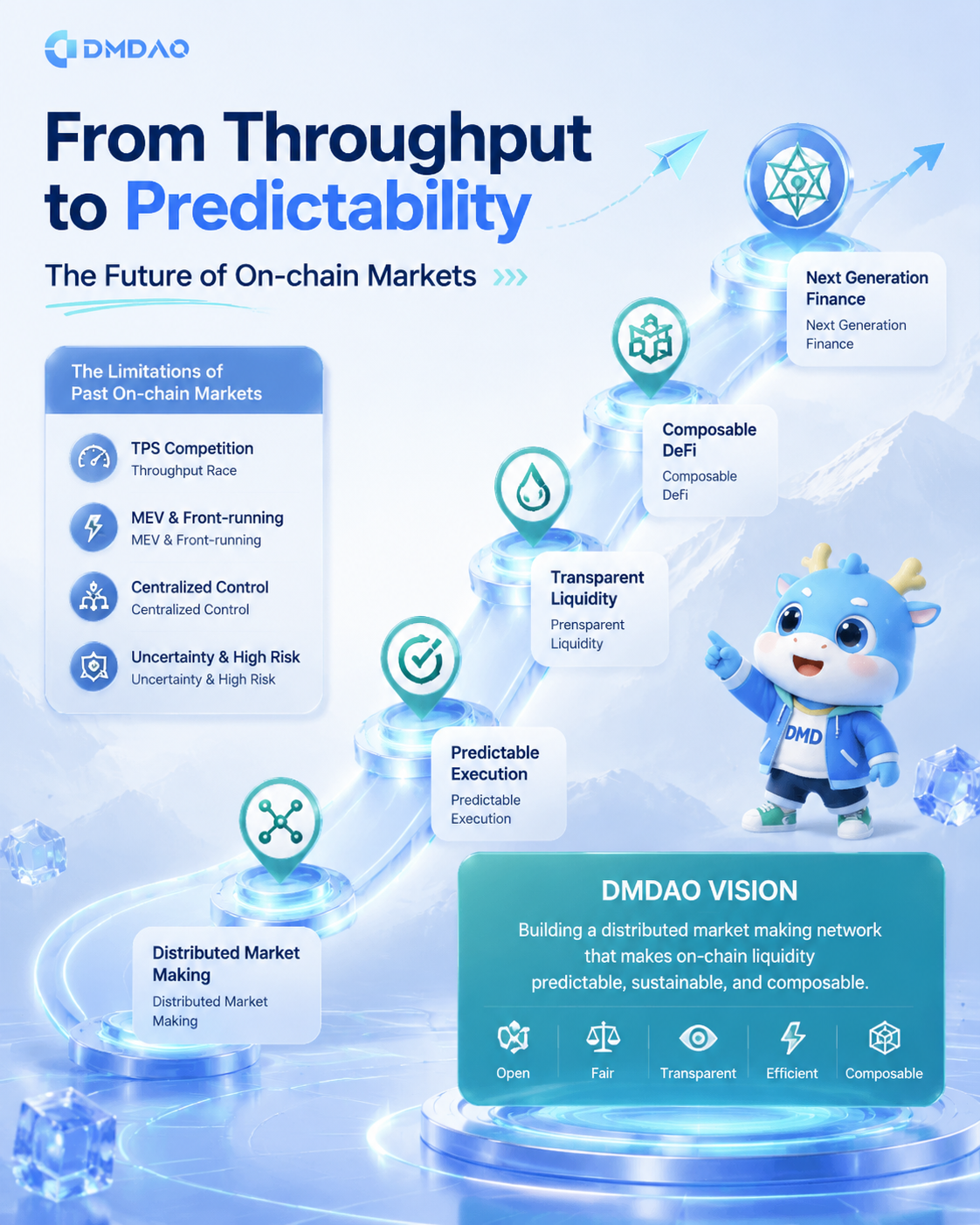
DMDAO firmly believes that genuine decentralized finance must never compromise by retreating off-chain.
DMDAO is constructing a fully on-chain, compliant, and transparent distributed market-making infrastructure. Whether through the forthcoming DMDAO Global Core Training Camp (Northern Station) or the recently launched D1/D3 node-specific reward programs and daily market subsidy initiatives, the core objective remains the same: to rally the strength of the network’s core nodes and fully implement distributed market-making strategies on-chain.
Through mechanism designs featuring “independent calculation of subsidies by tier” and “end-to-end logic that is fully public and transparent,” DMDAO is extending “predictability” from the underlying technology layer into market operations, offering global participants a fair, efficient, and frictionless distributed financial stage.
Conclusion: A New Era for On-Chain Finance
As a16z states, for blockchain to truly surpass existing traditional financial infrastructure, what matters more than simply increasing TPS is the certainty, transparency, and fairness of trade execution.
DMDAO has not only insightfully diagnosed this industry pain point but is, through the weapon of its Distributed Market-Making Protocol, combined with the extreme deflation of Matrix Prime and the strategic empowerment of MMT, step by step transforming the “ideal on-chain market” into reality.
Uniting nodes through algorithms and reshaping markets through contracts — DMDAO is ushering in a new era of predictable and generative on-chain liquidity.


All Comments