

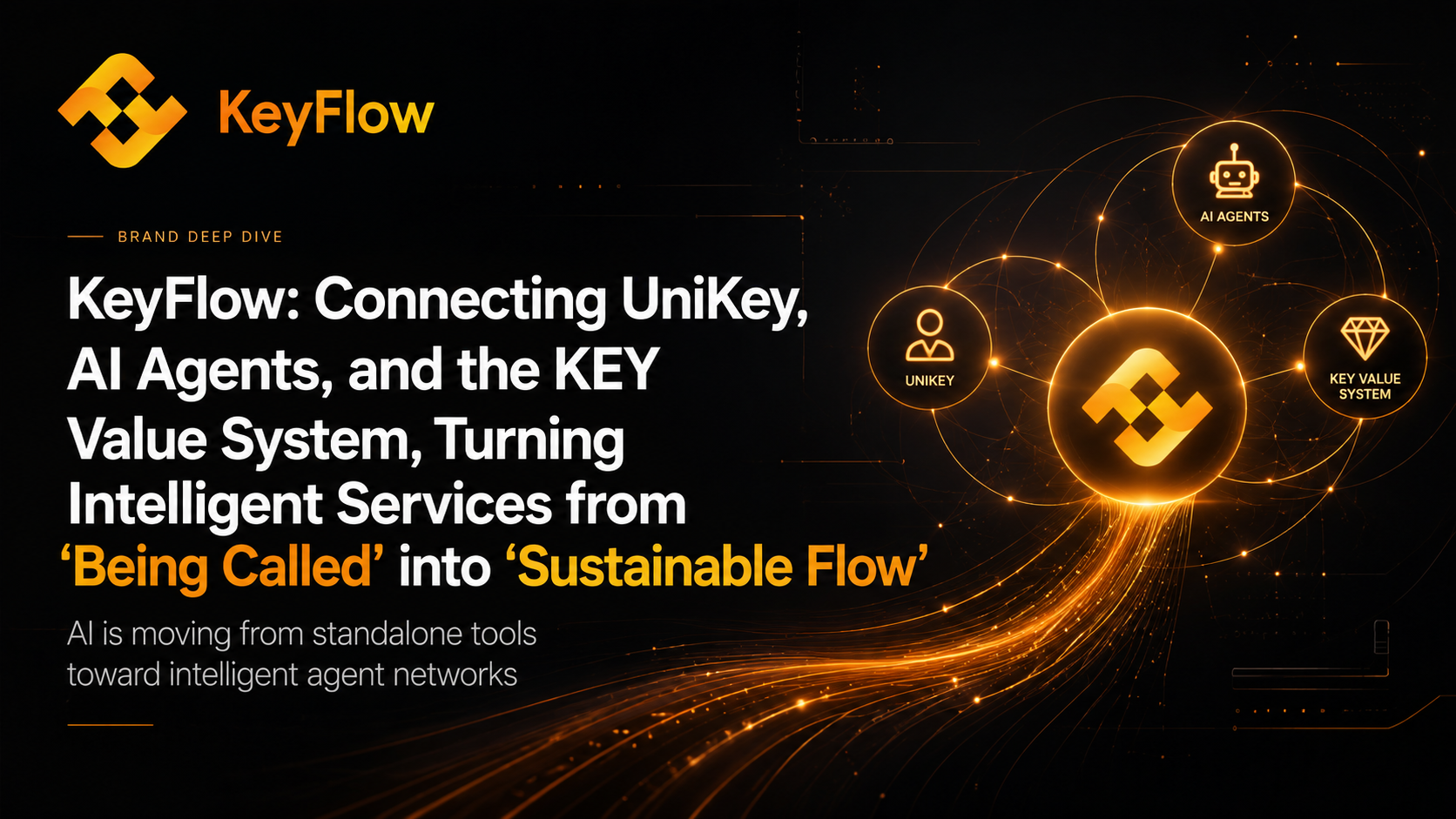
AI is moving from standalone tools toward intelligent agent networks.
In the past, when ordinary users used AI, they were usually opening a tool to complete a piece of writing, generate an image, or organize a document. At that stage, AI was more like a “toolbox,” where users had to decide what to use, how to use it, and where to use it.
But as we enter the AI Agent era, AI is no longer just a tool. It is gradually becoming an intelligent system capable of understanding tasks, calling capabilities, coordinating execution, and continuously delivering results. In the future, what truly matters will not only be how powerful a single AI tool is, but who can connect AI capabilities, user needs, intelligent agent services, and value flow into a continuously operating network.
This is where KeyFlow’s positioning is defined.
KeyFlow is not another ordinary AI application. Built around KEY, the core asset of the UniKey ecosystem, KeyFlow creates a value flow mechanism for the AI Agent era. Simply put, UniKey connects global AI capabilities, while KeyFlow enables these AI capabilities to form a clear, continuous, and recyclable value loop after they are used.
UniKey and KeyFlow: One Connects AI Capabilities, the Other Organizes Value Flow
UniKey is a one-stop AI infrastructure for the AI Agent era. Its core mission is to allow ordinary users, developers, enterprises, and intelligent agents to access professional AI capabilities through a unified gateway, so that AI is no longer scattered across different tools and platforms, but becomes part of a more complete AI usage-rights network.
Within this network, users need a simpler AI experience, developers need scenarios for publishing and calling intelligent services, and enterprises need stable, efficient, and scalable access to AI capabilities. UniKey’s role is to connect these scattered AI capabilities so they can be discovered, called, combined, and used.
KeyFlow goes one step further and addresses another question: once these AI capabilities are truly used, how does value flow?
If UniKey is the AI capability network, then KeyFlow is the value flow engine within that network. Around KEY, it builds a dynamic supply and value return mechanism, turning KEY from a simple ecosystem symbol into a core carrier for AI usage, intelligent agent collaboration, ecosystem contribution, and value accumulation.
KEY: The Core Carrier Connecting AI Usage and Ecosystem Value
In the KeyFlow system, KEY is not only something to be “held.” It is meant to be used, circulated, and returned.
The AI Agent era will generate a large number of real usage scenarios: users calling AI services, developers publishing intelligent capabilities, enterprises accessing intelligent systems, Agents executing automated tasks, and workflows running continuously. Behind these actions are real AI usage demand, platform revenue, service consumption, collaboration relationships, and ecosystem contribution.
What KeyFlow does is bring these scattered usage behaviors into one value system. Every AI use case is no longer an isolated call, but enters the KEY value flow loop. Every intelligent service call is no longer just a single-point consumption, but becomes part of the continued operation of the entire ecosystem network.
This is the core narrative of KeyFlow: allowing KEY to form value return alongside the growth of real AI usage, so ecosystem value no longer remains at the conceptual level, but becomes deeply connected with real usage, real demand, and real revenue.
From AI Revenue to Value Return, Building a Sustainable Loop
The core logic of KeyFlow can be summarized in one sentence:
Let real AI usage drive the long-term value flow of KEY.
As AI services within the UniKey network are continuously called, the platform generates real AI usage revenue. Through its dynamic supply and return mechanism, KeyFlow connects this revenue with KEY circulation, buyback, burn, ecosystem reinvestment, and other processes, allowing AI business growth and KEY value accumulation to move in the same direction.
The focus of this mechanism is not short-term stimulation, nor is it a single growth narrative. It is about building a long-term, sustainable ecosystem cycle. In the early stage, network development brings users, developers, and intelligent agent services into the ecosystem. In the middle stage, real AI usage strengthens revenue return. In the long term, revenue growth and net-supply adjustment allow KEY’s circulation structure to become more deeply tied to the scale of AI business.
Therefore, KeyFlow is not a value mechanism detached from business. It is an ecosystem flow system built around real AI usage. What it emphasizes is not empty concepts, but allowing every AI call, every intelligent agent collaboration, and every ecosystem contribution to enter a clearer value loop.
Why Ordinary Users Need KeyFlow
Many people do not lack AI needs. What they truly lack is a low-barrier entry point.
Ordinary users want to use AI for content creation, learning, design, office work, side businesses, and community operations. But when faced with complex tools, models, workflows, and technical concepts, they often remain stuck at the stage of “knowing AI is useful, but not knowing how to use it systematically.”
The UniKey network that KeyFlow relies on is designed to make professional AI capabilities easier to access. Users do not need to understand all the underlying logic, nor do they need to switch back and forth between multiple platforms. Through a unified AI usage-rights network, they can more simply access, call, and use professional artificial intelligence.
For ordinary users, the meaning of KeyFlow is not only “participating in an ecosystem.” It is also a way to enter the AI Agent-native era. It helps ordinary users move from using AI as a single-point tool into a new intelligent network made up of intelligent services, automated tasks, developer capabilities, and ecosystem value.
KeyFlow’s Brand Keywords: AI-Native, Value Flow, and Long-Term Return
KeyFlow’s brand identity can be understood through three keywords.
AI-native means KeyFlow is not simply packaging AI with traditional internet product logic. It is designed for the AI Agent era. It focuses on how intelligent agents collaborate, how AI capabilities are called, how user needs are matched, and how ecosystem value is organized.
Value flow means KeyFlow does not only connect tools. It connects the value relationships created after AI is used. The value of AI should not stop at a single call. It should continue to flow among users, developers, intelligent agents, platforms, and the ecosystem.
Long-term return means KeyFlow focuses more on sustainable growth. By connecting real AI revenue with the KEY value loop, it allows the ecosystem to rely not only on short-term attention, but on real usage, real demand, and long-term accumulation.
Together, these three keywords form the brand core of KeyFlow: it is not an isolated functional module, but a value organization system within an AI Agent-native ecosystem.
KeyFlow’s Long-Term Narrative: Bringing Intelligent Capabilities into a Flowing Network
The future AI world will not be a competition between isolated tools. It will be an intelligent productivity network made up of AI capabilities, intelligent agents, workflows, developers, enterprises, and ordinary users.
Within this network, AI capabilities need to be connected, intelligent agent services need to be called, user needs need to be fulfilled, ecosystem contributions need to be recognized, and value flow needs to be organized. KeyFlow is positioned to play this role.
It connects UniKey’s AI infrastructure while also carrying the value flow logic of KEY. UniKey brings global AI capabilities into one network, while KeyFlow enables those capabilities to form return, accumulation, and long-term circulation through real usage.
This is the core value of KeyFlow:
AI usage should no longer be just a one-time consumption, but should enter a continuously flowing intelligent ecosystem.
KEY should no longer be just an ecosystem symbol, but should become the core carrier of value flow in the AI Agent era.KeyFlow turns real AI usage into long-term value flow.


All Comments