

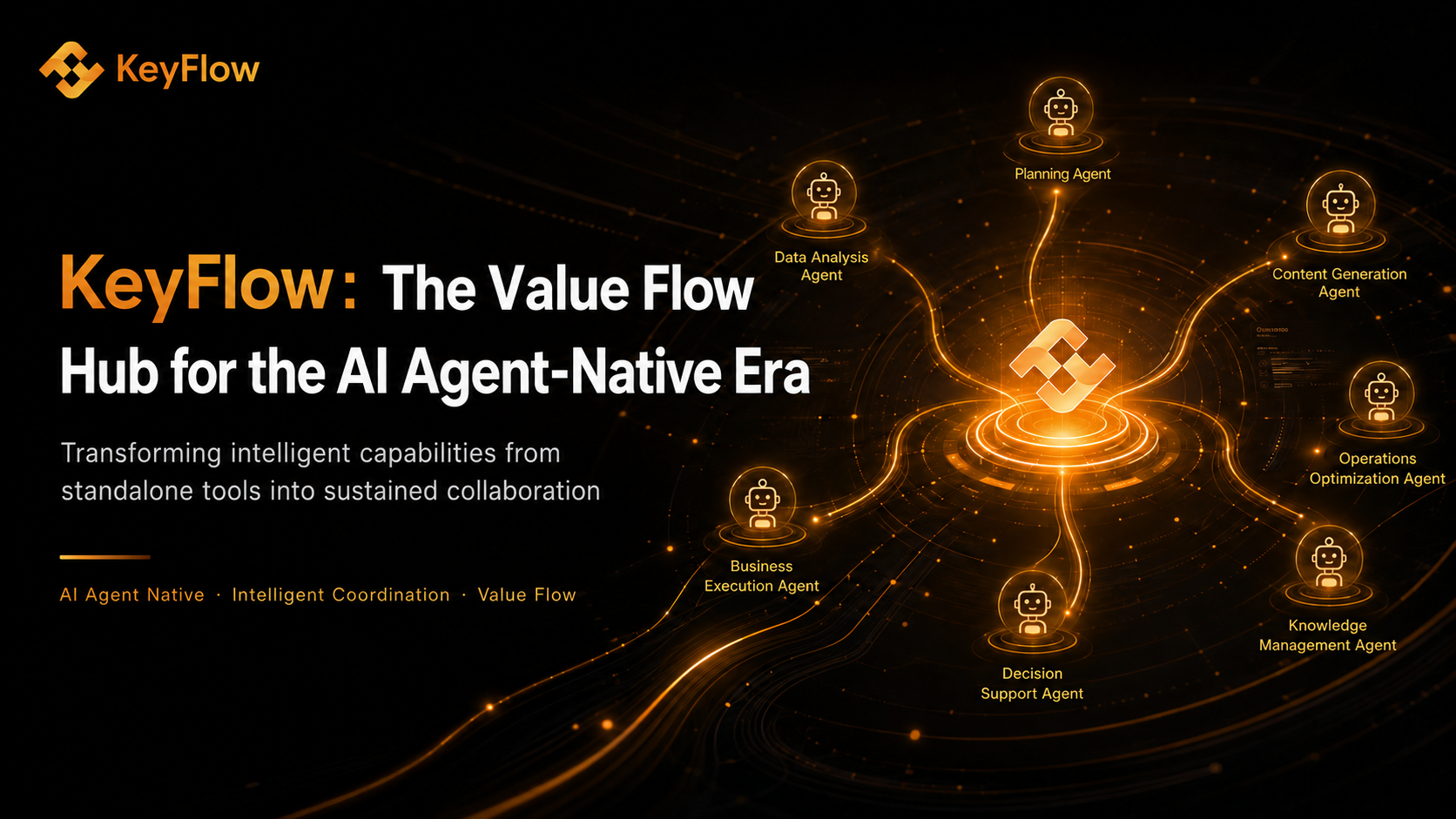
Transforming Intelligent Capabilities from Standalone Tools into Sustained Collaboration
AI is entering a new stage.
In the past, people mostly understood AI as a tool: writing a piece of copy, generating an image, summarizing a document, or answering a question. The AI tool era focused on “single-use calls” and “instant results.” But as large models continue to evolve, AI Agents are becoming a new type of intelligent execution unit. They do not simply answer questions; they can understand goals, break down tasks, call tools, coordinate workflows, and continuously deliver results in complex scenarios.
This means the core value of AI is shifting from “model capability” to “intelligent collaboration.” In the future, what matters most will not only be which model is stronger, but who can organize models, Agents, Skills, Workflows, APIs, user scenarios, and enterprise needs into a truly functioning intelligent network. KeyFlow emerges from this trend.
KeyFlow does not focus on standalone AI tools. It focuses on the value flow behind the AI Agent-native era. Its goal is to connect intelligent capabilities more efficiently, make collaboration between services smoother, and create clearer relationships between users, developers, platforms, and ecosystem participants.
From “Using AI” to “Organizing Intelligent Capabilities”
The transformation brought by the AI Agent-native era is not just that users now have a smarter assistant. It is that the entire way digital productivity is organized is being reshaped. A complete AI task may involve model calls, data processing, content generation, API integration, workflow orchestration, Agent collaboration, and final result delivery. For ordinary users, these steps should not become barriers. For enterprises and developers, these capabilities should not remain scattered across isolated systems.
The value of KeyFlow lies in organizing these scattered intelligent capabilities. It does not require users to understand complex underlying systems. Instead, it allows users to enter AI scenarios more naturally based on their real needs. Users need results; the system handles capability connection, path matching, and collaborative organization behind the scenes.
This is what makes KeyFlow different from ordinary AI applications. A normal AI application solves efficiency at a single point, while KeyFlow focuses on how AI capabilities can enter longer-term, more complex, and higher-frequency collaborative relationships. It serves the underlying order of the intelligent agent economy, rather than a single isolated function.
KeyFlow and UniKey: Capability Network and Value Flow
If UniKey is a one-stop AI infrastructure for the AI Agent era, then KeyFlow is the value flow hub within that infrastructure.
UniKey connects global AI capabilities, including models, tools, Skills, Agents, Workflows, APIs, and other intelligent services. It answers the question of where AI capabilities come from, how they are accessed, and how they are called. For users, UniKey is a more unified gateway to AI capabilities. For developers and service providers, UniKey is a platform where intelligent services can be discovered, used, and distributed.
KeyFlow goes one step further by focusing on how these AI capabilities generate continuous, orderly, and clear value flow after being used. It is not only about connecting capabilities, but also about enabling collaboration between them and giving intelligent service usage a clearer structure. UniKey builds the AI capability network, while KeyFlow makes that network truly flow.
Their relationship is not simply front end and back end. They are two key layers in the AI Agent-native ecosystem: UniKey is responsible for capability connection, while KeyFlow is responsible for value coordination. One answers “what can be used,” and the other answers “how it can continue to operate.”
The AI Agent Era Needs a New Collaboration Hub
When AI is only a tool, the process is relatively simple: users open a product, enter a request, and receive a result. But when AI Agents begin to participate in real business scenarios, the situation becomes very different. One Agent may need to call multiple models. One workflow may connect multiple intelligent nodes. One enterprise scenario may require long-term, stable API services. One developer’s Skill may be repeatedly used by different users and different Agents.
All of these scenarios point to one fact: the AI Agent-native era needs a new collaboration hub.
KeyFlow’s role is to build clearer connections between user needs, intelligent services, and ecosystem participants. It ensures that AI capabilities no longer exist in isolation, and that Agents are not just abstract concepts, but can enter real task chains, participate in ongoing collaboration, and support service delivery.
In this process, KeyFlow represents a more advanced form of AI product: from “providing tools” to “organizing intelligent collaboration,” from “single-use calls” to “long-term flow,” and from “feature experience” to “ecosystem operation.”
Making Professional AI Capabilities Easier to Access
Today, many people understand the importance of AI, but actually using AI well still involves many obstacles. There are too many models, tools are too scattered, workflows are too complex, Agent use cases are not always clear, and APIs or technical systems are often unfriendly to ordinary users. These problems make AI seem powerful, but not necessarily easy to integrate into everyday work and business processes.
One of KeyFlow’s core brand values is to reduce this distance.
KeyFlow aims to make professional AI capabilities no longer exclusive to technical teams, large enterprises, and developers. Instead, it wants AI to become an intelligent capability network that ordinary users, entrepreneurs, content creators, operators, and business teams can all use more easily. Users do not need to understand every technical detail or master complex system concepts. What matters is whether they can use AI around their real needs, use it smoothly, and continue using it over time.
This is KeyFlow’s core message to the broader market: AI should not remain a professional tool for a small group of people. It should become a new productivity system that more people can participate in.
Letting Intelligent Services Move from Fragmentation to Flow
The future AI ecosystem will not be determined by a single model. Models, Agents, Skills, Workflows, APIs, plugins, data interfaces, and application scenarios will together form an expanding network of intelligent services. Every capability can be called. Every call may connect to a new task. Every task may create a new collaborative relationship.
KeyFlow focuses exactly on this flow between intelligent services.
It aims to better organize scattered AI capabilities, help user needs match the right intelligent services faster, allow developers’ capabilities to enter real-world scenarios, and provide more stable AI support for enterprise-level needs. A truly valuable AI ecosystem is not about stacking many tools together. It is about allowing them to collaborate effectively with one another.
From this perspective, KeyFlow is not just a product name. It is an organizational language for the AI Agent-native era. It transforms complex relationships between intelligent services into an ecosystem structure that is easier to understand, easier to participate in, and capable of long-term growth.
KeyFlow’s Brand Keywords: Native, Collaborative, Flowing
KeyFlow’s brand identity can be summarized in three keywords: AI Agent-native, intelligent collaboration, and value flow.
AI Agent-native means KeyFlow is not simply applying AI to traditional internet product logic. Instead, it understands AI products from the perspective of agent collaboration, automated task execution, and capability networks. It faces a new world where Agents participate in execution, capabilities are continuously combined, and scenarios keep expanding.
Intelligent collaboration means KeyFlow does not focus only on a single model or tool. It focuses on how different intelligent capabilities work together. In the future, users will not need more isolated tools. They will need more complete, smoother, and more reliable intelligent collaboration experiences.
Value flow means KeyFlow focuses on how AI capabilities form long-term relationships after being used. The value of AI should not stop at one call. It should continue to flow between users, developers, Agents, services, and the ecosystem, forming a more stable intelligent service network.
A Long-Term Narrative for the Intelligent Era
Every major technological shift brings new infrastructure. The internet era connected information. The mobile internet era connected people and services. The AI Agent-native era will connect intelligent capabilities, task execution, and value collaboration.
KeyFlow’s long-term narrative is to become a key collaboration hub in this new stage.
Built on UniKey’s comprehensive AI infrastructure, KeyFlow serves a broader range of users, developers, enterprises, and ecosystem partners. It organizes AI capabilities from standalone tools into a sustainable intelligent network. It does not emphasize short-term hype. It emphasizes real usage, long-term collaboration, and ecosystem accumulation.
In the future, AI Agents will increasingly participate in content production, business operations, technology development, knowledge management, customer service, and enterprise decision-making. What KeyFlow aims to do is make these intelligent capabilities truly flow, allow more people to participate in the AI era with lower barriers, and transform professional AI from a complex system into a sustainable foundational capability.
KeyFlow makes the value of AI Agents flow. It connects intelligent capabilities, enables collaboration, and supports continuous use.
This article is intended only for KeyFlow brand and product narrative purposes. It does not involve any income promise, asset price judgment, or investment advice.


All Comments