

Cointime

Download App
iOS & Android

GWDC 2026 KOREA: The New Asian Paradigm of Web3 & AI Sets to Debut in Seoul on Sept 29-30, Inviting Global Builders to the Ultimate Developer Summit


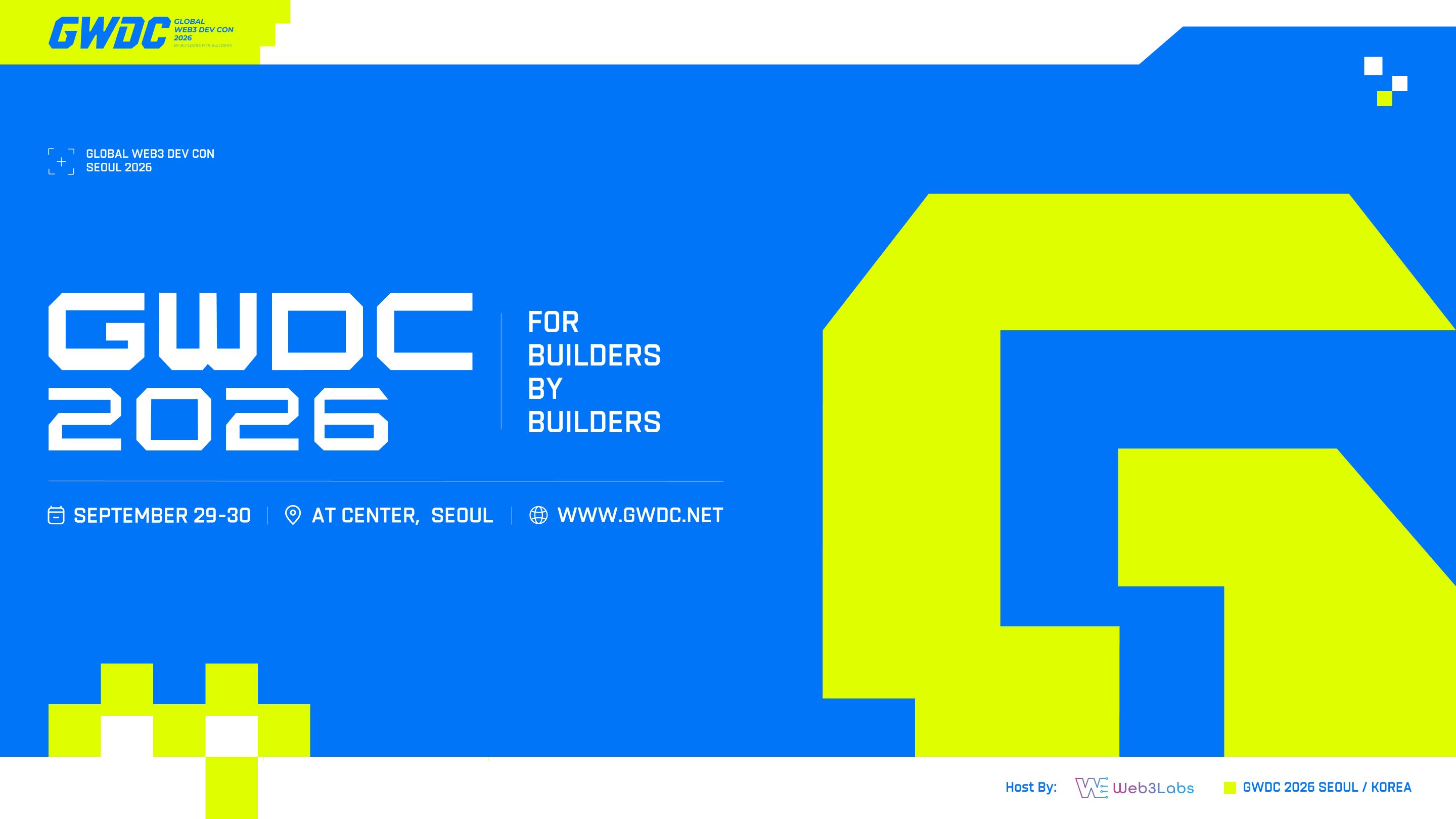
 Following the massive success of the inaugural Global Web3 Developer Conference (GWDC HK) in Hong Kong this February—which ignited a major tech wave in the Asia-Pacific region and gathered over 2,000 industry elites—organizers Web3Labs today officially announced a blockbuster upgrade: The 2nd Global Web3 Developer Conference (GWDC 2026 Korea) will officially take place from September 29 to 30 at the aT Center in Seoul, South Korea.

True to its core, developer-centric ethos of "For Builders, By Builders," GWDC 2026 Korea shifts its spotlight to one of Asia's premier tech hubs, aiming to establish a brand-new paradigm for the global Web3 builder ecosystem and next-generation industrial integration.

According to the latest forecasts from the organizing committee, the Seoul edition will witness an unprecedented scale of growth. The summit is projected to welcome over 8,000 attendees, 500 elite global developers, 100 industry-defining keynote speakers, and 100 top-tier exhibitors in Seoul. Together, they will witness the historic convergence of Web3 and Artificial Intelligence (AI), charting a new course for Web3 development in Asia.

Reimagining Space: Decoupling the Future of Web3 Across Four Core Zones 

Breaking away from traditional, flat exhibitions, GWDC 2026 Korea is restructuring the venue layout at the Seoul aT Center into four multi-dimensional, themed zones—comprehensively covering macro-strategy, hands-on technical deep-dives, hacker competitions, and business matchmaking:

1. Main Stage | Strategic Leadership & Global Dialogue

The intellectual epicenter of the conference, the Main Stage is designed for high-level strategy and vision. The summit will bring together government officials from Hong Kong and South Korea, decision-makers from global tech giants, and Web3 visionaries. Discussions will heavily focus on cross-border "policy synergy" and international cooperation, unpacking real-world AI implementations and next-generation decentralized infrastructure, while defining Asia's tech trajectory.

2. Innovation Stage | Vertical Tech Collisions

Rejecting empty talk, this stage is dedicated to delivering actionable, technical insights. It will feature three specialized sessions:

  • Developer Ecosystem: Centered on open-source culture and the evolution of developer toolchains.
  • Web3 & Financial Infrastructure: Decoding RWA, DeFi, and the latest in cross-border financial innovation.
  • AI & Cloud-Native: Addressing the underlying code behind model training and architectural upgrades.
  • Additionally, the final round and award ceremony of the GWDC Hackathon will culminate here in a high-stakes live pitch.

3. Innovation Booth Zone | An Immersive Tech Bazaar

Featuring over 99 themed booths spanning AI, blockchain, SaaS, and Developer Tools (DevTools), this zone abandons boring, static displays in favor of interactive, live product demos. To amplify global reach, over 30 top KOLs will conduct live roving interviews, high-frequency social media engagement, and flash K-pop dance performances by popular Korean idol groups, generating maximum foot traffic and engagement.

4. Hackathon Zone | 48-Hour Ultimate Coding Challenge

As the soul of GWDC, the Hackathon is gathering over 500 elite hackers from China, South Korea, Japan, India, and Southeast Asia. Breaking the limits of single ecosystems, five leading public chains will simultaneously launch custom developer tracks. Equipped with a cash prize pool exceeding $100,000, along with substantial computing power and resource backing from global cloud service giants, this zone serves as the ultimate testing ground bridging elite capital, public chain ecosystems, and developer talent.

  Unveiling the First Wave of Political, Business Leaders, and Ecosystem Partners 

The cross-industry influence of GWDC 2026 Korea continues to grow, attracting an elite global lineup spanning government, industry, finance, and research. We are proud to announce our first wave of confirmed keynote speakers:

  • Johnny Ng: Member of the National Committee of the CPPCC, Legislative Council Member of Hong Kong SAR
  • Min Byoung-dug: Member of the National Assembly of South Korea, Sponsor of the Framework Act on Digital Assets, Member of the National Policy Committee
  • Suk-hun Yoon: Chairman of the Asian Economic Development Committee
  • Caspar Wong: CEO of Web3Labs
  • Jack Kong: Founder of Nano Labs
  • Lee Jae-won: CEO of Bithumb
  • Evan Auyang: President of Animoca Brands
  • Ella Zhang: Managing Partner & Head of YZi Labs
  • Ryan Li: Deputy General Manager of Cloud Native & Digital Transformation Business, Microsoft Greater China 

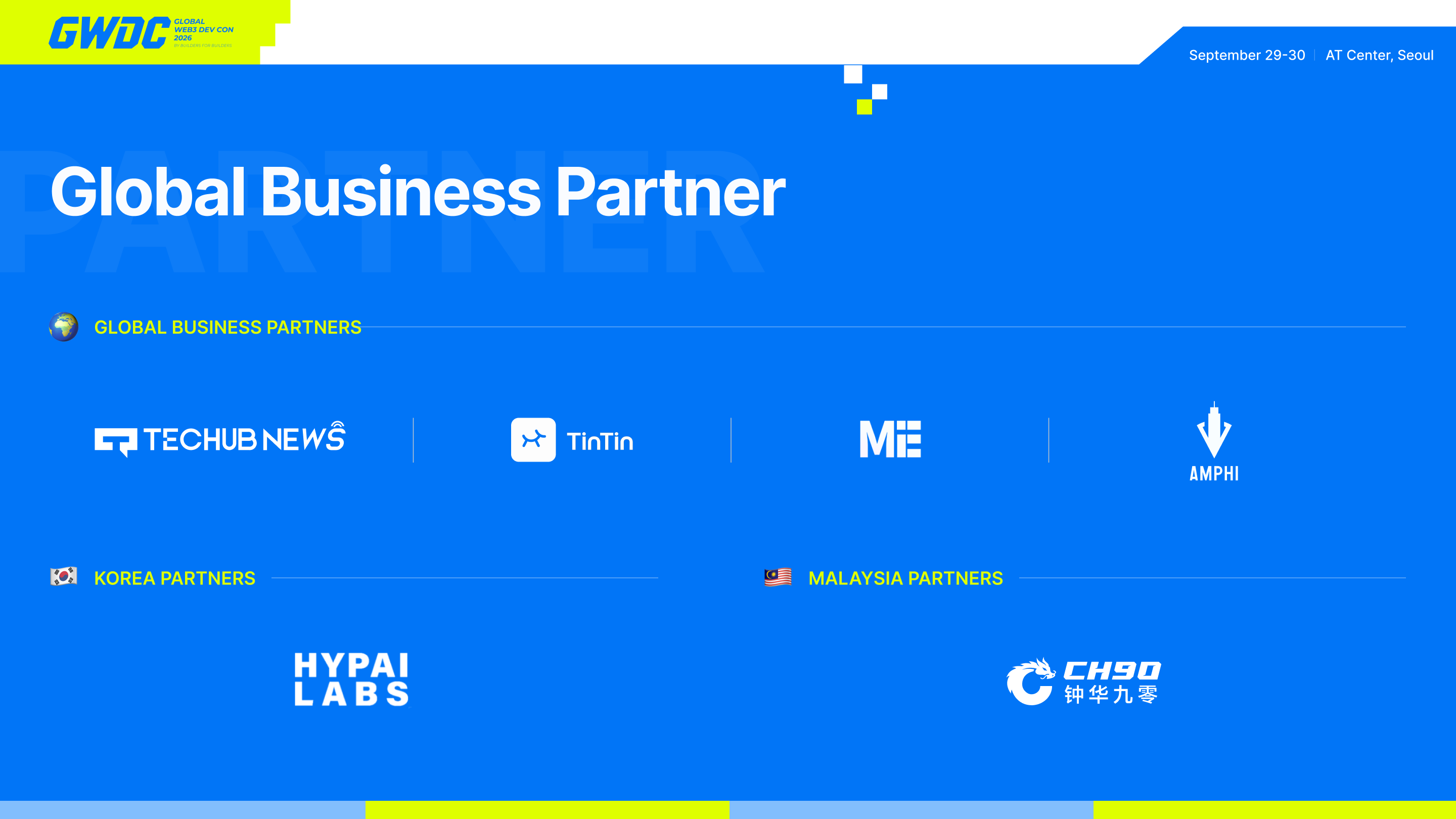
Supporting this world-class lineup, the global preparations of the summit are backed by leading industry partners. Techub News, TinTinLand, ME Group, AMPHI, HypaiLabs, and CH90 are officially introduced as the first wave of strategic business partners.
Join the Paradigm Shift

Global channels for sponsorships, booth bookings, and developer Hackathon registration for GWDC 2026 Korea are now officially open. We invite premium projects and developer communities worldwide to gather in Seoul and co-author the next chapter of Web3 and AI integration.

To learn more, inquire about sponsorships, or register for the event, please contact:

Comments

All Comments

Recommended for you

  • BTC Falls Below $77,000

    Market data shows that BTC has fallen below $77,000, currently priced at $76,996.84, with a 24-hour decline of 0.28%. The market is experiencing significant volatility, so please ensure proper risk management.

  • BTC Falls Below $77,000

    Market data shows that BTC has fallen below $77,000, currently priced at $76,996.84, with a 24-hour decline of 0.28%. The market is experiencing significant volatility, so please ensure proper risk management.

  • ITI Opposes FCC's Inclusion of Optical Modules in Covered List

    According to the authoritative U.S. communications media Communications Daily, the Information Technology Industry Council (ITI) formally expressed its opposition to the Federal Communications Commission (FCC) last week, urging the FCC not to include foreign-manufactured optical modules in the restricted list. This represents the latest stance of the U.S. technology industry organization on this issue, further reducing the likelihood of a blanket inclusion of optical modules in the Covered List. In its latest submission to the FCC, ITI explicitly recommended that the Covered List should continue to adopt a 'precise, risk-based' approach, focusing on entities or products with clear ties to foreign adversaries, rather than broadly covering entire categories of technology from trusted companies. More importantly, ITI specifically stated that optical transceivers should not be included in the Covered List, particularly opposing the inclusion of all foreign-produced optical modules in the restrictions.

  • ITI Opposes FCC's Inclusion of Optical Modules in Covered List

    According to the authoritative U.S. communications media Communications Daily, the Information Technology Industry Council (ITI) formally expressed its opposition to the Federal Communications Commission (FCC) last week, urging the FCC not to include foreign-manufactured optical modules in the restricted list. This represents the latest statement from the U.S. technology industry organization on the matter, further reducing the likelihood of a blanket inclusion of optical modules in the Covered List. In its latest submission to the FCC, ITI explicitly recommended that the Covered List should continue to adopt a 'targeted, risk-based' approach, focusing on entities or products with clear ties to foreign adversaries, rather than broadly covering entire categories of technology from trusted companies. More importantly, ITI specifically stated that optical transceivers should not be included in the Covered List, particularly opposing the inclusion of all foreign-produced optical modules in the restrictions.

  • Ulanqab Plans 12.5GW, Surpassing OpenAI's Stargate Target

    According to Goldman Sachs, Ulanqab, a prefecture-level city in Inner Mongolia, has committed to a total data center capacity of approximately 12.5GW, which exceeds OpenAI's initial target of 10GW for Stargate. However, only about 1.2GW is currently operational. This expansion has primarily occurred in the past year, with over 70% of the capacity commitments made in this timeframe. DeepSeek plans to build approximately 1GW of data centers, while Xiaohongshu is reportedly considering a project of around 600MW. Companies like ByteDance and Alibaba have also entered the market. The area benefits from low land and electricity costs, cold weather, and proximity to Beijing. Dedicated fiber optics have reduced the average latency from Ulanqab to Beijing to under 5 milliseconds.

  • Ulanqab Plans 12.5GW, Exceeding OpenAI's Stargate Target

    According to Goldman Sachs, the city of Ulanqab in Inner Mongolia has a total committed data center capacity of approximately 12.5GW, which surpasses the initial 10GW target set by OpenAI for Stargate. However, only about 1.2GW is currently operational. This expansion has primarily occurred in the past year, with over 70% of the capacity commitments made in that timeframe. DeepSeek plans to build approximately 1GW of data center capacity, while Xiaohongshu is reportedly considering a project of around 600MW. Companies such as ByteDance and Alibaba have also entered the market. The area benefits from low land and electricity costs, cold weather, and proximity to Beijing. Dedicated fiber optics have reduced the average latency from Ulanqab to Beijing to under 5 milliseconds.

  • Saudi Reconnaissance Drone Shot Down in Yemen's Hajjah Province

    According to the Iranian Tasnim News Agency, a Yemeni military source stated that the Yemeni armed forces shot down a Saudi 'ScanEagle' reconnaissance drone over Hajjah Province while it was attempting to enter Yemeni airspace. The source informed the Yemeni official news agency that the drone was hit and downed using 'appropriate weapons'.

  • Iranian Parliament Speaker Mocks: U.S. Economic Pressure on Iran Will Backfire

    Iranian Parliament Speaker Mohammad Baqer Qalibaf shared an image on social media platform X, outlining the economic pressures against Iran and the impact of changes in the energy market on the U.S. economy. Referring to recent measures taken by Trump to control U.S. commodity prices, he wrote: 'Importing frozen meat to control meat prices? Well, maybe effective. But what is the U.S. plan for national debt? Want to import “frozen yields”? For the housing market, are you going to introduce “frozen buyers”? To address wage issues, are you going to issue “frozen payrolls”? A rigid and uninnovative foreign policy will lead to a frozen and stagnant economy. What is the only thing still functioning? It is the boomerang of imposing “devastating economic pressure” on Iran, which will ultimately come back to the U.S. itself.' (Jinshi)

  • US Military Casualties in Iran War Rise to 774

    According to the Washington Post, the casualty statistics system of the U.S. Department of Defense shows that the number of U.S. military casualties in the Iran war has risen to 774, including 18 deaths and 756 injuries. Even during periods without large-scale combat, the Department of Defense has quietly added about 60 new injury records recently. A significant number of the injured were affected by traumatic brain injuries caused by explosions when U.S. bases in Jordan, Kuwait, Iraq, and Saudi Arabia were attacked.

  • US Military Casualties in Iran War Rise to 774

    According to the Washington Post, the casualty statistics system of the U.S. Department of Defense shows that U.S. military casualties in the Iran war have risen to 774, including 18 deaths and 756 injuries. Even during periods without large-scale combat, the Department of Defense has quietly added about 60 new injury records recently. A significant number of the injured were affected by traumatic brain injuries caused by explosions during attacks on U.S. bases located in Jordan, Kuwait, Iraq, and Saudi Arabia.
