

Cointime

Download App
iOS & Android

Ethereum devs up security efforts with new ‘Post-Quantum’ team

A group of Ethereum developers has launched a resource hub focused on protecting the blockchain from future quantum computing threats and securing the billions of dollars worth of value on the network.

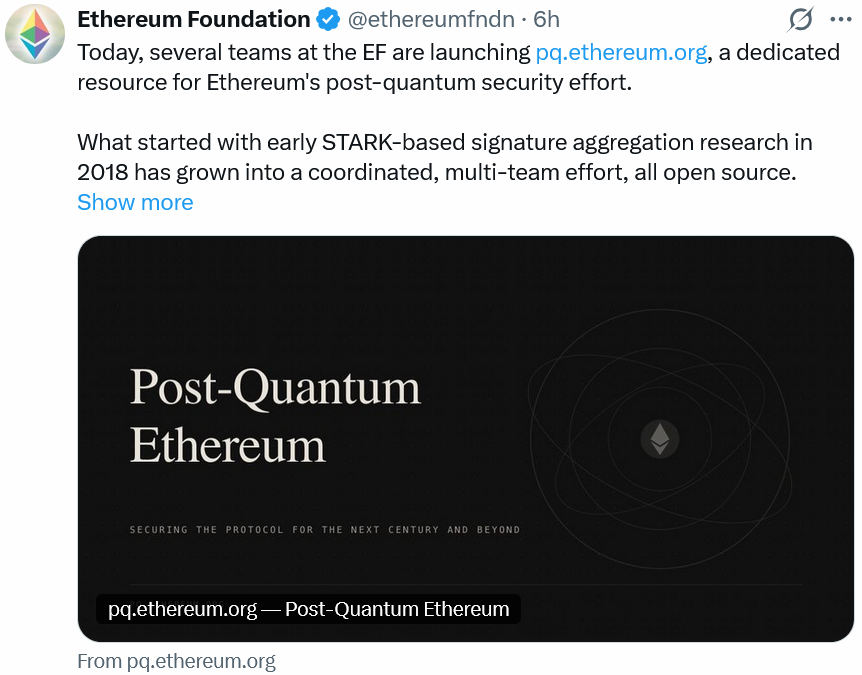
The “Post-Quantum Ethereum” website, launched on Tuesday by members of the Ethereum Foundation, says the organization’s new Post-Quantum team is planning to implement quantum solutions into Ethereum at the protocol level by 2029, with solutions targeting the execution layer to follow.

While the Post-Quantum team said no imminent quantum threat exists for cryptography-secured blockchains, early action is necessary due to the complexity involved:

“Migrating a decentralized, global protocol takes years of coordination, engineering, and formal verification,” the team said. “The work must begin well before the threat arrives.”
  Source: Ethereum Foundation


Concerns that quantum computers could eventually break blockchain cryptography have fueled industry-wide fear around private keys and wallet security, prompting broader debate over how the sector should prepare as the technology develops.

Most industry analysts acknowledge that quantum computing poses some level of threat to crypto. Galaxy Digital analyst Will Owens has said only crypto wallets with exposed public keys are vulnerable, while others, such as Capriole Investments’ Charles Edwards, have said all coins are at risk.

Post-Quantum team building SNARK-based signatures

Many crypto developers are focused on how quantum-safe solutions can be implemented into cryptographic signatures to fight off potential attacks.

However, some solutions are more computationally intensive and could potentially impact blockchain performance by increasing bandwidth and storage.
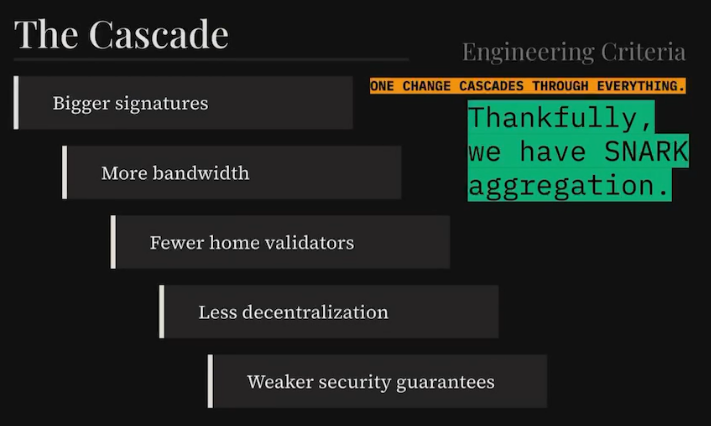
  Quantum-proof signatures can cause other problems, impacting network performance. Source: Post-Quantum Ethereum

The Post-Quantum team is integrating SNARK, or Zero-Knowledge Succinct Non-Interactive Argument of Knowledge technology, in an effort to prevent the Ethereum network from experiencing these issues.

Quantum solutions will be implemented into Ethereum’s consensus, execution and data layers, the team said.

The Post-Quantum team said it would prioritize protecting standard Ethereum wallets as it believes that’s where the largest pool of value is, followed by high-value operational wallets tied to crypto exchanges, bridges and custody solutions.

It said that one of the biggest challenges will be to deploy these solutions without disrupting the network.

“Choosing a post-quantum algorithm is only part of the challenge. The harder parts include safely upgrading hundreds of millions of accounts, preventing the migration from introducing new bugs, avoiding new attack surfaces, maintaining performance, and coordinating ecosystem-wide adoption.”


Comments

All Comments

Recommended for you

  • BTC Surpasses $82,000

    Market data shows that BTC has surpassed $82,000, currently priced at $82,002.01, with a 24-hour decline of 1.47%. The market is highly volatile, so please ensure proper risk management.

  • Fed's Musalem: Further Tightening of Monetary Policy Needed to Bring Inflation Back to Target; Rates Should Be Raised in Next 6 to 9 Months

    On October 9, Fed's Musalem stated that further tightening of monetary policy is necessary to bring inflation back to target, and interest rates should be raised in the next 6 to 9 months. The economy is currently quite strong, and the best thing the Fed can do is to lower inflation; market inflation expectations remain stable, and there has been no indication of a loss of credibility for the Fed.

  • BTC Falls Below $81,000

    Market data shows that BTC has fallen below $81,000, currently priced at $80,979.57, with a 24-hour decline of 2.79%. The market is experiencing significant volatility, so please ensure proper risk management.

  • ETH Falls Below $2500

    Market data shows that ETH has fallen below $2500, currently priced at $2499.36, with a 24-hour decline of 2.59%. The market is experiencing significant volatility, so please ensure proper risk management.

  • U.S. Government Transfers 12,267 BTC Worth Approximately $1.01 Billion

    According to Arkham and on-chain data, at 21:33 Beijing time on October 8, an address marked 'U.S. Government: Seized Funds from Bitfinex Hacker' transferred 12,267.02 BTC (approximately $1.01 billion). Subsequently, 6,000 BTC were sent in two transactions to a new address 33pYK…cFk, while the remaining approximately 6,267 BTC are temporarily held in another new address. In the previous two days, related addresses of the U.S. government had transferred over 6,200 BTC to Coinbase Prime.

  • Reports Indicate Trump Purchased Up to $25 Million in Meta Stock

    On October 8, reports emerged that U.S. President Trump purchased up to $25 million in Meta stock.

  • Tencent Plans to Issue Offshore Bonds to Raise $5 Billion for AI Business Development

    According to Bloomberg, sources reveal that Tencent Holdings is considering issuing offshore bonds to raise $5 billion to meet the funding demands arising from its artificial intelligence business expansion. The bonds may be denominated in US dollars and offshore renminbi, with issuance potentially occurring as early as this month. Analysts believe that in recent years, as the demand for AI infrastructure and computing power has increased, global tech companies have turned to bond financing to raise funds. This fundraising plan is still in the discussion phase, and the final scale and timing of the issuance have yet to be determined.

  • BTC Falls Below $82,000

    Market data shows that BTC has fallen below $82,000, currently priced at $82,008.19, with a 24-hour decline of 1.72%. The market is experiencing significant volatility, so please ensure proper risk management.

  • Moscow Exchange to Launch Cryptocurrency Trading Services on December 1

    According to TASS, the Moscow Exchange plans to offer cryptocurrency trading services starting December 1 under a new regulatory framework. Boris Blokhin, Senior Managing Director of the Moscow Exchange, stated that the exchange will continue relevant testing work before the official launch.

  • People's Bank of China Clarifies Policy Stance on RMB Exchange Rate

    On October 8, the RMB exchange rate, an important price in the financial market, has long attracted attention from various sectors, with recent discussions increasing. The People's Bank of China clarifies its policy stance on the RMB exchange rate as follows: China implements a managed floating exchange rate system based on market supply and demand, referencing a basket of currencies, and insists on allowing the market to play a decisive role in the formation of the exchange rate. Over the past two decades, the RMB exchange rate has fluctuated in both directions; since 2010, the RMB exchange rate has undergone multiple rounds of appreciation and depreciation cycles, with the characteristics of two-way fluctuation becoming more pronounced and its elasticity increasing. The development of China's trade is rooted in the enhancement of industrial international competitiveness. China has no need, nor intention, to gain trade competitive advantages through currency depreciation and does not engage in competitive currency devaluation.