

Cointime

Download App
iOS & Android

Aave surpasses $1T in lending volume amid institutional expansion

Decentralized finance protocol Aave has surpassed $1 trillion in cumulative lending volume, marking a historic first in the DeFi industry.

“A decade ago, DeFi and Aave didn’t exist. They were just ideas. Today, Aave stands as the backbone of onchain lending, powering a new financial system that is open, global, and unstoppable,” Aave Labs CEO Stani Kulechov said in an X post on Wednesday.

The feat marked another step toward Aave’s goal of becoming the “largest, most efficient liquidity network in the world,” Kulechov added. “One that builders, banks, and fintechs plug into by default, fundamentally improving liquidity and cost structures across global finance.”
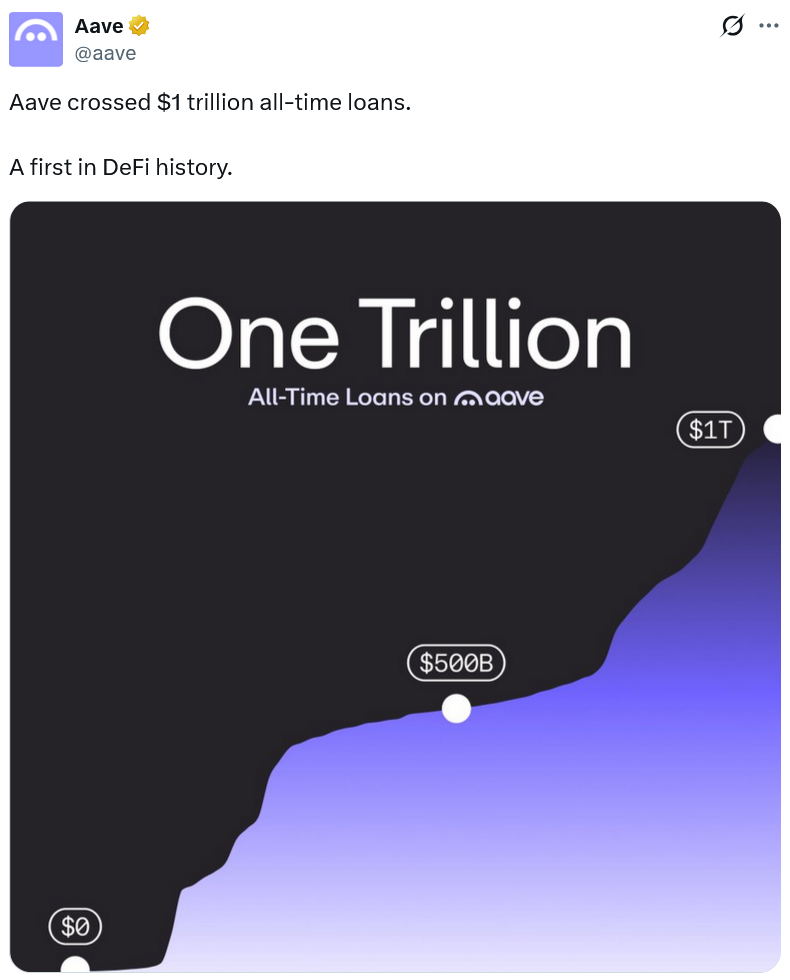
  Source: Aave

In August, Aave Labs launched Aave Horizon, a new lending market on Ethereum, specifically for traditional finance firms and other institutional investors to borrow stablecoins against real-world assets.

VanEck, WisdomTree and Securitize were among the first participants to use Aave’s institutional offering.

On Feb. 15, Kulechov said DeFi lending could benefit from tokenizing “abundance assets,” such as solar, batteries for energy storage and robotics for labor. He expects those assets to be worth a combined $50 trillion by 2050.

Kulechov originally launched Aave as ETHLend in November 2017 before rebranding to Aave in September 2018. It now secures over $27.2 billion in total value locked, enabling users to earn interest on deposits and borrow instantly using crypto as collateral.

Aave leads several prominent DeFi lending platforms in TVL, including Morpho, JustLend, SparkLend, Maple, Kamin Lend and Compound Finance, each of which holds over $1 billion in total value locked.

Aave has generated over $83.3 million in fees over the last 30 days, nearly four times that of its next-closest competitor, Morpho.

DAO proposal has caused division within Aave community

Aave’s milestone comes amid a protocol-wide feud over how much funding and revenue control Aave Labs should receive versus Aave’s decentralized autonomous organization.

Aave (AAVE) tokenholders have been asked to approve a package worth up to $42.5 million in stablecoins and 75,000 AAVE for Aave Labs.

In return, Aave Labs would route all revenue from Aave-branded products to the Aave DAO treasury under a DAO-funded operating model.


Comments

All Comments

Recommended for you

  • BTC Surpasses $82,000

    Market data shows that BTC has surpassed $82,000, currently priced at $82,002.01, with a 24-hour decline of 1.47%. The market is highly volatile, so please ensure proper risk management.

  • Fed's Musalem: Further Tightening of Monetary Policy Needed to Bring Inflation Back to Target; Rates Should Be Raised in Next 6 to 9 Months

    On October 9, Fed's Musalem stated that further tightening of monetary policy is necessary to bring inflation back to target, and interest rates should be raised in the next 6 to 9 months. The economy is currently quite strong, and the best thing the Fed can do is to lower inflation; market inflation expectations remain stable, and there has been no indication of a loss of credibility for the Fed.

  • BTC Falls Below $81,000

    Market data shows that BTC has fallen below $81,000, currently priced at $80,979.57, with a 24-hour decline of 2.79%. The market is experiencing significant volatility, so please ensure proper risk management.

  • ETH Falls Below $2500

    Market data shows that ETH has fallen below $2500, currently priced at $2499.36, with a 24-hour decline of 2.59%. The market is experiencing significant volatility, so please ensure proper risk management.

  • U.S. Government Transfers 12,267 BTC Worth Approximately $1.01 Billion

    According to Arkham and on-chain data, at 21:33 Beijing time on October 8, an address marked 'U.S. Government: Seized Funds from Bitfinex Hacker' transferred 12,267.02 BTC (approximately $1.01 billion). Subsequently, 6,000 BTC were sent in two transactions to a new address 33pYK…cFk, while the remaining approximately 6,267 BTC are temporarily held in another new address. In the previous two days, related addresses of the U.S. government had transferred over 6,200 BTC to Coinbase Prime.

  • Reports Indicate Trump Purchased Up to $25 Million in Meta Stock

    On October 8, reports emerged that U.S. President Trump purchased up to $25 million in Meta stock.

  • Tencent Plans to Issue Offshore Bonds to Raise $5 Billion for AI Business Development

    According to Bloomberg, sources reveal that Tencent Holdings is considering issuing offshore bonds to raise $5 billion to meet the funding demands arising from its artificial intelligence business expansion. The bonds may be denominated in US dollars and offshore renminbi, with issuance potentially occurring as early as this month. Analysts believe that in recent years, as the demand for AI infrastructure and computing power has increased, global tech companies have turned to bond financing to raise funds. This fundraising plan is still in the discussion phase, and the final scale and timing of the issuance have yet to be determined.

  • BTC Falls Below $82,000

    Market data shows that BTC has fallen below $82,000, currently priced at $82,008.19, with a 24-hour decline of 1.72%. The market is experiencing significant volatility, so please ensure proper risk management.

  • Moscow Exchange to Launch Cryptocurrency Trading Services on December 1

    According to TASS, the Moscow Exchange plans to offer cryptocurrency trading services starting December 1 under a new regulatory framework. Boris Blokhin, Senior Managing Director of the Moscow Exchange, stated that the exchange will continue relevant testing work before the official launch.

  • People's Bank of China Clarifies Policy Stance on RMB Exchange Rate

    On October 8, the RMB exchange rate, an important price in the financial market, has long attracted attention from various sectors, with recent discussions increasing. The People's Bank of China clarifies its policy stance on the RMB exchange rate as follows: China implements a managed floating exchange rate system based on market supply and demand, referencing a basket of currencies, and insists on allowing the market to play a decisive role in the formation of the exchange rate. Over the past two decades, the RMB exchange rate has fluctuated in both directions; since 2010, the RMB exchange rate has undergone multiple rounds of appreciation and depreciation cycles, with the characteristics of two-way fluctuation becoming more pronounced and its elasticity increasing. The development of China's trade is rooted in the enhancement of industrial international competitiveness. China has no need, nor intention, to gain trade competitive advantages through currency depreciation and does not engage in competitive currency devaluation.