

Cointime

Download App
iOS & Android

Aave's TVL tanks $8B a day after $293M Kelp DAO hack

Total value locked on decentralized lending protocol Aave dropped by nearly $8 billion over the weekend after hackers behind the $293 million Kelp DAO exploit borrowed funds on Aave, leaving roughly $195 million in “bad debt” on the protocol and triggering withdrawals.

Data from DeFiLlama shows that Aave’s TVL fell from about $26.4 billion to $18.6 billion by Sunday, losing the top spot as the largest DeFi protocol. 

Aave v3’s lending pools for USDt and USDC are now at 100% utilization, meaning that more than $5.1 billion worth of stablecoins cannot be withdrawn until new liquidity arrives or borrows are repaid. 
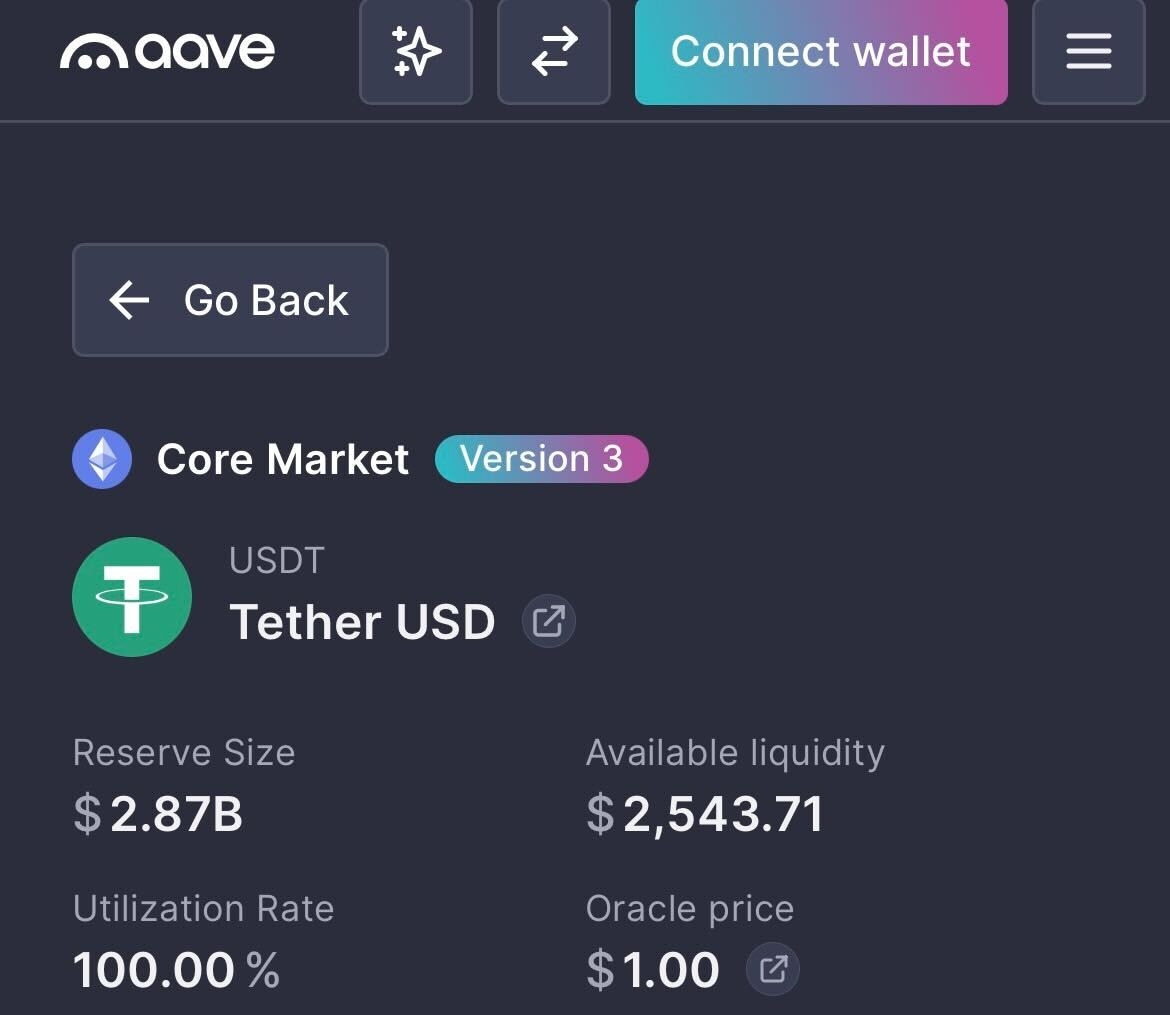
  $2,540 is available to be withdrawn from the $2.87 billion USDT pool on Aave v3 at the time of writing. Source: Aave


Aave’s TVL fall shows how rapidly risk from a single security incident can spread throughout the broader, interconnected DeFi lending market, potentially leading to a severe liquidity crisis.

The incident began on Saturday when hackers stole 116,500 Kelp DAO Restaked ETH (rsETH) tokens worth about $293 million from Kelp DAO’s LayerZero-powered bridge and used them as collateral on Aave v3 to borrow wrapped Ether (wETH).

Crypto analytics platform Lookonchain said the move created about $195 million in “bad debt” on Aave, which contributed to the Aave  token tankingnearly 20% from $112 on Saturday at 6:00 pm UTC to $89.5 about 25 hours later. 

Lookonchain noted that some of the largest crypto whales to withdraw funds from Aave were the MEXC crypto exchange and Abraxas Capital at $431 million and $392 million, respectively.
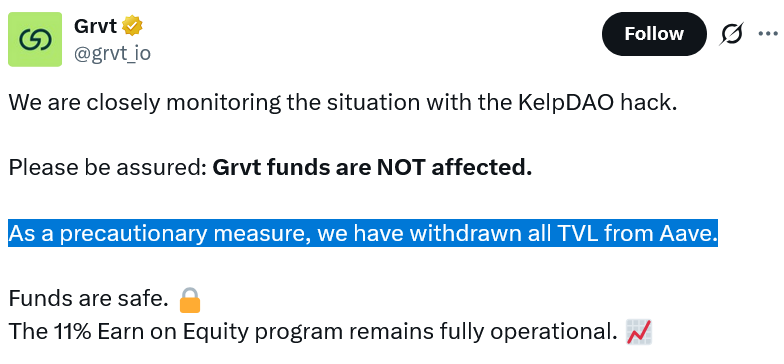
  Source: Grvt

Several crypto networks and protocols tied to rsETH or the LayerZero bridge have paused use of the bridge until the problem is resolved, including DeFi platform Curve Finance, stablecoin issuer Ethena and BitGo’s Wrapped Bitcoin (WBTC).

Aave has frozen several rsETH, wETH markets

Shortly after the Kelp DAO exploit, Aave said it froze the rsETH markets on both Aave v3 and v4 to prevent any suspicious borrowing and later stated that rsETH on Ethereum mainnet remains fully backed by underlying assets.

WETH reserves also remain frozen on Ethereum, Arbitrum, Base, Mantle and Linea, Aave said.

This incident marks the first significant stress test of Aave’s “Umbrella” security model, which was introduced in June 2025 to provide automated protection against protocol bad debt while enabling users to earn rewards.

Earlier this month, the Bank of Canada found that Aave avoided bad debt in its v3 market by using overcollateralization, automated liquidations and other strategies that shifted risk to borrowers.

In comments to Cointelegraph, Aave defended its liquidation-based model, framing it as a core safety mechanism that protects lenders while limiting downside for borrowers.

It comes as Aave parted ways with its longest-standing DeFi risk service provider, Chaos Labs, on April 6, following disagreements over the direction of Aave v4 and budget constraints.

Comments

All Comments

Recommended for you

  • BTC Surpasses $63,000

    Market data shows that BTC has surpassed $63,000, currently priced at $63,014.63, with a 24-hour decline narrowing to 0.67%. Due to significant market fluctuations, please ensure proper risk management.

  • Michael Saylor Releases New Bitcoin Tracker Information

    On July 5, Strategy founder Michael Saylor released new information regarding the Bitcoin Tracker. He stated, 'Bitcoin is digital energy.' Following previous patterns, Strategy typically discloses information about increasing Bitcoin holdings the day after related announcements.

  • BTC Falls Below $63,000

    Market data shows that BTC has fallen below $63,000, currently priced at $62,978.8, with a 24-hour increase of 0.24%. The market is experiencing significant volatility, so please ensure proper risk management.

  • Vitalik: Ethereum to Complete Major Third Iteration in Next 5 Years, Quantum Resistance and Privacy as Primary Goals

    On July 5, Vitalik Buterin announced that Ethereum researchers finalized the 'Streamlined Ethereum' roadmap during a conference in Berlin. This is not a one-time upgrade but a series of forks over the next 3 to 4 years (starting from 'I-star'), which will mark the third major era of Ethereum, almost replacing all core components. Core changes include: verification shifting from direct execution to recursive STARK; consensus introducing 1-2 rounds of finality for faster and safer transactions; multi-dimensional Gas pricing; and a complete replacement of existing solutions with quantum-resistant cryptography. The most disruptive change is the state model—current dynamic states only expand to about 2TB, while introducing new scalable states like UTXO and circular buffers, with a total scale reaching up to 100TB, suitable for ERC20/NFT/DeFi, potentially reducing transaction fees by over 10 times after the rewrite; complex applications (like Uniswap pools) will retain the old state without mandatory migration. However, the issue of who will store the 100TB state and the associated incentives has become a new focus of research. Privacy upgrades are now a primary design goal, with all new components needing to support quantum-resistant, intermediary-free privacy transactions. Formal verification will be fully implemented, and there is exploration into introducing RISC-V or leanISA as the underlying VM for the protocol, with EVM potentially becoming a feature at the compilation layer in the future. In terms of scalability metrics, Gas limits, Blob capacity, and block times will be increased multiple times over the next 5 years, with the Glasterdam fork set to significantly raise Gas limits first. In the order of forks, H-star (Hegota) will be the last 'pre-streamlined' fork, after which Ethereum will fully enter the streamlined era. Through this complex yet smooth transition, Ethereum is moving towards a quantum-resistant, massively scalable, privacy-first new network while maximizing the protection of existing applications. This cautious disruption over the next five years has officially begun.

  • ETH Surpasses $1800

    Market data shows that ETH has surpassed $1800, currently priced at $1803.65, with a 24-hour increase of 3.76%. The market is experiencing significant fluctuations, so please ensure proper risk management.

  • BTC Surpasses $63,000

    Market data shows that BTC has surpassed $63,000, currently priced at $63,057.24, with a 24-hour increase of 1.18%. The market is experiencing significant volatility, so please ensure proper risk management.

  • Bank of England Governor Bailey to Speak on Fiscal and Monetary Policy Coordination in Ten Minutes

    Bank of England Governor Bailey will deliver a speech on the issue of coordination between fiscal and monetary policy in ten minutes.

  • Solana Achieves $4.84 Billion in Spot Trading Volume for Tokenized Stocks This Quarter

    On July 3, it was reported that Solana broke multiple records in trading, revenue, and trading volume in the second quarter of 2026. In the tokenized stock sector, Solana's spot trading volume reached $4.84 billion this quarter, capturing over 96% market share. This volume far exceeded that of all other blockchains combined, marking the fourth consecutive quarter that Solana has led this sector, solidifying its dominant position. In terms of decentralized application revenue, the total dApp revenue for this quarter was $257 million, maintaining its lead over all Layer 1 and Layer 2 blockchains for the ninth consecutive quarter. Despite competitive pressure from peers, the enthusiasm of ecosystem developers and actual user demand remains strong. On-chain trading activity has surged, with daily, weekly, and monthly trading volumes all hitting new highs. The total number of non-voting transactions for the quarter approached 9.8 billion, with the overall network transaction volume rising to 59%, reaching an eleven-month high. The perpetual futures trading scale has seen a significant surge, with nominal trading volume for the quarter reaching $183 billion. GMTrade, Pacifica, and Jupiter were the main sources of trading volume, with GMTrade showing impressive growth in asset locking, cumulative trading volume, and protocol fees. The Phoenix platform also gained market recognition with its new features. Meanwhile, the Solana Foundation has proactively reduced its staking holdings, with the staking scale dropping to 4.92% of the total network staking, aiming to weaken its control over network validation and promote the decentralized and mature development of the validator ecosystem. Overall, even though the market is generally perceived to be at the bottom of a bear cycle, Solana's various innovative businesses and fundamental on-chain data are rising against the trend. If this quarter indeed marks the low point of the current market cycle, the existing performance will lay a solid foundation for long-term growth. The article also briefly mentions developments related to Solana's on-chain governance, the Grass rewards controversy, and future plans of the foundation's executives.

  • Venezuela's Largest Oil Refinery Resumes Operations

    On July 3, three sources reported that Venezuela's largest refinery, the Amuay refinery with a processing capacity of 645,000 barrels per day, has resumed operations after a power outage on Friday. It is currently processing approximately 140,000 barrels per day of crude oil, and the fluid catalytic cracking unit (FCC) has also restarted. Following two earthquakes last week that caused significant casualties, several refineries in Venezuela were affected by power outages. Additionally, sources indicated that the El Palito refinery, with a processing capacity of 146,000 barrels per day, has regained power, but staff have not yet been able to restart the production units.
