

Cointime

Download App
iOS & Android

Ethereum transaction volumes see year-high amid SEC staking drama

Transactions on the Ethereum network have reached a one-year high as the US Securities and Exchange Commission issues new guidance on staking.

This comes amid historical highs in Ether staked on the network; according to Dune Analytics, over 36 million Ether 

ETH$4,198is nowstakedon Ethereum, representing nearly 30% of the total token supply. 

A large number of tokens locked into smart contracts indicates that Ether holders are hunkering down, preferring to render their ETH unsellable for the time being in exchange for staking rewards.

The increased network activity follows guidance from the SEC and an additional commission statement that liquid staking may be exempt from securities laws; however, commentary from one commissioner suggests that it may not be that simple.
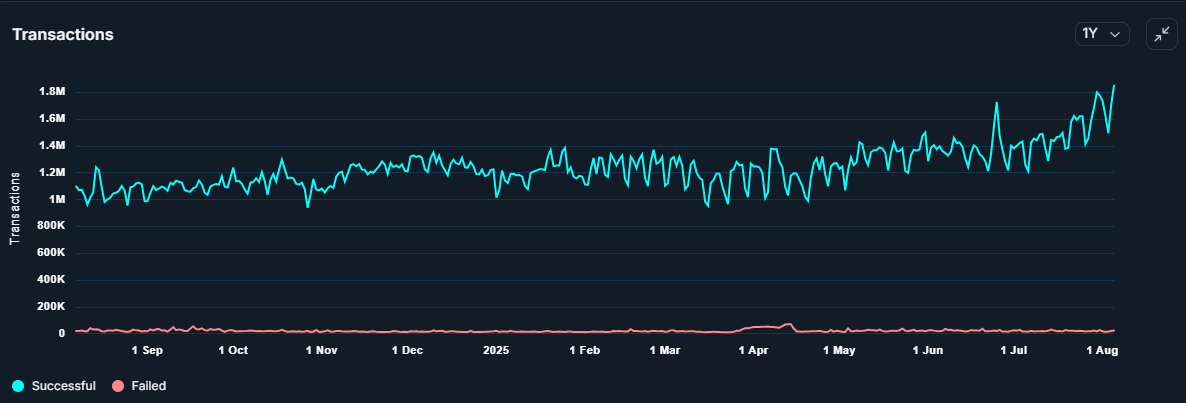
One-year chart of transactions on the Ethereum network. Source: Nansen


Liquid staking on Ethereum in “muddy waters”

On Tuesday, the SEC’s Division of Corporation Finance released a “Statement on Certain Liquid Staking Activities.” In it, the division defined and explained its views on liquid staking.

Liquid staking is a form of staking that issues a token representing a user’s staked asset. It allows investors to continue using decentralized finance (DeFi) protocols while earning staking rewards.

The division said that liquid staking activities, as well as the offer and sale of “staking receipt tokens,” insofar as they are described in the SEC’s statement, do not “involve the offer and sale of securities” as defined by the 1933 Securities Act. 

As such, entities issuing “staking receipt tokens,” so long as those tokens don’t constitute some form of investment contract, do not need to be registered with the SEC. 

The DeFi industry was quick to hail the updated guidance as a victory

“Institutions can now confidently integrate LSTs [liquid staking tokens] into their products, which is sure to drive new revenue streams, expand customer bases and enable the creation of secondary markets for staked assets,” Mara Schmiedt, CEO of blockchain developer company Alluvial, previously told Cointelegraph.

Jito Labs CEO Lucas Bruder said the guidance “shows the same nuanced understanding of LST technology that the Crypto Task Force exhibited when we met with them on this topic back in February.”

However, not everyone at the SEC is convinced that the Division of Corporation Finance made the right move. 

On Wednesday, Commissioner Caroline Crenshaw responded, saying that the division’s statement “stacks factual assumption on top of factual assumption on top of factual assumption, resulting in a wobbly wall of facts without an anchor in industry reality.” She said that their definition of staking “might not reflect prevailing conditions on the ground.” 

Per Crenshaw, the legal conclusions of the statement (i.e., that LSTs are exempt from securities laws) “apply only if those many factual assumptions hold.”

“To the extent that any particular liquid staking activity deviates from the numerous factual assumptions laid out in the Liquid Staking Statement, that activity is outside the statement’s scope.”

She concluded that the statement reflects only the views of the singular division, not the whole commission, and said it should give “little comfort” to entities involved in staking. 

The statement is not without allies in the SEC. So-called “Crypto Mom” Hester Peirce — an SEC commissioner who has advocated for more favorable regulations for the crypto industry over the years — released a statement of her own, saying that the division has clarified its view “that liquid staking activities in connection with protocol staking do not involve the offer and sale of securities.”

Chairman Paul Atkins said it was “a significant step forward in clarifying the staff’s view about crypto asset activities that do not fall within the SEC’s jurisdiction.”

Ethereum ascendent with DeFi still in legal gray area 

Regardless of the limitations of the division’s statement or the potential outcomes thereof, the Ethereum ecosystem is optimistic.

Pseudonymous CryptoQuant author Onchainschool noted in a Tuesday post that more than 500,000 ETH (worth approximately $1.8 billion at publishing time) was staked in the first half of June alone. 

“This growth signals rising confidence and a continued drop in liquid supply,” they stated. 

Furthermore, blockchain addresses with no selling history are also on the rise, holding nearly 23 million ETH (worth some $82.6 billion at current prices).
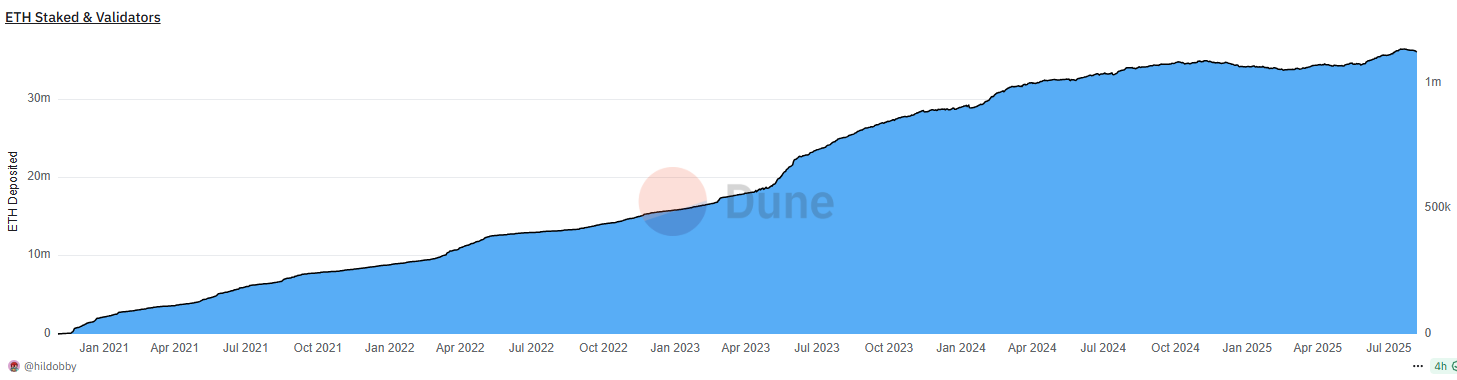
  Ether staked and validators since November 2020. Source: Dune


Still, the DeFi industry, much of which is built on the framework of Ethereum, still lacks legal recognition or regulation in many jurisdictions. 

In the case of the US SEC, the commission delayed its decision on Bitwise’s application to add staking to its Ether exchange-traded fund (ETF). 

The CLARITY Act, which would establish some regulations for the DeFi industry, is still making its way through the halls of Congress. The bill would exempt DeFi protocols from some of the standards it creates for other crypto-related entities and allow them to launch and sell native tokens. 

The European Union’s Markets in Crypto-Assets regulation does not contain provisions for the DeFi industry; however, this will reportedly become a priority for the bloc’s lawmakers in 2026.

Sooner or later, it appears that DeFi regulations are coming and ecosystems critical for the industry, like Ethereum, are getting ready. 

Comments

All Comments

Recommended for you

  • NVIDIA's Market Value Surpasses $5 Trillion Again

    On April 24, NVIDIA's stock price rose by 3.08%, reaching $205.790 per share, with a total market value of $5.00 trillion. The stock price hit a new high since late October 2025.

  • Ethereum Foundation to Sell 10,000 ETH to BitMine

    On April 24, the Ethereum Foundation announced the finalization of a sale of 10,000 ETH to BitMine, the first treasury company of Ethereum, through an over-the-counter (OTC) trading platform, at an average price of $2,387 per ETH.

  • Sources: U.S. Justice Department Expected to Drop Criminal Investigation into Powell

    On April 24, multiple informed sources revealed that the U.S. Justice Department is expected to conclude its criminal investigation into Federal Reserve Chairman Jerome Powell as early as Friday, thereby ending a stalemate that could have delayed the appointment of Powell's successor. Sources indicated that senior officials from the Justice Department recently contacted several senators, including Republican Senator Thom Tillis, a member of the Senate Banking Committee, to inform them of the plan to abandon the investigation into alleged cost overruns related to the renovation of the Federal Reserve's Washington headquarters, and to refer the matter to the Federal Reserve's internal oversight body. Powell's term is set to end next month, but he stated in March that he would remain until Trump's nominee for Federal Reserve Chair, Waller, is confirmed. (ABC News)

  • U.S. Stock Indices Open Higher; Intel Surges Approximately 23% to Record High

    On April 24, U.S. stock indices opened higher across the board, with the Dow Jones up 0.02%, the S&P 500 rising 0.4%, and the Nasdaq increasing by 0.73%. Intel surged approximately 23%, reaching a record high; the company expects second-quarter revenue between $13.8 billion and $14.8 billion, while the market estimate is $13.04 billion. AMD rose over 10%, and Arm increased more than 8%. Nvidia's stock price rose by 0.11%, while Google's Class A shares fell by 0.49%. Apple's stock price decreased by 0.61%, Microsoft’s stock rose by 0.47%, Amazon's stock increased by 1.42%, Meta Platforms Inc Class A shares fell by 0.34%, Tesla's stock remained unchanged, and Netflix's stock dropped by 0.92%.

  • BTC Surpasses $78,000

    Market data shows that BTC has surpassed $78,000, currently priced at $78,013.14, with a 24-hour increase of 0.7%. The market is experiencing significant volatility, so please ensure proper risk management.

  • Central Bank and Eight Departments: Prohibit Online Marketing Services for Virtual Currency Issuance and Trading

    On April 24, the People's Bank of China and eight other departments jointly issued the "Regulations on the Management of Online Marketing of Financial Products," which will take effect on September 30, 2026, systematically regulating online marketing activities for financial products. The regulations specify that only approved financial institutions and their self-operated platforms, as well as entrusted third-party internet platforms, may engage in online marketing of financial products. It prohibits providing online marketing services for illegal financial activities such as illegal fundraising, virtual currency issuance and trading, and illegal foreign exchange margin trading. The regulations detail requirements regarding the authenticity of marketing content, risk disclosure, algorithm recommendations, pop-up advertisements, account naming, trademark usage, cooperation models, and the protection of data and personal information. They also clarify the regulatory responsibilities and penalties for financial management departments, internet information, telecommunications, and market supervision departments.

  • BTC Surpasses $78,000

    Market data shows that BTC has surpassed $78,000, currently priced at $78,049.83, with a 24-hour increase of 0.04%. The market is experiencing significant volatility, so please ensure proper risk management.

  • DeepSeek-V4 Preview Version Officially Launched and Open-Sourced

    On April 24, DeepSeek announced via its official WeChat account that the preview version of the new model series DeepSeek-V4 is officially online and open-sourced. DeepSeek-V4 features a million-word ultra-long context and leads in agent capabilities, world knowledge, and reasoning performance in both domestic and open-source fields. The model is available in two versions based on size. Starting today, users can log in to the official website chat.deepseek.com or the official app to interact with the latest DeepSeek-V4 and explore the new experience of 1M ultra-long context memory. The API service has also been updated; by changing the model_name to deepseek-v4-pro or deepseek-v4-flash, users can access it.

  • Intel CEO: Semiconductor Potential Market Size Approaching $1 Trillion

    On April 24, local time, after the U.S. stock market closed on April 23, Intel officially released its Q1 fiscal year 2026 financial report and held an earnings call. The company delivered its sixth consecutive quarter of better-than-expected results, with revenue, gross margin, and earnings per share all surpassing guidance. The AI business has become the core growth engine, with a surge in demand for server CPUs and advancements in advanced processes and packaging exceeding expectations. Following this financial report, Intel's stock price surged nearly 20% in after-hours trading. During the earnings call, Intel CEO Pat Gelsinger stated that despite continuous improvements in factory capacity, demand across all business segments remains higher than supply, particularly for Xeon server CPUs, which are expected to maintain strong growth momentum over the next two years. Gelsinger also noted, 'In recent years, the focus in high-performance computing has been almost entirely on graphics processors and other accelerators. In recent months, clear signs have shown that central processing units are becoming an indispensable foundation in the era of artificial intelligence.' Looking at the overall market, Gelsinger anticipates that driven by explosive growth in AI demand, the overall potential market size of the semiconductor industry is approaching $1 trillion. However, Intel's management also warned that the company still faces multiple pressures, including declining demand in the PC market, rising costs, expanding capital expenditures, and supply constraints. (Dongxin News Agency)

  • Trump: U.S. to Soon Capture Nearly 50% of Chip Market

    On April 24, U.S. President Trump declared on the 23rd that the United States will soon capture nearly 50% of the chip market, warning that chip companies that do not manufacture in the U.S. will face very high tariffs in a year and a half to two years. U.S. Secretary of Commerce Gina Raimondo stated that the U.S. previously held only 3% to 4% of the chip market while having the largest demand for chips. Under Trump's directive, the U.S. is requiring semiconductor fabs to return to domestic production, with expectations that fabs worth $1 trillion will come to the U.S. Raimondo emphasized that this is not about tech giants purchasing chips, but rather about chip manufacturing. She mentioned commitments from Micron Technology to invest $200 billion and TSMC to invest $165 billion, along with $500 billion in funds from Taiwan expected to flow into the U.S. Raimondo also indicated during a congressional hearing on the 23rd that investments in the U.S. semiconductor industry during Trump's term are expected to reach $1 trillion. (Dongxin News Agency)
