

Cointime

Download App
iOS & Android

Where People Store Their Crypto, Post-FTX Collapse

Validated Project

Which Crypto Storage Method is Most Commonly Used?

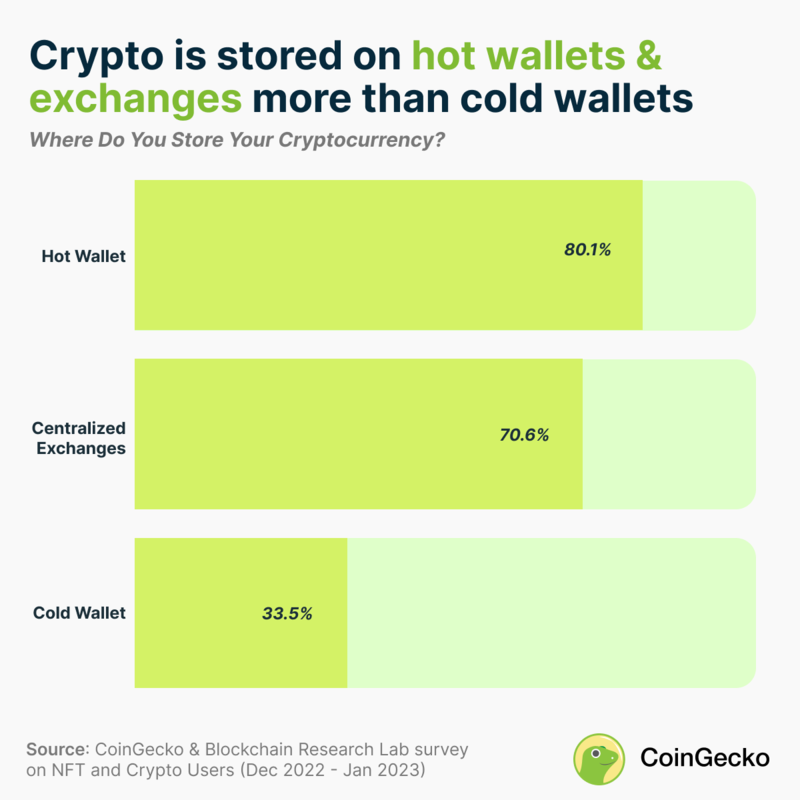
Hot wallets are the most popular way for crypto holders to store their funds. 8 out of 10 people use hot wallets, according to a recent survey of crypto holders. This points to a meaningful level of crypto holders practicing self-custody, after the collapse of a former leading centralized crypto exchange FTX and the mass withdrawals from centralized exchanges.

The widespread usage of hot wallets might also be driven by the popularity of NFTs among crypto holders. Participants usually need hot wallets like MetaMask, in order to mint, transfer, or buy and sell NFTs.

Self-Custody vs Custodial Crypto Storage

However, 7 out of 10 continue to store their crypto on centralized exchanges. The trend is in line with the current dominance of centralized exchanges over decentralized exchanges. Most crypto holders remain reliant on centralized exchanges for on- and off-ramping as well as for buying and selling crypto, such that holders prioritize convenience over security.

While the FTX collapse raised awareness about the risks of custodial entities, crypto holders are still unwilling or unable to completely switch away from storing their funds in centralized exchanges.

Are Crypto Holders Using Cold Wallets?

Cold wallets are not commonly used, despite being one of the safest ways for cryptocurrency storage. Just 3 out of 10 people use cold wallets to store their crypto, pointing to poor crypto cybersecurity practices.

Instead, crypto holders mostly prefer to use hot wallets or centralized exchanges for storage. This comes even as crypto hacks reached a ten-year high of $2.8 billion in 2022, including the Solana Slope wallet attack that led to user losses of $5.2 million.

The low usage of cold wallets also indicates that crypto adoption is still at an early stage, with most participants only engaging in easier-to-understand activities that have a lower barrier of entry or significant incentives. As cybersecurity awareness increases and crypto holders become more on-chain native, using cold storage wallets will hopefully become a common practice.

Methodology

The study examined 421 responses from the NFT and Crypto Users Survey, jointly conducted by CoinGecko and Blockchain Research Lab from December 2022 to January 2023.

Read more: https://www.coingecko.com/research/publications/where-people-store-crypto

Comments

All Comments

Recommended for you

  • BTC Surpasses $82,000

    Market data shows that BTC has surpassed $82,000, currently priced at $82,038.65, with a 24-hour increase of 0.31%. The market is experiencing significant volatility, so please ensure proper risk management.

  • ETH Surpasses $2400

    Market data shows that ETH has surpassed $2400, currently priced at $2400.26, with a 24-hour decline of 1.33%. The market is experiencing significant volatility, so please ensure proper risk management.

  • BTC Surpasses $81,000

    Market data shows that BTC has surpassed $81,000, currently priced at $81,016.34, with a 24-hour decline of 1.53%. The market is experiencing significant volatility, so please ensure proper risk management.

  • BTC Falls Below $80,000

    Market data shows that BTC has fallen below $80,000, currently priced at $79,940.09, with a 24-hour decline of 3.44%. The market is experiencing significant volatility, so please ensure proper risk management.

  • Philadelphia Semiconductor Index Set to Lose Over $2 Trillion in Market Value in Seven Trading Days

    The Philadelphia Semiconductor Index is poised to evaporate over $2 trillion in market value within seven trading days.

  • Philadelphia Semiconductor Index Drops 4% to Lowest Level in Nearly a Month

    The Philadelphia Semiconductor Index fell by 4.01% during the day, currently reported at 11,215.37 points. Nvidia dropped by 3.25%, Broadcom fell by 2.87%, Micron decreased by 5.79%, Intel declined by 5.81%, AMD dropped by 6.28%, Qualcomm rose by 0.66%, TSMC fell by 4.37%, and ASML decreased by 3.34%.

  • Philadelphia Semiconductor Index Falls 4% to Lowest Level in Nearly a Month

    The Philadelphia Semiconductor Index dropped 4.01% during the day, currently reported at 11,215.37 points. Nvidia fell by 3.25%, Broadcom by 2.87%, Micron by 5.79%, Intel by 5.81%, AMD by 6.28%, Qualcomm rose by 0.66%, TSMC fell by 4.37%, and ASML dropped by 3.34%.

  • Ripple Prime Launches Perpetual Contract Trading Services for Institutional Clients

    According to Bloomberg, Ripple's main brokerage division, Ripple Prime, is launching perpetual contracts for real-world assets (RWA) aimed at institutional clients, covering over 100 reference markets including stocks, indices, ETFs, and commodities. This product is offered through Trade.xyz on Hyperliquid, continuing Ripple Prime's previous initiative to provide clients with access to cryptocurrency perpetual contract trading.

  • NYC Comptroller Urges Anthropic to Pause IPO Plans

    On October 15, New York City Comptroller Mark Levine stated in an interview that he has written to Anthropic CEO Dario Amodei, urging the company to suspend its planned initial public offering (IPO). In the letter, he called for Anthropic to pause its IPO plans until it can fully and transparently address concerns related to AI safety, governance, and development that the company itself has raised. Levine wrote that the company should focus on mitigating these risks rather than advancing the IPO. Currently, New York City has an investment exposure of less than $10 million in Anthropic through the private market.

  • US September PPI Rises 6.3% Year-on-Year, Exceeding Market Expectations

    The US Producer Price Index (PPI) for September recorded a year-on-year increase of 6.3%, the highest since May 2026, surpassing market expectations of 5.3%. The month-on-month PPI for September was reported at 1.3%, significantly higher than the market forecast of 0.5%. Additionally, US retail sales for September showed a month-on-month increase of 0.8%, also exceeding market expectations.
