

Cointime

Download App
iOS & Android

What Is Proof of Knowledge?

Cryptographic proofs are seeing a Cambrian explosion of innovation in Web3. Many of these advancements have to do with zero-knowledge proofs—a subset of knowledge proofs, or proofs of knowledge.

Proof of Knowledge Explained

In a proof of knowledge, a prover must prove that it knows something to a verifier. Exactly what is being proved varies between proof protocols.

The terms “prover” and “verifier” are commonly used to describe cryptographic proofs. The prover is the entity or program that creates the cryptographic proof. The verifier is the entity or program that checks the proof’s contents.
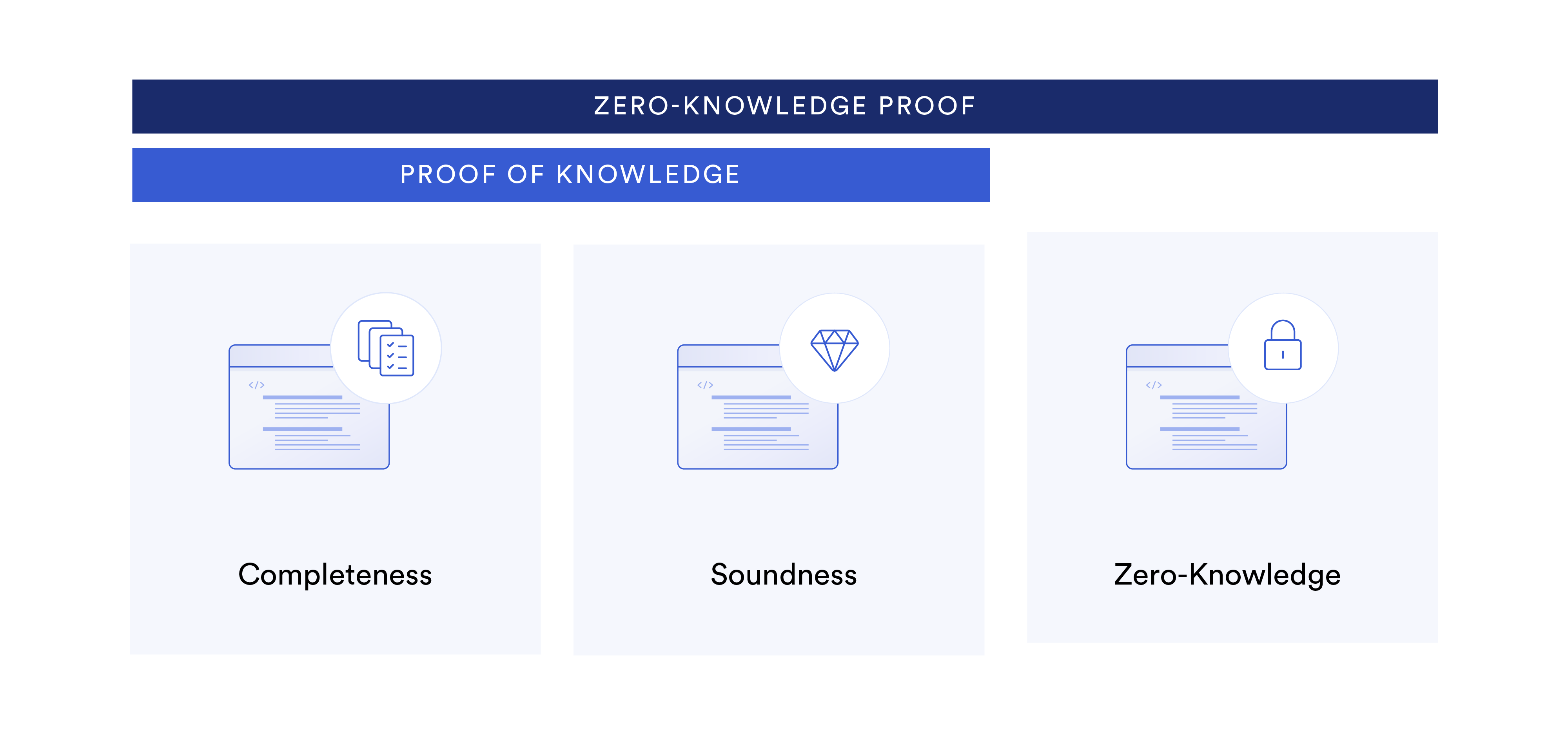
Zero-knowledge proofs are a subset of proofs of knowledge.

A proof of knowledge has two fundamental characteristics:

  • Completeness: If a statement is true, then an honest verifier can be convinced by an honest prover that they possess knowledge about the correct input.
  • Soundness: If a statement is false, then no dishonest prover can unilaterally convince an honest verifier that they possess knowledge about the correct input. 

The key difference between a proof of knowledge and a zero-knowledge proof is that a zero-knowledge proof has an additional characteristic:

  • Zero-knowledge: If a statement is true, then the verifier learns nothing more from the prover other than that the statement is true.

Another way to classify proofs of knowledge, including zero-knowledge proofs, is by interactivity—knowledge proofs are either interactive or non-interactive. Interactive zero-knowledge proofs require direct communication in rounds between the prover and the verifier, while non-interactive zero-knowledge proofs can be verified without any direct interaction between the two parties.

Note: Non-interactive variations of knowledge proofs that are not zero knowledge are sometimes called signature schemes.

Applications of Proof of Knowledge

Proofs of knowledge have a wide variety of applications for advancing digital identity, security, and privacy within blockchain networks and beyond.

Zero-Knowledge Cloud Storage and Password Management

Cloud storage and password management providers that offer zero-knowledge encryption use zero-knowledge proofs to verify whether a user has knowledge of an encryption key (which affords access to stored files or passwords) without needing to store the encryption key on their servers.

Schnorr Signatures in Bitcoin

Schnorr signatures, which use a non-interactive proof of knowledge (signature scheme), were implemented within the Bitcoin protocol during the Taproot upgrade. They enable the aggregation of multiple digital signatures into a single signature while still enabling a verifier to definitively know that all individual entities behind the aggregated signature have signed the transaction.

Privacy-Preserving Digital Identity Using DECO

Chainlink DECO is a privacy-preserving oracle service currently in development that uses zero-knowledge proofs to prove specific statements regarding a user—such as their bank account balance or health data—without revealing any specifics of the underlying information.
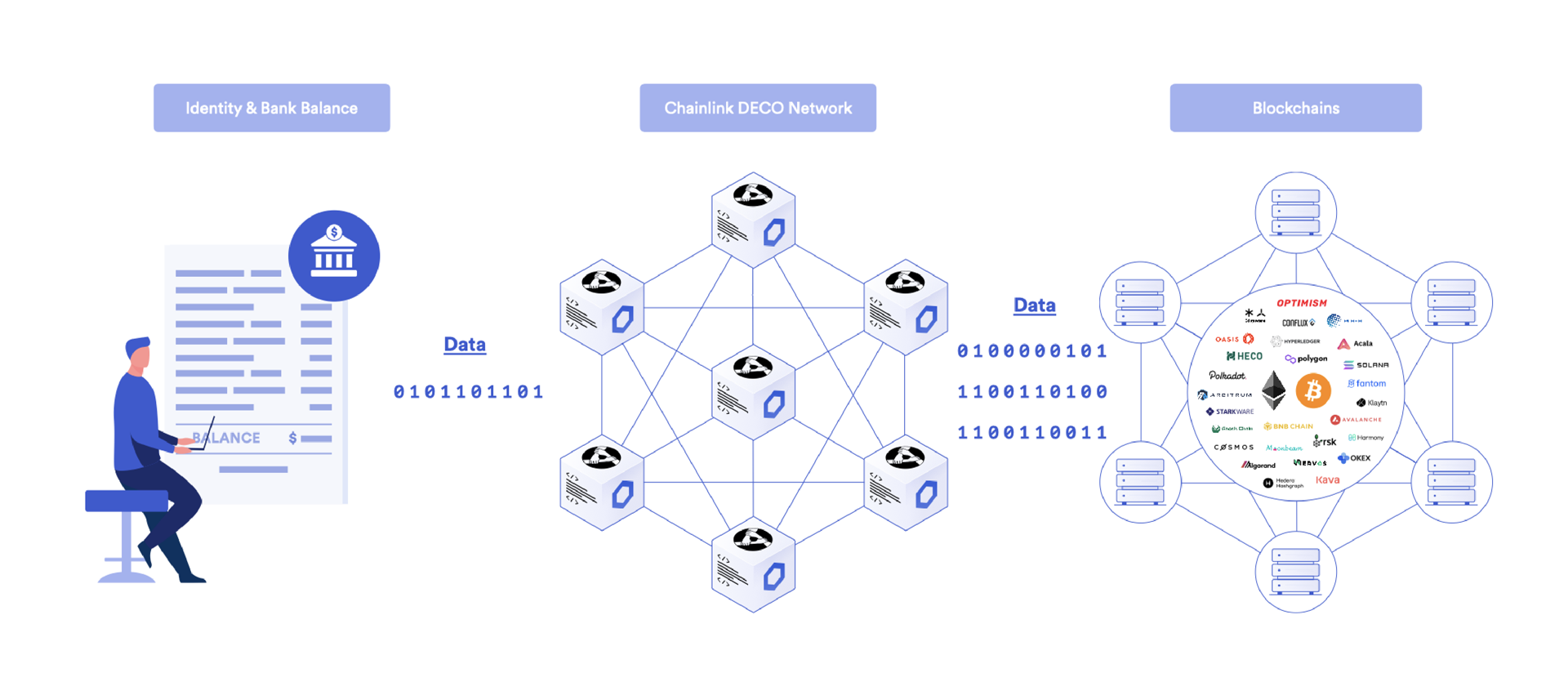
Chainlink DECO aims to preserve users’ data privacy by proving statements about a user without revealing the underlying information.

Conclusion

While proofs of knowledge come in a wide range of formats and flavors, the core premise of all knowledge proof protocols is that they provide more security, privacy, and usability within Internet-based technologies.

Read more: https://blog.chain.link/proof-of-knowledge/

Comments

All Comments

Recommended for you

  • NVIDIA's Market Value Surpasses $5 Trillion Again

    On April 24, NVIDIA's stock price rose by 3.08%, reaching $205.790 per share, with a total market value of $5.00 trillion. The stock price hit a new high since late October 2025.

  • Ethereum Foundation to Sell 10,000 ETH to BitMine

    On April 24, the Ethereum Foundation announced the finalization of a sale of 10,000 ETH to BitMine, the first treasury company of Ethereum, through an over-the-counter (OTC) trading platform, at an average price of $2,387 per ETH.

  • Sources: U.S. Justice Department Expected to Drop Criminal Investigation into Powell

    On April 24, multiple informed sources revealed that the U.S. Justice Department is expected to conclude its criminal investigation into Federal Reserve Chairman Jerome Powell as early as Friday, thereby ending a stalemate that could have delayed the appointment of Powell's successor. Sources indicated that senior officials from the Justice Department recently contacted several senators, including Republican Senator Thom Tillis, a member of the Senate Banking Committee, to inform them of the plan to abandon the investigation into alleged cost overruns related to the renovation of the Federal Reserve's Washington headquarters, and to refer the matter to the Federal Reserve's internal oversight body. Powell's term is set to end next month, but he stated in March that he would remain until Trump's nominee for Federal Reserve Chair, Waller, is confirmed. (ABC News)

  • U.S. Stock Indices Open Higher; Intel Surges Approximately 23% to Record High

    On April 24, U.S. stock indices opened higher across the board, with the Dow Jones up 0.02%, the S&P 500 rising 0.4%, and the Nasdaq increasing by 0.73%. Intel surged approximately 23%, reaching a record high; the company expects second-quarter revenue between $13.8 billion and $14.8 billion, while the market estimate is $13.04 billion. AMD rose over 10%, and Arm increased more than 8%. Nvidia's stock price rose by 0.11%, while Google's Class A shares fell by 0.49%. Apple's stock price decreased by 0.61%, Microsoft’s stock rose by 0.47%, Amazon's stock increased by 1.42%, Meta Platforms Inc Class A shares fell by 0.34%, Tesla's stock remained unchanged, and Netflix's stock dropped by 0.92%.

  • BTC Surpasses $78,000

    Market data shows that BTC has surpassed $78,000, currently priced at $78,013.14, with a 24-hour increase of 0.7%. The market is experiencing significant volatility, so please ensure proper risk management.

  • Central Bank and Eight Departments: Prohibit Online Marketing Services for Virtual Currency Issuance and Trading

    On April 24, the People's Bank of China and eight other departments jointly issued the "Regulations on the Management of Online Marketing of Financial Products," which will take effect on September 30, 2026, systematically regulating online marketing activities for financial products. The regulations specify that only approved financial institutions and their self-operated platforms, as well as entrusted third-party internet platforms, may engage in online marketing of financial products. It prohibits providing online marketing services for illegal financial activities such as illegal fundraising, virtual currency issuance and trading, and illegal foreign exchange margin trading. The regulations detail requirements regarding the authenticity of marketing content, risk disclosure, algorithm recommendations, pop-up advertisements, account naming, trademark usage, cooperation models, and the protection of data and personal information. They also clarify the regulatory responsibilities and penalties for financial management departments, internet information, telecommunications, and market supervision departments.

  • BTC Surpasses $78,000

    Market data shows that BTC has surpassed $78,000, currently priced at $78,049.83, with a 24-hour increase of 0.04%. The market is experiencing significant volatility, so please ensure proper risk management.

  • DeepSeek-V4 Preview Version Officially Launched and Open-Sourced

    On April 24, DeepSeek announced via its official WeChat account that the preview version of the new model series DeepSeek-V4 is officially online and open-sourced. DeepSeek-V4 features a million-word ultra-long context and leads in agent capabilities, world knowledge, and reasoning performance in both domestic and open-source fields. The model is available in two versions based on size. Starting today, users can log in to the official website chat.deepseek.com or the official app to interact with the latest DeepSeek-V4 and explore the new experience of 1M ultra-long context memory. The API service has also been updated; by changing the model_name to deepseek-v4-pro or deepseek-v4-flash, users can access it.

  • Intel CEO: Semiconductor Potential Market Size Approaching $1 Trillion

    On April 24, local time, after the U.S. stock market closed on April 23, Intel officially released its Q1 fiscal year 2026 financial report and held an earnings call. The company delivered its sixth consecutive quarter of better-than-expected results, with revenue, gross margin, and earnings per share all surpassing guidance. The AI business has become the core growth engine, with a surge in demand for server CPUs and advancements in advanced processes and packaging exceeding expectations. Following this financial report, Intel's stock price surged nearly 20% in after-hours trading. During the earnings call, Intel CEO Pat Gelsinger stated that despite continuous improvements in factory capacity, demand across all business segments remains higher than supply, particularly for Xeon server CPUs, which are expected to maintain strong growth momentum over the next two years. Gelsinger also noted, 'In recent years, the focus in high-performance computing has been almost entirely on graphics processors and other accelerators. In recent months, clear signs have shown that central processing units are becoming an indispensable foundation in the era of artificial intelligence.' Looking at the overall market, Gelsinger anticipates that driven by explosive growth in AI demand, the overall potential market size of the semiconductor industry is approaching $1 trillion. However, Intel's management also warned that the company still faces multiple pressures, including declining demand in the PC market, rising costs, expanding capital expenditures, and supply constraints. (Dongxin News Agency)

  • Trump: U.S. to Soon Capture Nearly 50% of Chip Market

    On April 24, U.S. President Trump declared on the 23rd that the United States will soon capture nearly 50% of the chip market, warning that chip companies that do not manufacture in the U.S. will face very high tariffs in a year and a half to two years. U.S. Secretary of Commerce Gina Raimondo stated that the U.S. previously held only 3% to 4% of the chip market while having the largest demand for chips. Under Trump's directive, the U.S. is requiring semiconductor fabs to return to domestic production, with expectations that fabs worth $1 trillion will come to the U.S. Raimondo emphasized that this is not about tech giants purchasing chips, but rather about chip manufacturing. She mentioned commitments from Micron Technology to invest $200 billion and TSMC to invest $165 billion, along with $500 billion in funds from Taiwan expected to flow into the U.S. Raimondo also indicated during a congressional hearing on the 23rd that investments in the U.S. semiconductor industry during Trump's term are expected to reach $1 trillion. (Dongxin News Agency)
