


The metric assesses market sentiment and the likelihood of miners capitulating as the price of the first cryptocurrency falls or mining operating costs rise.
Hash Ribbons is predicated on the assumption that miners are the least susceptible to shocks and the most sensitive to market recovery.
Who created Hash Ribbons?
Hash Ribbons was developed by Charles Edwards, founder of Capriole Investments, in 2019.
The creation of the metric was preceded by his earlier work on a way to determine the price bottom of bitcoin based on the network’s hashrate data (Hash Rate Capitulation).
Edwards took advantage of analyst Willie Wu’s work, who proposed the Difficulty Ribbon Compression indicator, which is based on the Difficulty Ribbon. He combined both approaches into a single concept.
What is Miner Capitulation?
In the context of the Hash Ribbons indicator, miner capitulation occurs when the costs of equipment maintenance and energy outweigh the price of the mined cryptocurrency over a period of 1–2 months.
Hash Ribbons, based on the bitcoin hashray, predicts miner capitulation. In other words, the indicator indicates that a large portion of the equipment has been disconnected from the network.
Rationale for the Hash Ribbons indicator
According to Edwards, the price of bitcoin and the cost of mining are inextricably linked to hash rate. The fewer miners remain in the network, the lower the price and the higher the costs. In contrast, the greater the price and lower the costs, the greater the interest from process participants.
Because Hash Ribbon is based on average bitcoin hashrate data, it is ideal for analyzing long-term trends and identifying market entry points.
Because Hash Ribbon is based on averaged bitcoin hash data, it is ideal for analyzing long-term trends and identifying market entry points.
The metric’s lagging nature makes it ineffective for identifying favorable times to sell bitcoin.
How to use Hash Ribbons?
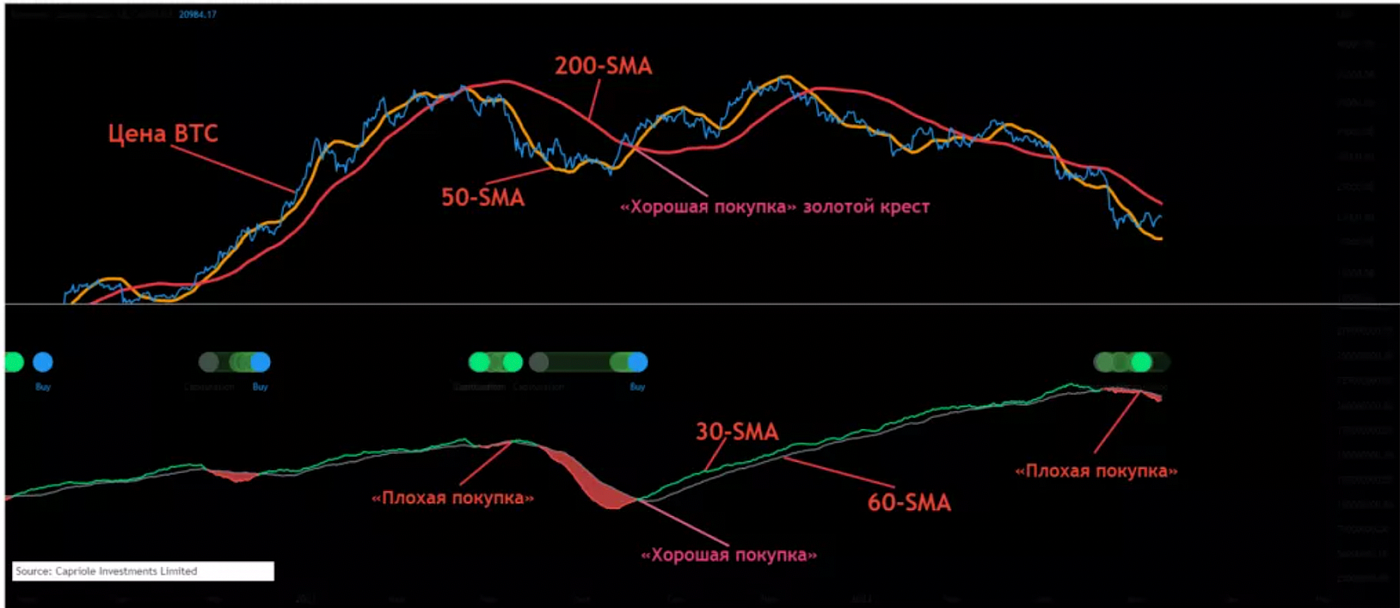
The Hash Ribbon chart is based on two daily bitcoin hash rate simple moving averages (SMAs) with periods of 30 and 60 days. The beginning of miner capitulation is indicated when the 30-SMA crosses the 60-SMA from top to bottom. A cross from the bottom to the top indicates a buy signal.
According to Edwards, the Hash Ribbon indicator revealed a “bad” entry point in 2015, when the bitcoin price fell 42%. A similar scenario occurred in 2019, 2021, and 2022.
According to Edwards, such “bad trades” can be avoided by incorporating simple moving averages (50-SMA, 200-SMA) for bitcoin price. The simultaneous use of the two instruments will help to reduce risks.
Risks of using the indicator
The popularity and historically positive return on investments based on the Hash Ribbon does not guarantee the “working out” of signals in the future. Let us consider a number of risks associated with the use of the indicator.
Hashrate
Hashrate is the only calculation unit used to create a metric. In contrast to mining complexity, the value of a network’s processing power is an approximate and highly volatile metric. Inaccurate data can lead to incorrect conclusions.
Market volatility
According to Edwards’ statistics, from the moment the buy signal is formed, bitcoin price can lose from 3% to 42%. This value could rise in the future, so the risk of volatility should be considered.
Regulation
The legal ban on mining in China has demonstrated how industry regulation affects the hash of the bitcoin network. Local or global government restrictions can have an impact on industry participants in a specific country. This reduces the network’s hash rate, distorting the logic behind the Hash Ribbon.
Technological risks
The beginning of sales of more efficient mining equipment, improvements in the performance of older equipment, and the emergence of new cheap energy sources are all risks to the analysis of the world’s hash rate distribution.
New technologies can replace old ones without reducing the network’s overall computing power. Inefficient market participants will exit, lowering the cost of bitcoin mining. As a result, even if miners capitulate, the Hash Ribbon indicator will not detect it.


All Comments