

This digest breaks down what is bot trading, how it works and whether you should dive in. Moreover, it unveils the definition of trading bot types along with their pros and cons. Read on if you want to understand the automated trading essentials.
What Are Crypto Trading Bots?
By definition, a crypto trading bot or robot is a piece of software working automatically. Unlike traders, bots perform automatically when pre-built conditions are satisfied. Operating with almost no downtime, these bots analyze the market based on technical indicators, price levels and volatility to decide whether to trade. Which is why such trading systems are widely used on the crypto market and take up to 80% of the whole volume traded.
How Does a Trading Bot Work?
Reliable trading bots revolve around a clear trading strategy, which should be fully formalized — the rules for opening, maintaining, and closing trades are defined and programmed. In general, once a bot detects a trigger, it will either notify you or make a buy/sell decision based on the rules defined in advance. To monetize a trading opportunity, bots use the following steps:
- Analyze market data
- Evaluate market risks
- Decide whether to buy or sell
- Enter/close a trade
Most robots trade a 15-minute, an hour, or a daily timeframe, blindly following the pre-built algorithm. This way, bots completely eliminate the human factor and emotions. For example, the robot can check the price deviation from the set hourly interval and buy/sell the asset.
Even though complex robots use a wide range of tools to process a large number of crypto quotes and provide more accurate signals; as a result, some indicators dominate across various bots. A bright example is the Moving Average (MA) technical indicator.
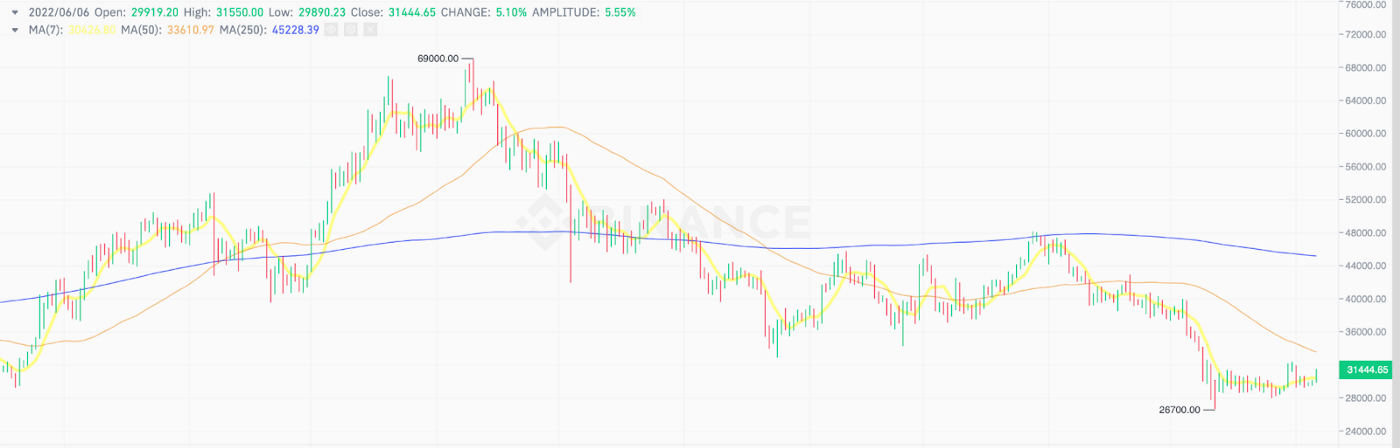
Most robots would buy an asset once its price falls below the average and sell once the quote crosses the average from above. The specific frame depends either on your risk management or the provider’s strategy. As a rule, robots with higher returns (hence, risks) use short frame moving averages like 7-day MA, shown yellow, while less risky robots stick to extended frames like the 50-day MA, shown orange, or the 250-day MA, shown blue.
Types of Bots
All crypto robots have pretty much the same backbone, but each robot has specific nuances that should be considered, as they vary in terms of if/then conditions set to execute trading strategies. Therefore, types of bots and types of trading strategies often correlate and are used interchangeably. The most common types of bots include:
- Arbitrage bots. Arbitrage is a market opportunity based on price imbalances across markets. Simply put, buy lower and sell higher. Arbitrage bots monitor price changes automatically and enter a trade blazingly fast.
- Trend bots. As the name states, these bots follow the main trend by evaluating an asset’s momentum. Rising trends cause long positions while market dips entail shorts.
- Market Making bots. These bots focus on order book spreads to make profits. The logic is pretty straightforward — whenever an asset is traded actively, spreads widen. The bots monitor markets to spot the biggest spreads.
- Lending bots. Bots lend assets to margin traders, assuming the latter will pay back the interest rate. The clear benefit is automation, as a trader can rely on software rather than setting parameters manually.
Some traders also address high-frequency trading (HFT) bots that can make thousands of deals per second, but such bots are hardly suitable for retail users. HFT bots must have a minimum ping — the time interval during which the signal sent from the operational server passes through the network to another server and comes back. Ideally, the servers should share adjacent locations, as a closer distance means a faster data transfer rate. Estimated expenditures can hit multiple digits and fit trading organizations rather than stand-alone traders.
Advantages of Crypto Trading Bots
Trading robots have multiple benefits to offer. Here’s the list of key advantages.
- Bootstrap your efficiency. Robots use backtesting tools, data insights & analysis features, advanced risk evaluation, and more to maximize your trading efficiency.
- Trade 24/7, no downtime. Algorithms do not need any rest and work continuously with no need for breaks, which means they monitor markets and have a higher chance to monetize opportunities you’d otherwise miss.
- Tame your emotions. Imagine controlling the main risk related to trading. Bots follow pre-programmed patterns to trade automatically, with no strings attached.
- Trade in a simple way. You don’t have to be a crypto expert in using bots, as most of them have already analyzed and processed tons of data on your behalf. This is a ready-to-go solution if the trading bot provider is reliable.
Disadvantages of Crypto Trading Bots
There are three core factors to consider when it comes to automated trading software disadvantages.
- Marginal returns might not be the best pick for a veteran trader
- Some trading bots are designed poorly, resulting in losses for a trader
- A bigger part of the market already uses bots and you can rarely outperform larger players like exchanges.
Most automated software providers do not provide valuable products, disguising real returns under loads of formal numbers (which is true but is none of the interest to a trader). However, that’s not the case for the whole market. To avoid this risk you might want to deal only with established brands and check your potential profits in advance. Once you calculate returns, you should also jot down fees. The difference would be your tangible profit.
Are Crypto Trading Bots Worth It?
Once you already understand what bot trading is, you might wonder whether bots actually yield returns. The answer is yes if your bot provider is reliable and trustworthy. The trust issue is a big concern for the whole Web3 community, and bots are not an exception, as many providers gloss over lack of returns or inefficient trading strategies.
To pick a good bot, you might want to have a look at some established trading software providers like 3Commas.
FAQ
Are Trading Bots Actually Profitable?
Not all bots are designed equal, as profits trading, bots depend on the strategy picked. Some reliable bots like 3Commas can make money steadily, especially over the long run.
How Much Does a Trading Bot Cost?
The price majorly depends on functions provided by the bot — more functions entail a higher price. On average, a monthly subscription for a reliable bot starts from $15, while lifetime offers vary significantly across the board.
Is a Trading Bot Worth It?
A trading bot can be valuable if you use several strategies and allocate your capital accordingly. Depending on your initial capital, bots can make huge annual profits on your behalf.
What Is The Best Trading Bot?
Depending on your needs, some bots fit better than others. However, you might want to narrow down your selection to reliable bots only. An example of such a bot is 3Commas.
How Do Bots Make Money?
Bots implement various technical indicators and algorithms to check the market and adjust their behavior accordingly, based on the pre-built logic sets. A wide range of tools allows bots to trade quite effectively, making money in an automated manner.
How Do You Set Up a Trading Bot?
Settings depend on the software provider and may vary slightly across the market. Generally, you should visit the website and follow the clear instructions provided.
How Do You Make a Trading Bot?
You can either build a bot from scratch all by yourself or use presets to avoid coding requirements. For example, 3Commas allows two ways of setting preset bots — adjust their strategies based on your needs manually or automatically.


All Comments