


Web3 is booming, and Arweave is becoming a popular infrastructure choice for developers. PermaDAO is a community where everyone can contribute to the Arweave ecosystem. It's a place to propose and tackle tasks related to Arweave, with the support and feedback of the entire community. Join PermaDAO and help shape Web3!
Author: Spike @ Contributor of PermaDAO
Translator: Spike @ Contributor of PermaDAO
Reviewer: Viya @ Contributor of PermaDAO
A bear market is a suitable time for building, but there is a premise: having the financial reserve to sustain the project's operations. Otherwise, it's very likely that you won't make it to the next bull market and will have to sacrifice in the darkness of the bear market prematurely.
However, capital seeks returns and won't easily invest money just based on a PowerPoint presentation. Therefore, gaining a deep understanding of the preferences of venture capitalists (VCs) becomes crucial. Avoiding detours is the shortcut to outperforming other projects.
The road less traveled is not necessarily difficult; it's often because people don't know how to navigate it. This time, with the data collected and compiled by Roodata, we can, for the first time, observe VC's specific behavioral preferences comprehensively.
This report does not provide specific investment advice; it's merely an observation of VC behavior. The data is a summary of information currently available, and it does not guarantee 100% accuracy.
Whether you make a profit or incur losses has no relation to this article.
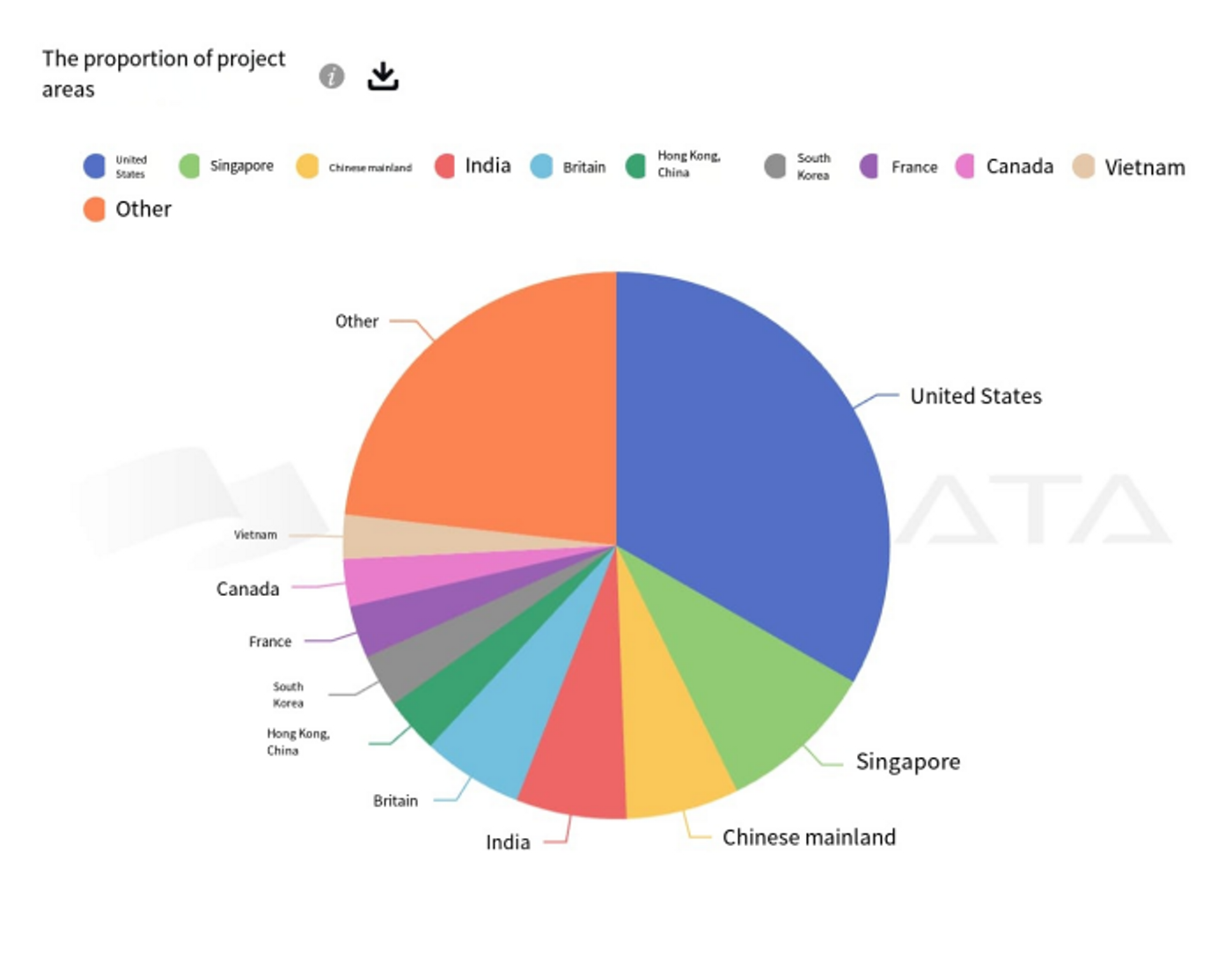
Caption: Proportion of project areas established since 2020
Source: https://www.rootdata.com
First of all, the United States is still the absolute highland of Web3 entrepreneurship, and is in an absolute dominant position. It commands over one-third of the total industry funding share, with a staggering 474 startups securing investments., which is more than the sum of the projects distributed in the next 2-5 countries. The United States is the absolute highland of entrepreneurs.
Moving beyond the United States, the numbers drop significantly. The 2-5 positions only have around 100 companies each, while Hong Kong falls below 50. We can roughly categorize these into three tiers: the United States standing alone at the top and dominating, with Singapore being somewhat unique as a gateway to the Asia-Pacific market. Meanwhile, the startup scene in Hong Kong has yet to recover its 2017 peak.
We can conclude that there are currently three main markets for blockchain: North America, Asia and others, presenting an overall entrepreneurial landscape of one main hub and one sub-hub. It's important to note that the Asian market extends beyond mainland China, with 95 companies based in mainland China and India closely following with 93 companies.
In addition, the number of Vietnamese startups in the Southeast Asian market is 37, which is consistent with the trend of Southeast Asia since the explosion of Axie Infinity. Whether for international expansions or localization, the Southeast Asian market deserves more attention.
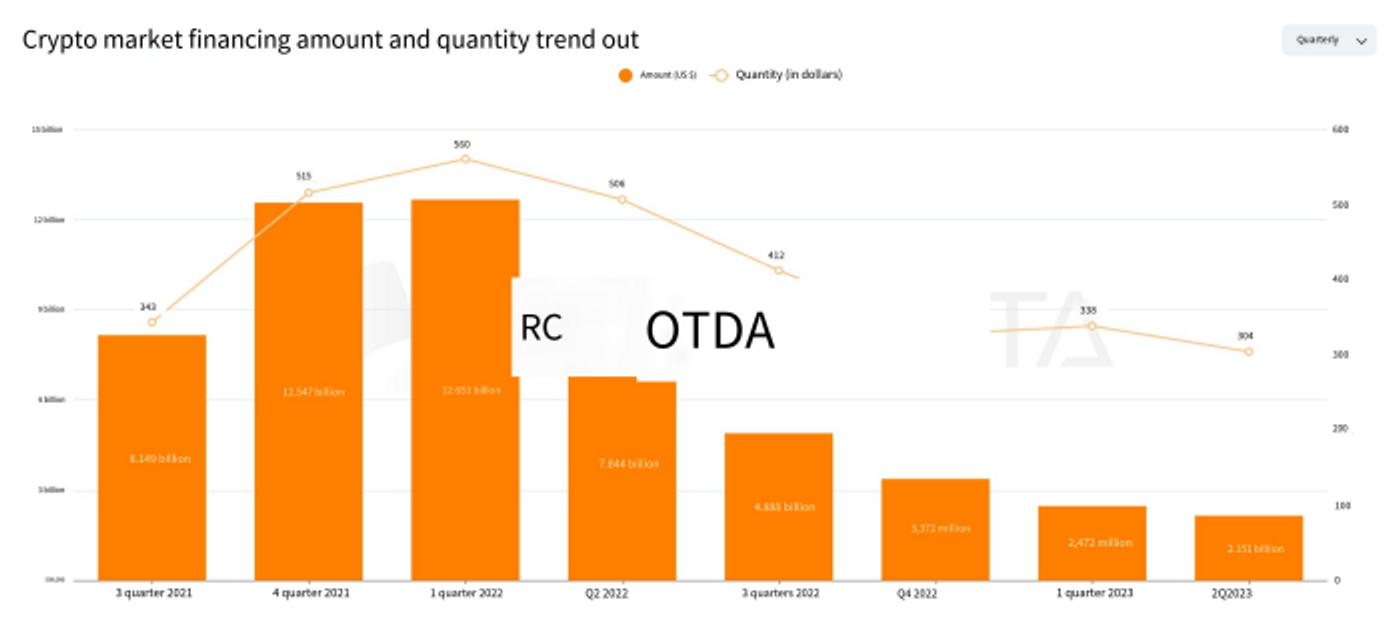
Caption: Crypto market Funding and volume trends (by quarter)
Source: https://www.rootdata.com
Second, a bear market is real, don't believe any short-term bullish indicators. One of the most noticeable signs is the significant reduction in institutional participation. Over the past two years, in 2022 and 2023, both the amount and number of institutional investments have seen a sharp decline compared to 2021.The funding amount has been declining steadily since Q1 2022, so it has been very difficult for the bear market to digest these early investments, and the struggle of the stock market will continue for a long time.
Despite the decline in bear market investment, the overall number of investments since DeFi Summer is still high compared to the period before 2020. It is difficult to draw a conclusion on the merits of high-priced bear market and low-priced bull market at present, but at least it is certain that institutions are not desperate and the long-term market is still worth looking forward to.
But it is still unknown when we can emerge from the bear market. The absolute decrease in numbers is an intuitively terrible display of the bear market‘s severity. The number of projects has decreased by 222 when comparing Q1 2023 to 2022 Q1, and the funding amount is plummeted by a staggering 80%, indicating a significant difference in scale.
The funding amounts since Q1 2021 have noticeably increased by an order of magnitude compared to before. The good news is that projects securing funding can remain stable for quite a long time, even if they take a back seat; they can survive for an extended period.
The downside is that if you're starting a venture now, the available funding in the market may be reduced by as much as 80%, and there are even fewer opportunities to secure that funding than before. Unless you have ample confidence, most people might opt for a more secure path.
If there's one comforting thought, it's that as long as project teams persevere for another quarter, they might see the light at the end of the tunnel. Looking at data from 2017 to 2020, the general trend was a seasonal fluctuation, but there was usually one quarter that returned to a peak, typically in the second or third quarter. Please hold on a bit longer.
In summary, the primary challenge at the moment is that the market is saturated with a massive amount of existing capital, and without a killer application attracting new external users, it can only rely on insiders to gradually absorb it.
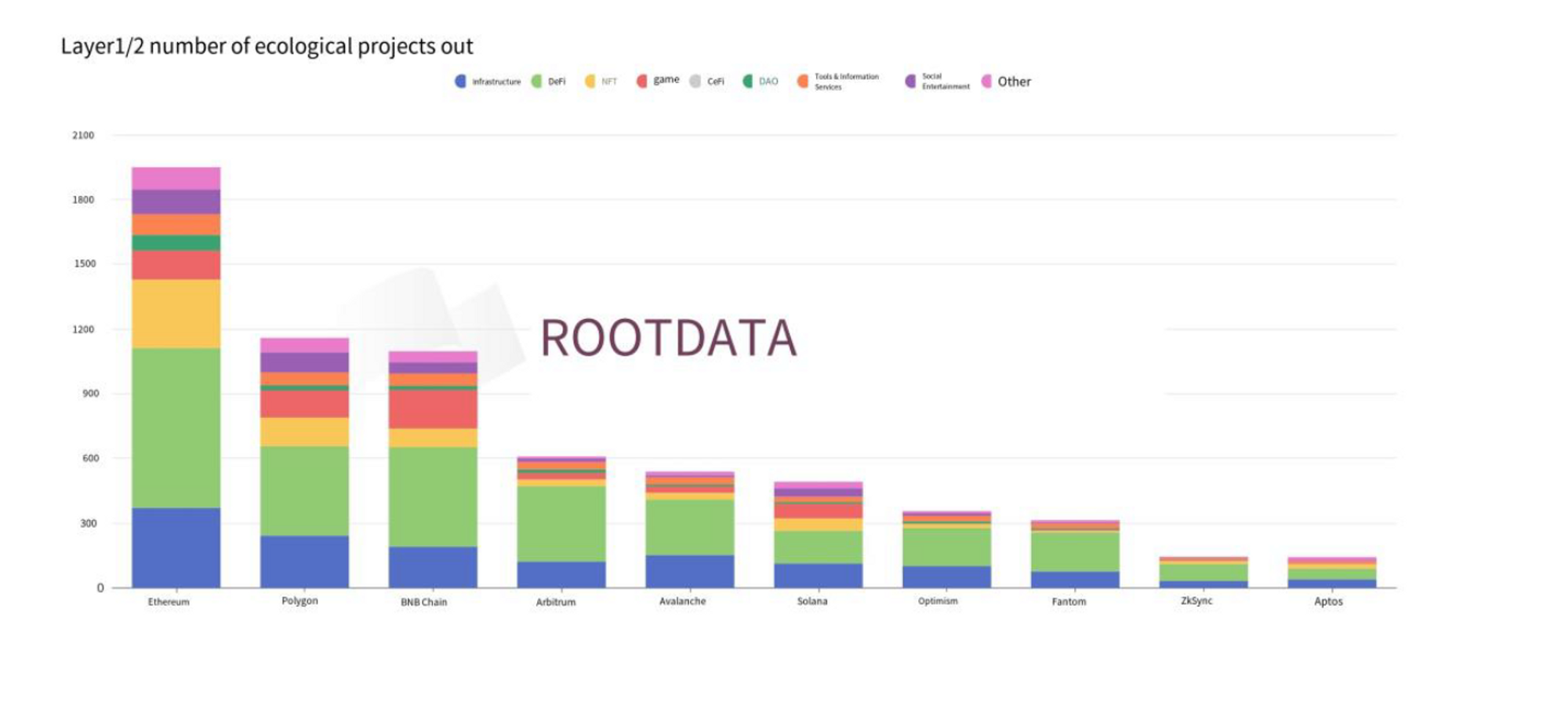
Furthermore, despite the constant emergence of new blockchains and models, Ethereum maintains its absolute dominance in the long run. The lower-ranked Layer 1 and Layer 2 blockchains may have only a handful of projects attracting investments.
However, there is no problem with the overall trend. The figure above has clearly revealed that the key to challenging Ethereum is not performance and anti-censorship but the ecosystem. But the good news is that Solona, which is not compatible with EVM, has slipped to the sixth place, and its ability of constructing ecosystem is being put to the test, and it may even be argued that the competition among public chains is entering a cooling-off period. In the long bear market period, people still prefer Ethereum ecology.
In this sense, few other public chains can be considered having ecosystems. Being EVM-compatible can essentially turn a blockchain into an Ethereum "sidechain", while those that are not compatible don't seem to have much traction at the moment. Ethereum's dominant position is likely to endure for a considerable amount of time.
The reason behind this is the dominance of top-tier capital. There is a plethora of blockchain capital available, but the ability to construct an ecosystem truly depends on the guidance of the big players in the field. While there is a lot of cryptocurrency capital, not everyone can muster billions of dollars for ecosystem development. The majority of projects are still raising funds under $3 million, accounting for over one-third, while only 34 projects have managed to secure over $50 million in funding.
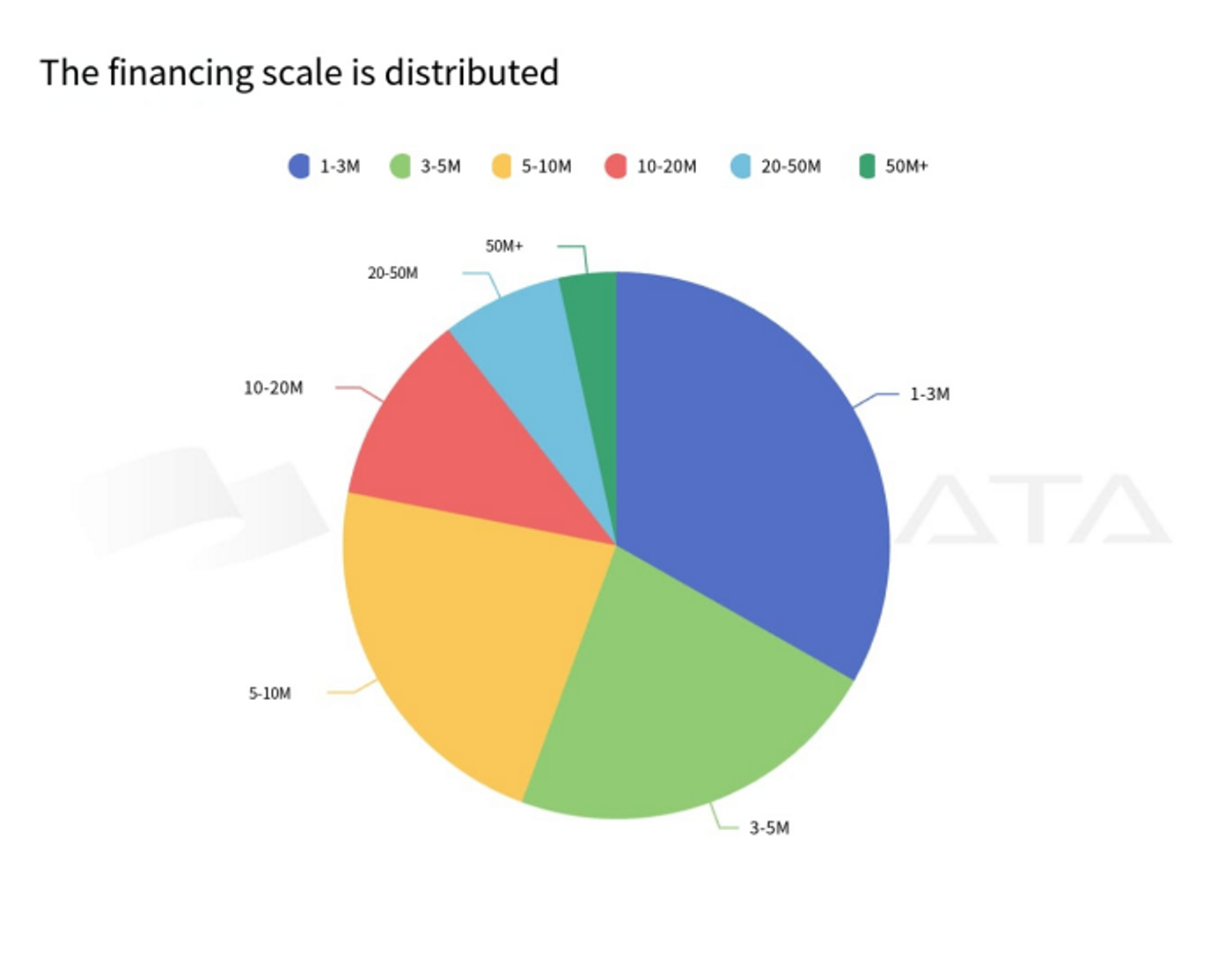
Caption: Distribution of financing size
Source: https://www.rootdata.com
There are many articles analyzing the behavioral preferences of investment institutions in the market. This paper will not repeat it. Instead, it will take a more interesting perspective to examine when VCs enter the scene, categorizing them by funding rounds rather than by sectors, in order to gain a more macroscopic understanding.
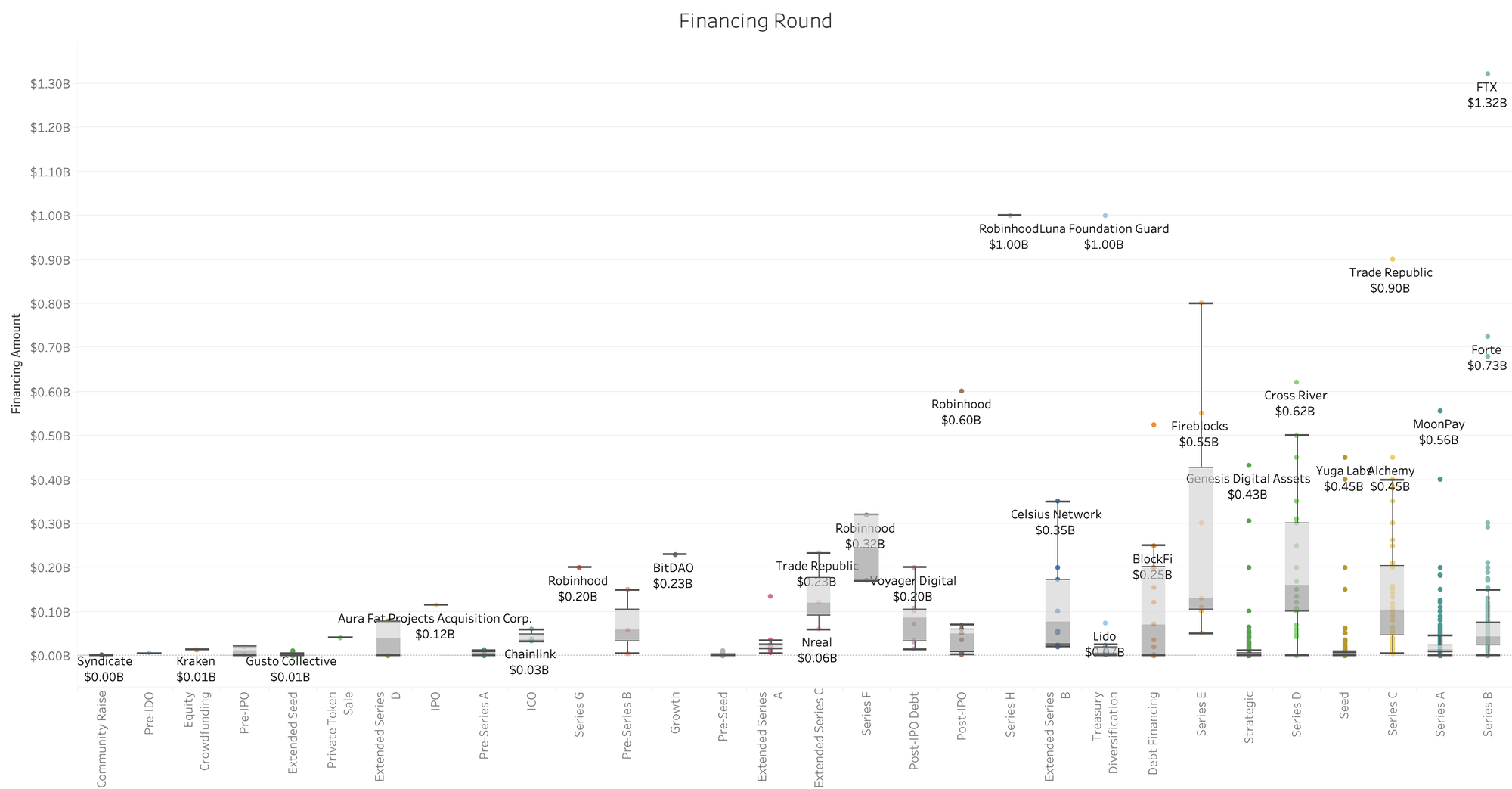
Unlike the traditional methods of funding rounds like Seed, Angel, A, B, C, D round and the IPO, the multiple funding patterns with Token-based financing offers institutions limitless freedom, ranging from rounds A to F and maybe even going beyond to Z rounds. It has truly revolutionized the entry and exit mechanisms, with various financing options revolving around Tokens, including IDO/IEO, public offerings, and private placements, and even wish to take airdrops into consideration.
Furthermore, it's worth noting that institutions are also enthusiastic about these options. To see this in action, take a look at our box-whisker plot above, which illustrates the internal differences across various sectors. In terms of preferences, seed and A, B, and C rounds are remain the common. This suggests that, overall, institutions are still rational and traditional in their approach. However, the existence of other raising methods provides institutions with more choices.
Arweave SCP Ventures is an ecological fund jointly founded by Arweave and everVision, focusing on incubating and investing in the Arweave ecosystem. Currently, it has invested in projects such as 4EVERLAND, ReadON, S31 Labs, Mind Network, and Starpower.
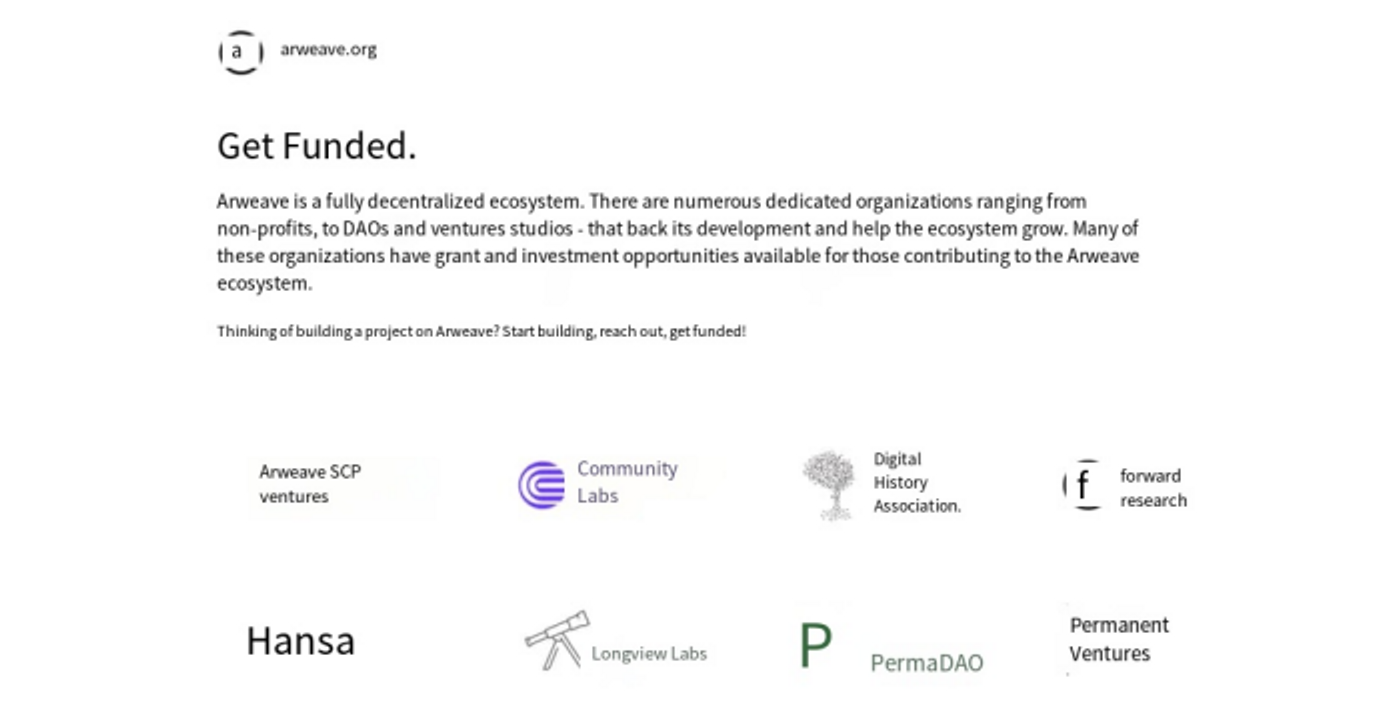
Caption: List of Arweave Eco-funds
Source: https://arweave.org/funding
🔗 More infomations about PermaDAO:Website | Twitter | Telegram | Discord | Medium | Youtube


All Comments