


By Cointime.com 237
UvChain: A Next-Generation Business-Grade Blockchain Protocol
UvChain is a next-generation commercial-grade blockchain protocol designed to unlock a large number of practical application support structures. The protocol combines the best features of multiple dedicated public chains and allows various applications to work seamlessly together in the UvChain network to send data.
As a highly scalable business-class blockchain network, UvChain can connect more chains and specialized application providers, creating more opportunities for innovation. It provides data encryption and security for application providers and optimizes the facilities of each individual chain in the network. At the same time, it allows data exchange, interconnection and processing of transactions between different chains.
In the past few years, blockchain has shown great potential in areas such as the Internet of Things, finance, arts, and gaming. However, there were limitations in previous system designs that hindered its large-scale adoption. the UvChain team has implemented a faster and more transparent technical architecture by designing and refactoring the basic modules with a dedicated two-tier network consensus mechanism and VRF algorithm to support the new decentralized marketplace. This enables a variety of application providers to access blockchain technology at lower cost and faster.
UvChain is designed with several distinct advantages that meet the speed and concurrency requirements of large-scale business applications. It offers technical advantages such as high performance, scalability, scalability, transparent governance, and cross-chain combinations. In addition, it has unlimited data storage capacity and self-healing capabilities designed to drive large-scale commercial adoption of public blockchain networks.
UvChain is committed to helping more traditional enterprises establish distributed business ecosystems, achieve high-speed value transfer, and successfully apply to the realization of large-scale business cases for blockchain.
System Architecture Design

UvChain focuses on providing practical and stable performance and privacy protection support for business applications, building a trusted distributed public infrastructure network, and facilitating the advent of the era of large-scale blockchain. Specifically, it has the following features in system design:
1. Extensive introduction of new technologies
UvChain adopts the low-power MPOR consensus mechanism and the self-developed distributed storage protocol "ISS Protocol". The ISS protocol is used to release the stored data targeted for junk and unsuitable data by regularly reporting junk and invalid data through ambassadors elected by the community. The core advantage of UvChain is the "Infinite Space System ISS", with a throughput of hundreds of thousands of TPS. users can encrypt and upload information to the chain by themselves to ensure data privacy and security.
2. Collateral mechanism
On UvChain, developers can choose an excellent storage provider for data storage. Through the collateralized economic model, developers can use storage in parallel for free or for a fee, and collateralize UVC rewards to pay storage miners. Users can use the storage and POS blocks provided by the pool for co-mining, establishing the pool as a professional storage and compute power provider and attracting more retail investors to participate in the pool's co-mining. This combination ensures computing power and storage, enabling UvChain to operate stably for a long time.
3. Two-tier network consensus mechanism and VRF algorithm
UvChain introduces a two-tier network consensus mechanism and VRF algorithm, which optimizes the problem of excessive concentration of computational power in the DPoS consensus mechanism of current mainstream projects and solves election-related problems such as insufficient community activity. the voting scheme of UVC has a certain degree of randomness, and attackers cannot predict the final result of the election in advance, thus improving the security of the entire network. The two-layer network achieves a data consistency mechanism for the entire network nodes, which effectively improves the network performance and solves the problem of excessive concentration of computational power. Nodes need to pledge a certain amount of UVC assets to participate in the election, and if the elected nodes do not perform their duties or carry out malicious behaviors, the pledged tokens will be deducted as punishment, increasing the cost of malicious behaviors of nodes and ensuring the long-term stability and security of the network.
Product Description

UvChain is committed to providing developers and users with an efficient, flexible and scalable blockchain infrastructure, thereby promoting the widespread adoption of blockchain technology in various fields. In order to achieve that? goal, UvChain highlights the following major products:
1. Modular Componentization
UvChain is not only a chain, but also uses related components as infrastructure to provide component-based services for related fields.
UvChain adopts a component-based development model at the early stage of development, which facilitates the rapid development of the smallest runnable version, solves the problem of high coupling between components in blockchain public chain projects, and greatly reduces development and maintenance costs. At the same time, componentization can quickly iterate the version, so there is no need to worry about the impact on other components when adding and modifying components, and it can also solve the problem of unclear division of business modules.
2. High-performance distributed development and operation platform
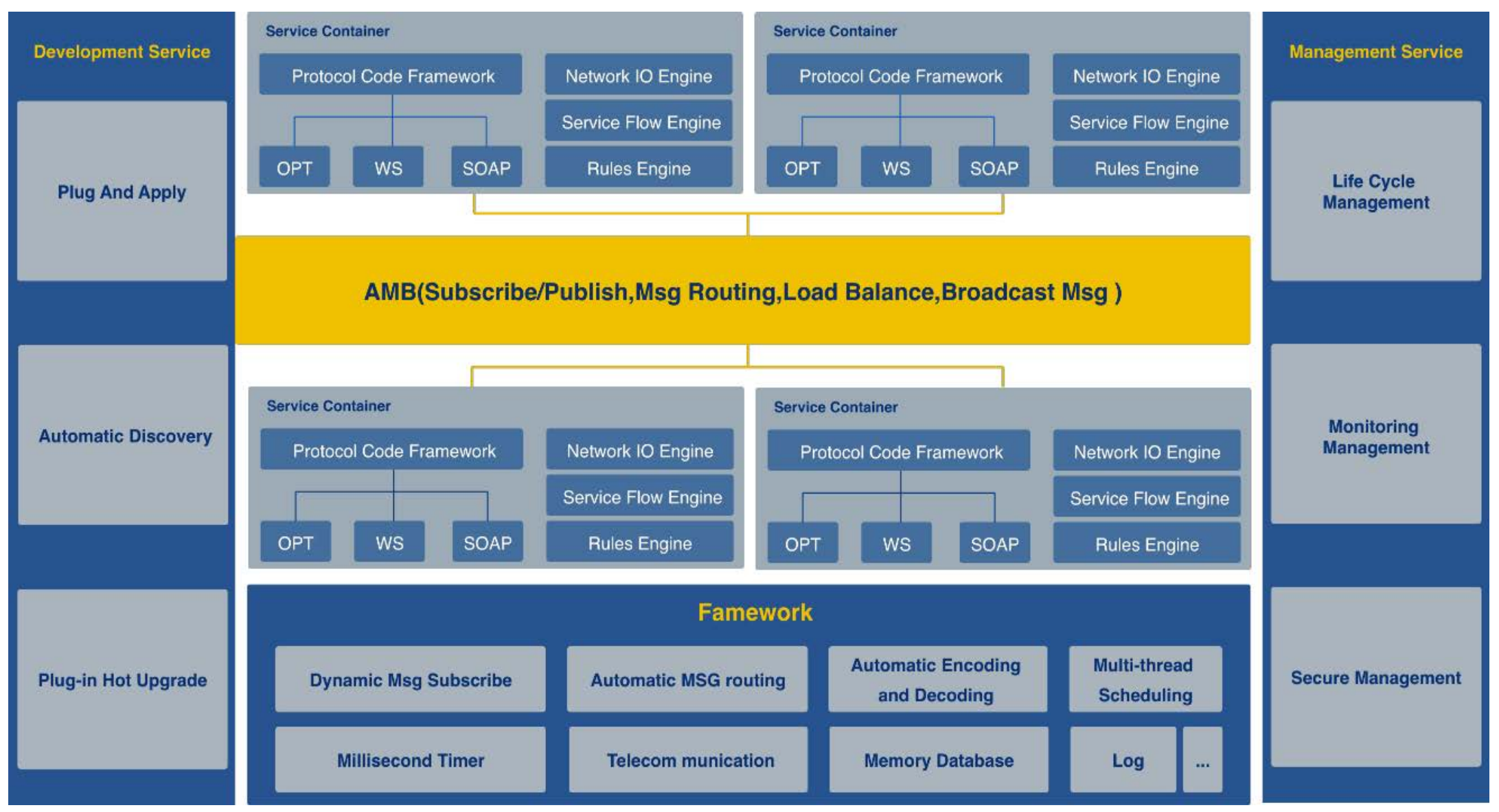
UvChain provides a high-performance development and operation platform, which helps achieve more efficient and mature development, and faster system operation. The platform has the following features:
1) Distributed Platform
By adopting a distributed platform, each service can be developed and operated independently with scalability and portability.
2) Microkernel design
Unlike the current mainstream Linux versions, the UvChain development and operation platform optimizes the Linux kernel and provides a simplified version of the core functions of the operating system. It is designed in a small memory space and offers a modular design where each module only needs to be loaded on demand.
The microkernel is highly scalable and simplifies application development. Users only need to run services, helping to reduce disk space and memory requirements.
3) Development of microservices
Each microservice is very small and can focus on a specified business function or business requirement. All services are loosely coupled with each other, and the various services on the platform are independent during the development phase or deployment phase. Due to the service independence, microservices can be developed in different languages.
In addition, microservices allow developers to take advantage of the integration of the latest technologies to improve the performance and stability of the services. This is easy for developers to understand and easy to incorporate. As long as developers focus on their business logic, they can bring high value to the development of the entire project.
4) Non-blocking and pure asynchronous scheduling
Tasks with non-blocking and pure asynchronous scheduling can return the initial result to the caller immediately. During execution, occupied threads and other resources can be released to avoid blocking, and thread processing can be acquired again after the results are generated to make full use of operating system resources.
5)Isolation
The development of the upper layer application does not need to pay attention to the way the platform works, and only needs to focus on its own business logic development according to the open interface of the platform. If the upper layer application has problems, it will not affect the whole blockchain network, and the performance of the upper layer application will not affect the blockchain network, and the upper layer application can also improve the performance of the whole system by optimizing its own application system.
6)Cluster function
The platform has built-in clustering function, which has strong scalability. With the growth of demand and load, more servers can be added to the cluster system through configuration.
3. API and SDK
UvChain provides comprehensive API and SDK support for identity creation, token creation, smart contracts, cross-chain interaction, trusted data and trusted storage, etc. The SDK is compatible with mainstream programming languages, such as Golang, C++, JavaScript and Python, for easy use and integration by developers.
4. Blockchain Browser
UvChain plans to build a blockchain browser to accompany the main chain, providing comprehensive blockchain information retrieval and usage functions. The browser will enable users to easily query and understand various blockchain data.
Economic Model and Governance
1、UVC Token
UVC (UVC) is a native token issued on the UvChain main chain, which is the core asset of the public chain and used as the proof of ecological token rights. the scarcity of UVC and the strong application demand for ecological construction support its huge ecological cycle value.
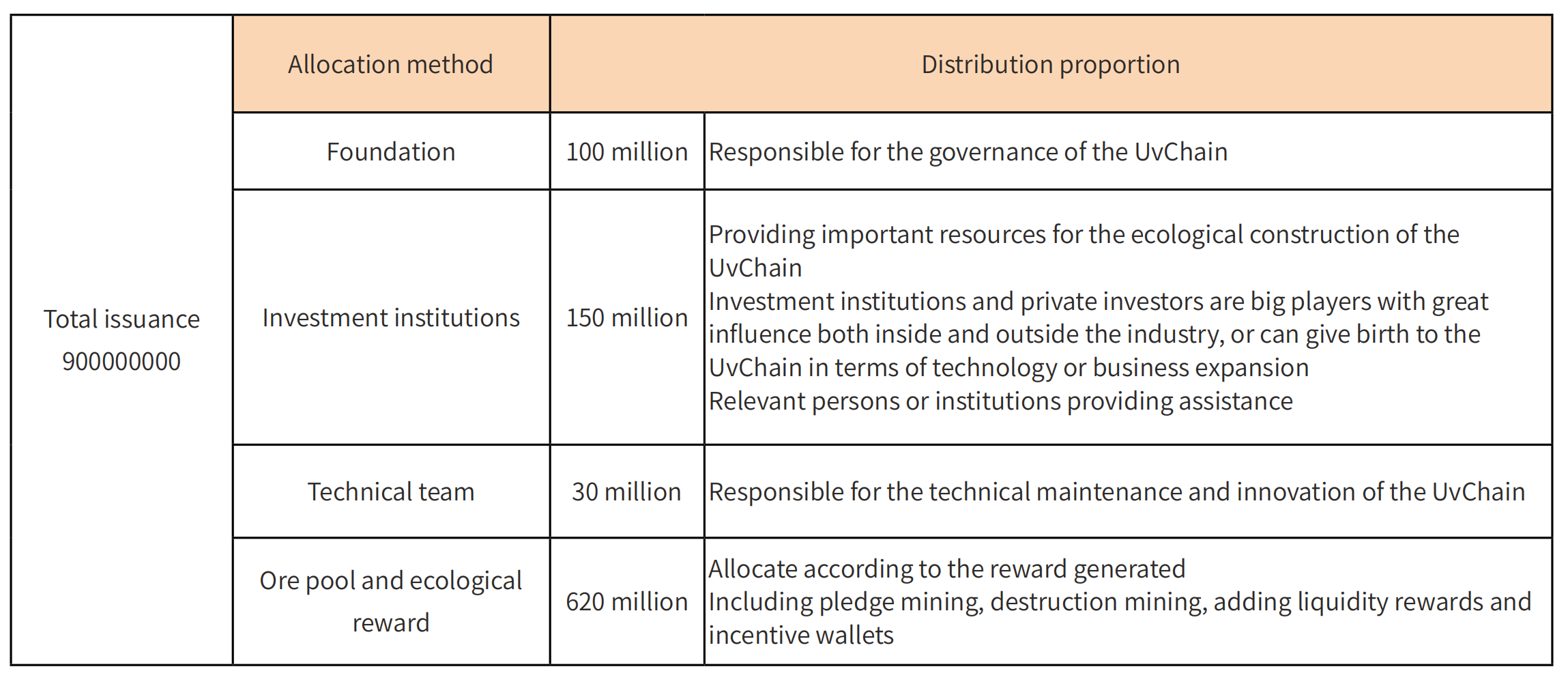
The initial issuance data of UVC is shown in the following chart:
2. Governance model
Governance is the core feature of public chain. An effective and reasonable decentralized governance mechanism is crucial to the long-term development of public chains, and UvChain combines on-chain and off-chain governance to achieve decentralized governance and guarantee its effectiveness. Every UVC asset holder has the right to participate in the decentralized governance of UvChain.
1)Governance Committee
As a decentralized public chain, effective governance is the guarantee of long-term operation of the public chain. How to ensure that the blockchain eliminates the hidden danger of disorder caused by the control of no central authority in the environment of fully autonomous and discrete nodes is a topic worth thinking about.
The UvChain Governance Committee has seven seats, of which three are held by the UvChain Foundation, one by the technical creation team, and the other three by community vote.
Three of the Foundation seats are for a three-year term, and the remaining seats are for a one-year term, after which they will be re-elected. Any organization or node can participate in the election. During the term, they will exercise the highest voting power on behalf of all coin holders and the community.
UvChain's governance scheme provides a "coherence policy". All cryptocurrency holders receive voting rights by pledging a certain number of UVCs, one vote per account, and users participate in the governance power of the UvChain public chain by voting co-signatures.
At the same time, through the governance mechanism, users can also initiate proposals and vote through the co-signatures of the governance committee. When the number of co-signatures exceeds half, the governance committee can be triggered to vote on the co-signed proposal, which ultimately determines whether the proposal will be implemented, at what block height, and automatically executed through smart contracts under certain conditions. After the vote is completed, the UVC pledged by the user will be automatically redeemed and returned to the user's account. For example, the right to modify all important parameters affecting the operation of the public chain and ecological governance, such as upgrading the consensus algorithm, the parameters of the number of elected nodes, cluster size, block size, transaction size, block out time, reward parameters, etc., is given to all coin holders for voting decision, and after passing, it will be automatically executed according to the set system smart contract, thus finally completing the governance.
For the election of 7 seats in the decision-making governance committee, users have the right to vote and be elected, and all changes to the chain parameters are decided through the public chain governance. Meanwhile, the governance of management and technology is applied to the whole governance system of UvChain to realize the decentralized governance of blockchain.
2) Foundation
UvChain's Foundation is a third-party neutral organization responsible for the governance of the public chain community, aiming to promote and maintain the ecological construction and healthy development of UvChain through a scientific, rational and effective governance mechanism, and to assist in managing the daily affairs of the community.
Conclusion
UvChain is a next-generation commercial-grade blockchain protocol designed to provide a high degree of scalability and drive large-scale commercial applications of public chains. The protocol integrates the best features of multiple dedicated public chains and allows various applications to work together in the UvChain network to send data.
By designing and refactoring the basic modules with a dedicated two-tier network consensus mechanism and VRF algorithm, the UvChain team is committed to providing a faster and more transparent technical architecture to reduce the cost and acceleration of application providers to access blockchain technology. At the same time, UvChain is designed with technical advantages such as high performance, scalability, scalability, transparent governance and cross-chain combinations to support large-scale commercial applications.
Despite UvChain's many potentialities, large-scale commercial adoption of the public chain still faces challenges. Factors such as limitations of prior system design and market acceptance may affect its adoption rate. However, UvChain's features and technical advantages make it competitive in driving large-scale commercial adoption of public chains.
In the future, as UvChain evolves and the market changes, we will closely monitor its practical applications in IoT, finance, art, gaming, etc. The efforts of the UvChain team will provide opportunities for traditional enterprises to build distributed business ecosystems and facilitate the widespread adoption of blockchain technology in business cases. However, successful commercial applications will need to overcome challenges in terms of technology and market, and gain acceptance and adoption from all parties.
Overall, UvChain, as a highly scalable commercial-grade blockchain protocol, opens up new possibilities for large-scale commercial adoption of public chains. However, its true commercial success remains to be further observed and verified.


All Comments