
Cointime

Download App
iOS & Android

US national debt crosses $38.5T, as Bitcoiners celebrate 'Genesis Day'

The United States National Debt surged past $38.5 trillion on Saturday, as Bitcoiners celebrated “Genesis Day,” the day the first block was mined on the Bitcoin network by pseudonymous Bitcoin creator Satoshi Nakamoto.

US government debt at the time of this writing is about $38,561,900,451,378, according to the US National Debt Clock.

“Lie, cheat, steal, and print relentlessly. It’s the playbook of fiat currency, and it weakens the money until confidence in that currency ultimately fails,” market analyst James Lavish said in response to the rising debt.
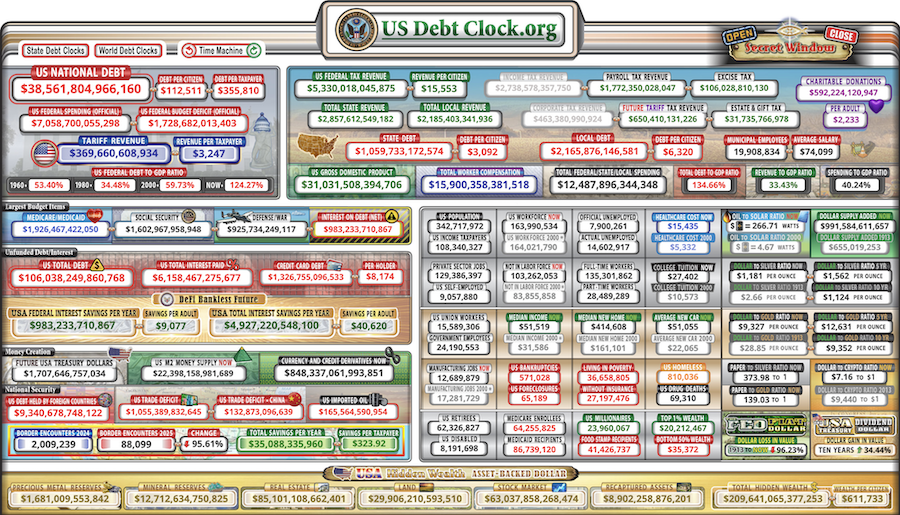
  A dashboard breaking down the $38.5 trillion, and rising, US government debt. Source: US Debt Clock


Nakamoto mined the Bitcoin Genesis Block on January 3, 2009, and included a newspaper headline titled “Chancellor on brink of second bailout for banks,” referencing the UK government’s monetary stimulus in response to the 2008-2009 financial crisis.

“Happy Bitcoin Genesis Block day,” Paolo Ardoino, the CEO of stablecoin issuer Tether, said, while Sam Callahan, the director of strategy and research at BTC treasury company OranjeBTC, echoed the message.

The Bitcoin community often touts the headline embedded within the Genesis Block as a symbol of the Bitcoin protocol’s core value proposition: money resistant to inflation or debasement due to decentralization and a maximum supply cap.
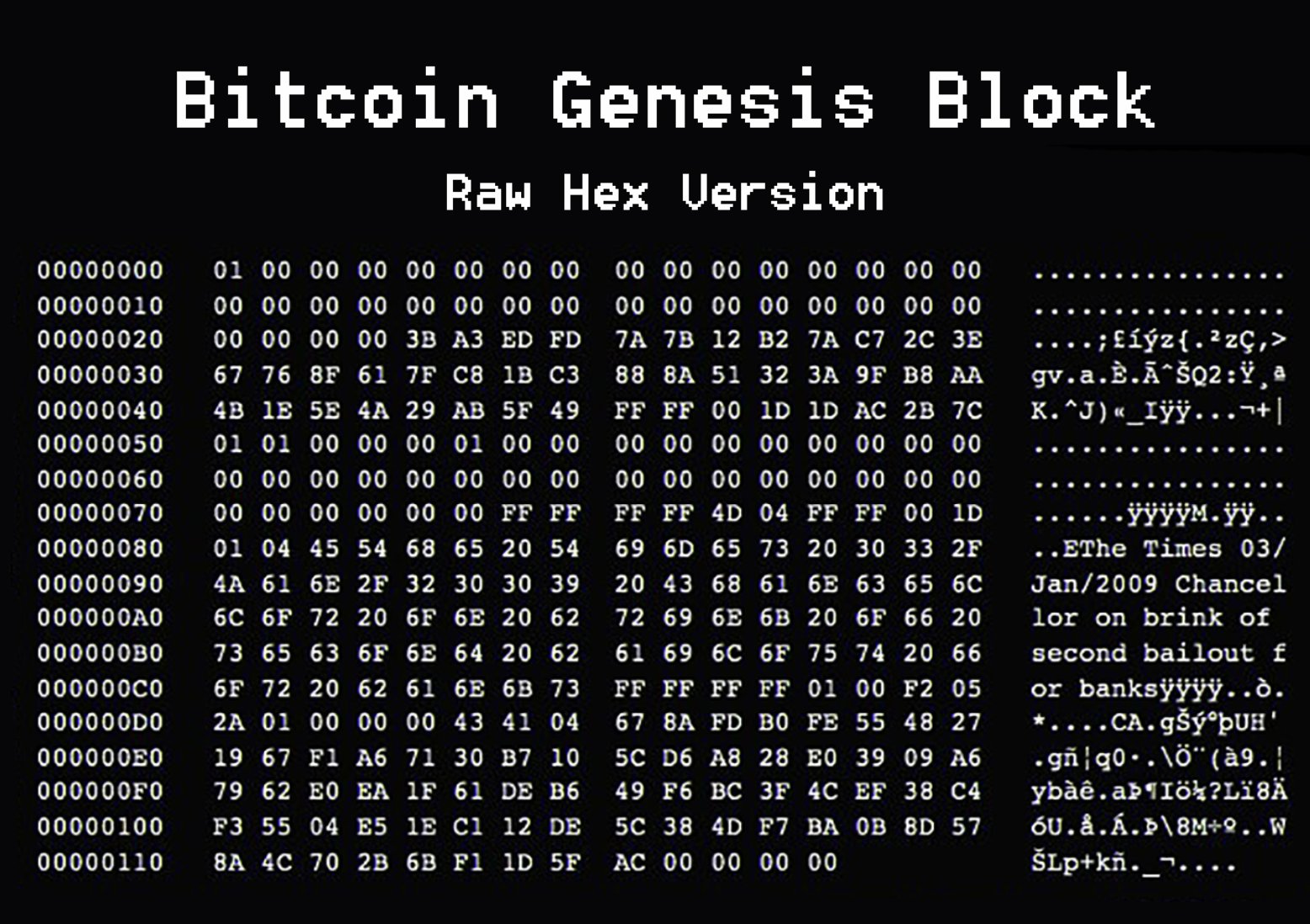
  The Bitcoin Genesis Block. Source: Bitcoin Policy UK

US debt spirals out of control, driven by fiat money printing

The US government was adding about $6 billion per day, on average, to the national debt in 2025, according to Congressional data, meaning $2.2 trillion was added to the total debt in a single year.

For context, it took over 200 years for the US national debt to cross $1 trillion, which it did in October 1981, according to the US House of Representatives Budget Committee. 

The Federal Reserve M2 money supply, a metric used as a proxy for the total amount of US dollars in circulation, continues to rise, reaching $22.4 trillion at the time of this writing, according to data from the St. Loud Federal Reserve.
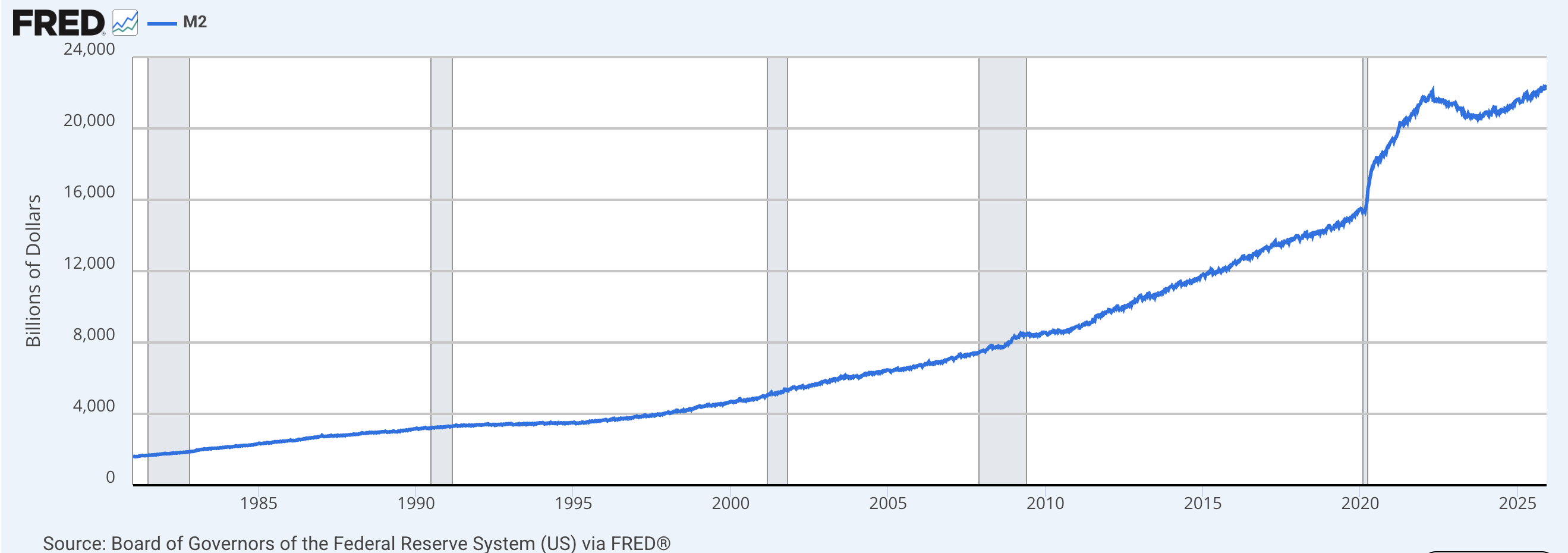
  The Federal Reserve M2 money supply figure is at $22.4 trillion and continues to rise. Source: St. Louis Federal Reserve

Inflation of the fiat money supply lowers the value of that money by eroding its purchasing power, reducing its price relative to goods and services, which are finite. 

Bitcoin solves this by having a fixed, maximum supply cap of 21 million that is produced on a steady supply schedule, becoming deflationary over time and increasing purchasing power relative to goods and services, according to Bitcoin advocates. 

Comments

All Comments

Recommended for you

  • ETH Surpasses $2300

    Market data shows that ETH has surpassed $2300, currently priced at $2300.25, with a 24-hour increase of 0.92%. The market is highly volatile, so please ensure proper risk management.

  • Insiders: Anthropic's Usable Computing Power to Reach 3.5 Gigawatts by Year-End

    AI giant Anthropic submitted its S-1 filing last week and is expected to complete a record IPO this month, stirring Wall Street sentiment. On Monday, the company updated its prospectus, revealing impressive growth data, but also highlighting significant expenditure risks. Over the past year, Anthropic has signed numerous computing power procurement contracts to secure resources for training and operating large AI models, betting that soaring demand can cover substantial investments. The updated S-1 shows that Anthropic's revenue for the third quarter reached $17 billion, a twelvefold year-on-year increase and a 47% rise from the second quarter; however, it reported a net loss of $23 billion, with the growth rate slowing from 144% in the previous quarter. By 2045, Anthropic's total commitments for data centers, chips, and computing power procurement could reach $895.4 billion, with nearly $70 billion in contract payments due within the next 12 months. Two insiders revealed that by the end of this year, the company's usable computing power will reach 3.5 gigawatts, enough to supply all households in Chicago; the target is to double this capacity next year. Anthropic is even deeply involved in data center design, hiring infrastructure and supply chain experts, and procuring hardware such as cooling systems from contractors. Its primary competitor, OpenAI, is also making massive investments in computing power, with insiders indicating that OpenAI expects total computing power investments to reach about $750 billion by 2030.

  • Spot Gold Falls Below $3900 per Ounce

    Spot gold has fallen below $3900 per ounce, declining by 1.19% during the day.

  • U.S. Stocks to Trade 'Around the Clock': Nasdaq to Implement 23-Hour Trading Starting December 6

    On November 3, Nasdaq announced that since its establishment in 1971, the regular trading hours for U.S. stocks have long been maintained from 9:30 AM to 4:00 PM Eastern Time. Although pre-market and after-hours trading have been available for many years, the core trading framework has remained unchanged for over forty years. This December, this pattern will undergo a significant change—Nasdaq will officially launch a '23/5' trading system on December 6, with only a 1-hour market closure each day, allowing for continuous trading for the remaining 23 hours.

  • BTC Surpasses $77,000

    Market data shows that BTC has surpassed $77,000, currently priced at $77,001.78, with a 24-hour decline of 1.94%. The market is experiencing significant volatility, so please ensure proper risk management.

  • SEC Updates FAQ on Crypto Assets, Clarifies 'Central Party' Criteria

    On November 2, according to the SEC's Office of Corporate Finance website, the department updated the frequently asked questions regarding the applicability of federal securities laws to crypto assets, adding three new Q&As: Participants in a broad governance system who are not related, have no contractual arrangements or tacit agreements (including through delegation) to act in concert are generally not considered a 'central party'; 'Central party oversight participation' refers to the unilateral authority to control access, change voting procedures, modify rule code, or revoke transactions at the protocol layer, validator layer, or user layer, while significant operations are entirely executed automatically by rule code or discretion is exercised only by the broad governance system; 'Functional' and 'decentralization' are different concepts. This FAQ reflects staff opinions and does not have the force of rules or regulations, and is related to the interpretive release on March 17 and the proposed 'Crypto Asset Regulation' on August 18.

  • North Korea Denies Involvement in Binance Theft, Calls Accusations 'Fabrications'

    On November 3, Reuters reported that North Korean state media, KCNA, stated that claims regarding North Korea being behind the theft of approximately $630 million from Binance are 'fabrications.' Previously, the FBI attributed the attack to North Korea, and blockchain analysis firms such as Chainalysis and TRM Labs also linked it to the North Korean-affiliated hacker group TraderTraitor.

  • Trump States He Will Not Strike Iran After Midterm Elections

    On November 3, Trump stated that he would not launch an attack on Iran after the midterm elections.

  • BTC Falls Below $77,000

    Market data shows that BTC has fallen below $77,000, currently priced at $76,986.81, with a 24-hour decline of 1.41%. The market is experiencing significant volatility, so please ensure proper risk management.

  • U.S. Stock Indices Open Higher, Tech Stocks Generally Rebound

    The three major U.S. stock indices opened higher, with the Dow Jones Industrial Average rising by 0.80%, the S&P 500 increasing by 0.44%, and the Nasdaq Composite gaining 0.63%. Among popular tech stocks, Apple shares fell by 0.31%, NVIDIA shares rose by 1.48%, Microsoft shares increased by 0.32%, Alphabet (Google) shares were up by 0.99%, Amazon shares rose by 1.36%, TSMC shares increased by 1.42%, SpaceX shares surged by 2.2%, Tesla shares rose by 1.28%, Meta shares declined by 0.47%, Broadcom shares increased by 0.27%, SK Hynix shares rose by 2.46%, Micron Technology shares were up by 0.14%, AMD shares increased by 0.71%, ASML shares rose by 0.45%, Cisco shares increased by 0.23%, Oracle shares fell by 3.9%, Intel shares dropped by 1.22%, Dell Technologies Class C shares decreased by 0.5%, and ARM shares fell by 0.18%.