

Cointime

Download App
iOS & Android

US banks moved $312B in dirty money, but critics still blame crypto

Validated Individual Expert

US banks were responsible for moving $312 billion for Chinese money launderers between 2020 and 2024, according to a new report.

In a US Financial Crimes Enforcement Network (FinCEN) advisory on Thursday, the watchdog analyzed over 137,000 Bank Secrecy Act reports from 2020 to 2024. 

It found that over $62 billion per year on average has gone through the US banking system from Chinese money launderers.

Chinese money-laundering networks have formed a symbiotic relationship with Mexico-based drug cartels. The cartels need to launder US dollar drug proceeds, while Chinese gangs want US dollars to circumvent China’s currency control laws, it reported.

“These networks launder proceeds for Mexico-based drug cartels and are involved in other significant, underground money movement schemes within the United States and around the world,” said FinCEN Director Andrea Gacki. 

Beyond drug money laundering, Chinese gangs are involved in human trafficking and smuggling, healthcare fraud and elder abuse. They are also involved in real estate money laundering to the tune of $53.7 billion in suspicious transactions, the report added.

Crypto still gets unfair rap

Despite this, crypto has often been singled out for money laundering and illicit purposes by pro-banking politicians such as the ranking member of the Senate Banking Committee, Senator Elizabeth Warren. 

“Bad actors are also increasingly turning to cryptocurrency to enable money laundering,” she said earlier this year, demanding tougher regulations. 

The latest figures reveal an often suppressed fact, that most money laundering has nothing to do with crypto.
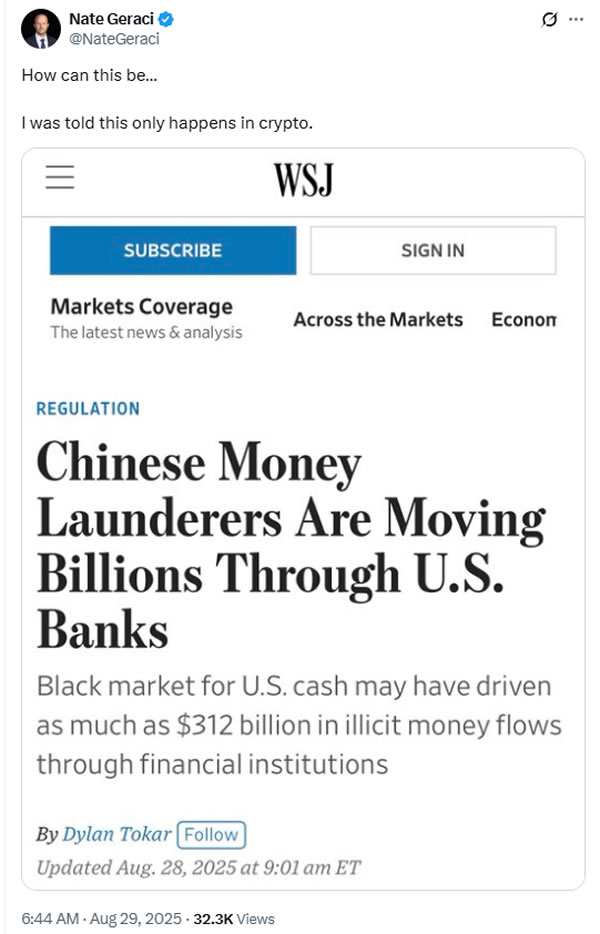
  Source: Nate Geraci

According to the United Nations Office on Drugs and Crime, the estimated amount of money laundered globally in one year is more than $2 trillion.

In comparison, the entire cryptocurrency space’s illicit crypto volumes totalled around $189 billion over the last five years, according to Chainalysis.

“Illicit activity is but a small fraction of the crypto ecosystem. We estimate that it is less than 1% of overall crypto volume,” TRM Labs head of policy and strategic partnerships, Angela Ang, told Cointelegraph. 

“FinCEN's findings align with a broader pattern - these underground banking networks function as a shadow financial system for organized crime worldwide, operating at the seams of banking systems,” Ang said.  
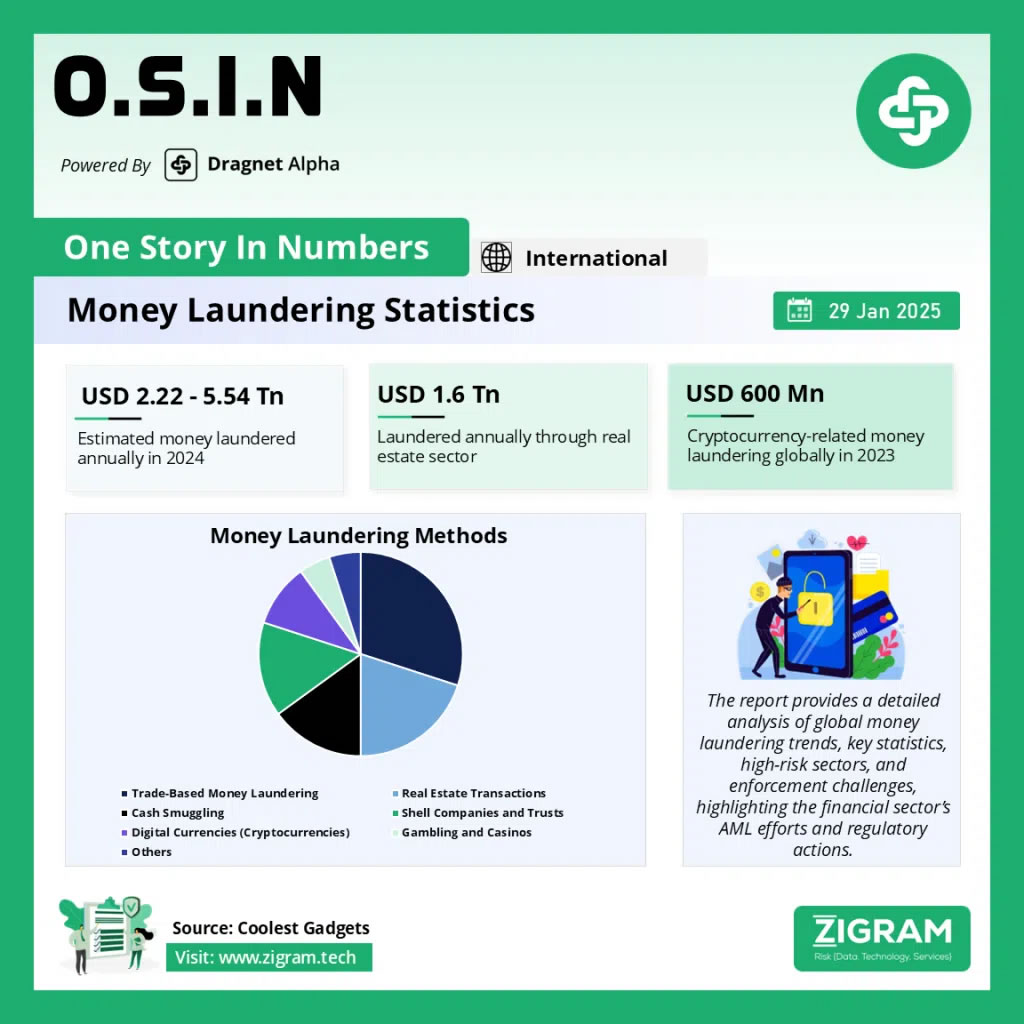
  Money laundering through cash and banks dwarfs the amount laundered with crypto. Source: Zigram
Comments

All Comments

Recommended for you

  • BTC Falls Below $77,000

    Market data shows that BTC has fallen below $77,000, currently priced at $76,988.19, with a 24-hour increase of 0.2%. The market is highly volatile, so please ensure proper risk management.

  • Cyberspace Administration: Rapid Development of AI is Profoundly Changing Content Production

    On April 29, according to The Paper, the State Council Information Office held a press conference. At the meeting, Niu Yibing, Deputy Director of the Cyberspace Administration of China (CAC), stated that the rapid development of new artificial intelligence technologies is profoundly changing content production, dissemination methods, and interaction forms in cyberspace, while also presenting new era challenges for the construction of online civilization. Niu pointed out that the development of artificial intelligence provides new technical support and pathways for producing high-quality content, innovating online communication, and cultivating a civilized atmosphere. However, it also brings a series of new issues, situations, and challenges, such as the identification of false information, personal information protection, and ethical safety in AI applications, which need to be addressed with strengthened regulation and effective responses while promoting development. Since the beginning of this year, the CAC has focused on new technologies and applications of artificial intelligence, continuously enhancing institutional supply, and in collaboration with relevant departments, has issued the 'Interim Measures for the Management of Humanized Interactive Services of Artificial Intelligence' and publicly solicited opinions from society regarding the management measures for digital virtual human information services.

  • U.S. Senate to Vote Today on Confirmation of First Bitcoin-Supporting Federal Reserve Chair

    On April 29, the U.S. Senate will vote today to confirm the first Federal Reserve Chair who supports Bitcoin. This position oversees the world's largest central bank and is involved in the cryptocurrency sector. (The Bitcoin Historian)

  • US Spot Bitcoin ETF Sees $89.7 Million Net Outflow Yesterday

    On April 29, according to monitoring data from Farside Investors, the US spot Bitcoin ETF experienced a net outflow of $89.7 million yesterday.

  • US Spot Ethereum ETF Sees Net Outflow of $21.8 Million Yesterday

    On April 29, according to monitoring data from Farside Investors, the US spot Ethereum ETF experienced a net outflow of $21.8 million yesterday.

  • BTC Surpasses $77,000

    Market data shows that BTC has surpassed $77,000, currently priced at $77,003.63, with a 24-hour increase of 0.23%. The market is highly volatile, so please ensure proper risk management.

  • ETH Surpasses $2300

    Market data shows that ETH has surpassed $2300, currently priced at $2300.38, with a 24-hour increase of 0.67%. The market is experiencing significant volatility, so please ensure proper risk management.

  • NVIDIA Executive to Discuss Physical AI Collaboration with Samsung and SK Hynix

    On April 29, according to Yonhap News Agency citing industry sources, a key executive from NVIDIA (NVDA.US) will meet with counterparts from Samsung Electronics and SK Hynix on Wednesday to discuss collaboration in the field of physical artificial intelligence. Madison Huang, Senior Director of Product and Technology Marketing for NVIDIA's Physical AI platform, is visiting South Korea to expand partnerships in this area. Her team is responsible for NVIDIA's Omniverse development platform aimed at physical and industrial AI simulation applications, as well as supporting the company's initiatives in industrial digitalization and physical AI strategies through its robotics platform. Samsung Electronics and SK Hynix are major suppliers of memory chips used in NVIDIA's AI chips. NVIDIA is also collaborating with these South Korean chip manufacturers to deploy large-scale GPU clusters to strengthen South Korea's national AI infrastructure and promote the application of AI in robotics, factories, and industrial platforms. (Dongxin News Agency)

  • A-shares Trading Volume Exceeds 1 Trillion Yuan

    On April 29, the trading volume of the Shanghai and Shenzhen stock exchanges surpassed 1 trillion yuan, a decrease of nearly 120 billion yuan compared to the same time the previous day. (Dongxin News Agency)
