


The Identity Dilemma that Plagues Humanity
The question of identity should be considered one of the most fundamental questions for human beings, and thousands of years ago our ancestors asked the question "Who am I? Where do I come from? Where am I going?" The question was asked thousands of years ago. To this day, these questions remain unanswered, but the management and authentication of human identity have never stopped.
For a long time, our identities have been managed and controlled by a single organization or an organization with a multi-tiered structure, an approach also commonly referred to as centralized identity management. Under this model, all of the people's identity information would be connected through web services, devices, and applications.
But as more and more personal information is stored and shared on the web, information security becomes an issue that cannot be ignored. Our information is often misused by online information managers to push the display of targeted content and advertising, or even to track us personally.
At the same time, as people visit more and more websites and applications, they have to create and manage more and more accounts, which undoubtedly results in a poor user experience.
From an administrator's point of view, the security of centralized management systems is also problematic, with cyber attacks and privacy breaches a common occurrence. The reason for this is not difficult to understand - after all, with huge amounts of user data stored in one place, hackers can access a large amount of confidential information at once, making the job "cost-effective" for hackers.
It is because of the many problems associated with a centralized digital identity that federated identity management systems have been created.
Federated identities allow authorized users to access multiple applications and websites using a set of credentials, for example, users can use their Google or Facebook account to log in to a website or application. In this model, users will no longer need to create a completely new account, which will undoubtedly make web interactions easier, but it still has some problems.
Even though this type of login is more convenient for people, if the password is stolen, it means that all other websites used by the user with that single sign-on account could be exposed. This would therefore place a very high level of trust in the companies and websites that provide the service.
However, in recent years, there have been many cases of misuse of information by Facebook and Google, including Facebook user data to manipulate people's emotions and Google employees using their positions to steal, leak, or misuse data to which they may have access.
But even so, we can't stop putting our information into a dangerous in order to apply for a mortgage, buy a car or sign up for a new service. Life seems to be telling us through this that if we want the full experience of life we have to trade in our privacy.
Does this really have to be the case?
The answer is of course NO.
A centralized identity solution can effectively address these privacy and data leakage issues.
TRU3T - DID System Is Driven By AI

Decentralized identity (DID) is a type of identity management that allows people to control their own digital identity without relying on a specific service provider. Decentralized identity allows people to have full ownership and control of their own personal information and credentials. Under this model, the potential for misuse and infringement of users' personal information is greatly reduced.
Our protagonist today, TRU3T, is a global Web 3.0 company that focuses on optimizing decentralized identity management using artificial intelligence, quantum machine learning algorithms, digital twins, virtual worlds, and blockchain. It is the world's first AI-powered DID system. The advantages of this model are obvious.
1. The creation and ownership of multidimensional, visual on-chain identities as Web 3.0 social passes through the TRU3T identity generation engine, as your social pass for Web 3.0;
2. Create a Web 3.0 profile through TRU3T's quantitative model of individual competencies to effectively participate as a contributor in building Web 3.0 together and reap the benefits;
3. Build a more efficient and lower the risk credit system by establishing modular, transparent, and non-tamperable on-chain credit through the TRU3T credit model.
TRU3T Protocol
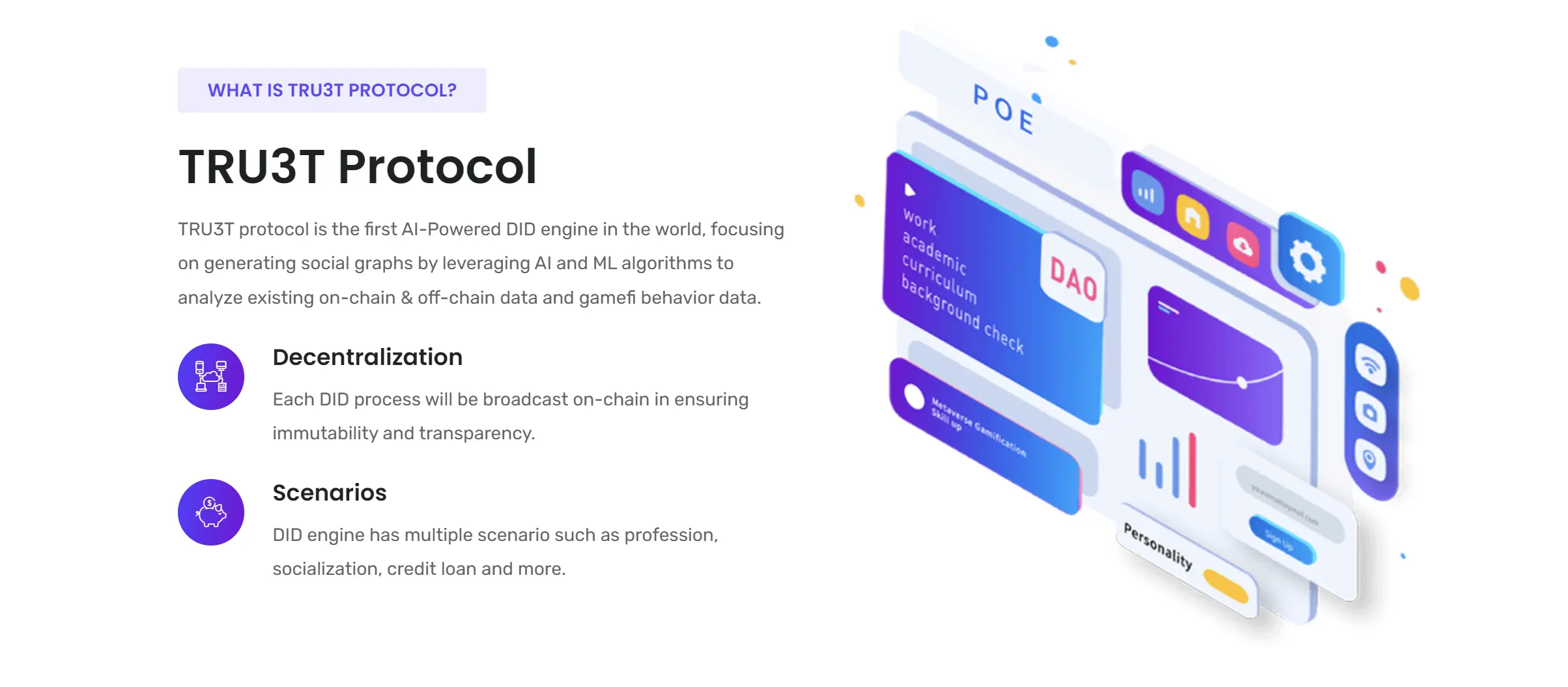
The TRU3T protocol is the world's first AI-Powered DID engine that focuses on generating social graphs by using AI and ML algorithms to analyze existing on- and off-chain data and GameFi behavioral data.
As each DID process will be broadcast on the chain, its invariance, and transparency are ensured, which in a sense enables decentralization. At the same time, the DID engine has a variety of scenarios such as professional, social, and credit lending. It allows on-chain identities to gradually intersect with actual on-chain activities.
Conclusion
In my opinion, the DID track is not going to be the breakout point like NFT or DeFi. Its cornerstone nature will make it difficult for it to enter the public eye as a Web 3 infrastructure. But that doesn't mean it's not important. On the contrary, DID represents the core of the Web 3.0 narrative.
The topic of identity, which we discussed at the beginning of this article, is in a sense no longer only about a change in technology, but even a hint of philosophical origins, which are often the cultural roots of an era.
In my opinion, Web 3.0 also needs these underlying designs, and DIDs are essential for this.


All Comments